
 100% FREE ACCESS
11th Standard CBSE Syllabus & Materials
11th Standard CBSE
CBSE 11th Economics PART-A - Presentation of Data - New Sample Question Papers Study Material - QB365 Set A
NEW11th Standard CBSE
CBSE 11th Economics PART-A - Organisation of Data - New Sample Question Papers Study Material - QB365 Set A
NEW11th Standard CBSE
CBSE 11th Economics PART-A - Collection of Data - New Sample Question Papers Study Material - QB365 Set A
NEW11th Standard CBSE
CBSE 11th Economics PART-A - Introduction to Economics and Statistics - New Sample Question Papers Study Material - QB365 Set A
NEW11th Standard CBSE
CBSE 11th Business Studies International Trade Sample Question Papers Study Material - QB365 Set A
NEW11th Standard CBSE
CBSE 11th Business Studies Evolution and Fundamentals of Business Sample Question Papers Study Material - QB365 Set A

Published on: 09/09/2022
QB365 provides a detailed and simple solution for every Possible Case Study Questions in Class 11 Biology Subject - Plant Kingdom, CBSE. It will help Students to get more practice questions, Students can Practice these question papers in addition to score best marks.
Download CBSE Class 11th Standard CBSE Biology question papers, sample papers, important questions, and previous year solved papers in PDF format. Get free study materials, NCERT solutions, and exam preparation resources for Class 11th Standard CBSE Biology
Questions + Answers key
Take MCQ Biology Test
1.
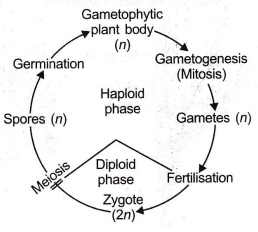
(a) Identify the type of life cycle pattern shown in the diagram given above. Name an alga that shows this life cycle pattern.
(b) Name the types of life cycle patterns exhibited by plants with dominant diploid phase. Give an example for each.
2.
Since both haploid and diploid plant bodies are present in sexually reproducing plants, there is alternation of generations, i.e., between the haploid and diploid phases. The different plant groups differ in the patterns of life cycle they show.
What are the three different life cycle patterns exhibited by plants? Mention one example of a plant or a plant group for each of the three patterns.
3.
In plants, both haploid and diploid cells can divide by mitosis. This feature leads to the formation of haploid and diploid plant bodies/phases.
(a) What technical term is given to the haploid and diploid plant bodies/phases, respectively?
(b) Name the type of cell division involved in the formation of
(i) gametes by haploid Plant body.
(ii) spores by diploid plant body/phases.
(c) What do the spores germinate/develop into?
4.
In angiosperms, flowers are the specialised reproductive structures. Stamens are the male , reproductive organs, where pollen grains are produced in the anther. Carpels are the female reproductive organs that contain the ovules. The pollen grains germinate on the stigma, each producing two male gametes to fertilise an ovule.
(a) Why are two male gametes necessary to fertilise an ovule?
(b) What do the products develop into?
5.
Gymnosperms and Angiosperms are seed-bearing plants. Yet, they are put under two different divisions of the kingdom Plantae.
Write three major differences between the two divisions regarding the reproductive structures and the process of reproduction.
6.
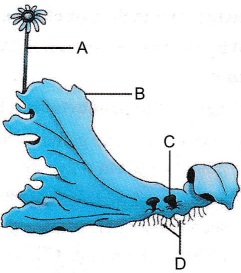
(a) Identify the plant given above and name the division, it belongs to.
(b) Label the parts A, B, C and D marked on it.
7.
Bryophytes are the first land plants, which occur in damp, cool and shady places. They are known as amphibians of plant kingdom, as they need water for fertilisation. In general, Bryophytes are of little economic importance; but, they are of great ecological importance.
(a) Write two ecological significance of mosses.
(b) Name the moss used for trans-shipment of living material. Justify your answer.
8.
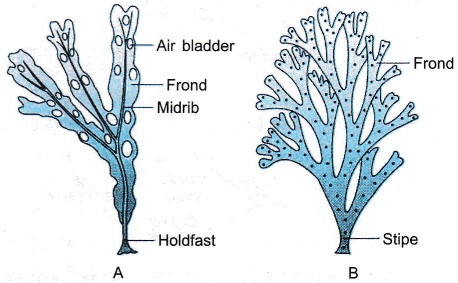
Two members of a class of algae are shown above.
(a) Identify the two algae A and B and name the class, which they both belong to.
(b) Name the pigment which gives them the characteristic colour.
(c) Mention the characteristics of their gametes with reference to
(i) shape and
(ii) flagellation.
9.
Algae are simple thalloid, chlorophyll-bearing, aquatic (both marine and freshwater) organisms. The form and size of algae is highly variable. They are categorised into three classes.
(a) Name the three classes of algae.
(b) Mention the two major characteristics that form the basis for this classification.
(c) Name one unicellular alga.
1.
(a) It is haplontic life. cycle.
e.g. Spirogyra, Chlamydomonas
(b) Plants with dominant diploid phase show:
(i) Haplo-diplontic life cycle
e.g. Pteridophytes
(ii) Diplontic life cycle
e.g. Gymnospeflns, Angiosperms.
2.
The different life cycle patterns are
(i) Haplontic life cycle, e. g. Spirogyra, Chlamydomonas
(ii) Diplontic life cycle, e. g. Fucus, Gymnosperms, Angiospenns
(iii) Haplo-diplontic life cycle. e.g. Ectocarpus, Polysiphonia, Bryophytes, Pteridophytes.
3.
(a) Haploid - Gametophyte
Diploid - Sporophyte
(b) (i) Mitosis
(ii) Meiosis
(c) Gametophytic plantrphase.
4.
(a) (i) One of the male gametes fuses with the female gamete to form a zygote.
(ii) The second male gamete fuses with the diploid secondary nucleus to form a triploid primary endosperm nucleus (PEN).
(b) (i) The zygote develops into the embryo.
(ii) PEN develops into the endosperm.
5.
| Gymnosperms | Angiosperms |
| The ovules are naked and not enclosed in the ovary and there is no fruit formation. | The ovules are enclosed within the ovary and there is fruit formation. |
| Archegonia are formed in the female gametophyte | There is no formation of archegonia. |
| There is no double fertilisation and endosperm is formed before fertilisation | There is double fertilisation and endosperm develops after fertilisation. |
6.
(a) It is Marchantia.
It belongs to Division Bryophyta.
(b) A - Archegoniophore
B - Thallus
C - Gemmae
D - Rhizoids
7.
(a) Ecological significance of mosses
(i) Mosses grow as dense mats and prevent soil erosion by reducing the impact of falling rain on soil.
(ii) Along with lichens, they initiate succession on bare rocks.
(b) Sphagnum; it is due to its capacity to hold water.
8.
(a) A- Fucus, B - Dictyota
They both belong to Phaeophyceae.
(b) Fucoxanthin
(c) (i) Gametes are pyriform (pear-shaped).
(ii) Two unequal flagella, laterally attached
9.
(a) The three classes of algae are
(i) Chlorophyceae,
(ii) Phaeophyceae and
(iii) Rhodophyceae.
(b) The basis for this classification
(i) The type of pigments.
(ii) The nature of reserve food.
(c) Chlamydomonas, Chlore

11th Standard CBSE Syllabus & Materials
11th Standard CBSE
CBSE 11th Business Studies Forms of Business Organisation Sample Question Papers Study Material - QB365 Set A
NEW11th Standard CBSE
CBSE 11th Business Studies Business, Trade and Commerce Sample Question Papers Study Material - QB365 Set A
NEW11th Standard CBSE
CBSE 11th Physics Waves Sample Question Papers Study Material - QB365 Set A
NEW11th Standard CBSE
CBSE 11th Physics Kinetic Theory Sample Question Papers Study Material - QB365 Set A



CBSE 11th Standard CBSE Subjects
CBSE Standards









