
 100% FREE ACCESS
11th Standard CBSE Syllabus & Materials
11th Standard CBSE
CBSE 11th Economics PART-A - Presentation of Data - New Sample Question Papers Study Material - QB365 Set A
NEW11th Standard CBSE
CBSE 11th Economics PART-A - Organisation of Data - New Sample Question Papers Study Material - QB365 Set A
NEW11th Standard CBSE
CBSE 11th Economics PART-A - Collection of Data - New Sample Question Papers Study Material - QB365 Set A
NEW11th Standard CBSE
CBSE 11th Economics PART-A - Introduction to Economics and Statistics - New Sample Question Papers Study Material - QB365 Set A
NEW11th Standard CBSE
CBSE 11th Business Studies International Trade Sample Question Papers Study Material - QB365 Set A
NEW11th Standard CBSE
CBSE 11th Business Studies Evolution and Fundamentals of Business Sample Question Papers Study Material - QB365 Set A

Published on: 09/09/2022
QB365 provides a detailed and simple solution for every Possible Case Study Questions in Class 11 Biology Subject - Respiration in Plants, CBSE. It will help Students to get more practice questions, Students can Practice these question papers in addition to score best marks.
Download CBSE Class 11th Standard CBSE Biology question papers, sample papers, important questions, and previous year solved papers in PDF format. Get free study materials, NCERT solutions, and exam preparation resources for Class 11th Standard CBSE Biology
Questions + Answers key
Take MCQ Biology Test
1.
Given below is a flow chart showing the interrelationship among different metabolic pathways.
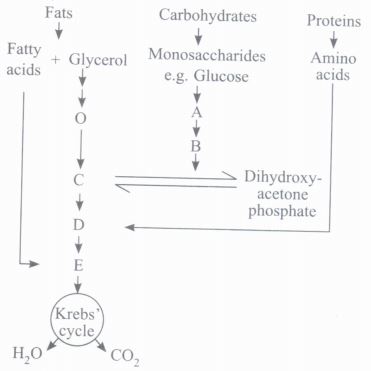
Study the flow chart given above and answer the following questions.
(a) Identify the respective chemical compounds that the letters A, B, C, D, and E represent.
(b) Why is the respiratory pathway appropriately designated as amphibolic pathway?
2.
A list of enzymes is given below:
(i) Lactic dehydrogenase
(ii) Ribulose 1, 5-bisphosphate carboxylase
(iii) Cytochrome oxidase.
(iv) Pyruvic dehydrogenase
(v) Phosphoenolpyruvate carboxylase
(vi) ATP synthetase
Select two enzymes each that are involved in
(a) Respiration only.
(b) Photosynthesis only.
(c) Both respiration and photosynthesis.
3.
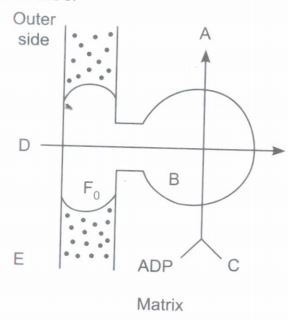
(a) What does the above diagram represent?
(b) What do the letters A, B, C and D represent?
(c) Which among them undergoes conformational changes?
4.
The summary equation for a particular phase of respiration is given below. Study the equation and answer the questions that follow.
\(\begin{aligned}
\ { Pyruvic \ \ acid }+4 \mathrm{NAD}^{+}+\mathrm{FAD}+2 \mathrm{H}_{2} \mathrm{O}+\mathrm{ADP}+\mathrm{P}_{i} \longrightarrow 3 \mathrm{CO}_{2}+4 \mathrm{NADH}+4 \mathrm{H}^{+}+\mathrm{FADH}_{2}+\mathrm{ATP}
\end{aligned} \)(a) What does the equation represent?
(b) Where does this process take place?
(c) How many ATPs can be formed from 4NADH and one FADH2 shown 'in the equation?
5.
Study the equation given below and answer the questions that follow:
\(\begin{aligned}
\text { Pyruvic acid }+\mathbf{C o A}+\mathbf{N A D}^{+} \frac{\mathbf{M g}^{2+}}{(\mathrm{A})} \ { Acetyl } \mathbf{C o A}+\mathbf{C O}_{2}+\mathbf{N A D H}+\mathbf{H}^{+}
\end{aligned}\)
(a) Name the type of reaction, the pyruvic acid undergoes.
(b) Where does this process take place?
(c) Name the enzyme \(\text { (A) }\) involved in the reaction.
(d) What is the fate of acetyl CoA formed?
6.
The flow chart given below represents the major pathways of anaerobic respiration. Answer the questions that follow:
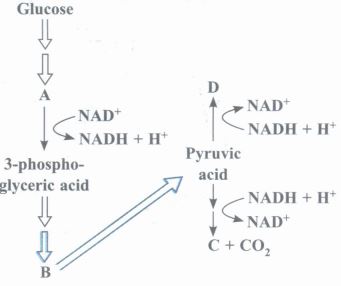
(a) Identify A, B, C and D.
(b) Name the two enzymes involved in the conversion of pyruvic acid to C.
7.
A simplified form of glycolysis is shown in the flow chart given below, where pyruvic acid is the end product.
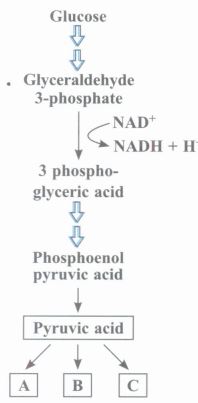
Write the three metabolic fates, A, Band C of the pyruvic acid and mention against each aerobic or anaerobic condition.
8.
A process is occurring throughout the day in an organism 'X'. Cells of the body do participate in the process. During the process, ATP, CO2 and water are formed. It is not a light-dependent process.
(a) Name the process.
(b) Is it a catabolic process or an anabolic process?
(c) What could be the raw material for this process?
1.
(a) A - Glucose 6-phosphate
B - Fructose 1, 6-bisphosphate
C - Glyceraldehyde 3-phosphate
D - Pyruvic acid
E - Acetyl CoA.
(b) Respiratory pathway is called amphibolic pathway because it involves both anabolic and catabolic processes.
2.
(a) (i) Lactic dehydrogenase
(iv) Pyruvic dehydrogenase
(b) (ii) Ribulose I, 5-bisphosphate carboxylase
(v) Phosphoenol pyruvate carboxylase
(c) (iii) Cytochrome oxidase
(vi) ATP synthetase.
3.
(a) It represents the formation of ATP by phosphorylation of ADP.
(b) A-ATP
B - F1 particle
C-Pi
D-2H+
4.
(a) It represents the reactions in Kreb's/Citric acid cycle
(b) It occurs in the mitochondrial matrix.
(c) 4NADH will yield 12ATPs while one FADH2 will yield 2 ATPs.
5.
(a) Pyruvic acid undergoes oxidative decarboxylation.
(b) It takes place in the mitochondrial matrix.
(c) Pyruvic dehydrogenase.
(d) Acetyl CoA enters the citric acid cycle (also called Kreb's cycle) and combines with oxaloacetic acid.
6.
(a) A - Glyceraldehyde 3-phosphate
B - Phosphoenol pyruvic acid
C - Ethyl alcohol (ethanol)
D - Lactic acid.
(b) Pyruvic decarboxylase and alcohol dehydrogenase.
7.
\(\begin{array}{|l|}
\hline \mathrm{A} \\
\hline
\end{array}\) - Kreb's cycle, under aerobic condition.
\(\begin{array}{|l|}
\hline \mathrm{B} \\
\hline
\end{array}\) - Alcohol fermentation under anaerobic condition.
\(\begin{array}{|l|}
\hline \mathrm{C} \\
\hline
\end{array}\) - Lactic acid fermentation under anaerobic condition.
8.
(a) It is respiration.
(b) It involves both catabolic and anabolic processes; hence, it is an amphibolic pathway.
(c) (i) Glucose is the most favoured substrate.
(ii) Other carbohydrates, fats, organic acids and proteins are used as substrates under certain conditions.

11th Standard CBSE Syllabus & Materials
11th Standard CBSE
CBSE 11th Business Studies Forms of Business Organisation Sample Question Papers Study Material - QB365 Set A
NEW11th Standard CBSE
CBSE 11th Business Studies Business, Trade and Commerce Sample Question Papers Study Material - QB365 Set A
NEW11th Standard CBSE
CBSE 11th Physics Waves Sample Question Papers Study Material - QB365 Set A
NEW11th Standard CBSE
CBSE 11th Physics Kinetic Theory Sample Question Papers Study Material - QB365 Set A



CBSE 11th Standard CBSE Subjects
CBSE Standards









