
 100% FREE ACCESS
11th Standard CBSE Syllabus & Materials
11th Standard CBSE
CBSE 11th Economics PART-A - Presentation of Data - New Sample Question Papers Study Material - QB365 Set A
NEW11th Standard CBSE
CBSE 11th Economics PART-A - Organisation of Data - New Sample Question Papers Study Material - QB365 Set A
NEW11th Standard CBSE
CBSE 11th Economics PART-A - Collection of Data - New Sample Question Papers Study Material - QB365 Set A
NEW11th Standard CBSE
CBSE 11th Economics PART-A - Introduction to Economics and Statistics - New Sample Question Papers Study Material - QB365 Set A
NEW11th Standard CBSE
CBSE 11th Business Studies International Trade Sample Question Papers Study Material - QB365 Set A
NEW11th Standard CBSE
CBSE 11th Business Studies Evolution and Fundamentals of Business Sample Question Papers Study Material - QB365 Set A

Published on: 09/09/2022
QB365 provides a detailed and simple solution for every Possible Case Study Questions in Class 11 Biology Subject - Structural Organisation in Animals, CBSE. It will help Students to get more practice questions, Students can Practice these question papers in addition to score best marks.
Download CBSE Class 11th Standard CBSE Biology question papers, sample papers, important questions, and previous year solved papers in PDF format. Get free study materials, NCERT solutions, and exam preparation resources for Class 11th Standard CBSE Biology
Questions + Answers key
Take MCQ Biology Test
1.
The nervous system of cockroach consists of a series of fused, segmentally arranged ganglia, which are joined by paired longitudinal connectives along the ventral side.
(a) How many ganglia are present in the (i) thorax and (ii) abdomen, respectively?
(b) A cockroach can survive for as long as one week, even if its head is severed from the body. Give reason.
(c) What represents the brain in a cockroach? Name the parts/organs to which it supplies nerves.
2.
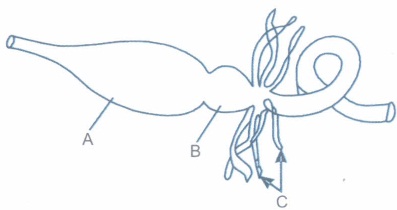
In the figure, some parts of alimentary canal of a cockroach are shown. Name the organs (A), (B) and (C). State the function of each of these organs.
3.
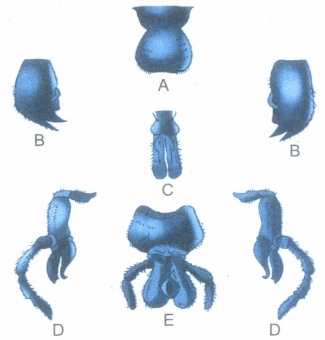
The diagram given below depicts the mouth parts of a cockroach. Answer the questions that follow:
(a) What type of mouth parts does a cockroach possess?
(b) Identify and name the part that acts as
(i) lower lip
(ii) upper lip
(iii) tongue
(c) Name the mouth part that is used for grinding and incising.
4.
The body of a cockroach is segmented and divisible into three regions - head, thorax and abdomen. The entire body is covered by an exoskeleton made of chitin.
(a) Write the scientific name of the common species of cockroach.
(b) How many segments are there in each of the following?
(I) Head,
(ii) Thorax,
(iii) Abdomen
(c) What name is given to the hardened plates of the exoskeleton of each segment? How are they joined to each other?
5.
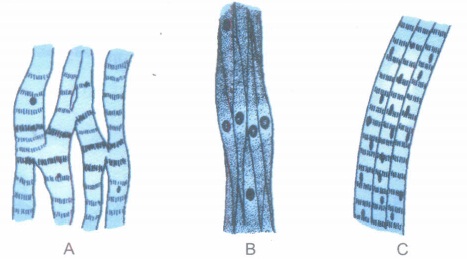
Three types of muscle tissue are shown in the picture given above.
(a) Identify the type of muscle tissue A, Band C.
(b) Mention one location or site in a human body, where each of them is present.
6.
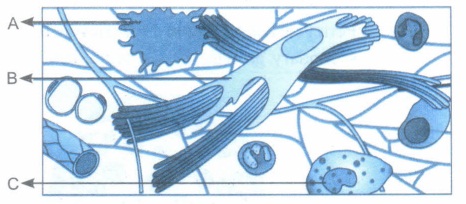
The diagrammatic representation of a type of loose connective tissue is given above. Answer the following questions based on that.
(a) Identify the type of connective tissue.
(b) Identify and name the three types of cells present in it.
(c) Mention two functions of the cells
7.
Connective tissues are the most abundant and widely distributed tissues in the body of complex animals. They range from loose connective tissues to specialized types.
(a) Why are connective tissues named so?
(b) Name two types of loose connective tissues.
(c) Why is blood called a fluid connective tissue?
8.
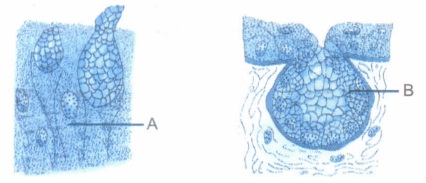
Unicellular and multicellular glands are shown in the figure given above. Answer the following questions.
(a) Name the types of epithelial cells that become specialised for secretion.
(b) Give an example each, of unicellular and multicellular glands in our body.
(c) Name the types of glands based on the mode of pouring their secretion
9.
In nearly all animal tissues, specialised junctions provide both structural and functional links between the individual cells of the tissue. Three types of cell junctions are found in the epithelium and other tissues.
Name the three types of cell junctions and mention one function of each of them.
1.
(a) (i) Three,
(ii) Six
(b) Since the head holds only a bit of the nervous system, while the remaining part of it is distributed throughout the body, cockroach can survive even after its head is severed.
(c) (i) Supra-oesophageal ganglion.
(ii) To antennae and compound eyes.
2.
A - is crop
The food remains temporarily stored in it.
B - is gizzard
It helps in grinding the food.
C - is hepatic caecae
They secrete digestive enzymes for digestion of all types of nutrients.
3.
(a) Biting and chewing type.
(b) (i) E - Labium, (ii) A-Labrum, (iii) C - Hypopharynx
(c) B-Mandibles
4.
(a) Periplaneta americana
(b) (i) Six, (ii) Three, (iii) Ten
(c) Sclerites
They are joined by arthrodial membrane.
5.
(a) A - Cardiac muscle tissue
B - Smooth muscle tissue
C - Striated muscle tissue
(b) (i) Cardiac muscle tissue is present in the heart.
(ii) Smooth muscle tissue is present in the wall of blood vessels, intestine, ureters, etc.
(iii) Striated muscle tissue is present in skeletal muscles like biceps.
6.
(a) It is Areolar connective tissue.
(b) A - Macrophage
B - Fibroblast
C - Mast cell
(c) Functions of cells
(i) The cells secrete collagen and elastin fibres, the structural proteins.
(ii) They also secrete some modified polysaccharides that form the matrix (ground substance).
7.
(a) Connective tissues are named so because they link and support other tissues/organs of the body.
(b) Areolar tissue and adipose tissue.
(c) Blood is a fluid connective tissue because its matrix (plasma) is a fluid that lacks fibres.
8.
(a) Cuboidal and columnar epithelial cells.
(b) Unicellular glands - Goblet cells Multicellular glands - Pancreas, salivary glands, etc.
(c) Exocrine glands and endocrine glands.
9.
Cell junctions
(i) Tight junctions
They help to stop leaking of substances across a tissue.
(ii) Adhering junctions
They perform cementing to keep the adjacent cells together.
(iii) Gap junctions
They facilitate the cells to communicate with each other by connecting the cytoplasm of adjoining cells for rapid transfer of ions and molecules.

11th Standard CBSE Syllabus & Materials
11th Standard CBSE
CBSE 11th Business Studies Forms of Business Organisation Sample Question Papers Study Material - QB365 Set A
NEW11th Standard CBSE
CBSE 11th Business Studies Business, Trade and Commerce Sample Question Papers Study Material - QB365 Set A
NEW11th Standard CBSE
CBSE 11th Physics Waves Sample Question Papers Study Material - QB365 Set A
NEW11th Standard CBSE
CBSE 11th Physics Kinetic Theory Sample Question Papers Study Material - QB365 Set A



CBSE 11th Standard CBSE Subjects
CBSE Standards









