
 100% FREE ACCESS
11th Standard CBSE Syllabus & Materials
11th Standard CBSE
CBSE 11th Economics PART-A - Presentation of Data - New Sample Question Papers Study Material - QB365 Set A
NEW11th Standard CBSE
CBSE 11th Economics PART-A - Organisation of Data - New Sample Question Papers Study Material - QB365 Set A
NEW11th Standard CBSE
CBSE 11th Economics PART-A - Collection of Data - New Sample Question Papers Study Material - QB365 Set A
NEW11th Standard CBSE
CBSE 11th Economics PART-A - Introduction to Economics and Statistics - New Sample Question Papers Study Material - QB365 Set A
NEW11th Standard CBSE
CBSE 11th Business Studies International Trade Sample Question Papers Study Material - QB365 Set A
NEW11th Standard CBSE
CBSE 11th Business Studies Evolution and Fundamentals of Business Sample Question Papers Study Material - QB365 Set A

Published on: 09/09/2022
QB365 provides a detailed and simple solution for every Possible Case Study Questions in Class 11 Biology Subject - The Living World, CBSE. It will help Students to get more practice questions, Students can Practice these question papers in addition to score best marks.
Download CBSE Class 11th Standard CBSE Biology question papers, sample papers, important questions, and previous year solved papers in PDF format. Get free study materials, NCERT solutions, and exam preparation resources for Class 11th Standard CBSE Biology
Questions + Answers key
Take MCQ Biology Test
1.
Classification is not a single-step process, but involves a hierarchy of steps, in which each step represents a rank or category. Each category, a unit of classification, represents a taxon. Taxonomical studies of all the known organisms have led to the development of certain common categories.
(a) Name and arrange the common categories in proper sequence in a hierarchy, from the lowest to the highest category
(b) Name the following:
(i) The family that includes lion, tiger and leopard, all belonging to the genus Panthera.
(ii) The order that includes the plant families Convolvulaceae and Solanaceae.
2.
Taxonomic studies of various species of plants, animals and other groups of organisms are useful in forestry, agriculture, industry and in general in knowing our bioresources and their diversity. Biologists have established certain procedures and techniques to store and preserve the information as well as the specimens.
(a) Mention two such taxonomic aids each, where
(i) live specimens are available.
(ii) preserved specimens are kept.
(b) What does a couplet in the taxonomic keys represent?
3.
All living phenomena are due to the underlying interactions, which result in emergent properties at higher levels of organisation. It is true in the hierarchy of organisational complexity at all levels.
(a) Give two examples to substantiate the above statement.
(b) Define living organisms based on this property
4.
When we try to define 'living', we conventionally look for certain distinctive characteristics exhibited by living organisms. Some of them are 'defining' properties while some others are not 'defining' properties.
(a) Give four 'defining' properties of living organisms.
(b) Why is reproduction not considered an all inclusive defining characteristic of living organisms?
1.
(a)
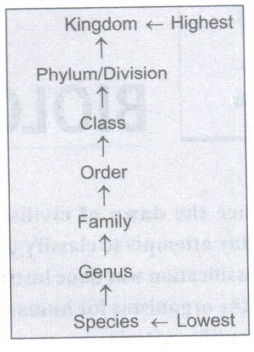
(b) (i) Felidae
(ii) Polemoniales
2.
(a) (i) Botanical garden and zoological garden (zoo).
(ii) Museums and herbarium.
(b) A couplet in the taxonomic key represents the choice made between the two contrasting characters i.e., two opposite options.
3.
(a) (i) Properties of tissues are not present in the constituent cells.
(ii) Properties of cellular organelles are not present in their molecular constituents.
(b) Living organisms can be defined as the selfreplicating, evolving and self-regulating interactive systems capable of responding to external stimuli.
4.
(a) The defining properties are:
(i) cellular organisation of the body.
(ii) metabolism.
(iii) consciousness to sense and respond to environmental cues.
(iv) interactions and emergent properties
(b) It is because
(i) there are certain organisms like mules, sterile worker honey bees, infertile human couples, etc. who do not reproduce at all.
(ii) in unicellular organisms, we are not sure about the two terms - reproduction and growth.

11th Standard CBSE Syllabus & Materials
11th Standard CBSE
CBSE 11th Business Studies Forms of Business Organisation Sample Question Papers Study Material - QB365 Set A
NEW11th Standard CBSE
CBSE 11th Business Studies Business, Trade and Commerce Sample Question Papers Study Material - QB365 Set A
NEW11th Standard CBSE
CBSE 11th Physics Waves Sample Question Papers Study Material - QB365 Set A
NEW11th Standard CBSE
CBSE 11th Physics Kinetic Theory Sample Question Papers Study Material - QB365 Set A



CBSE 11th Standard CBSE Subjects
CBSE Standards









