
 100% FREE ACCESS
11th Standard CBSE Syllabus & Materials
11th Standard CBSE
CBSE 11th Economics PART-A - Presentation of Data - New Sample Question Papers Study Material - QB365 Set A
NEW11th Standard CBSE
CBSE 11th Economics PART-A - Organisation of Data - New Sample Question Papers Study Material - QB365 Set A
NEW11th Standard CBSE
CBSE 11th Economics PART-A - Collection of Data - New Sample Question Papers Study Material - QB365 Set A
NEW11th Standard CBSE
CBSE 11th Economics PART-A - Introduction to Economics and Statistics - New Sample Question Papers Study Material - QB365 Set A
NEW11th Standard CBSE
CBSE 11th Business Studies International Trade Sample Question Papers Study Material - QB365 Set A
NEW11th Standard CBSE
CBSE 11th Business Studies Evolution and Fundamentals of Business Sample Question Papers Study Material - QB365 Set A

Published on: 09/09/2022
QB365 provides a detailed and simple solution for every Possible Case Study Questions in Class 11 Biology Subject - Transport in Plants, CBSE. It will help Students to get more practice questions, Students can Practice these question papers in addition to score best marks.
Download CBSE Class 11th Standard CBSE Biology question papers, sample papers, important questions, and previous year solved papers in PDF format. Get free study materials, NCERT solutions, and exam preparation resources for Class 11th Standard CBSE Biology
Questions + Answers key
Take MCQ Biology Test
1.
Observe the diagrams of the stomatal apparatus given below and answer the questions that follow:
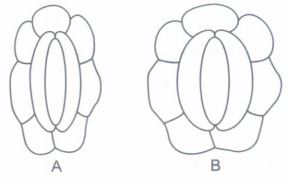
(a) In which of the diagrams, are the guard cells more turgid?
(b) Mention one function of the stomata other than loss of water vapour during transpiration.
(c) Name the element involved in the opening and closing of stomata.
2.
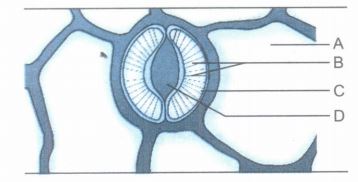
A stomatal apparatus is shown in the diagram given above. Observe the diagram and answer the following questions.
(a) Identify the cells A and C.
(b) What does B represent in the diagram? How do they aid in the opening of stoma?
(c) What is the immediate cause of opening and closing of stomata?
3.
Water moves upward through xylem in plants at a fairly high rate, i.e. about 15 metres per hour. Rani had a doubt whether the water is pushed up or pulled through xylem. Her doubt was cleared by her teacher that it can be by both the methods.
(a) What is the driving force for pushing up water? When does it normally occur?
(b) What is responsible for pulling up of water?
(c) Mention the three properties of water that are responsible for water movement as a column.
4.
Observe the diagram given and answer the questions that follow:
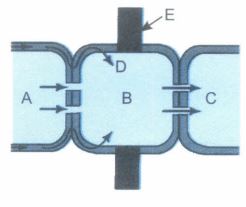
(a) Identify and name the cells A, Band C.
(b) Name the pathway of water movement represented by D.
(c) What does Erepresent and name the substance, it is made of?
5.
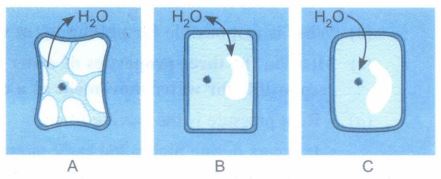
(a) Identify the nature of the external solution with reference to that of the cytoplasm of the cell in A, Band C.
(b) Mention the processes occurring in A and C.
(c) Why is there no net movement of water in B?
6.
In an experimental set up on osmosis, a 'stronger' solution of glucose is taken in a thistle funnel with its mouth tied with a semipermeable membrane. It is kept in a beaker containing a 'weaker' solution of glucose.
(a) What is meant by 'stronger' and 'weaker' solutions?
(b) Which of them has a higher water potential?
(c) Which of them has a lower solute potential?
(d) If a pressure is applied from the upper part of the funnel, the diffusion of water into it stops.
(i) What is this pressure known as?
(ii) Which of the solutions (mentioned above) will have a higher pressure?
7.
Study the figure given below, in which two chambers A and B containing solutions of different concentrations are separated by a selectively permeable membrane.
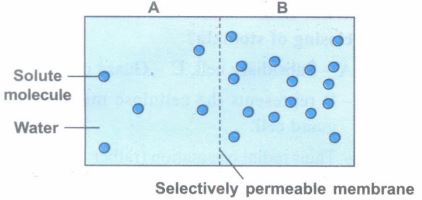
(a) Solution of which chamber has a lower water potential?
(b) Solution of which chamber has a lower solute potential?
(c) In which direction will osmosis occur?
(d) At equilibrium which chamber will have lower water potential?
(e) If one chamber has a \(\Psi\) of - 2000 kPa, and the other - 1000 kPa, which is the chamber that has the higher \(\Psi\)?
(f) What will be the direction of the movement of water when two solutions with \(\Psi_{\mathbf{w}}\) =-0.2 MPa and \(\Psi_{\mathbf{w}}\) = 0.1 MPa are separated by a selectively permeable membrane?
8.
Certain proteins in the membrane are responsible for facilitated diffusion and active transport; hence, they show some common characteristics. They also differ from each other in certain aspects.
(a) Describe two such similar features of the proteins involved in facilitated diffusion and active transport.
(b) Mention one feature other than the requirement of energy, in which the proteins of active transport differ from that of facilitated diffusion.
9.
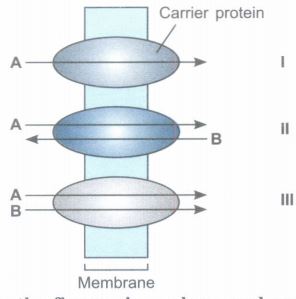
Observe the figure given above and answer the following questions.
(a) Identify the process I, II and III.
(b) Why does the transport rate reach a maximum in facilitated diffusion?
(c) What term is given to the membrane proteins involved in active transport?
10.
Transport in plants over long-distance proceeds through the vascular tissues in a process, called translocation. Transport in xylem (of water and minerals) is unidirectional.
(a) How do substances move over short distances?
(b) Organic and mineral nutrients undergo multidirectional transport. Justify (Give four points).
1.
(a) In B, the guard cells are more turgid.
(b) Exchange of gases (oxygen and carbon dioxide) occurs through stomata.
(c) Potassium.
2.
(a) A - Subsidiary cell, C - Guard cell
(b) (i) B represents the cellulose microfibrils of the guard cell.
(ii) Their radial orientation (rather than longitudinal orientation) helps in opening of stomata.
(c) Change in turgidity of guard cells is the immediate cause for opening and closing of stomata.
3.
(a) (i) Root pressure is the driving force
(ii) It occurs during nights and early morning.
(b) Transpiration from leaves is responsible for this.
(c) Properties of water
(i) Cohesion among water molecules.
(ii) Adhesion between water molecules and the surface of tracheary elements.
(iii) Surface tension of water molecules.
4.
(a) A - Cortical cell
B - Endodermis
C - Pericycie
(b) D represents apoplastic pathway.
(c) E represents Casparian thickening; it is made of suberin.
5.
(a) A - Hypertonic
B - Isotonic
C - Hypotonic
(b) A - Exosmosis
B - Endosmosis
(c) There is no net movement of water in B, as the osmotic pressure of the external solution balances that of the cytoplasm, i.e. the solution is isotonic.
6.
(a) (i) 'Stronger' solution is the one with higher solute concentration.
(ii) 'Weaker' solution is a dilute solution with a low solute concentration.
(b) The 'weaker' solution has a higher water potential.
(c) The 'stronger' solution has a lower solute potential.
(d) (i) It is called osmotic pressure .
(ii) The 'stronger' solution will have a higher osmotic pressure.
7.
(a) Chamber B.
(b) Chamber B.
(c) From chamber A to B.
(d) Both the chambers will have the same water potential.
(e) The chamber with \(\Psi\) of -1000 kPa.
(f) From solution of - 0.1 MPa to solution of - 0.2 MPa.
8.
(a) Similarities
(i) The transport proteins are highly specific for the substance to be transported.
(ii) The proteins are sensitive to inhibitors, which react with their side chains.
(b) Difference
(i) In active transport, the proteins (called pumps) can transport substances from a region of lower concentration to a region of higher concentration, but in facilitated diffusion, this cannot occur as it requires energy
9.
(a) I - Uniport
II - Antiport
III - Symport
(b) Transport rate reaches a maximum, when all the transport or carrier proteins are being occupied by the substance to be transported.
(c) They are called pumps.
10.
(a) Substances move over short distances by
(i) diffusion,
(ii) cytoplasmic streaming and
(iii) active transport.
(b) (i) Organic compounds synthesised during photosynthesis by leaves are transported to all other parts.
(ii) Hormones and other plant growth regulators are also transported in very small quantities, more often in a strictly polarised or unidirectional manner from where they are synthesised.
(iii) The organic food materials are also mobilised from the storage organs and moved to those regions where energy is needed.
(iv) When any plant part undergoes senescence, nutrients may be withdrawn from such regions and moved to the growing parts.

11th Standard CBSE Syllabus & Materials
11th Standard CBSE
CBSE 11th Business Studies Forms of Business Organisation Sample Question Papers Study Material - QB365 Set A
NEW11th Standard CBSE
CBSE 11th Business Studies Business, Trade and Commerce Sample Question Papers Study Material - QB365 Set A
NEW11th Standard CBSE
CBSE 11th Physics Waves Sample Question Papers Study Material - QB365 Set A
NEW11th Standard CBSE
CBSE 11th Physics Kinetic Theory Sample Question Papers Study Material - QB365 Set A



CBSE 11th Standard CBSE Subjects
CBSE Standards









