
 100% FREE ACCESS
11th Standard CBSE Syllabus & Materials
11th Standard CBSE
CBSE 11th Economics PART-A - Presentation of Data - New Sample Question Papers Study Material - QB365 Set A
NEW11th Standard CBSE
CBSE 11th Economics PART-A - Organisation of Data - New Sample Question Papers Study Material - QB365 Set A
NEW11th Standard CBSE
CBSE 11th Economics PART-A - Collection of Data - New Sample Question Papers Study Material - QB365 Set A
NEW11th Standard CBSE
CBSE 11th Economics PART-A - Introduction to Economics and Statistics - New Sample Question Papers Study Material - QB365 Set A
NEW11th Standard CBSE
CBSE 11th Business Studies International Trade Sample Question Papers Study Material - QB365 Set A
NEW11th Standard CBSE
CBSE 11th Business Studies Evolution and Fundamentals of Business Sample Question Papers Study Material - QB365 Set A

Published on: 09/09/2022
QB365 provides a detailed and simple solution for every Possible Case Study Questions in Class 11 Chemistry Subject - Hydrocarbons, CBSE. It will help Students to get more practice questions, Students can Practice these question papers in addition to score best marks.
Download CBSE Class 11th Standard CBSE Chemistry question papers, sample papers, important questions, and previous year solved papers in PDF format. Get free study materials, NCERT solutions, and exam preparation resources for Class 11th Standard CBSE Chemistry
Questions + Answers key
Take MCQ Chemistry Test
1.
Hydrocarbons are compounds of carbon and hydrogen only, obtained from coal and petroleum mainly which are major sources of energy. Hydrocarbons are classified as open chain, saturated (alkanes), unsaturated (alkenes and alkynes), cyclic (alicyclic) and aromatic based on structure.
Alkanes show conformational isomerism due to free rotation along C-C bond leading to staggered and eclipsed conformations of ethane. Staggered conformation is more stable. Alkenes show geometrical (Cis-trans) isomerism due to restricted rotation around carbon-carbon double bond. Benzene and benzenoid show aromatic character. They follow Huckel rule \((4 n+2) \pi\) electrons which must be delocalised. The presence of activating and deactivating groups decide the position of electrophile after electrophilic substitution. Polynuclear fused aromatic hydrocarbons have carcinogenic property. Benzene is prepared by polymerisation of ethyne and by heating sodium benzoate with soda lime.
(a) Why is staggered form of ethane more stable than eclipsed form?
(b) Out of T-butene and 2-butene which will show geometrical isomerism.
(c) Why is cis-2.-butene has higher boiling point than trans-2-butene?
(d) Why is cyclopentadienyl anion is aromatic?
(e) Why is -NO2 group m-directing towards electrophilic substitution?
(f) Convert acetylene to benzene .
(g) Sodium benzoate, on heating with soda lime gives benzene, name the reaction.
2.
Observe the table of variation of melting and boiling point in Alkanes. Study the table and answer the questions that follow based on table and related studied concepts.
Variation of Melting Point and Boiling Point in Alkanes
| Molecular formula |
Name | Molecular mass/u |
b.p./(K) | m.p./(K) |
| CH4 | Methane | 16 | 111.0 | 90.5 |
| C2H6 | Ethane | 30 | 184.4 | 101.0 |
| C3H8 | Propane | 44 | 230.9 | 85.3 |
| C4H10 | Butane | 58 | 272.4 | 134.6 |
| C4H10 | 2-Methylpropane | 58 | 261.0 | 114.7 |
| C5H12 | Pentane | 72 | 309.1 | 143.3 |
| C5H12 | 2-Methylbutane | 72 | 300.9 | 113.1 |
| C5H12 | 2,2-Dimethylpropane | 72 | 282.5 | 256.4 |
| C6H14 | Hexane | 86 | 341.9 | 178.5 |
| C7H16 | Heptane | 100 | 371.4 | 182.4 |
| C5H18 | Octane | 114 | 398.7 | 216.2 |
| C9H20 | Nonane | 128 | 423.8 | 222.0 |
| C10H22 | Decane | 142 | 447.1 | 243.3 |
| C20H42 | Eicosane | 282 | 615.0 | 236.2 |
(a) How does boiling point varies with the increase in carbon chain? Why?
(b) Why does 2, 2-dimethyl propane has lower boiling point than 2-methyl butane and n-pentane?
(c) Why is melting point of 2, 2-dimethyl propane is higher than n-pentane and 2-methyl butane?
(d) What is physical state of heptane?
(e) How does density vary with the increase in molar mass in hydrocarbons?
(f) What is physical state of C20H42(Eicosane)?
3.
Organic reactions can be classified into four main categories. Substitution reactions, addition reactions, elimination reactions and rearrangement reactions. Substitution reactions can be further classified into free radical, nucleophilic and electrophilic substitution reactions. Addition reactions can be nucleophilic as well as electrophilic addition reactions. Dehydration, dehydrohalogenation, dehalogenation are examples of elimination reactions. Conversion by ammonium cyanate to urea is an example of rearrangement reactions. Reactions are classified on the basis to nature of intermediate species formed. Mechanism of reaction is exact path followed by the reaction involving all steps showing intermediates and slowest steps of the reaction which is rate determining step. Oxidation, reduction, combustion reactions are also important in hydrocarbons.
(a) Halogenation of alkane is an example of which type of reaction?
(b) What happens when 2-methyl propane is heated with KMnO4?
(c) What type of reaction takes place when n-hexane is heated in presence of AICI3 (anhy.) and HCI?CH2 =CH2 + KCI + HzO
(d) What happens when but-2-yne reacts with H2 in presence of Lindlar's catalyst.
(e) CH3CH2C1 + KOH(alc) \(\longrightarrow\) CH2 =CH2 + KCI + H2O
What is type of reaction?
(f) Why do aromatic hydrocarbons undergo electrophilic substitution reaction?
1.
(a) It has less repulsion between C-H bonds.
(b) But-2-ene.
(c) It is because cis-2-butene is more polar, has more van der Waals' forces of attraction than trans-form.
(d) It has \(6 \pi\) electrons which are delocalised.
(e) It is electron-withdrawing, i.e., deactivating, there is +ve charge on 0 and p-position, so electrophile attacks on m-position
(f)
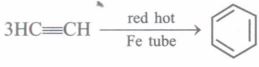
(g) Decarboxylation
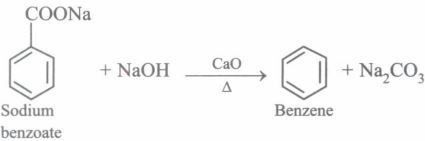
2.
(a) Boiling point increases with increase in carbon chain because surface area increases, van der Waals' forces of attraction increases, hence boiling point increases.
(b) It is because boiling point decreases with increase in branching because surface area decreases, van der Waals' forces of attraction decreases, hence it has lower boiling point.
(c) It is because molecules are closely packed in 2, 2-dimethyl propane as compared to 2-methyl butane and n-pentane
(d) It is liquid.
(e) The density goes on increasing with the increase in molar mass.
(f) It exist in solid state.
3.
(a) Free radical substitution.
(b) Tert. butyl alcohol is formed.
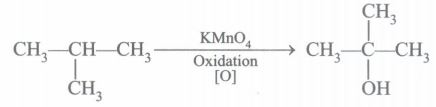
(c) Isomerisation (Rearrangement) reaction takes place.

(d) Cis-But-2-ene is formed

(e) It is nucleophilic elimination reaction (Dehydrohalogenation).
(f) It is due to presence of n-electrons in aromatic hydrocarbons, electrophile can replace H+ ion.

11th Standard CBSE Syllabus & Materials
11th Standard CBSE
CBSE 11th Business Studies Forms of Business Organisation Sample Question Papers Study Material - QB365 Set A
NEW11th Standard CBSE
CBSE 11th Business Studies Business, Trade and Commerce Sample Question Papers Study Material - QB365 Set A
NEW11th Standard CBSE
CBSE 11th Physics Waves Sample Question Papers Study Material - QB365 Set A
NEW11th Standard CBSE
CBSE 11th Physics Kinetic Theory Sample Question Papers Study Material - QB365 Set A



CBSE 11th Standard CBSE Subjects
CBSE Standards









