
 100% FREE ACCESS
11th Standard CBSE Syllabus & Materials
11th Standard CBSE
CBSE 11th Economics PART-A - Presentation of Data - New Sample Question Papers Study Material - QB365 Set A
NEW11th Standard CBSE
CBSE 11th Economics PART-A - Organisation of Data - New Sample Question Papers Study Material - QB365 Set A
NEW11th Standard CBSE
CBSE 11th Economics PART-A - Collection of Data - New Sample Question Papers Study Material - QB365 Set A
NEW11th Standard CBSE
CBSE 11th Economics PART-A - Introduction to Economics and Statistics - New Sample Question Papers Study Material - QB365 Set A
NEW11th Standard CBSE
CBSE 11th Business Studies International Trade Sample Question Papers Study Material - QB365 Set A
NEW11th Standard CBSE
CBSE 11th Business Studies Evolution and Fundamentals of Business Sample Question Papers Study Material - QB365 Set A

Published on: 09/09/2022
QB365 provides a detailed and simple solution for every Possible Case Study Questions in Class 11 Chemistry Subject - Redox Reactions, CBSE. It will help Students to get more practice questions, Students can Practice these question papers in addition to score best marks.
Download CBSE Class 11th Standard CBSE Chemistry question papers, sample papers, important questions, and previous year solved papers in PDF format. Get free study materials, NCERT solutions, and exam preparation resources for Class 11th Standard CBSE Chemistry
Questions + Answers key
Take MCQ Chemistry Test
1.
The standard electrode potentials at 298 K
Ions are present as aqueous species and H 2O as liquid; gases and solids are shown by g and s respectively.
| Reaction (Oxidised form + ne- \(\rightarrow\) Reduced form) |  |
\(\mathbf{E}^{\odot} / \mathbf{V}\) | |
 |
\(\mathbf{F}_{2}(g)+2 e^{-} \longrightarrow 2 \mathbf{F}\) \(\mathrm{Co}^{3+}+e^{-} \longrightarrow \mathrm{Co}^{2+}\) \(\mathbf{H}_{2} \mathbf{O}_{2}+\mathbf{2} \mathbf{H}^{+}+\mathbf{2} e^{-} \longrightarrow \mathbf{2} \mathbf{H}_{2} \mathbf{O}\) \(\mathrm{MnO}_{4}^{-}+8 \mathrm{H}^{+}+5 e^{-} \longrightarrow \mathrm{Mn}^{2+}+4 \mathrm{H}_{2} \mathrm{O}\) \(\mathbf{A u}^{3+}+\mathbf{3} \boldsymbol{e}^{-} \longrightarrow \mathbf{A u}(s)\) \(\mathrm{Cl}_{2}(g)+2 e^{-} \longrightarrow 2 \mathrm{Cl}^{-}\) \(\mathrm{Cr}_{2} \mathrm{O}_{7}^{2-}+\mathbf{1 4 H}^{+}+6 e^{-} \longrightarrow 2 \mathrm{Cr}^{3+}+7 \mathrm{H}_{2} \mathrm{O}\) \(\mathrm{O}_{2}(\mathrm{~g})+4 \mathrm{H}^{+}+4 e^{-} \longrightarrow 2 \mathrm{H}_{2} \mathrm{O}\) \(\mathrm{MnO}_{2}(s)+4 \mathrm{H}^{+}+2 e^{-} \longrightarrow \mathrm{Mn}^{2+}+2 \mathrm{H}_{2} \mathrm{O}\) \(\mathbf{B r}_{2}+2 e^{-} \longrightarrow 2 \mathbf{B r}^{-}\) \(\mathrm{NO}_{3}^{-}+4 \mathrm{H}^{+}+3 e^{-} \longrightarrow \mathrm{NO}+\underline{2} \mathrm{H}_{2} \mathrm{O}\) \(2 \mathrm{Hg}^{2+}+2 e^{-} \longrightarrow \mathrm{Hg}_{2}^{2+}\) \(\mathbf{A g}^{+}+\boldsymbol{e}^{-} \longrightarrow \mathbf{A g}(\boldsymbol{s})\) \(\mathbf{F e}^{3+}+e^{-} \longrightarrow \mathbf{F e}^{2+}\) \(\mathrm{O}_{2}(g)+2 \mathrm{H}^{+}+2 e^{-} \longrightarrow \mathbf{H}_{2} \mathrm{O}_{2}\) \(\mathbf{I}_{2}(s)+2 e^{-} \longrightarrow 2 \mathbf{I}^{-}\) \(\mathbf{C u}^{+}+e^{-} \longrightarrow \mathbf{C u}(\boldsymbol{s})\) \(\mathrm{Cu}^{2+}+2 e=\mathrm{Cu}(s)\) \(\mathbf{A g C l}(s)+e^{-} \longrightarrow \mathbf{A g}(s)+\mathbf{C l}\) \(\mathbf{A g B r}(s)+e^{-} \longrightarrow \mathbf{A g}(s)+\mathbf{B r}^{-}\) \(2 \mathrm{H}^{+}+2 e^{-} \longrightarrow \mathbf{H}_{2}(g)\) \(\mathbf{P b}^{2+}+2 e^{-} \longrightarrow \mathbf{P b}(s)\) \(\mathrm{Sn}^{2+}+2 e^{-} \longrightarrow \operatorname{Sn}(s)\)\(\)\(\) \(\)\(\mathbf{N i}^{2+}+2 e^{-} \longrightarrow \mathbf{N i}(s)\) \(\)\(\mathrm{Fe}^{2+}+2 e-\mathrm{Fe}(s)\) \(\)\(\mathrm{Cr}^{3+}+3 e^{-} \longrightarrow \mathrm{Cr}(s)\) \(\)\(\mathbf{Z n}^{2+}+2 e^{-} \longrightarrow \mathbf{Z n}(s)\) \(\)\(\mathbf{2} \mathbf{H}_{2} \mathbf{O}+\mathbf{2} e^{-} \longrightarrow \mathbf{H}_{2}+\mathbf{2} \mathbf{O H}^{-}\) \(\)\(\mathbf{A l}^{3+}+\mathbf{3 e}^{-} \longrightarrow \mathbf{A l}(\boldsymbol{s})\) \(\)\(\mathbf{M g}^{2+}+2 e^{-} \longrightarrow \mathbf{M g}(s)\) \(\)\(\)\(\mathrm{Na}^{+}+e^{-} \longrightarrow \mathrm{Na}(s)\) \(\mathrm{Ca}^{2+}+2 e^{-} \longrightarrow \mathrm{Ca}(s)\) \(\mathbf{K}^{+}+e^{-} \longrightarrow \mathbf{K}(\boldsymbol{s})\) \(\mathbf{L i}^{+}+e^{-} \longrightarrow \mathbf{L i}(s)\) |
2.87 | |
| 1.81 | |||
| 1.78 | |||
| 1.51 | |||
| 1.40 | |||
| 1.36 | |||
| 1.33 | |||
| 1.23 | |||
| 1.23 | |||
| 1.09 | |||
| 0.97 | |||
| 0.92 | |||
| 0.80 | |||
| 0.77 | |||
| 0.68 | |||
| 0.54 | |||
| 0.52 | |||
| 0.34 | |||
| 0.22 | |||
| 0.10 | |||
| 0.00 | |||
| 0.13 | |||
| 0.14 | |||
| 0.25 | |||
| 0.44 | |||
| 0.74 | |||
| 0.76 | |||
| 0.83 | |||
| 1.66 | |||
| 2.36 | |||
| 2.71 | |||
| 2.87 | |||
| 2.93 | |||
| 3.05 |
1. A negative \(\boldsymbol{E}^{\ominus}\) means that the redox couple is a stronger reducing agent than the H+/H2 couple.
2. A positive \(\boldsymbol{E}^{\ominus} \) means that the redox couple is a weaker reducing agent than the H+/H2 couple.
(a) Which is best oxidising agent and why?
(b) Which is best reducing agent and why?
(c) Calculate \(\mathbf{E}^{\circ} \text { cell }\) lof Zn(s)/Zn2+(1M) II Cu2 +(aq)/Cu(s).
(d) If a redox couple has negative Eo, is it stronger or weaker reducing agent than H+/H2 couple?
(e) Arrange K, Ag, Hg, Mg, Cr in increasing order of reducing power.
(f) Arrange AI, Cu, Fe, Mg and Zn in order in which they will displace each other from salt solution.
2.
Redox reactions are important class of reactions which are taking place in our daily life. Metals are good reducing agents because they can lose electrons easily whereas non-metals are good oxidising agents which can gain electrons easily. In electrolytic cells, electricity is passed to bring about redox reaction. All rechargeable batteries act as electrolytic cells while recharging. Electrochemical cells produce electricity as a result of redox reaction. Salt bridge is used in electrochemical cell to complete internal circuit and prevents accumulation of charges.
(a) What is electrochemical cell?
(b) Why is anode called oxidation electrode?
(c) Give one example of rechargeable cells widely used in vehicles.
(d) Highly reactive metals are obtained by electrolysis of their molten ores, why?
(e) What is direction of flow of current and electrons?
(f) What is standard electrode potential?
(g) What is meaning of -ve value of reduction potential? Give example.
3.
Redox reactions are reactions in which oxidation and reduction takes place simultaneously. Oxidation number are assigned in accordance with the set of rules. Oxidation number and ion electron methods both are used in balancing ionic equations. Redox reactions are classified as combination, decomposition, displacement and disproportionation reactions. The concept of redox couple and electrode processes is basis of electrolysis and electrochemical cells.
(a) What are oxidation number of each individual Br in Br3 O8 ?
(b) If electrolysis of CuSO4 solution is carried out using Cu electrodes, what will be reaction taking place at anode.
(c) What is oxidation number of Cr in CrO5?
(d) Give one example of disproportionation reaction.
1.
(a) F2 is best oxidising agent because it has highest standard reduction potential.
(b) Lithium is best reducing agent because it has lowest standard reduction potential.
(c) \(\mathrm{E}_{\text {cell }}^{\circ}=\mathrm{E}^{\circ} \text { cathode }-\mathrm{E}^{\circ} \text { anode }\)
= + 0.34V - (- 0.76V)
= 1.10 V
(d) It will be stronger reducing agent.
(e) Ag < Hg < Cr < Mg < K
(f) Cu, Fe, Zn, AI, Mg is increasing order of reactivity and increasing ability to displace other metals.
2.
(a) The cell in which chemical energy of redox reaction is converted into electrical energy.
(b) It is because loss of electrons take place at anode, i.e., oxidation takes place.
(c) Lead storage battery
(d) It is because these metals are good reducing agents, cannot be obtained by chemical reduction.
(e) Electrons flow from anode to cathode where as current flows from cathode to anode.
(f) When concentration of each species is unity, any gas involved is at 1 bar, temperature is 298 K, the potential of electrode is called standard electrode potential measured with respect to standard hydrogen electrode.
(g) It means redox couple is stronger reducing agent than H+/H2 couple.
E.g. \(\mathrm{E}_{\mathrm{Zn}^{2+} / \mathrm{Zn}}^{\circ}=\) -0.76 V, Zn is stronger reducing agent than H2.
3.
(a)
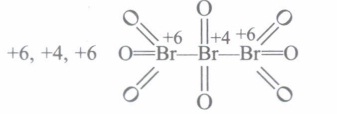
(b) Cu \(\rightarrow\) Cu 2 + + 2e-
(c)
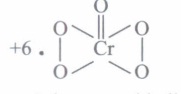
\(\therefore\) It has peroxide linkage.
(d) 2Cu + \(\rightarrow\) Cu2+ + Cu
(e) \(\begin{aligned}
\mathrm{MnO}_{4}^{2-} & \longrightarrow \mathrm{MnO}_{4}^{-}+e^{-} \\
2 e^{-}+4 \mathrm{H}^{+}+\mathrm{MnO}_{4}^{2-} & \longrightarrow \mathrm{MnO}_{2}+2 \mathrm{H}_{2} \mathrm{O} \\
\hline 3 \mathrm{MnO}_{4}^{2-}+4 \mathrm{H}^{+} & \longrightarrow 2 \mathrm{MnO}_{4}^{-}+\mathrm{MnO}_{2}+2 \mathrm{H}_{2} \mathrm{O} \\
\hline
\end{aligned}\)

11th Standard CBSE Syllabus & Materials
11th Standard CBSE
CBSE 11th Business Studies Forms of Business Organisation Sample Question Papers Study Material - QB365 Set A
NEW11th Standard CBSE
CBSE 11th Business Studies Business, Trade and Commerce Sample Question Papers Study Material - QB365 Set A
NEW11th Standard CBSE
CBSE 11th Physics Waves Sample Question Papers Study Material - QB365 Set A
NEW11th Standard CBSE
CBSE 11th Physics Kinetic Theory Sample Question Papers Study Material - QB365 Set A



CBSE 11th Standard CBSE Subjects
CBSE Standards









