
 100% FREE ACCESS
11th Standard CBSE Syllabus & Materials
11th Standard CBSE
CBSE 11th Economics PART-A - Presentation of Data - New Sample Question Papers Study Material - QB365 Set A
NEW11th Standard CBSE
CBSE 11th Economics PART-A - Organisation of Data - New Sample Question Papers Study Material - QB365 Set A
NEW11th Standard CBSE
CBSE 11th Economics PART-A - Collection of Data - New Sample Question Papers Study Material - QB365 Set A
NEW11th Standard CBSE
CBSE 11th Economics PART-A - Introduction to Economics and Statistics - New Sample Question Papers Study Material - QB365 Set A
NEW11th Standard CBSE
CBSE 11th Business Studies International Trade Sample Question Papers Study Material - QB365 Set A
NEW11th Standard CBSE
CBSE 11th Business Studies Evolution and Fundamentals of Business Sample Question Papers Study Material - QB365 Set A

Published on: 09/09/2022
QB365 provides a detailed and simple solution for every Possible Case Study Questions in Class 11 Chemistry Subject - Classification of Elements and Periodicity in Properties, CBSE. It will help Students to get more practice questions, Students can Practice these question papers in addition to score best marks.
Download CBSE Class 11th Standard CBSE Chemistry question papers, sample papers, important questions, and previous year solved papers in PDF format. Get free study materials, NCERT solutions, and exam preparation resources for Class 11th Standard CBSE Chemistry
Questions + Answers key
Take MCQ Chemistry Test
1.
Study the table 1 and 2 related to electronegativity values along the period 2 and 3 Group 1 and 17 and answer the questions that follow based on these.
Electronegativity Values (on Pauling scale) Across the Periods
| Atom (Period II) | Li | Be | B | C | N | O | F |
| Electronegativity | 1.0 | 1.5 | 2.0 | 2.5 | 3.0 | 3.5 | 3.0 |
| Atom (period III) | Na | Mg | AI | Si | P | S | Cl |
| Electronegativity | 0.9 | 1.2 | 1.5 | 1.8 | 2.1 | 2.5 | 3.0 |
Electronegativity Values (on Pauling scale) Down a Family
| Atom (Group I) | Electronegativity Value | Atom (Group XVII) | Eledronegativity Value |
| Li | 1.0 | F | 4.0 |
| Na | 0.9 | CI | 3.0 |
| K | 0.8 | Br | 2.8 |
| Rb | 0.8 | I | 2.5 |
| Cs | 0.7 | At | 2.2 |
(a) How does electronegativity varies along a period and why?
(b) Why does K and Rb have same electronegativity although Rb is bigger than K?
(c) Why does electronegativity decrease down the group?
(d) Why is CsF most ionic?
(e) Why is H- ion bigger than F- ion?
(f) Why is Lil covalent?
(g) Why is CI2 O7 more acidic than Cl2O5?
2.
Study the table of electron gain enthalpies of some main group elements and answer the questions that follow based on table and related concepts.
| Group 1 | \(\Delta_{\mathrm{eg}} \mathbf{H}\) | Group 16 | \(\Delta_{\mathrm{eg}} \mathbf{H}\) | Group 17 | \(\Delta_{\mathrm{eg}} \mathbf{H}\) | Group 0 | \(\Delta_{\mathrm{eg}} \mathbf{H}\) |
| H | -73 | He | +48 | ||||
| Li | -60 | O | -141 | F | -328 | Ne | +116 |
| Na | -53 | S | -200 | CI | -349 | Ar | +96 |
| K | -48 | Se | -195 | Br | -325 | Kr | +96 |
| Rb | -47 | Te | -190 | I | -295 | Xe | +77 |
| Cs' | -46 | Po | -175 | At | -270 | Rn | +68 |
(a) Why do group 1 elements have low electron gain enthalpies?
(b) Why is electron gain enthalpy of sulphur more than oxygen?
(c) Why do noble gases have +ve electron gain enthalpies?
(d) Arrange P, S, CI, F is increasing order of electron gain enthalpeis.
3.
Observe the group shown in figure and answer the questions that follow based on the graph and related studied concepts.
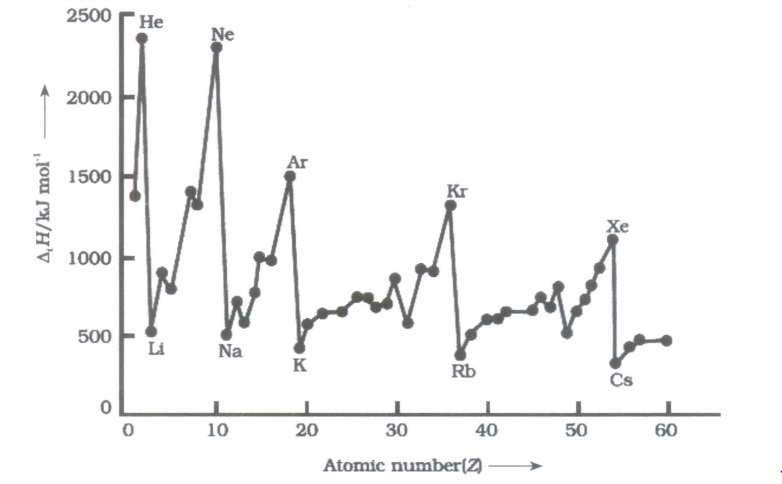
(a) Which group elements have lowest ionisation enthalpy and why?
(b) Which group element have highest ionisation enthalpy and why?
(c) Why is ionisation enthalpy of Be more than B?
(d) Why does 'N' have higher ionisation enthalpy than O?
4.
The atomic and ionic radii decrease with increase in atomic number along a period from left to right. Atomic size and ionic size increases down the group.
Ionisation enthalpy decreases down the group and increases along a period from left to right. It also depends upon shielding effect as well as stability of electronic configuration.
Electronegativity decreases down the group but increases along the period.
(a) Arrange the elements of second period in increasing order of first ionisation enthalpy.
(b) Arrange the elements of group 13 in increasing order of atomic size.
(c) Select the' amphoteric oxides among the following:
NO, B2O3, Cr 2O3, BeO, ZnO, CO2 , Al2 O3
(d) For an element I.E1 = 738 kJ mol-1, IE2 = 1450 kJ mol-1, IE3 = 7700 kJ mol-1, IE4 = 1.1 x 10 4 kJ mol-1. Name the main group to which element belong. Why?
5.
Modern periodic table arranges the elements in the increasing order of atomic number. It has 18 groups and 7 periods. Atomic numbers are consecutive in a period and increases in group in a pattern. Elements are divided into four blocks, s-block,p-block, d-block andf-block based on their electronic configuration. 78% of elements are metals, about 20 elements are non-metals and few elements like B, Si, Ge, As are metalloids. Metallic character increases down the group but decreases along the period from left to right. The physical and chemical properties vary periodically with their atomic numbers.
Periodic trends are observed in atomic size, ionisation enthalpies, electron gain enthalpies, electronegativity and valence. Oxides of metals are basic, some are amphoteric. Non-metals form acidic oxides, some form neutral oxides. s-block elements are soft, highly reactive, do not show variable oxidation states. p-block elements are metals, non-metals as well as metalloids, show variable oxidation states, exist as solids, liquids and gases. d-block elements are metals, form coloured ions, show variable oxidation states, have high melting and boiling points. Lanthanoids and actinoids are f-block elements, form coloured ions. All actinoids are radioactive.
(a) Name the elements which belong to d-block but are not transition metals.
(b) What are representative elements?
(c) What is difference between oxidation states of p-block and d-block elements?
(d) Which group elements are most electropositive and why?
(e) What happens to reactivity down the group 17?
(f) What type of compounds are formed by element belonging to group 14 and third period? Identify the element.
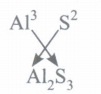
(g) What is formula of compound formed between AI and S
1.
(a) Electronegativity increases along a period due to decrease in atomic size and increase in effective nuclear charge.
(b) It is due to poor shidding effect of d-orbitals in Rb, effective nuclear charge does not decrease, therefore, electronegativity remains the same.
(c) It is due to increase in atomic size and decrease in effective nuclear charge.
(d) It is because Cs is most electropositive element and 'F' is most electronegative element. Greater the difference in electronegativity, more will be ionic character
(e) It is because 1 proton can attract 2 electrons less strongly than 9 protons attract 10 electrons.
[Size of H- = 134 pm, F- = 128.5 pm]
(f) It is because Li+ (smaller cation) and F (larger anion) have high polarising power, more tendency to form covalent compounds.
(g) Higher the oxidation state, more will be acidic character.
2.
(a) It is because they have large size, least effective nuclear charge and electropositive elements.
(b) It is due to inter electronic repulsion in 'O' due to exceptionally small size than 'S', therefore, less energy is released on gaining electron.
(c) It is because they have stable electronic configuration and energy is needed to overcome repulsion between valence electrons and electron to be added.
(d) P < S < F < Cl.
3.
(a) Group 1 because they have largest atomic size.
(b) Group 18 because they have stable electronic configuration.
(c) Be(1s2 2s2). It is because 'Be' has completely filled s-orbital which is more stable therefore, needs higher energy to remove electrons than B(1s2 2s2 2p1).
(d) It is because 'N' has half filled orbital which is more stable and more energy is needed to remove electron in 'N' than O.
4.
(a) Li < B < Be < C < O< N < F < Ne.
(b) B < Ga < Al < In < TI
(c) Cr2 O3 , BeO, ZnO and Al2 O3 .
(d) Group 2, because its third ionisation is very high as compared to second because after losing 2 electrons it acquires nearest noble gas configuration.
5.
(a) Zn, Cd, Hg
(b) s-block and p-block elements are called representative elements or main group elements.
(c) In p-block elements oxidation states differ by 2 and lower oxidation state is more stable where as in d-block, oxidation state differ by 1 and mostly higher oxidation state is more stable.
(d) Group 1 due to largest atomic size and lowest ionisation enthalpies in respective periods.
(e) Reactivity goes on decreasing down the group as tendency to gain electron decreases.
(f) Covalent, silicon.
(g)

11th Standard CBSE Syllabus & Materials
11th Standard CBSE
CBSE 11th Business Studies Forms of Business Organisation Sample Question Papers Study Material - QB365 Set A
NEW11th Standard CBSE
CBSE 11th Business Studies Business, Trade and Commerce Sample Question Papers Study Material - QB365 Set A
NEW11th Standard CBSE
CBSE 11th Physics Waves Sample Question Papers Study Material - QB365 Set A
NEW11th Standard CBSE
CBSE 11th Physics Kinetic Theory Sample Question Papers Study Material - QB365 Set A



CBSE 11th Standard CBSE Subjects
CBSE Standards









