
 100% FREE ACCESS
11th Standard CBSE Syllabus & Materials
11th Standard CBSE
CBSE 11th Economics PART-A - Presentation of Data - New Sample Question Papers Study Material - QB365 Set A
NEW11th Standard CBSE
CBSE 11th Economics PART-A - Organisation of Data - New Sample Question Papers Study Material - QB365 Set A
NEW11th Standard CBSE
CBSE 11th Economics PART-A - Collection of Data - New Sample Question Papers Study Material - QB365 Set A
NEW11th Standard CBSE
CBSE 11th Economics PART-A - Introduction to Economics and Statistics - New Sample Question Papers Study Material - QB365 Set A
NEW11th Standard CBSE
CBSE 11th Business Studies International Trade Sample Question Papers Study Material - QB365 Set A
NEW11th Standard CBSE
CBSE 11th Business Studies Evolution and Fundamentals of Business Sample Question Papers Study Material - QB365 Set A

Published on: 09/09/2022
QB365 provides a detailed and simple solution for every Possible Case Study Questions in Class 11 Chemistry Subject - State of Matter, CBSE. It will help Students to get more practice questions, Students can Practice these question papers in addition to score best marks.
Download CBSE Class 11th Standard CBSE Chemistry question papers, sample papers, important questions, and previous year solved papers in PDF format. Get free study materials, NCERT solutions, and exam preparation resources for Class 11th Standard CBSE Chemistry
Questions + Answers key
Take MCQ Chemistry Test
1.
In ionic compounds, there is electrostatic forces between oppositely charged ions. Covalent bonds are present in polar as well as non-polar molecules. Polar molecules have dipole-dipole attraction. Polar molecules with non-polar molecules have dipole-induced dipole attraction, non-polar molecules have induced dipole-induced dipole, dispersion forces (London forces). H-bonds are present in some polar molecules. Ion-dipole attraction exist between ions and polar molecules intermolecular forces are negligible in gaseous state with large intermolecular space. Interdependence of some observable properties pressure, volume, temperature and mass lead to different gas laws, Boyle's law, Charle's law, Gay-Lussac's law, Avogadro's law and Dalton's law of partial pressure. Ideal gas equation pV = nRT is followed by ideal gases. At high pressure and low temerature intermolecular forces start operatin~ strongly and molecules come close to each other. They show positive and negative deviation from ideal gas behaviour and follow van der Waals' equation. Gases can be liquefied at low temperature and high pressure. Liquids have more intermolecular forces of attraction. Some properties of liquids, e.g., surface tension and viscosity are due to strong attractive forces.
Molecules of gases are in constant random motion. Their velocity can be expressed as average velocity, root mean square velocity and most portable velocity.
(a) Under what conditions real gases show ideal gas behaviour?
(b) What type of forces of attraction exist between NO3- and water?
(c) How are different types of velocities related to molar mass?
(d) A gas at 350 K and 15 bar has molar volume 20% less than that for an ideal gas under the same conditions. What is value of 'Z'?
(e) Why is HF liquid, HCI, HBr, HI are gases?
(f) How is pressure of dry gas calculated?
(g) What is Boyle's temperature?
2.
Observe the graph A, B and C and answer the questions that follow based on the graph and related studied concepts.
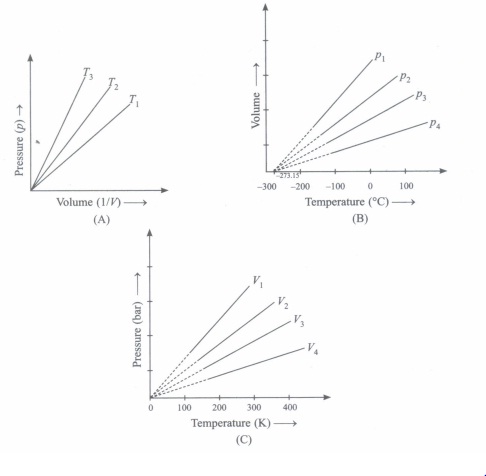
(a) Which law is depicted by graph A?
(b) Give relationship between T1,T2 and T3 .
(c) Which law is depicted by graph B?
(d) Give mathematical formula of Charle's law
(e) Why are straight lines in graph C called isochore?
(f) What is relationship between V1, V2, V3 and V4 ?
(g) What is mathematical formula for Gay Lussac's law.
3.
Table shows critical temperatures of some substances. Study the table and answer the questions that follow:
Critical Constants for Some Substances
| Substance | Tc/K | pc/bar | Vc /dm3mol -1 |
| H2 | 33.2 | 12.97 | 0.0650 |
| He | 5.3 | 2.29 | 0.0577 |
| N2 | 126.0 | 33.9 | 0.0900 |
| O2 | 154.3 | 50.4 | 0.0744 |
| CO2 | 304.10 | 73.9 | 0.0956 |
| H2O | 647.7 | 220.6 | 0.0450 |
| NH3 | 405.5 | 113.0 | 0.0723 |
(a) Why is Helium most difficult to liquefy?
(b) Out of CO2 and NH3 which will liquefy first?
(c) Critical temperature of CH4 and CO2 are -81.9°C and 31.1°C respectively. Which of these have stronger intermolecular forces of attraction?
(d) What is critical temperature?
(e) What is critical volume? How is it related to 'b' van der Waals' constant?
4.
The pressure exerted by vapours over the liquid is called vapour pressure of liquid in a closed container. When liquid and vapour phase are in equilibrium, the vapour pressure of this stage is known as equilibrium vapour pressure or saturated vapour pressure. Vapour pressure depends upon temperature. Boiling point is temperature at which vapour pressure of liquid becomes equal to atmospheric pressure.
(a) Why does water boil below 100°C at hill stations?
(b) Why does vapour pressure of sea water is lower than distilled water?
(c) Two liqurds 'X' and 'V' boil at 110°Cand 130°C respectively. Which of them has higher vapour pressure at 50°C?
(d) What is boiling point of water inside the pressure cooker?
(e) How is vapour pressure related to temperature?
1.
(a) Low pressure and high temperature
(b) Ion-dipole attraction.
(c) Velocities are inversely proportional to square root of molar mass.
(d) \(Z=\frac{V_{\text {real }}}{V_{\text {ideal }}}=0.8\)
(e) HF molecules are associated with intermolecular H-bonding
(f) Pdrygas = P moist gas - Aqueous tension (Vapour pressure of water vapours).
(g) It is temperature at which most of gases show ideal gas behaviour over wide range of pressure.
2.
(a) Boyle's law.
(b) T3 > T2> T1.
(c) Charle's law.
(d) \(\frac{V_{1}}{T_{1}}=\frac{V_{2}}{T_{2}}\)
(e) It is because these are plotted at constant volume.
(f) V1 < V2 < V3 < V4 .
(g) \(\frac{P_{1}}{T_{1}}=\frac{P_{2}}{T_{2}}\)
3.
(a) It has weak van der Waals' forces of attraction and low critical temperature.
(b) Ammonia will liquify first because its critical temperature will be reached first. Liquefaction of CO2 will require more cooling.
(c) CO2 has stronger forces of attraction due to more polarity than CH4.
(d) The temperature above which a gas can not be liquefied.
(e) It is volume occupied by 1 mole of gas at Tc and Pc (Critical pressure).
Vc = 3b.
4.
(a) It is because atmospheric pressure is low, therefore, at lower temperature vapour pressure of liquid becomes equal to atmospheric pressure.
(b) It is because non-volatile solutes are present in sea water due to which surface molecules have both solute and solvent molecules, escaping tendency of solvent molecules into vapours decreases, hence vapour pressure decreases.
(c) 'X' will have higher vapour pressure because it has lower boiling points.
(d) It is more than 100°Cbecause steam exerts pressure and raises boiling point of water.
(e) It is directly proportional to temperature.

11th Standard CBSE Syllabus & Materials
11th Standard CBSE
CBSE 11th Business Studies Forms of Business Organisation Sample Question Papers Study Material - QB365 Set A
NEW11th Standard CBSE
CBSE 11th Business Studies Business, Trade and Commerce Sample Question Papers Study Material - QB365 Set A
NEW11th Standard CBSE
CBSE 11th Physics Waves Sample Question Papers Study Material - QB365 Set A
NEW11th Standard CBSE
CBSE 11th Physics Kinetic Theory Sample Question Papers Study Material - QB365 Set A



CBSE 11th Standard CBSE Subjects
CBSE Standards









