
 100% FREE ACCESS
11th Standard CBSE Syllabus & Materials
11th Standard CBSE
CBSE 11th Economics PART-A - Presentation of Data - New Sample Question Papers Study Material - QB365 Set A
NEW11th Standard CBSE
CBSE 11th Economics PART-A - Organisation of Data - New Sample Question Papers Study Material - QB365 Set A
NEW11th Standard CBSE
CBSE 11th Economics PART-A - Collection of Data - New Sample Question Papers Study Material - QB365 Set A
NEW11th Standard CBSE
CBSE 11th Economics PART-A - Introduction to Economics and Statistics - New Sample Question Papers Study Material - QB365 Set A
NEW11th Standard CBSE
CBSE 11th Business Studies International Trade Sample Question Papers Study Material - QB365 Set A
NEW11th Standard CBSE
CBSE 11th Business Studies Evolution and Fundamentals of Business Sample Question Papers Study Material - QB365 Set A

Published on: 09/09/2022
QB365 provides a detailed and simple solution for every Possible Case Study Questions in Class 11 Chemistry Subject - Structure of Atom, CBSE. It will help Students to get more practice questions, Students can Practice these question papers in addition to score best marks.
Download CBSE Class 11th Standard CBSE Chemistry question papers, sample papers, important questions, and previous year solved papers in PDF format. Get free study materials, NCERT solutions, and exam preparation resources for Class 11th Standard CBSE Chemistry
Questions + Answers key
Take MCQ Chemistry Test
1.
Bohr's model explained electrons can revolve only in certain permitted orbits whose angular momentum is integral multiple of h/2\(\pi\), associated with fixed amount of energy. Bohr theory could successfully explain stability of atoms and spectrum of unielectron species. Hydrogen spectrum consist of Lyman, Balmer, Paschen, Brackett and Pfund series. Bohr's theory could not explain spectrum of multi-electron species, Stark effect, Zeeman effect, dual nature of matter, de Broglie equation and Heisenberg uncertainty principle which lead to orbital concept. Electrons were filled in orbitals according to Autbau's principle, Hund's Rule and Pauli's exclusion principle. Each electron is identified by four quantum numbers n, I, ml and ms out which n, I, ml were derived from Schrodinger's wave equation. Half filled and completely filled orbitals are more stable due to exchange energy and symmetrical distribution of electrons.
(a) Heat treatment of muscular pain involves radiation of wavelength 900 nm which spectral line of H-atom is suitable for this purpose.
(b) Arrange 4d, 3d, 4p and 3p in increasing order of energy.
(c) What is name of spectrum of radiation emitted by substance that has absorbed radiation?
(d) What rules out the probability of existence of definite path of electrons?
(e) State de Broglie equation.
(f) The angular momentum of d-orbital is equal to?
(g) State Pauli exclusion principle.
2.
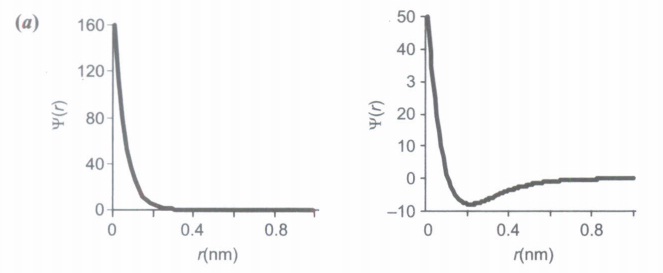
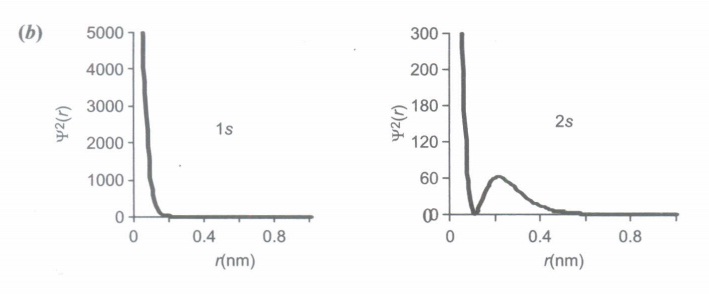
The plots of (a) orbital wave function \(\Psi\)(r) and (b) the variation of probability density\(\Psi\) 2(r) as function of distance'r' of the electron from the nucleus for Is and 2s orbitals are shown in the figure. Answer the questions as follows based on graph and related studied concepts.
(a) What is meant by\(\Psi\)?
(b) What is meant by \(\Psi\)2?
(c) What happens to probability density in Is orbital?
(d) What happens to \(\Psi\) 2 in '2s' orbital?
(e) What are nodes?
(f) How many nodes are 1s, 2s, 3s orbitals?
(g) What are angular nodes?
(h) How many radial and angular nodes are there in 3d orbital?
3.
Orbitals are region or space wher.e there is maximum probability of finding electrons. Qualitatively, these orbitals can be distinguished by their size, shape and orientation. An orbital of small size means there is more chance of finding the electron near the nucleus. Shape and orientation means the direction in which probability of finding electron is maximum. Atomic orbitals can be distinguished by quantum numbers. Each orbital is designated by three quantum numbers n, I and m1 (magnetic quantum number) which define energy, shape and orientation but these are not sufficient to explain spectra of multi-electrons atoms. Spin quantum number (ms ) determines the spin of electron. Spin angular momentum of electron has two orientations relative to chosen axis which are distinguished by spin quantum numbers ms which can take values +1/2 and -1/2.
| Value of 'l' | 0 | 1 | 2 | 3 | 4 |
| Notation for subshell | s | p | d | f | g |
(a) How many orbitals are associated with n = 3?
(b) Describe the orbitals represented by (i) n = 2, l = 1 (ii) n = 4, l = 0.
(c) How many electron are possible in an orbital? Why?
(d) What is shape of 's' and 'p' orbitals?
(e) Name two d-orbitals which are on axis.
1.
(a) \(\bar{v}=\frac{1}{\lambda}=R_{H}\left(\frac{1}{n_{1}^{2}}-\frac{1}{\infty}\right)\)
\(\Rightarrow \ 1 \times 10^{5} \times \frac{1}{x^{2}}=\frac{1 \times 10^{5}}{9}\)
\(\Rightarrow\) x2 = 9
\(\Rightarrow\) x = 3
Paschen series, \(\infty\) to 3rd energy level has wavelength of 900nm.
(b) 3p < 3d < 4p < 4d.
(c) Emission spectrum
(d) Heisenberg's uncertainty principle.
(e) \(\lambda=\frac{h}{m C}\) the wavelength of matter waves is inversely proportional to momentum.
(f) \(m v r=\sqrt{l(l+1)} \frac{h}{2 \pi}\)
\(=\sqrt{2 \times 3} \frac{h}{2 \pi}=\sqrt{6} \frac{h}{2 \pi}\)
(g) No two electrons in an atom can have all the four quantum numbers same. They will differ at least in spin quantum number.
2.
(a) It is mathematical function of the coordinates of the electron. It can be +ve as well as -ve. It is orbital wave function.
(b) It gives probability density of electron at that point. It is always +ve.
(c) It is maximum near the nucleus and decreases sharply as we move away from it.
(d) It first decreases sharply to zero and again starts increasing, then decrease.
(e) The regions where \(\Psi\)2 = 0 are called nodes.
(f) 1 s has orbitals does not have any node. 2s orbital has 1 node whereas 3s orbital has 2 nodes.
(g) The plane along with,\(\Psi\)2 = 0 is called nodal plane. These are called angular nodes.
(h) For 3d orbital, angular nodes = 'l' = 2. Radial nodes = n - l - l
= 3 - 2 - 1
= 0
3.
(a) Number of orbitals = n 2 = 3 2 = 9 orbitals, 3s, 3 px, 3 py , 3 pz, 3 d x2 - y2, 3 dz2, 3 dxy, 3 dyz and 3 dzx.
(b) (i) 2p (ii) 4s
(c) Orbital can have maximum two electron which must be of opposite spin.
(d) 's' orbitals are spherical and 'p' orbitals have dumb-bell shaped.
(e) d x2 - y2 , dz2.

11th Standard CBSE Syllabus & Materials
11th Standard CBSE
CBSE 11th Business Studies Forms of Business Organisation Sample Question Papers Study Material - QB365 Set A
NEW11th Standard CBSE
CBSE 11th Business Studies Business, Trade and Commerce Sample Question Papers Study Material - QB365 Set A
NEW11th Standard CBSE
CBSE 11th Physics Waves Sample Question Papers Study Material - QB365 Set A
NEW11th Standard CBSE
CBSE 11th Physics Kinetic Theory Sample Question Papers Study Material - QB365 Set A



CBSE 11th Standard CBSE Subjects
CBSE Standards









