
 100% FREE ACCESS
11th Standard CBSE Syllabus & Materials
11th Standard CBSE
CBSE 11th Economics PART-A - Presentation of Data - New Sample Question Papers Study Material - QB365 Set A
NEW11th Standard CBSE
CBSE 11th Economics PART-A - Organisation of Data - New Sample Question Papers Study Material - QB365 Set A
NEW11th Standard CBSE
CBSE 11th Economics PART-A - Collection of Data - New Sample Question Papers Study Material - QB365 Set A
NEW11th Standard CBSE
CBSE 11th Economics PART-A - Introduction to Economics and Statistics - New Sample Question Papers Study Material - QB365 Set A
NEW11th Standard CBSE
CBSE 11th Business Studies International Trade Sample Question Papers Study Material - QB365 Set A
NEW11th Standard CBSE
CBSE 11th Business Studies Evolution and Fundamentals of Business Sample Question Papers Study Material - QB365 Set A

Published on: 09/09/2022
QB365 provides a detailed and simple solution for every Possible Case Study Questions in Class 11 Physics Subject - System of Particles and Rotational Motion, CBSE. It will help Students to get more practice questions, Students can Practice these question papers in addition to score best marks.
Download CBSE Class 11th Standard CBSE Physics question papers, sample papers, important questions, and previous year solved papers in PDF format. Get free study materials, NCERT solutions, and exam preparation resources for Class 11th Standard CBSE Physics
Questions + Answers key
Take MCQ Physics Test
1.
Angular momentum of a rotating body is measure of quantity of motion in rotational motion about an axis which is measured by product of moment of inertia and angular velocity i.e., L = \(I \omega\) . It is moment of linear momentum about axis of rotation. Being a vector quantity its direction is along the axis of rotation. In the absencse of an external torque, angular momentum vector remains constant.
(i) If angular momentum is conserved in a system whose moment of inertia is decreased, will its rotational kinetic energy be also conserved? Explain.
(ii) Why spin angular velocity of a star is greatly enhanced when it collapses under gravitational pull and becomes a neutron star?
(iii) A Person sits near the edge of a circular platform revolving with a uniform angular speed. What will be the change in the motion of the platform?
(iv) What would happen if the person starts moving from the edge toward the centre of the platform?
(v) Why are there two propellers in a helicopter?
(vi) A thin uniform circular disc of mass M and Radius R is rotating in a horizontal plane about an axis passing through its centre and perpendicular to its plane with an angular velocity \(\omega \text { . }\) Another disc of same dimensions but of mass \(\frac{\boldsymbol{M}}{\mathbf{4}}\) is placed gentally 4 on the first disc coaxially show that angular velocity of the system is \(\frac{4}{5} \omega.\)
2.
A hollow sphere of mass M and Radius R is initially at rest on a horizontal rough surface. It moves under the action of constant horizontal force F as shown in Fig.
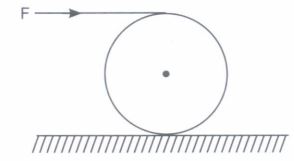
(i) Determine the direction of frictional force between the sphere and the surface.
(ii) Determine the linear acceleration of the sphere.
(iii) What is the frictional force between the sphere and the surface?
(iv) State the relationship between angular momentum and torque of rotating body about an axis.
(v) Solid cylinder of mass m and radius r rolling down an inclined plane of \(\theta\) inclination e without slipping. Determine the acceleration of the cylinder down the inclined plane.
3.
Moment of inertia of a body about a given axis is the rotational inertia of the body about that axis. It is represented by 1= MK2, where M is mass of body and K is radius of gy ration of the body about that axis. it is a scalar quantity, which is measured in kg m2.
When a body rotates about a given axis and the axis of rotation also moves, then total K.E of body = K.E of translation + kinetic energy of rotation.
\(K=\frac{1}{2} m v^{2}+\frac{1}{2} I \omega^{2}\)
(i) Is the M.I of a body about a given axis is vector or scalar quantity?
(ii) On what factors does M.I of a body depend?
(iii) Determine the moment of inertia of circular disc and circular ring of same mass and radius about an axis perpendicular to plane.
(iv) A 40 kg flywheel in the form of a uniform circular disc of diameter 1 m is making 120 rpm. What is the M.I about a transverse axis through its centre?
(v) Determine kinetic of rotation of the flywheel in the above case.
(vi) Calculate radius of gyration of a cylindrical rod of mass m and length L about an axis of rotation perpendicular to its length and passing through its centre,
(vii) Determine the ratio of the radii of gyration of a circular disc about a tangential axis in the plane of the disc and of a circular ring of the same radius about a tangential axis in the plane of the ring.
4.
The centre of mass of a body is a point at which the entire mass of the body is supposed to be concentrated. The \(\vec{r}\) of c.m of the system of two particles of masses m1 and m2 with position vector \(\vec{r}_{1} \text { and } \vec{r}_{2}\) is given by
\(\vec{r}=\frac{m_{1} \vec{r}_{1}+m_{2} \vec{r}_{2}}{m_{1}+m_{2}}\)
for an isolated system, where no external force is acting \(\overrightarrow{v_{c m}}\) = constant
Under no circumstance, the velocity of centre of mass of an isolated system can undergo a change.
(i) What should be the position of the centre of mass of a system of two particles of unequal masses?
(ii) An electron and a proton move towards each other with velocities v1 and v2 respectively. What is the velocity of their centre of mass?
(iii) Two bodies of masses 1kg and 2 kg are located at (1, 2) and (-1, 3) respesctively, determine the coordinates of the centre of mass.
(iv) A bomb dropped from an aeroplane in level flight explodes in the middle. How would be the motion of centre of mass of the fragments?
(v) Two blocks of masses 5 kg and 2 kg are placed on a frictionless surface and connected by a spring. An external kick gives a velocity of 14 ms-1 to the heavier block in the direction of the lighter one. Determine the velocity gained by the centre of mass.
(vi) Can centre of mass of a body lie where there is absolutely no mass? Give example.
(vii) Can centre of mass of a body coincide with the geometrical centre of the body?
1.
(i) Here \(L=I \omega\) = constant, K.E = \(\frac{1}{2} I \omega^{2}\)
K. E = \(\frac{L^{2}}{2 I} \Rightarrow \mathrm{K} . \mathrm{E} \alpha \frac{1}{I}\)
therefore when M.l decreases, K.E of rotation (K.E) increases and not remain conserved.
(ii) On collapsing under gravitational pull, the size of star decreases.
(iii) Therefore, its moment of inertia decreases. As angular momentum \((L=I \omega)\) is conserved and 1 decreases, therefore, spin angular velocity co increases.
(iii) Since \(L=I \omega\) = Constant, since moment of inertia 1 increases, therefore, will decrease.
(iv) As the person starts moving from the edge towards the centre of platform, therefore. M.I goes on decreasing. Hence co goes on increasing.
(v) If the helicopter had only one propeller, then due to conservation of angular momentum, the helicopter itself would turn in opposite direction. Thus two propellers provide helicopter a steady movement.
(vi) Initial angular momentum of one disc L = \(I \omega=\frac{1}{2} M R^{2} \omega\) angular momentum remain conserved \(\mathrm{I} \omega=\mathrm{I}^{\prime} \omega^{\prime}\). Since no external torque act.
\(I^{\prime}=\frac{1}{2} M R^{2}+\frac{1}{2}\left(\frac{M}{4}\right) R^{2}=\frac{5}{8} M R^{2}\)
Therefore, \(\omega^{\prime}=\frac{I \omega}{I^{\prime}}=\frac{\frac{1}{2} M R^{2} \omega}{\frac{5}{8} M R^{2}}=\frac{4}{5} \omega\).
2.
(i) Frictional forces opposes the translational motion of the sphere and it acts in the direction of force F motion as shown. These two forces form torque to rotate the sphere faster.
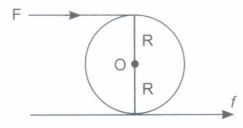
(ii) For translational motion F + f= Ma ...(i)
Net torque FR - fR = \(I \alpha=\frac{I a}{R}\)
For hollow sphere \(I=\frac{2}{3} M R^{2}\)
\(\Rightarrow \quad F-f=\frac{2}{3} M a\) ...(ii)
from equation (i) and (ii)
\(a=\frac{6 \mathrm{~F}}{5 \mathrm{M}}\)
(iii) F+ f= Ma
F -f = \(\frac{2}{3} M a\)
therefore \(f=\frac{M a}{6}=\frac{F}{5}\)
(iv) Torque is proportional to rate of change of angular momentum about axis of rotation. \(\bar{\tau}=\frac{d \overline{\mathrm{L}}}{d t}\)
(v)
.JPG)
f = ma = mg sin \(\theta\) - F
\(\tau=I \alpha=\frac{1 a}{r}=F \times r\)
\(\Rightarrow \quad F=\frac{I a}{r^{2}} \Rightarrow m a=m g \sin \theta-\frac{I a}{r^{2}}\)
\(a=\frac{m g \sin \theta}{m+\frac{\mathrm{I}}{r^{2}}}\)
Since M.I. of solid cylinder I \(=\frac{1}{2} m r^{2}\)
\(a=\frac{2}{3} g \sin \theta\)
3.
(i) Moment of inertia of a body about a given axis is a scalar quantity.
(ii) Moment of inertia of a body depends on
(i) Mass of the body
(ii) Size and shape of the body
(iii) axis of rotation of the body.
(iii) \(I_{d i s c}=\frac{1}{2} M R^{2}, I_{r i n g}=M R^{2}\)
(iv) \(\mathrm{I}=\frac{1}{2} M R^{2}=\frac{1}{2} \times 40\left(\frac{1}{2}\right)^{2}=5 \mathrm{~kg} \mathrm{~m}^{2}\)
(v) K.E of rotation = \(\frac{1}{2} I \omega^{2}=\frac{1}{2} I(2 \pi n)^{2}\)
\(\frac{1}{2} \times 5\left(2 \pi \times \frac{120}{60}\right)^{2}=394.8 \mathrm{~J}\)
(vi) \(I=\frac{M L^{2}}{2}=M K^{2} \text { or } K=\frac{L}{2 \sqrt{3}}\)
(vii) \(I_{1}=M K_{1}^{2}=\frac{5}{4} M R^{2} \Rightarrow K_{1}=\sqrt{\frac{5}{4}} R\)
M.I of circular ring of same radius about a tangential axis in the plane of the ring.
\(I_{1}=M K_{2}^{2}=\frac{3}{2} M R^{2}\)
\(K_{2}=\sqrt{\frac{3}{2} R}\)
\(\therefore \quad \frac{K_{1}}{K_{2}}=\sqrt{\frac{5}{4} \times \frac{2}{3}}=\sqrt{\frac{5}{6}}\)
4.
(i) The centre of mass of a system of two particles of .. unequal masses is closer to heavier particles.
Since m1r1 + m2 r2 = 0, when c.m is at origin
\(\therefore \quad r_{2}=\frac{-m_{1} r_{1}}{m_{2}} \text { if } m_{2}>m_{1} \text { then } r_{2}<r_{1}\)
(ii) As the force of attraction is mutual, the system is inertial i.e., system without external force, therefore, vcm = 0.
(iii) Here m1 = 1 kg, m2 = 2kg, x1 = 1,Y1 =2, x2 =-1,Y2 = 3 coordinates of the centre of mass are
\(x=\frac{m_{1} x_{1}+m_{2} x_{2}}{m_{1}+m_{2}}=-\frac{1}{3}\)
\(y=\frac{m_{1} y_{1}+m_{2} y_{2}}{m_{1}+m_{2}}=\frac{8}{3}\)
(iv) As the explosion is due to internal forces only, the centre of mass of fragments continues to follow the same parabolic path which it would have followed if there was not explosion.
(v) Here m1 = 5kg, m2 = 2 kg
v1 = 14 ms-1, v2 = 0, vcm = ?
\(v_{c m}=\frac{m_{1} v_{1}+m_{2} v_{2}}{m_{1}+m_{2}}\)
= \(\frac{5 \times 14+2 \times 0}{5+2}=\frac{70}{7}=10 \mathrm{~ms}^{-1}\)
(vi) Yes, for example, the centre of mass of a uniform circular ring lies at the centre of the ring where there IS no mass.
(vii) Yes, when a body has uniform mass density, its centre of mass shall coincide with its geometrical centre.

11th Standard CBSE Syllabus & Materials
11th Standard CBSE
CBSE 11th Business Studies Forms of Business Organisation Sample Question Papers Study Material - QB365 Set A
NEW11th Standard CBSE
CBSE 11th Business Studies Business, Trade and Commerce Sample Question Papers Study Material - QB365 Set A
NEW11th Standard CBSE
CBSE 11th Physics Waves Sample Question Papers Study Material - QB365 Set A
NEW11th Standard CBSE
CBSE 11th Physics Kinetic Theory Sample Question Papers Study Material - QB365 Set A



CBSE 11th Standard CBSE Subjects
CBSE Standards









