
 100% FREE ACCESS
7th Standard CBSE Syllabus & Materials
7th Standard CBSE
CBSE 7th Social Science Theme E - Understanding Market - New Sample Question Papers Study Material - QB365 Set A
NEW7th Standard CBSE
CBSE 7th Social Science Theme E - From Barter to Money - New Sample Question Papers Study Material - QB365 Set A
NEW7th Standard CBSE
CBSE 7th Social Science Theme D - The Constitution of India- An Introduction - New Sample Question Papers Study Material - QB365 Set A
NEW7th Standard CBSE
CBSE 7th Social Science Theme D - From the Rulers to the Ruled : Types of Governments - New Sample Question Papers Study Material - QB365 Set A
NEW7th Standard CBSE
CBSE 7th Social Science Theme B - The Age of Reorganisation - New Sample Question Papers Study Material - QB365 Set A
NEW7th Standard CBSE
CBSE 7th Social Science Theme B - The Rise of Empires - New Sample Question Papers Study Material - QB365 Set A

Published on: 31/12/2018
Class 7 Model Question
Download CBSE Class 7th Standard CBSE Social Science question papers, sample papers, important questions, and previous year solved papers in PDF format. Get free study materials, NCERT solutions, and exam preparation resources for Class 7th Standard CBSE Social Science
Questions + Answers key
Take MCQ Social Science Test
1.
What do you mean by 'terrace farming'?
2.
There is no air pressure on the Moon. Why?
3.
Define health.
4.
Why did the Dutch and English East India Companies attempt to control Masulipatnam?
5.
When did the merchants and the migrants brought the teachings of Quran in India?
6.
There are thousands of weekly markets in India.
7.
Murshidabad on the banks of Ravi became capital of Bengal in 1704.
8.
Our Earth is like an aquarium.
9.
OPD stands for Old Patient Department.
10.
Migrants brought with them the Holy Quran.
11.
At times media is prevented from publishing a story, this is called___________.
12.
Men and women do not have the same______
13.
The atmosphere consists of __________% nitrogen and _________ % oxygen.
14.
____________ was the ruler of the Mongol tribes; China and Central Asia.
15.
The wealth Mahmud carried away was used to create a splendid capital city at ________________.
16.
Give an account of the different layers of the atmosphere.
17.
'The poor depend on rich and powerful for loans. Because of this dependence, the poor are exploited.' Explain how.
18.
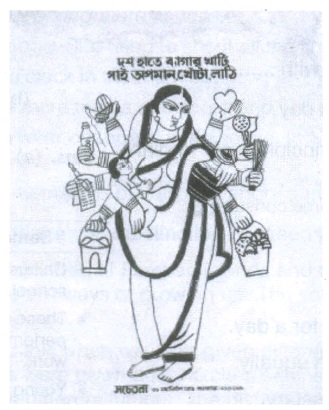
Write an interesting slogan for the poster given below.
19.
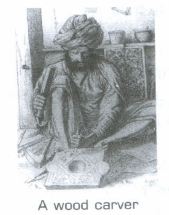
Observe the picture and answer the following questions. What does the picture show?
20.
Discuss the main reasons which are responsible for continuance of discrimination.
21.
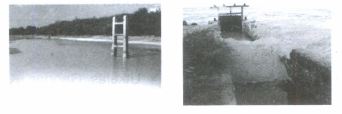
Interpret and compare the two above figures and answer the question When was fig. I made?
22.
Look at the photograph and think about the boy who is being carried down the stairs. Do you think the above law is being implemented in his case? What needs to be done to make the building more accessible for him? How would his being carried down the stairs affect his dignity as well as his safety.
23.
In what ways do you think the policies of Rajendra I and Mahmud of Ghazni were a product of their time? How were the actions taken by the two rulers different?
24.
What are the demands foreign buyers make on the garment exporters? Why do the garment exporters agree to these demands?
25.
Why do you think ordinary people preserved the memory of Mirabai?
26.
Differentiate between tropical grasslands and temperate grasslands.
27.
What is happening in Patalpuram?
28.
Describe about the 'Token currency' of Tughluq.
29.
Tehri dam is across river:
Narmada
Ganga
Subernlekha
Yamuna
30.
One-horned rhinoceros is found in :
Brahmaputra plain
Amazon basin
Ghaghra plain
None of these
31.
What do we buy from a doctor or an accountant?
Milk
Vegetables
Services
None of these
32.
Ahom society was divided into clans or :
Paiks
Garhs
Khels
Tanda
33.
An important variety of temperate evergreen forest:
Rosewood
Teak
Pine
Neem
34.
Cartographer is the person who draws
Paintings
Pictures
Sketches
Maps
35.
What is the name for an early television?
Teleview
TV
Televisor
Telecom
36.
The Ladakh desert is mainly inhabited by
Christians and Muslims
Buddhists and Muslims
Christians and Buddhists
37.
These wind blow constantly throughout the year in particular direction.
permanent winds
local winds
seasonal winds
both (a) and (b)
38.
Akbar's religious discussions took place in the
Royal Palace
Mosque
Ibadat Khana
House of the Ulama
39.
On an outline map of the Indian sub-continent, draw the rivers Ganga and Brahmaputra from the source to the mouth. Also show the important tributaries of both rivers.
40.
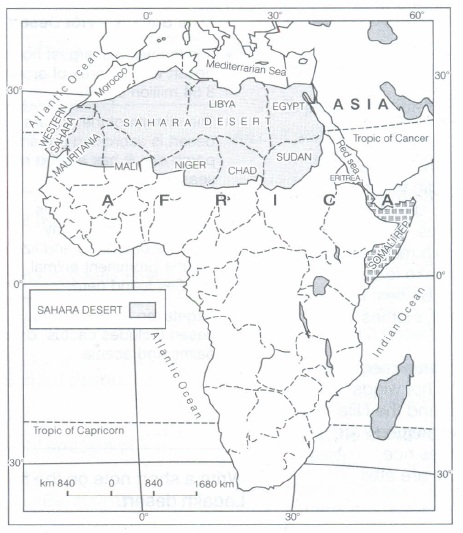
On the outline map of Africa, mark the Sahara desert and any four countries around it.
41.
The rainforests are depleting
42.
Sedimentary rocks are formed from sediments.
43.
Did you notice that the names by which languages are known have changed with time?
44.
Why are the latest technologies costly?
45.
Write a detailed note on the life of the Banjaras as described by the English trader Peter Mundy.
1.
()
Terraces are built on steep slopes to create flat surfaces on which crops are grown. This is called terrace farming
2.
()
There is no air on the Moon and hence, no air pressure on the Moon.
3.
()
Health can be defined as our capacity to remain free of illness and injuries.
4.
()
Both the Dutch and English East India Companies attempted to control Masulipatnam as it became the most important port on the Andhra coast.
5.
()
In the 7th century, the merchants and migrants brought the teachings of Quran in India
6.
(a)
7.
(b)
8.
(b)
9.
(b)
10.
(a)
11.
()
censorship.
12.
()
status
13.
()
78,21
14.
()
Genghis Khan
15.
()
Ghazni
16.
Our atmosphere has five different layers. They are:
(i) Troposphere,
(ii) Stratosphere,
(iii) Mesosphere,
(iv) Thermosphere,
(v) Exosphere.
(i) Troposphere : It is most important layer of the atmosphere with average height of 13 km from the earth. The air that we breathe exists here. Almost all the weather phenomena such as rainfall, fog and hailstorm occur here.
(ii) Stratosphere : This layer extends up to a height of 50 km. It presents the most ideal conditions for flying aeroplanes. It contains a layer of ozone gas which protects us from harmful effects of the sun rays.
(iii) Mesosphere : This layer extends up to a height of 80 km. Meteorites burn up in this layer on entering from the space.
(iv) Thermosphere: In this layer temperature rises very rapidly with increasing height. Ionosphere is the part of this layer. This layer extends between 80- 400km. It helps in radio transmission. Radio waves transmitted from the earth are reflected back to the earth by this layer.
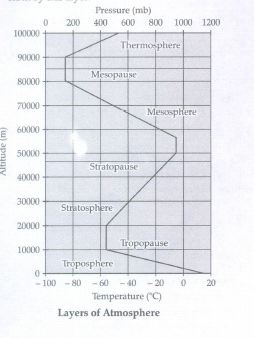
(v) Exosphere: It is the uppermost layer where there is very thin air. Light gases such as helium and hydrogen float into the space from here.
17.
It is the market which provides opportunities for work and to serf things. But mostty It rs me rich and powerful who receive the maximum benefit from the market. Rich and powerful includes people having money, land holdings, shops, etc. The poor are dependent on these people for
(i) Loans (ii) Raw materials (iii) Marketing of goods (iv) Employment
It is this dependency which exploits them. Measures should be taken to reduce such exploitation. For example, cooperatives should be formed and it should be ensured that law are strictly followed.
18.
Slogan for the poster is - The Power of Women
19.
The picture shows the woodcarver carving wood for making furniture. Wood carving flourished in the Medieval period. The contribution of Cholas and Vijayanagara empire in the field of wood carving was simply unparalleled.
20.
One of the significant reasons for continuance of discrimination is that attitudes change very slowly. Even though persons are aware that discrimination is against the law, they continue to treat people unequally on the basis of their caste, religion, disability, economic status and sex.
It is only when people begin to believe that no one is inferior and that every person deserves to be treated with dignity that attitude will change. Establishing equality in a democratic society is a continuous struggle and it is required for individuals and various communities to come together to remove inequality.
21.
Fig. I was made during the 9th century.
22.
In this case, the above law is not implemented. To make the building accessible for him, it should have a plain surface so that he can move in or out easily and on his own. Being carried down the stairs shows his dependence which affects his dignity and also his safety because there is a chance of getting hurt if he slips down.
23.
King Rajendra I looted the temples of the defeated rulers and seized prized statues from them. He used these statues in the decoration of the Shiva temple, that he built in his capital in the early 11th century.
Whereas Sultan Mahmud of Ghazni was a contemporary of Rajendra I. He destroyed and looted the wealth and the idols of the temples of defeated kings in order to win credit as a great hero of Islam. Thus, king Rajendra, I constructed temples while Mahmud of Ghazni destroyed them. He took all the riches to his place outside the Indian subcontinent.
24.
The demands offoreign buyers are
Lowest prices for the garments.
High standards for quality of production.
Timely delivery with no defects.
The exporters agree to these demands because selling products to these powerful buyers will help them in earning profits.
25.
Ordinary people preserved the memory of Mirabai because
1.Though she was a Rajput princess married into the royal family of Mewar. But she had no interest of worldly affairs. Mirabai was devoted to Krishna and composed innumerable bhajans expressing her intense devotion.
2. Her devotion to her deity was supreme. She lived a simple life with ordinary people.
3. Her songs also openly challenged the norms of the 'upper' caste and became popular with the masses in Rajasthan and Gujarat.
26.
The differences between tropical grasslands and temperate grasslands are
| Tropical grasslands | Temperate grasslands |
|---|---|
| 1. These grasslands occur on either side of the equator and extend till the tropics. | These are found in the mid-latitudinal zones and in the interior part of the continents. |
| 2. Elephants, zebras, giraffes deer, leopards are common in tropical grasslands. | Wild buffaloes, bisons, antilopes are common in the temperate region. |
27.
Patalpurarn is experiencing the problem of shortage of water which has resulted in outbreak of diarrhoea in the city.
28.
Tughluq did not control prices of goods. Rather, he used a token currency, made out of cheap metals and not of gold and silver. The token currency was somewhat like present-day paper currency. People of the 14th century did not believe in these coins. They saved their gold and silver coins and paid all their taxes to the state with this token currency. This cheap currency could be counterfeited easily.
29.
(a)
Narmada
30.
(a)
Brahmaputra plain
31.
(c)
Services
32.
(c)
Khels
33.
(c)
Pine
34.
(d)
Maps
35.
(c)
Televisor
36.
(b)
Buddhists and Muslims
37.
(a)
permanent winds
38.
(c)
Ibadat Khana
39.
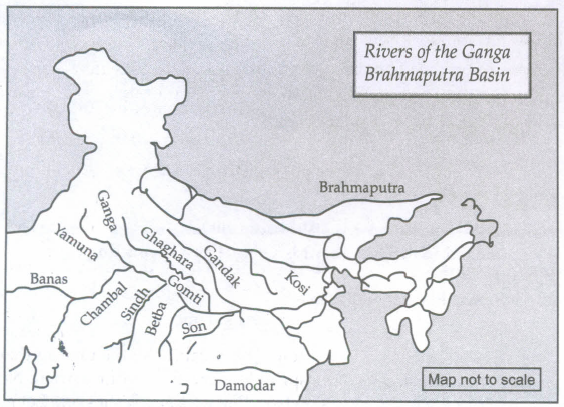
40.
The answer map isgiven below
41.
The rainforests are depleting because of the developmental activities that are going on at fast speed. The biologically diverse rainforests are being destroyed day by day. It is estimated that a large area of rainforests has been disappearing annually in the Amazon basin. As a result, the top soil is washed away when the rain falls and the lush green forest turns into a barren landscape.
42.
Sedimentary rocks are formed by transported and deposited small fragmented rocks by wind, water, ere and these loose sediments are compressed and hardened to form layers of rocks. e.g. sandstone is made from grains of sand
43.
The names of languages which changed over time are as follows
Lahori : Punjabi
Telangani : Telugu
Gujari : Gujarati
Mabari : Tamil
Gauri : Bengali
Hindawi : Hindi
44.
(i) There are different technologies that media use today and these are costly. T.V. studio with cameras, sound recorders, lights, transmission and satellites cost a lot of money.
(ii) News studio or serial production require the services of large number of people like readers, cameraman, actors, production units, etc and their salaries add to the expenses.
(iii) Electronic media also involves money.
(iv) Print media needs offices, machines, people to work on them, people Work related like reporting, getting advertisements, marketing or selling, all this again cost a lot of money.
(v)Moreover, the technology keeps on changing, and the media has to keep pace with that which itself is costly.
45.
The Life of Banjaras :
Peter Mundy, an English trader who came to India during the early seventeenth century, has described the Banjaras.
(i) In the morning we met a tanda of Banjaras with 14,000 oxen.
(ii) They were all laden with grains such as wheat and rice.
(iii) These Banjaras carry their hold, wives and children, along with them.
One tanda consists of many families Their way of life is similar to that of carriers who continuously travel from place to place. They own their oxen. They are sometimes hired by merchants, but most commonly they are themselves merrhants. They buy grain where it is cheaply available and carry it to places where it is dearer. From there, they again reload their oxen with anything that can be profitably sold in other places.
(iv) In a tanda there may be as many as 6 or 7 hundred persons. They do not travel more than 6 or 7 miles a day that, too, in the cool weather. After unloading their oxen, they turn them free to graze as there is enough land here, and no one is there to forbid them.

7th Standard CBSE Syllabus & Materials
7th Standard CBSE
CBSE 7th Social Science Theme B - New Beginnings : Cities and States - New Sample Question Papers Study Material - QB365 Set A
NEW7th Standard CBSE
CBSE 7th Social Science Theme A - Climates of India - New Sample Question Papers Study Material - QB365 Set A
NEW7th Standard CBSE
CBSE 7th Social Science Theme A - Geographical Diversity of India - New Sample Question Papers Study Material - QB365 Set A
NEW7th Standard CBSE
CBSE 7th Science Earth, Moon and the Sun - New Sample Question Papers Study Material - QB365 Set A



CBSE 7th Standard CBSE Subjects
CBSE Standards




