
 100% FREE ACCESS
11th Standard CBSE Syllabus & Materials
11th Standard CBSE
CBSE 11th Economics PART-A - Presentation of Data - New Sample Question Papers Study Material - QB365 Set A
NEW11th Standard CBSE
CBSE 11th Economics PART-A - Organisation of Data - New Sample Question Papers Study Material - QB365 Set A
NEW11th Standard CBSE
CBSE 11th Economics PART-A - Collection of Data - New Sample Question Papers Study Material - QB365 Set A
NEW11th Standard CBSE
CBSE 11th Economics PART-A - Introduction to Economics and Statistics - New Sample Question Papers Study Material - QB365 Set A
NEW11th Standard CBSE
CBSE 11th Business Studies International Trade Sample Question Papers Study Material - QB365 Set A
NEW11th Standard CBSE
CBSE 11th Business Studies Evolution and Fundamentals of Business Sample Question Papers Study Material - QB365 Set A

Published on: 02/03/2019
Classification of Elements and Periodicity in Properties Important Questions
Download CBSE Class 11th Standard CBSE Chemistry question papers, sample papers, important questions, and previous year solved papers in PDF format. Get free study materials, NCERT solutions, and exam preparation resources for Class 11th Standard CBSE Chemistry
Questions + Answers key
Take MCQ Chemistry Test
1.
Define ionisation enthalpy
2.
What are representative elements?
3.
Give four examples of species which are isoelectronic with ca2+
4.
Write the general outer electronic configuration of s-, p-, d- and f- block elements.
5.
Using the Periodic Table, predict the formulas of compounds which might be formed by the following pairs of elements;
(a) silicon and bromine
(b) aluminium and sulphur.
6.
Arrange the following elements in the increasing order of non-metallic character. B, C, Si, N, F
7.
Predict the formulae of the stable binary compounds that would be formed by the combination of the following pairs of elements.
Aluminum and iodine
8.
Na+ has higher ionisation enthalpy than Ne.Explain, why?
9.
What are the various factors due to which the ionization enthalpy of the main group elements tends to decrease down a group?
10.
Among alkali metals which element do you expect to be least electronegative and why?
11.
Atomic radii of fluorine is 72 pm where as atomic radii of neon is 160 pm. Why?
12.
Out of Na and Mg, which has higher second ionisation energy?
13.
Use the Periodic table to answer the following questions.
Identify an element that would tend to lose two electrons.
14.
What would be the IUPAC name and symbol for the element with atomic number 120?
15.
Which properties of the elements depend on the electronic configuration of the atoms and which do not?
16.
What is the basic theme of organisation in the periodic table?
17.
Discuss the factors that influence the magnitude of ionization enthalpy. What are the general trends of variation of ionization enthalpy in the periodic table? Explain.
18.
Chemical reactivity of elements is highest at the two extremes of a period and is lowest in the center. Highly reactive elements do not occur in nature in free state, they usually occur in nature in free state, they usually occur in combined state. Some students are highly aggressive and keep on fighting with each other like highly reactive elements. Some students are sober and help each other and do not fight.
(i) Elements of which group are most reactive?
(ii) Which group elements are least reactive and why?
(iii) What are the harmful effects of being aggressive?
(iv) What values are possessed by sober people?
(v) Which kind of people pick up fight, while driving on the road in case of accidents? What are its consequences? What should we do?
19.
Reena wants to remain alone just like noble gases. She is generally not interested in talking to others and remain in her own world and remains sad. Ritu has many friends. She actively participates in all activities and remains happy. Noble gases are least reactive. Among noble gases, He, Ne and Ar do not form any compound. Compounds of Kr, Xe, and Rn have been discovered. Xe forms maximum number of compounds.
(i) Do you think remaining alone is a good idea? What are its advantages and disadvantages of remaining alone like Sonia?
(ii) What values are possessed by Ritu?
(iii) Why does Xe form maximum number of compounds?
20.
Justify the given statement with suitable examples "the properties of the elements are a periodic function of their atomic number".
21.
The sums of first and second ionization energies and those of third and fourth ionization energies, (in M J mol-1) of nickel and platinum are
| (IE)1 + (IE)2 | (IE)3 + (IE)4 | |
| Ni | 2.49 | 8.80 |
| Pt | 2.66 | 6.70 |
Based on this information, write
(i) the most common oxidation states of Ni and Pt.
(ii) name of metal (Ni or Pt) which can easily form compounds in its +4 oxidation state.
22.
Define electron gain enthalpy. What are its units?
23.
Elements A, B, C and D have atomic numbers 12, 19, 29, and 36 respectively. On the basis of electronic configuration, write to which group of the periodic table each element belongs.
24.
Consider the following species : N3–, O2–, F– , Na+, Mg2+ and Al3+
(a) What is common in them?
(b) Arrange them in the order of increasing ionic radii.
25.
Arrange the following as stated. 'Decreasing order of electropositive character of Cu, Fe Mg'
26.
The amount of energy released when 1\(\times \)1010 atoms of chlorine in vapor state are converted to Cl- ions according to the equation, Cl ( g ) + e- \(\longrightarrow\) Cl- ( g ) is 57.86 \(\times\)10-10 J
Calculate the electron gain enthalpy of the chlorine atom in terms of kJ mol-1 and eV per atom.
27.
Which one of the following is isoelectronic with Ne?
N3-
Mg2+
AI3+
all of the above
28.
Diagonal relationships are shown by _____.
Be and Al
Mg and Al
Li and Mg
Band P
29.
Among the following elements, which has the least electron affinity?
Phosphorous
Oxygen
Sulphur
Nitrogen
30.
The highest ionization energy is exhibited by _____.
halogens
alkaline earth metals
transition metals
noble gases
1.
It is the energy required to remove an electron from an isolated gaseous atom in its ground state.
M(g) + I.E. ⟶M+ (g) + e-
2.
The elements of group 1 (alkali metals), group 2 (alkaline earth metals) and group 13 to 17 constitute the representative elements. They are elements of s-block and p-block.
3.
Ar, K+, Cl- S2-, or P3- are isoelectronic with ca2+.
4.
(i) s-Block elements: ns1-2 where n = 2 - 7.
(ii) p-Block elements: ns2 np1-6 where n = 2 - 6.
(iii) d-Block elements: (n -1) d1-10nsO-2 where n = 4 - 7.
(iv) f-Block elements: (n - 2)f0-14 (n - 1) d0-1 ni where n = 6 - 7
5.
(a) Silicon is group 14 element with a valence of 4; bromine belongs to the halogen family with a valence of 1. Hence the formula of the compound formed would be SiBr4.
(b) Aluminium belongs to group 13 with a valence of 3; sulphur belongs to group 16 elements with a valence of 2. Hence, the formula of the compound formed would be Al2S3.
6.
The given nom-metals are arranged in the increasing order of non-metallic character as follow

7.
| Element | Group number | Electrons in valence shell | Valency | Formulae of binary compound |
| Group 13 | 3 | 3 | \({ AII }_{ 3 }\) | |
| Group 17 | 7 | 8 - 7 = 1 |
8.
Na+ and Ne are isoelectronic species. However, the nuclear charge in Na+ is more than in Ne. Hence, the electrons are more tightly held in Na+ and it has higher ionisation enthalpy.
9.
The ionisation enthalpy of the main group elements decreases regularly on moving down the group due to the following two factors.
(i) Atomic size On moving down the group,atomic size increases due to the addition of new higher energy shell.As a result of this, forces of attraction of nucleus for valence electrons decrease and ionisation enthalpy also decreases.
(ii) Screening effect On moving down the group, screening effect or shielding effect increases, so ionisation enthalpy decreases (because forces of attraction between nucleus and electron secreases).
10.
On moving down the group, electronegativity decreases because atomic size increases. Fr has the largest size, therefore it is least electronegative.
11.
Atomic radius of F is expressed in terms of covalent radius while, atomic radius of neon is usually expressed in terms of van der Waals' radius. van der Waals' radius of an element is always large than its covalent radius.
Therefore, atomic radius of F is smaller than atomic radius of Ne (F = 72 pm, Ne = 160 pm)
12.
Electronic configuration of Na and Mg are
Na = 1s2, 2s2, 2p6, 3s1 and 1s2, 2s2 , 2p6, 3s2.
Second ionisation energy of Na is higher of because it acquires nearest noble gas configuration after losing one electron and second electron is to be removed from the noble gas configuration.
13.
Elements of second group are known as alkaline earth metals ( Mg, Cs, Sr, Ba, etc. ). Their general electronic configuration for valence shell is ns2. These elements can form dipostive cations by the loss of two electrons easily.
14.
From Table
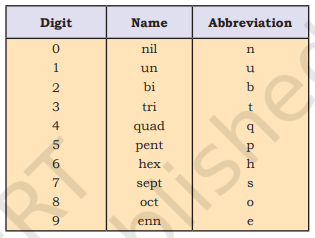
the roots for 1, 2 and 0 are un, bi and nil, respectively. Hence, the symbol and the name respectively are Ubn and unbinilium.
15.
Chemical and many physical properties of the elements depend on the electronic configuration of the atoms, whereas the nuclear properties do not.
16.
The basic theme of organisation in the periodic table is to simplify and systematise the study of physical and chemical properties of all the elements and their innumerable compounds.
17.
Factors affecting Ionization enthalpy.
(i) Atomic size. With the increase in atomic size, the number of electron shells increases and thus the force of attraction between the electrons and the nucleus decreases. Therefore the ionization enthalpy decreases.
(ii) Nuclear charge. As the nuclear charge increases the attraction for the electron also increases that's why ionization enthalpy increases.
(iii) Screening or shielding effect. In a multi-electron atom, the electron present in the inner shells shield the electrons in the valence shell as a result these electrons experience less attraction from the nucleus. This leads to lesser ionization enthalpy.
Variation along a period. On moving from left to right in a period the nuclear charge increases and the atomic size decreases as a result ionization enthalpies are expected to increase.
Variation within a group. On moving down the group as the atomic size of the elements increases that's why ionization enthalpy decreases down the group
18.
(i) Group 1 elements are most reactive.
(ii) Group 18 elements are least reactive because they have stable electronic configuration.
(iii) It may cause high blood pressure and any other harm to the body. It disturbs the person physically and mentally also.
(iv) They are cool, calm, happy and help other people. They are more healthy than aggressive people.
(v) aggressive people pick up fight. They do not accept their fault. Sometimes, it leads to physical injury which put them in trouble. We should not involve in such act.
19.
(i) No, it is not a good idea to remain alone.
Advantages
(a) The person does not bend under peer pressure.
(b) The person can do his work peacefully and remain attentive in the class which may help to get success.
Disadvantages
(a) It makes the person tensed due to low social interaction.
(b) Person becomes self-centred.
(c) Interaction with other helps to increase knowledge and increases tolerance.
(ii) She has values like cooperation, tolerance, respecting each other's work and ideas. She is more successful than the person working alone.
(iii) It is because it has lowest ionisation enthalpy and higher polarising power.
20.
There are numerous physical properties of elements such as melting points, boiling points, heats of fusion and vaporisation, energy of atomisation, etc., which show periodic variations. The cause of periodicity in properties is the repetition of similar outer electronic configuration after certain regular intervals. e.g. all the elements of 1s group (alkali metals) have similar outer electronic configuration, i.e. ns1.
3Li = 1s2, 2s1
11Na = 1s2, 2s2, 2p6 , 3s1
19K = 1s2, 2s2, 2p6 , 3s2, 3p6, 4s1
Therefore, due to similar outermost shell electronic configuration all alkali metals have similar properties. e.g., sodium and potassium both are soft and reactive metals. They all form basic oxides and their basic character increases down the group. They all form unipositive ion by the loss of one electron. Similarly, all the elements of 17th group (halogens) have similar outermost shell electronic configuration, i.e. ns2 np5 and thus possess similar properties.
9F = 1s2, 2s1 , 2p5
17Cl = 1s2, 2s2, 2p6 , 3s2 , 3p5
35Br = 1s2, 2s2, 2p6 , 3s2, 3p6, 3d10, 4s2 , 4p5
21.
(i) Ni = + 2, Pt = + 4
(II) Platinum forms more stable complexes in +4 state due to its higher stability than +2 state.
22.
The energy which is released by an atom in gaining an electron from outside atom or ion to form negative ion (or anion) is called electron gain enthalpy (\(\triangle\)eg H). Unit of electron gain enthalpy is kJ/mol. In some cases, like in noble gas, atoms do not have any attraction to gain an electron. In that case energy has to be supplied.
For example :
Ne(g) + e- ⟶ Ne-(g)
\(\triangle\)egH = +116 kJ mol-1
23.
Electronic configuration of A (Z = 12)
1s2 2S2 2p6 3s2
period = 3, Element's name = Mg
block = s, Group = II
Electronic configuration of B (Z = 19)
Element's name K (potassium)
1s2 2S2 2p6 3s2 3p6 4S1
n = 4, period = 4
Block = s, Group = I
Electronic configuration of C (Z = 29)
1s2 2S2 2p6 3s2 3p6 3d10 4S1
n = 4, period = 4
Block = d
Electronic configuration of D (Z = 36)
1s2 2S2 2p6 3s2 3p6 4S2 3d10 4p6
period = 4
Block = p-Block
group = 18
24.
(a) All the given species have a same number of electrons \(({ 10e }^{ 1 })\)Therefore, all are isoelectronic species.
(b) The ionic radii of isoelectronic species decreases with increase in atomic number (as magnitude of the nuclear charge increase with increase in atomic number)
Therefore, their ionic radii increase in the order.\(\underset { z=13 }{ { Al }^{ 3+ } } <\underset { 12 }{ { Mg }^{ 2+ } } <\underset { 11 }{ { Na }^{ + } } <\underset { 9 }{ { F }^{ - } } <\underset { 8 }{ { O }^{ 2 } } <\underset { 7 }{ { N }^{ 3- } } \)
25.
Electropositive character means tendency to give an electron to form cation. It varies directly with atomic radii. Thus, the correct order is Mg > fe > Cu.
26.
The amount of energy released when 1 x 10¹⁰ atoms of chlorine in vapour state are converted to Cl- ions, according to the equation.
Cl ( G ) + e- \(\longrightarrow \) Cl- ( g ) is 57.86 \(\times \) 10-10 J
\(\therefore \) The electron gain enthalpy of ghlorine, i.e. the amount of energy releaed ehen 1 mole ( 6.023 \(\times \) 1023 ) atoms of chlorineare coverted into Cl- ions according to the above equation will be
= -\(\frac { 57.86\times { 10 }^{ -10 } }{ 1\times { 10 }^{ 10 } } \times 6.023\times { 10 }^{ 23 }\)
= -348.49 \(\times\) 103 J mol-1
= -348.49 kJ mol-
Now 1 eV/atom = 96.49 kj mol-1
\(\therefore\) Electron gain enthalpy of chlorine
= -\(\frac { 348.49 }{ 96.49 }\)
= - 3.61 eV/atom
27.
(d)
all of the above
28.
(c)
Li and Mg
29.
(d)
Nitrogen
30.
(b)
alkaline earth metals

11th Standard CBSE Syllabus & Materials
11th Standard CBSE
CBSE 11th Business Studies Forms of Business Organisation Sample Question Papers Study Material - QB365 Set A
NEW11th Standard CBSE
CBSE 11th Business Studies Business, Trade and Commerce Sample Question Papers Study Material - QB365 Set A
NEW11th Standard CBSE
CBSE 11th Physics Waves Sample Question Papers Study Material - QB365 Set A
NEW11th Standard CBSE
CBSE 11th Physics Kinetic Theory Sample Question Papers Study Material - QB365 Set A



CBSE 11th Standard CBSE Subjects
CBSE Standards









