
 100% FREE ACCESS
11th Standard CBSE Syllabus & Materials
11th Standard CBSE
CBSE 11th Economics PART-A - Presentation of Data - New Sample Question Papers Study Material - QB365 Set A
NEW11th Standard CBSE
CBSE 11th Economics PART-A - Organisation of Data - New Sample Question Papers Study Material - QB365 Set A
NEW11th Standard CBSE
CBSE 11th Economics PART-A - Collection of Data - New Sample Question Papers Study Material - QB365 Set A
NEW11th Standard CBSE
CBSE 11th Economics PART-A - Introduction to Economics and Statistics - New Sample Question Papers Study Material - QB365 Set A
NEW11th Standard CBSE
CBSE 11th Business Studies International Trade Sample Question Papers Study Material - QB365 Set A
NEW11th Standard CBSE
CBSE 11th Business Studies Evolution and Fundamentals of Business Sample Question Papers Study Material - QB365 Set A

Published on: 01/08/2018
Based on the chapter Conic Sections, some of the important questions are prepared in this question paper. It covers one mark, two, three and five marks questions from the book back and creative question.
Download CBSE Class 11th Standard CBSE Mathematics question papers, sample papers, important questions, and previous year solved papers in PDF format. Get free study materials, NCERT solutions, and exam preparation resources for Class 11th Standard CBSE Mathematics
Questions + Answers key
Take MCQ Mathematics Test
1.
Find the equation of the hyperbola with vertices at (0, \(\pm \)6) and e = \(\frac { 5 }{ 3 } \) Find its foci.
2.
If the distance between the foci of a hyperbola is 16 and its eccentricity is \(\sqrt { 2 } \) , then find the equation of the hyperbola.
3.
Find the equation of the ellipse, whose axes along coordinates axes, passing through (4,3) and (-1,4).
4.
Find the equation of ellipse, if foci are \((\pm 5,0)\) and a=6.
5.
If the parabola y2 = 4ax passes through the point (3,2), find the length of its latusrectum.
6.
Find the equation of the circle with
center=(-a,-b) and radius= \(\sqrt { { a }^{ 2 }-{ b }^{ 2 } } \)
7.
Prove that the radius of the circles x2+ y2 = 1, x2 + y2 - 2x - 6y = 6 and x2 + y2 - 4x - 12y = 9 are in AP
8.
Prove that the line lx + my + n=0 will touch the parabola y2 = 4ax, if ln = am2
9.
Find the equation of the parabola which is symmetric about the Y-axis and psses through the point (2,-3).
10.
Find the equation of circle whose center is(1, 2) and touches X-axis
11.
The cable of a uniformly loaded suspension bridge hangs in the form of a parabola. The roadway which is horizontal and 100 m long is supported by vertical wires attached to the cable, the longest wire being 30 m and the shortest being 6 m. Find the length of a supporting wire attached to the roadway 18 m from the middle.
12.
Draw the shape of ellipse \(\frac { { x }^{ 2 } }{ 49 } +\frac { { y }^{ 2 } }{ 16 } =1\)and find the length of latusrectum of given ellipse.
13.
Draw the shape of the ellipse \(\frac { { x }^{ 2 } }{ 36 } +\frac { { y }^{ 2 } }{ 16 } =1\) and find their major axis, minor axis, value of c, vertices, direction, foci, eccentricity and length of latusrectum.
14.
Find the eccentricity of the hyperbola \(\frac { { x }^{ 2 } }{ { a }^{ 2 } } -\frac { { y }^{ 2 } }{ { b }^{ 2 } } =1\) , when passes through the points (3,0) and \((3\sqrt { 2 } ,2)\)
15.
Find the equation of the ellipse whose focus is(1,-1), the directrix is the line x-y-3=0 and eccentricity is 1/2.
1.
Let vertices \(\equiv \) (0, \(\pm \)b) = (0, \(\pm \)6)
b = 6 and e = \(\frac { 5 }{ 3 } \)
\(\therefore { e }^{ 2 }=\frac { { a }^{ 2 }+{ b }^{ 2 } }{ { b }^{ 2 } } \Rightarrow \frac { 25 }{ 9 } =\frac { 36+{ a }^{ 2 } }{ 36 } \Rightarrow { a }^{ 2 }=48\)
Hence, the required equation of hyperbola is
\(-\frac { { x }^{ 2 } }{ 48 } +\frac { { y }^{ 2 } }{ 36 } =1\Rightarrow \frac { { y }^{ 2 } }{ 36 } -\frac { { x }^{ 2 } }{ 48 } =1\)
\(\therefore foci=(0,\pm be)=(0,\pm 10)\)
2.
Here, 2c = 16 \(\Rightarrow \) c = 8
\(e=\frac { c }{ a } \Rightarrow \sqrt { 2 } =\frac { 8 }{ a } \Rightarrow a=4\sqrt { 2 } \)
c2 = a2 + b2
x2 - y2 = 32
3.
\(\text{Let equation of ellipse be} \frac { { x }^{ 2 } }{ { a }^{ 2 } } +\frac { { y }^{ 2 } }{ { b }^{ 2 } } =1,\ a>b\)
\(\therefore \quad \frac { 16 }{ { a }^{ 2 } } +\frac { 9 }{ { b }^{ 2 } } =1\quad and\quad \frac { 1 }{ { a }^{ 2 } } +\frac { 16 }{ { b }^{ 2 } } =1\Rightarrow { b }^{ 2 }=\frac { 247 }{ 15 } and\quad { a }^{ 2 }=\frac { 247 }{ 7 } \)
Ans. \(7{ x }^{ 2 }+15{ y }^{ 2 }=247\)
4.
\(\frac { { x }^{ 2 } }{ 36 } +\frac { { y }^{ 2 } }{ 11 } =1\)
5.
parabola y2 = 4ax passes through the point (3,2).
(2)2 = 4a(3) \(\Rightarrow a=\frac { 1 }{ 3 } \)
Then, length of latusrectum = 4a= \(\frac { 4 }{ 3 } \)
Ans \({ 4 }/{ 3 }\)
6.
Given center is (-a,-b)
\(\therefore h=-a,k=-b\) and radius (r) =\(\sqrt { { a }^{ 2 }-{ b }^{ 2 } } \)
On putting these values in equation of circle
\((x-h)^{ 2 }+(y-k)^{ 2 }={ r }^{ 2 }\) we get
\([x-(-a)]^{ 2 }+[y-(-b)]^{ 2 }=(\sqrt { { a }^{ 2 }-{ b }^{ 2 } } )^{ 2 }\)
\(\Rightarrow (x+a)^{ 2 }+(y+b)^{ 2 }={ a }^{ 2 }-{ b }^{ 2 }\)
\(\Rightarrow { x }^{ 2 }+a^{ 2 }+2ax+{ y }^{ 2 }+b^{ 2 }+2by={ a }^{ 2 }-{ b }^{ 2 }\quad [\because (A+B)^{ 2 }={ A }^{ 2 }+2AB+B^{ 2 }]\)
\(\Rightarrow { x }^{ 2 }+y^{ 2 }+2ax+2by+{ a }^{ 2 }+{ b }^{ 2 }=0\)
\(\therefore { x }^{ 2 }+y^{ 2 }+2ax+2by+2b^{ 2 }=0\)
Which is the required equation of circle
7.
Given circles are x2+ y2-1 = 0.....(i)
x2 + y2 - 2x - 6y - 6 = 0.....(ii)
and x2+ y2- 4x 12y - 9 = 0.....(iii)
Let r1,r2 and r3 be the radii of circle (i), (ii) and (iii), respectively.
We know that the general form of the circle is
x2+ y2+ 2 gx + 2 fy + c = 0
Now, comparing Eq.(i) with Eq. (iv), we get
2g = 0 \(\Rightarrow\)g = 0, 2f = 0
f = 0 and c = -1
Radius (r) = \(\sqrt { { g }^{ 2 }+{ f }^{ 2 }-c } =\sqrt { { 0 }^{ 2 }-{ 0 }^{ 2 }-(-1) } =1\)
On comparing Eq.(ii) with Eq.(iv), we get
2g = -2 \(\Rightarrow\)g = - 1, 2f = - 6
f = -3 and c = - 6
Radius (r2) = \(\sqrt { { g }^{ 2 }+{ f }^{ 2 }-c } =\sqrt { (-1)^{ 2 }+(-3)^{ 2 }+6 } \)
\(=\sqrt { 1+9+6 } =\sqrt { 16 } =4\)
Again, comparing Eq.(ii) with Eq.(iv), we get
2g = - 4 \(\Rightarrow\) g = -2
2f = -12
f = - 6 and c = - 9
Radius (r2) = \(\sqrt { { g }^{ 2 }+{ f }^{ 2 }-c } =\sqrt { (-2)^{ 2 }+(-6)^{ 2 }-(-9) } \)
\(=\sqrt { 4+36+9 } =\sqrt { 49 } =7\)
Now, r2-r1 = 4 -1 =3, r3 - r2 = 7 - 4 =3
So, r1,r2 and r3 are in arithmetic progression.
Hence proved
8.
\(Given\quad equation\quad of\quad line\quad is\quad lx+my+n=0.\)
\(\Rightarrow y=\frac { -lx-n }{ m }\)
\(and\quad equation\quad of\quad parabola\quad is\quad { y }^{ 2 }=4ax\)
\(From\quad Eqs.\quad (i)\quad and\quad (ii),\quad we\quad get\)
\({ \left( \frac { { -lx-n } }{ m } \right) }^{ 2 } =4ax\)
\(\Rightarrow { l }^{ 2 }{ x }^{ 2 }+2lxn+{ n }^{ 2 } =4{ m }^{ 2 }ax\)
\(\Rightarrow { l }^{ 2 }{ x }^{ 2 }+2lxn-4a{ m }^{ 2 }x+{ n }^{ 2 }=0\)
\(\Rightarrow { l }^{ 2 }{ x }^{ 2 }=x(2ln-4a{ m }^{ 2 })= { n }^{ 2 }=0\)
\(Since,\quad the\quad line\quad lx+my=n\quad touches\quad the\quad parabola.\)
\(So,Eq.(iii)\quad have\quad equal\quad roots.\)
\( i.e\quad discriminant\quad (D)=0\quad \Rightarrow \quad { B }^{ 2 }-4AC=0\)
\(\Rightarrow { (2ln-4a{ m }^{ 2 }) }^{ 2 }-{ 4l }^{ 2 }{ n }^{ 2 }=0\)
\( \Rightarrow 4{ l }^{ 2 }{ n }^{ 2 }-16lna{ m }^{ 2 }=16{ a }^{ 2 }{ m }^{ 4 }-{ 4l }^{ 2 }{ n }^{ 2 }=0\)
ln = am2
Hence proved
9.
Parabola is symmetrical about Y-axis and passes through (2, -3)
So, equation of parabola is of the form x2 = -4 day
On putting x= 2, y=-3, we get
4 = -4a(-3)\(\Rightarrow a=\frac { 1 }{ 3 } \)
10.
Given, centre (h, k) = (1, 2)
and circle touches on X-axis.
\(\therefore\) Radius (r) = y-coordinate of centre = 2
So, equation of circle is
\((x-1)^{2}+(y-2)^{2}=2^{2} \quad\left[\because(x-h)^{2}+(y-k)^{2}=r^{2}\right] \)
\(\Rightarrow x^{2}-2 x+1+y^{2}-4 y+4=4 \)
\(\left[\because(a-b)^{2}=a^{2}+b^{2}-2 a b\right] \)
\(\Rightarrow x^{2}+y^{2}-2 x-4 y+1=0\)
which is the required equation of circle.
11.
Here, wire are vertical.
Let equation of the parabola be in the form
\({ x }^{ 2 }=4ay\) ...(i)
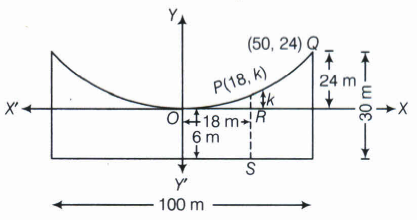
Focus is at the middle of the cable and shortest and longest vertical supports are 6 m and 30 m and roadway in 100 m long.
Clearly, the coordinates of Q(50, 24) will satisfy Eq.(i)
\(\therefore \quad (50)^{ 2 }=4a\times 24\Rightarrow 2500=96a\Rightarrow a=\frac { 2500 }{ 96 } \)
\(Hence,from\quad Eq.(i),\quad { x }^{ 2 }=4\times \frac { 2500 }{ 96 } y\Rightarrow { x }^{ 2 }=\frac { 2500 }{ 24 } y\)
Let PR=km
Then, point\ P(18,k) will satisfy the equation of parabola.
\(\therefore \quad From\quad Eq.(i),\quad (18)^{ 2 }=\frac { 2500 }{ 24 } \times k\)
\(\Rightarrow 324=\frac { 2500 }{ 24 } k\Rightarrow k=\frac { 324\times 24 }{ 2500 } =\frac { 324\times 6 }{ 625 } =\frac { 1944 }{ 625 } \)
\( \Rightarrow k=3.11\)
Therefore Required length= 6+k=6+3.11=9.11m(approx.)
12.
Given equation of ellipse is \(\frac { { x }^{ 2 } }{ 49 } +\frac { { y }^{ 2 } }{ 16 } =1.\)
\(\text{On comparing with} \frac { { x }^{ 2 } }{ { a }^{ 2 } } +\frac { { y }^{ 2 } }{ { b }^{ 2 } } =1\text{,we get }a=7,b=4\)
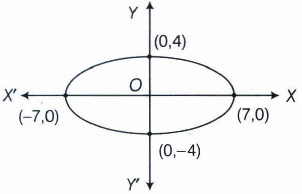
Here, a>b, so major axis is along X-axis.
Length of latusrectum,
\(\frac { { 2b }^{ 2 } }{ a } =\frac { 2\times 16 }{ 7 } =\frac { 32 }{ 7 } \)
13.
Given equation of ellipse is \(\frac { { x }^{ 2 } }{ { a }^{ 2 } } +\frac { { y }^{ 2 } }{ { b }^{ 2 } } =1.\)
Since, denominator of \(\frac { { x }^{ 2 } }{ 36 } \) is greater than denominator of \(\frac { { y }^{ 2 } }{ 16 } \) .
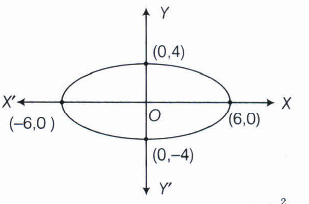
On comparing the above equation with \(\frac { { x }^{ 2 } }{ { a }^{ 2 } } +\frac { { y }^{ 2 } }{ { b }^{ 2 } } =1.\)
\(we\quad get\quad a=6\quad and\quad b=4.\)
\(\therefore Major\quad axis=2a=2\times 6=12\)
\(minor\quad axis=2b=2\times 4=8\)
\(value\quad of\quad c=\sqrt { { a }^{ 2 }-{ b }^{ 2 } } =\sqrt { (6)^{ 2 }-(4)^{ 2 } } \)
\(=\sqrt { 36-16 } =\sqrt { 20 } =2\sqrt { 5 } \)
\(Vertices\quad are\quad (6,0)\quad and\quad (-6,0)\)
\(Eccentricity,e=\sqrt { 1-\left( \frac { b }{ a } \right) ^{ 2 } } =\sqrt { 1-\left( \frac { 4 }{ 6 } \right) ^{ 2 } }\)
\(=\sqrt { \frac { 36-16 }{ 36 } } =\sqrt { \frac { 20 }{ 36 } } =\frac { \sqrt { 20 } }{ 6 } \)
\(Directrices\quad are\quad x=\pm \frac { a }{ e } =\pm \frac { 6 }{ \sqrt { 20/6 } } =\pm \frac { 36 }{ \sqrt { 20 } }\)
\( and\quad length\quad of\quad latusrectum=\frac { 2{ b }^{ 2 } }{ a } =\frac { 2(4)^{ 2 } }{ 6 } =\frac { 16 }{ 3 } \)
14.
Let Since, it is passes through (3,0) and \((3\sqrt { 2 } ,2)\)
\(\frac { 9 }{ { a }^{ 2 } } -0=1\) and \(\frac { 18 }{ { a }^{ 2 } } -\frac { 4 }{ { b }^{ 2 } } =1\)
a2 = 9 and b2 = 4
b2 = a2 (e2-1)
\(e=\frac { \sqrt { 13 } }{ 2 } \)
15.
\(\sqrt { { (x-1) }^{ 2 }+{ (y+1) }^{ 2 } } =\frac { 1 }{ 2 } .\frac { \left| x-y-3 \right| }{ \sqrt { { 1 }^{ 2 }+{ 1 }^{ 2 } } } \)
\(\Rightarrow 8[({ x }^{ 2 }+1-2x)+({ y }^{ 2 }+1+2y)]\)
\(={ x }^{ 2 }+{ y }^{ 2 }+9-2xy+6y-6x\)
Ans. \(7{ x }^{ 2 }+7{ y }^{ 2 }+2xy+10x-10y+7=0\)

11th Standard CBSE Syllabus & Materials
11th Standard CBSE
CBSE 11th Business Studies Forms of Business Organisation Sample Question Papers Study Material - QB365 Set A
NEW11th Standard CBSE
CBSE 11th Business Studies Business, Trade and Commerce Sample Question Papers Study Material - QB365 Set A
NEW11th Standard CBSE
CBSE 11th Physics Waves Sample Question Papers Study Material - QB365 Set A
NEW11th Standard CBSE
CBSE 11th Physics Kinetic Theory Sample Question Papers Study Material - QB365 Set A



CBSE 11th Standard CBSE Subjects
CBSE Standards









