
 100% FREE ACCESS
10th Standard CBSE Syllabus & Materials
10th Standard CBSE
CBSE 10th Social Science ECO - Globalisation and the Indian Economy - New Model Questions Papers Study Material - QB365 Set A
NEW10th Standard CBSE
CBSE 10th Social Science ECO - Money and Credit - New Model Questions Papers Study Material - QB365 Set A
NEW10th Standard CBSE
CBSE 10th Social Science ECO - Sectors of the Indian Economy - New Model Questions Papers Study Material - QB365 Set A
NEW10th Standard CBSE
CBSE 10th Social Science ECO - Development - New Model Questions Papers Study Material - QB365 Set A
NEW10th Standard CBSE
CBSE 10th Social Science PS - Outcomes of Democracy - New Model Questions Papers Study Material - QB365 Set A
NEW10th Standard CBSE
CBSE 10th Social Science PS - Gender, Religion and Caste - New Model Questions Papers Study Material - QB365 Set A

Published on: 05/03/2019
Control and Coordination Important Questions
Download CBSE Class 10th Standard CBSE Science question papers, sample papers, important questions, and previous year solved papers in PDF format. Get free study materials, NCERT solutions, and exam preparation resources for Class 10th Standard CBSE Science
Questions + Answers key
Take MCQ Science Test
1.
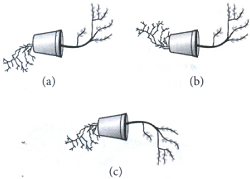
In the given figures, (a), (b) and (c), which appears more accurate and why?
2.
Why is the use of iodised salt advisable?
3.
What health disorder may occur if the following hormones are not secreted properly?
(a) Growth hormone
(b) Insulin
(c) Thyroxine
(d) Testosterone
4.
Name two plant hormones that help in stem growth.
5.
What is reflex action?
6.
What are cranial nerves?
7.
Name the plant hormones responsibility for the following:
(a) Elongation of cells
(b) Growth of stem
(c) Promotion of cell division
(d) Falling of senescent leaves.
8.
How do auxins promote the growth of a tendril around a support?
9.
Junction between two neurons is called
Cell junction
Neuro muscular junction
Neural joint
Synapse
10.
Which statement is not true about thyroxin?
Iron is essential for the synthesis of thyroxin
It regulates carbohydrates, protein and fat metabolism in the body
Thyroid gland require iodine to synthesise thyroxin
Thyroxin is also called thyroid hormone
11.
Which of the following statements about transmission of nerve impulse is incorrect?
Nerve impulse travels from dendritic end towards axonal end.
At the dendritic end electrical impulses bring about the release of some chemicals which generate an electrical impulse at the axonal end of another neutron.
The chemicals released from the axonal end of one neuron cross the synapse and generate a similar electrical impulse in a dendrite of another neuron.
A neuron transmits electrical impulses not only to another neuron but also to muscle and gland cells.
12.
Choose the incorrect statement about insulin.
It is produced from pancreas
It regulates growth and development of the body
It regulates blood sugar level
Insufficient secretion of insulin will cause diabetes
13.
Which of the following statements are true about the brain?
(i) The main thinking part of brain is hind brain
(ii) Centres of hearing, smell, memory, sight, etc. are located in forebrain.
(iii) Involuntary actions like salivation, vomiting, blood pressure are controlled by the medulla in the hind brain
(iv) Cerebellum does not control posture and balance of the body
(i) and (ii)
(i), (ii) and (iii)
(ii) and (iii)
(iii) and (iv)
14.
In a synapse, chemical signal is transmitted from
Dendritic end of one neuron to axonal end of another neuron
Axon to cell body of the same neuron
Cell body to axonal end of the same neuron
Axonal end of one neuron to dendritic end of another neuron
15.
The gap between two neurons is called as
Dendrite
Synapse
Axon
Impulse
16.
Why is the flow of signals in a synapse from axonal end of one neuron to dendritic end of another neuron but not the reverse?
17.
Name various plant hormones. Also give their physiological effects on plant growth and development.
18.
Mention one function for each of these hormones:
(a) Thyroxin
(b) Insulin
(c) Adrenaline
(d) Growth hormone
(e) Testosterone
19.
Distinguish between voluntary and involuntary actions of our body.
20.
How do neurons transmit information?
21.
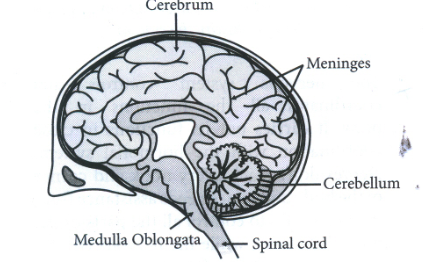
Draw a diagram of human brain and label on it the following of its parts:
(i) Cerebrum
(ii) Meninges
(iii) Medulla Oblongata
(iv) Cerebellum
22.
Describe the central nervous system in human being under the following heads:
(i) Regions included
(ii) Three functions of any one region
1.
Figure (a) appears more accurate because it is showing positive geotropic movement in roots and negative geotropic movement in stem.
2.
Iodised salt in diet is advisable because it contains iodine, which is essential element for the synthesis of thyroxine hormone by thyroid gland. In case, iodine is deficient in our diet, there is a possibility of suffering from goitre.
3.
(a) Dwarfism if less hormone; Gigantism if secreted more.
(b) Diabetes
(c) Goitre
(d) Masculine characters will not develop properly in male.
4.
Auxin and gibberellin.
5.
It is a spontaneous, involuntary and unconscious response to a stimulus.
6.
Nerves which originated from the brain are called cranial nerves.
7.
(a) Auxin
(b) Giberellin
(c) Cytokinin
(d) Abscissic acid
8.
Auxins promote cell elongation and are present at the shoot tip. When tendril comes in contact with a support, auxin stimulates faster growth of the cells on the opposite sides. Thus, the tendril coils around the support.
9.
(d)
Synapse
10.
(a)
Iron is essential for the synthesis of thyroxin
11.
(b)
At the dendritic end electrical impulses bring about the release of some chemicals which generate an electrical impulse at the axonal end of another neutron.
12.
(b)
It regulates growth and development of the body
13.
(c)
(ii) and (iii)
14.
(d)
Axonal end of one neuron to dendritic end of another neuron
15.
(b)
Synapse
16.
The flow of signals through neurons takes place in the form of specialized chemicals; called neurotransmitters. The neurotransmitters. The neurotransmitters can only enter a neuron through dedicated receptor channels. Such receptor channels a5re only present at the dendritic end but not at the axonal end. Hence, the flow of signals in a synapse happens from axonal end of one neuron to dendritic end of another neuron but not in the reverse direction.
17.
Various plant hormones and their effects are as follows:
(i) Auxin : Promotes cell elongation and thus promotes growth of a plant part.
(ii) Gibberellins : Promotes growth.
(iii) Cytokinin : Promotes cell division and thus promotes growth.
(iv) Abscissic acid : Inhibits growth and is responsible for shedding or older parts.
18.
(a) General metabolism.
(b) Controls blood sugar level.
(c) Prepare the body for 'fight or flight' response.
(d) Promotes growth and development.
(e) Triggers sperm production and is responsible for the development of secondary sexual characters in males.
19.
Voluntary actions are under the control of our will, it needs thinking. e.g. talking, walking. Involuntary actions are not under the control of our will, they are automatic. eg. salivation, heart beat.
20.
Information passes through neuron in the form of electro-chemical signals. These signals are called impulse.
When an impulse reaches the end of the axon it sets off the release of some chemicals. These chemicals cross the gap or the synapse and start a similar electrical impulse in a dendrite of the next neuron. A similar synapse allows the delivery of impulses from the neurons to other cells, like muscle cells or glands.
21.
22.
(i) Regions included in central nervous system are the brain and the spinal cord. The brain and the spinal cord. The brain is further divided into three parts - forebrain, midbrain, and hindbrain.
(ii) Three of the functions of the brain are:
Forebrain controls intelligence, learning, memory, thinking, speech, etc.
Midbrain is associated with the sense of sight and hearing.
Hindbrain controls all involuntary actions such as breathing, peristalsis, etc.

10th Standard CBSE Syllabus & Materials
10th Standard CBSE
CBSE 10th Social Science PS - Federalism - New Model Questions Papers Study Material - QB365 Set A
NEW10th Standard CBSE
CBSE 10th Social Science PS - Power Sharing - New Model Questions Papers Study Material - QB365 Set A
NEW10th Standard CBSE
CBSE 10th Social Science GEO - Manufacturing Industries - New Model Questions Papers Study Material - QB365 Set A
NEW10th Standard CBSE
CBSE 10th Social Science GEO - Minerals and Energy Resources - New Model Questions Papers Study Material - QB365 Set A



CBSE 10th Standard CBSE Subjects
CBSE Standards





