
 100% FREE ACCESS
11th Standard Syllabus & Materials
11th Standard
TN 11th Tamil இயற்கை வேளாண்மை,சுற்றுச்சூழல் -செய்யுள் - மனோன்மணீயம் Important Questions And Answers Study Material - QB365 Set A
NEW11th Standard
TN 11th Tamil என்னுயிர் என்பேன் -துணைப்பாடம் - இசைத்தமிழர் இருவர் Important Questions And Answers Study Material - QB365 Set A
NEW11th Standard
TN 11th Tamil மொழி கலை -செய்யுள் - ஒவ்வொரு புல்லையும் Important Questions And Answers Study Material - QB365 Set A
NEW11th Standard
TN 11th Tamil பீடு பெற நில் - இலக்கணம் - பகுபத உறுப்புகள் Important Questions And Answers Study Material - QB365 Set A
NEW11th Standard
TN 11th Tamil பீடு பெற நில் - துணைப்பாடம் - வாடிவாசல் Important Questions And Answers Study Material - QB365 Set A
NEW11th Standard
TN 11th Tamil பீடு பெற நில் - செய்யுள் - குறுந்தொகை Important Questions And Answers Study Material - QB365 Set A

Published on: 29/04/2019
Model question paper - II
Download Tamil Nadu 11th Standard Chemistry question papers, model tests, one-mark questions, important questions, and public exam papers in PDF format. Free study materials and answer keys for TN State Board students.
Questions + Answers key
Take MCQ Chemistry Test
1.
Which of the following orders of ionic radii is correct?
H- > H+ > H
Na+ > F- > O2-
F > O2- > Na+
None of these
2.
In a given shell the order of screening effect is __________
s > p > d > f
s > p > f > d
f > d > p > s
f > p > s > d
3.
The element with positive electron gain enthalpy is _________
Hydrogen
Sodium
Argon
Fluorine
4.
Identify the wrong statement.
Amongst the isoelectronic species, smaller the positive charge on cation, smaller is the ionic radius
Amongst isoelectric species greater the negative charge on the anion, larger is the ionic radius
Atomic radius of the elements increases as one moves down the first group of the periodic table
Atomic radius of the elements decreases as one moves across from left to right in the 2nd period of the periodic table.
5.
In the third period the first ionization potential is of the order.
Na > Al > Mg > Si > P
Na < Al < Mg < Si < P
Mg > Na > Si > P > Al
Na< Al < Mg < Si < P
6.
Electronic configuration of species M2+ is 1s2 2s2 2p6 3s2 3p6 3d6 and its atomic weight is 56. The number of neutrons in the nucleus of species M is ________
26
22
30
24
7.
Calculate the percentage of N in ammonia molecule.
121.42%
28.35%
82.35%
28.53%
8.
What will be the basicity of H3BO3, which is not a protic acid?
One
Two
Three
Four
9.
One 'U' stands for the mass of ______________.
An atom of carbon-12
1/12th of the carbon-12
1/12th of a hydrogen atom
One atom of any of the element
10.
The volume occupied by any gas at S.T.P. is_____
22.4 litres
2.24 litres
224 litres
0.224 litres
11.
Statement I: an Equivalent mass of Mg is determined by Oxide Method
Statement II: Molecular mass is calculated using vapour density
Both the statements are individually true
Both the statements are individually true and statement II is the correct explanation of statement I.
Statement I is true but statement It is false.
Statement I is false but statement II is true
12.
Match list I with list II and identify the correct code.
| List I | List II | ||
|---|---|---|---|
| A | Bronze | 1 | Element |
| B | Table Salt | 2 | Homogeneous mixture |
| C | Gold | 3 | Alloy |
| D | Petrol | 4 | Compound |
| A | B | C | D |
| 1 | 4 | 2 | 3 |
| A | B | C | D |
| 3 | 4 | 1 | 2 |
| A | B | C | D |
| 2 | 3 | 4 | 1 |
| A | B | C | D |
| 4 | 2 | 3 | 1 |
13.
The solid state of matter is converted into gas by
sublimation
deposition
freezing
condensation
14.
Identify the redox reaction taking place in a beaker.
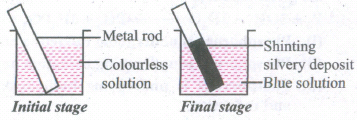
Zn(s)+ Cu2+(aq) \(\longrightarrow\) Zn2+(aq) + Cu(s)
Cu(s) + 2Ag+(aq) \(\longrightarrow\) Cu2+(aq) + 2Ag(s)
Cu(s) + Zn2+(aq) \(\longrightarrow\) Zn(s) + Cu2+ (aq)
2Ag(s) + cu2+(aq) \(\longrightarrow\) 2Ag+aq + Cu(s)
15.
Identify the correct statements with reference to the given reaction
P4 + 3OH- + 3H2O \(\longrightarrow\) PH3 + 3H2PO2-
(i) Phosphorous is undergoing reduction only
(ii) Phosphorous is undergoing oxidation only
(iii) Phosphorous is undergoing both oxidation and reduction.
(iv) Hydrogen is undergoing neither oxidation nor reduction.
only (iii)
both (iii) and (iv)
only (i)
None of these
16.
Which of the following does not represent the mathematical expression for the Heisenberg uncertainty principle?
\(\triangle x.\triangle p\ge \frac { h }{ 4\pi } \)
\(\triangle x.\triangle v\ge \frac { h }{ 4\pi m } \)
\(\triangle E.\triangle t\ge \frac { h }{ 4\pi } \)
\(\triangle E.\triangle x\ge \frac { h }{ 4\pi } \)
17.
18.
The equivalent mass of ferrous oxalate is __________.
\(\frac { molar\ mass\ of\ ferrous \ oxalate }{ 1 } \)
\(\frac { molar\ mass\ of\ ferrous \ oxalate }{ 2 } \)
\(\frac { molar\ mass\ of\ ferrous \ oxalate }{ 3 } \)
None of these
19.
Match the items in column list-I with relevant items in list-II.
| List-I | List-II | ||
| A | Ions having positive charge | 1 | anion |
| B | Ions having negative charge | 2 | -1 |
| C | Oxidation number of fluorine in NaF | 3 | 0 |
| D | The sum of oxidation number of all atoms in a neutral molecule | 4 | cation |
| A | B | C | D |
| 3 | 4 | 2 | 1 |
| A | B | C | D |
| 1 | 2 | 3 | 4 |
| A | B | C | D |
| 2 | 3 | 4 | 1 |
| A | B | C | D |
| 4 | 1 | 2 | 3 |
20.
Match the list-I with list-II and select the correct answer using the code given below the lists.
| List-I | List-II | ||
| A | Cr2O72- | 1 | +5 |
| B | MnO4- | 2 | +6 |
| C | VO3- | 3 | +3 |
| D | FeF63+ | 4 | +7 |
| A | B | C | D |
| 3 | 1 | 4 | 2 |
| A | B | C | D |
| 4 | 3 | 2 | 1 |
| A | B | C | D |
| 2 | 4 | 1 | 3 |
| A | B | C | D |
| 3 | 2 | 1 | 4 |
21.
Electron density in the yz plane of 3dxy orbital is ___________
zero
0.50
0.75
0.90
22.
Which of the following statement(s) is/are not true about the following decomposition reaction.
2KClO3 \(\longrightarrow\) 2KCl + 3O2
(i) Potassium is undergoing oxidation
(ii) Chlorine is undergoing oxidation
(iii) Oxygen is reduced
(iv) None of the species are undergoing oxidation and reduction.
only (iv)
(i) and (iv)
(iv) and (iii)
All of these
23.
Among the three metals, zinc, copper and silver, the electron releasing tendency decreases in the following order.
zinc > silver > copper
zinc > copper > silver
silver > copper > zinc
copper > silver > zinc
24.
Which one of the following represents 180 g of water ?
5 Moles of water
90 moles of water
\(\frac { 6.022\times { 10 }^{ 23 } }{ 180 } \) molecules of water
6.022\(\times\)1024molecules of water
25.
Fe2 + \(\longrightarrow\) Fe3+ + e- is a ________ reaction.
redox
reduction
oxidation
decomposition
26.
Two electrons occupying the same orbital are distinguished by ___________
azimuthal quantum number
spin quantum number
magnetic quantum number
orbital quantum number
27.
Which of the following elements will have the highest electro negativity ____________
Chlorine
Nitrogen
Cesium
Fluorine
28.
In which of the following options the order of arrangement does not agree with the variation of property indicated against it?
I< Br < CI < F (increasing electron gain enthalpy)
Li < Na < K < Rb (increasing metallic radius)
Al3+< Mg2+ < Na+
B < C < O < N (increasing first ionisation enthalpy)
29.
40 ml of methane is completely burnt using 80 ml of oxygen at room temperature The volume of gas left after cooling to room temperature is _______.
40 ml CO2 gas
40 ml CO2 gas and 80 ml H2O gas
60 ml CO2 gas and 60 ml H2O gas
120 ml CO2 gas
30.
How much volume of chlorine is required to form 11.2 L of HCI at 273 K and 1 atm pressure?
31.
How much volume of carbon dioxide is produced when 50 g of calcium carbonate is heated completely under standard conditions ?
32.
How many moles of hydrogen is required to produce 10 moles of ammonia ?
33.
Calculate the amount of water produced by the combustion of 32 g of methane.
34.
Which one of the two, ClO2- or ClO4- shows disproportionation reaction and why?
35.
Determine the values of all the four quantum numbers of the 8th electron in O- atom and 15th electron in Cl atom.
36.
Calculate the uncertainty in position of an electron, if Δv = 0.1% and \(\upsilon \) = 2.2 x 10⁶ ms-1.
37.
Show that the circumference of the Bohr orbit for the hydrogen atom is an integral multiple of the de Broglie wave length associated with the electron revolving around the nucleus.
38.
Elements a, b, c and d have the following electronic configurations:
a: 1s2, 2s2, 2p6
b: 1s2, 2s2, 2p6, 3s2, 3p1
c: 1s2, 2s2, 2p6, 3s2, 3p6
d: 1s2, 2s2, 2p1
Which elements among these will belong to the same group of periodic table.
39.
In what period and group will an element with Z = 118 will be present?
40.
The electronic configuration of atom is one of the important factor which affects the value of ionisation potential and electron gain enthalpy. Explain.
41.
What do you understand by the terms acidity and basicity ?
42.
The electron gain enthalpy of chlorine is 348 kJ mol-1. How much energy in kJ is released when 17.5 g of chlorine is completely converted into Cl- ions in the gaseous state?
43.
The element with atomic number 120 has not been discovered so far. What would be the IUPAC name and the symbol for this element? Predict the possible electronic configuration of this element.
44.
3 grams of hydrogen reacts with 29 g of O, to yield H2O. Which is the limiting reagent ?
45.
Calculate the equivalent masses of the following - HCl
46.
Calculate the screening constant in Zinc for
(i) 4s electron
(ii) for a 3d electron.
The electronic configuration of Zinc (30) is (ls)2 (2s, 2p)8 (3s,3p)8 (3d10) (4s)2
47.
Why atomic masses are called as relative atomic masses?
48.
Distinguish between a homogeneous and heterogeneous mixture.
49.
Balance the following equations by oxidation number method - \(Cu+{ HNO }_{ 3 }\longrightarrow Cu\left( { No }_{ 3 } \right) _{ 2 }+{ No }_{ 2 }+{ H }_{ 2 }O\)
50.
Calculate the molar mass of the following compounds.
Boric Acid [H3 BO3]
51.
Calculate the molar mass of the following compounds.
i) urea [CO(NH2)2]
ii) Acetone [CH3 COCH3]
iii) Boric Acid [H3 BO3]
iv) Sulphuric Acid [H2 SO4]
52.
Balance the following equations by oxidation number method.
K2Cr2O7 + HI ⟶ KI + Crl3 + H2O + I2
53.
Balance the following equations by oxidation number method.
CuO + NH3 ⟶ Cu +N2 + H2O
54.
Balance the following equations by ion electron method
\(Zn+{ NO }_{ 3 }^{ - }\longrightarrow { Zn }^{ 2+ }+No\)
55.
Balance the following equations by ion electron method
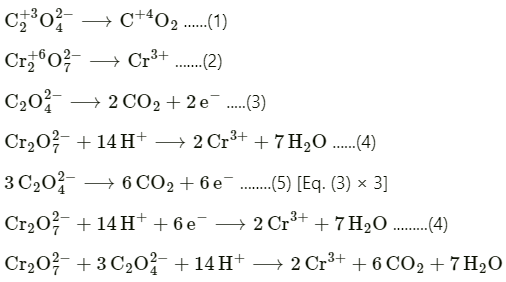
\({ C }_{ 2 }{ O }_{ 4 }^{ 2- }+{ Cr }_{ 2 }{ O }_{ 7 }^{ 2- }\longrightarrow { Cr }^{ 3+ }+{ CO }_{ 2 }\) (in acid medium)
56.
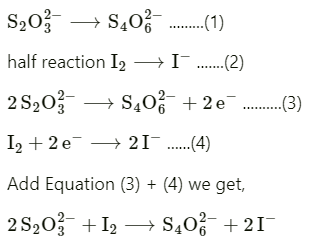
Balance the following equations by ion electron method.
i) \({ KMn }O_{ 4 }+{ SnCl }_{ 2 }+HCI\longrightarrow MnCI_{ 2 }+{ SnCI }_{ 4 }+{ H }_{ 2 }O+KCI\)
ii) 
iii) 
iv) 
57.
A Compound on analysis gave Na = 14.31% S = 9.97% H = 6.22% and 0 = 69.5%.
Calculate the molecular formula of the compound if all the hydrogen in the compound is present in combination with oxygen as a water of crystallization. (molecular mass of the compound is 322).
58.
Calculate the empirical and molecular formula of a compound containing 76.6% carbon, 6.38 % hydrogen and rest oxygen its vapour density is 47.
59.
What is screening effect? Briefly give the basis for pauling's scale of electronegativity.
60.
Describe the Aufbau principle
61.
Assertion: The ash produced by burning paper in air is lighter than the original mass of paper.
Reason: he residue left after combustion of a chemical entity is always lighter
Codes:
(a) Both assertion and reason are correct and reason is the correct explanation for assertion.
(b) Both assertion and reason are correct but reason is not the correct explanation for assertion
(c) Assertion is true but reason is false.
(d) Both assertion and reason is false.
Both assertion and reason are correct and reason is the correct explanation for assertion.
Both assertion and reason are correct but reason is not the correct explanation for assertion
Assertion is true but reason are false
Both assertion and reason are false
1.
(d)
None of these
2.
(a)
s > p > d > f
3.
(c)
Argon
4.
(a)
Amongst the isoelectronic species, smaller the positive charge on cation, smaller is the ionic radius
5.
(b)
Na < Al < Mg < Si < P
6.
(c)
30
7.
(c)
82.35%
8.
(a)
One
9.
(b)
1/12th of the carbon-12
10.
(a)
22.4 litres
11.
(a)
Both the statements are individually true
12.
(b)
| A | B | C | D |
| 3 | 4 | 1 | 2 |
13.
(a)
sublimation
14.
(d)
2Ag(s) + cu2+(aq) \(\longrightarrow\) 2Ag+aq + Cu(s)
15.
(b)
both (iii) and (iv)
16.
(d)
\(\triangle E.\triangle x\ge \frac { h }{ 4\pi } \)
17.
(a)
18.
(c)
\(\frac { molar\ mass\ of\ ferrous \ oxalate }{ 3 } \)
19.
(d)
| A | B | C | D |
| 4 | 1 | 2 | 3 |
20.
(c)
| A | B | C | D |
| 2 | 4 | 1 | 3 |
21.
(a)
zero
22.
(b)
(i) and (iv)
23.
(b)
zinc > copper > silver
24.
(d)
6.022\(\times\)1024molecules of water
25.
(c)
oxidation
26.
(b)
spin quantum number
27.
(d)
Fluorine
28.
(a)
I< Br < CI < F (increasing electron gain enthalpy)
29.
(a)
40 ml CO2 gas
30.
The balanced equation for the formation of HCI is,
H2(g) + CI2(g) \(\rightarrow\) 2 HCI (g)
As per the stoichiometric equation, under given conditions,
To produce 2 moles of HCI, 1 mole of chlorine gas is required.
To produce 44.8 litres of HCI, 22.4 litres of chlorine gas are required.
\(\therefore\) To produce 11.2 litres of HCI,
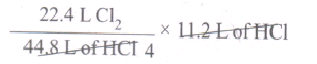
= 5.6 litres of chlorine are required.
31.
The balanced chemical equation is,
\({ CaCO }_{ 3 }\left( s \right) \overset { \triangle }{ \longrightarrow } { CaO }_{ (s) }+{ CO }_{ 2 }(g)\)
As per the stoichiometric equation,
1 mole (100g) CaC03 on heating produces 1 mole CO2
.png)
At STP, 1 mole of CO2 occupies a volume of 22.7 liters
At STP, 50 g of CaCO3 on heating produces,
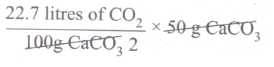
= 11.35 liters of CO2
32.
The balanced stoichiometric equation for the formation of ammonia is
N2(g) + 3H2 (g) \(\rightarrow\) 2NH3 (g)
As per the stoichiometric equation,
To produce 2 moles of ammonia, 3 moles of hydrogen are required.
\(\therefore\) to produce 10 moles of ammonia,
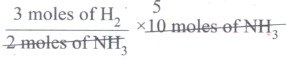
= 15 moles of hydrogen are required.
33.
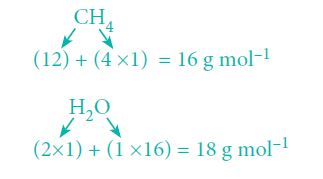
CH4(g) + 2O2 \(\rightarrow\) CO2 + 2H2O
16g (2x18)g
As per stoichiometric equation,
16 g of methane produces 36 g of H2O
\(\therefore\) 32 g of methane will produce = \(\frac { 36 }{ 16 } \times 32=72\) g of water.
34.
The oxidation state of CI in ClO2- is +3. So, chlorine can get oxidised as well as reduced and can act as reductant and oxidant.
The disproportionation reaction of ClO2- is
\(\begin{matrix} +1 \\ 3Cl{ O }_{ 2 }^{ - } \end{matrix}\longrightarrow { Cl }^{ - }+\begin{matrix} +5 \\ Cl{ O }_{ 3 }^{ - } \end{matrix}\)
In CIO4- , CI is in its highest oxidation state, So it can only be an oxidant.
35.
Electronic configuration of oxygen
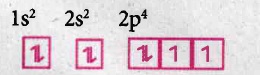
ஃ 8th electron present in 2px orbital and the quantum numbers are
n = 2,l = 1,m1 = either + 1 or -1 and s = -1/2
Electronic configuration of chlorine
.png)
15th electron present in 3Pz orbital and the quantum numbers are n = 3, l = 1, m1 = either +1 or -1 and ms = +1/2
36.
\(\triangle x.\triangle p\ge \frac { h }{ 4\pi } \)
\(\triangle x.\triangle p\ge 5.28 \times{ 10 }^{ -35 }Kg{ m }^{ 2 }{ s }^{ -1 }\)
\(\triangle x.(m\triangle v)\ge 5.28 \times{ 10 }^{ -35 }Kg{ m }^{ 2 }{ s }^{ -1 }\)
Given \(\triangle\)v = 0.1%
v = 2.2 x 10⁶ ms-1
m = 9.1 x 10⁻³¹Kg
\(\triangle\)v = \(\frac{0.1}{100}\times2.2\times{10}^{6}ms^{-1}\)
= \(2.2\times{10}^{6}ms^{-1}\)
\(\therefore \triangle x\ge \frac { { 5.28\times 10 }^{ -35 }{ Kgm }^{ 2 }{ s }^{ -1 } }{ 9.1\times { 10 }^{ -31 }Kg\times 2.2\times { 10 }^{ 3 }m{ s }^{ -1 } } \)
\(\\ \triangle x\ge 2.64\times { 10 }^{ -8 }m\)
37.
Circumference of the orbit - 2\(\pi\)r .... ...(1)
Circumference of the orbit of H - atom (n = 1) - n\(\lambda\), .........(2)
(1) = (2) \(2 \pi r=\lambda \text { (or) } 2 \pi r=\frac{\mathrm{h}}{\mathrm{mv}}\)
38.
In the periodic table vertical columns are called groups.
Elements in the same vertical column possess similar number of electrons in the outer orbitals.
∴ Elements a and c belongs to group 18
Elements b and d belongs to group 13
39.
Z = 118; [86Rn] 5f14 6d10 7s2 7p6
In the periodic table the element with Z = 118 is located in p-block,
Period no = 7 (as n = 7 for valence shell)
Group no. = 18 (group no = 10+ ns electrons + np electrons) (n - outer most shell)
40.
(i) Electronic configuration is the arrangement of electrons in an atom. The outermost electron shell is often referred to as the "valence shell"determines the chemical properties.
(ii) Ionization energy and electron affinity is the amount of energy released or required in pulling out or adding an electron to a neutral atom. So both depend on electronic configuration of the element.
41.
Acidity : The number of hydroxyl ions present in one mole of a base is known as the acidity of the base.
Basicity : The number of replaceable hydrogen atoms present in a molecule of the acid is referred to as its basicity.
42.
Cl(g) + e- ⟶Cl-(g) AH = 348 kJ mol-1
For one mole (35.5g) 348 kJ is released.
\(\therefore \text { For } 17.5 \mathrm{~g} \text { chlorine, } \frac{348 \mathrm{~kJ}}{35.5 \mathrm{~\not g}} \times 17.75 \mathrm{~\not g} \text { energy leased. }\)
∴ The amount of energy released =\(\frac { 348 }{ 2 } \) =174 kJ
43.
Atomic number: 120
IUPAC temporary symbol: Unbinilium
IUPAC temporary symbol: Ubn
Possible electronic configuration :[Og] 8s2
44.
\(\underset { 2\quad mol }{ { 2H }_{ 2 } } +\underset { 1\quad mol }{ { { O }_{ 2 } } } \rightarrow \underset { 2\quad mol }{ { 2H }_{ 2 }O } \)
Number of mole of H2 taken = \(\frac{3}{2}\) = 1.5
Number of mole of O2 taken = \(\frac{29}{32}\) = 0.9062
\(\therefore\) 2 mole of H2 react with 1 mole of O2
\(\therefore\) 1.5 mol of H2 will react with = \(\frac{1}{2}\times \) 1.5 = 0.75 mole of O2
Available mole of O2 (0.9062) > required mol of O2 (0.75)
Thus, O2 is in excess and therefore, H2 will be the limiting reagent.
45.
Molar Mass of HCl = 1 + 35.5 = 36.5
Basicity of HCl = 1
\(\therefore\) equivalent mass of hcl = \(\frac { 36.5 }{ 1 } =36.5g\) eq-1
46.
(i) \(\sigma \) = 1 x 0.35 + 18 x 0.85 + 10 x 1 = 25.65
(ii) \(\sigma \) = 9 x 0.35 +18 x 1.0 = 21.15
47.
The mass of an atom (10-27 kg) is too small to be measured directly. They are measured with reference to a standard atom, Hence they are called as relative atomic masses.
48.
In a homogeneous mixture, the composition of the constituents are uniform throughout whereas in a heterogeneous mixture, the composition is not uniform throughout.
49.
(iii) \(\overset { 0 }{ \underset { \underset { 2e^{ - } }{ \downarrow } }{ Cu } } { O }_{ 7 }+H\overset { +5 }{ \underset { { 1e }^{ - } }{ \underset { \uparrow }{ N } } } { O }_{ 3 }\longrightarrow \overset { +2 }{ Cu } \left( { No }_{ 3 } \right) _{ 2 }+\overset { +4 }{ N } { O }_{ 2 }+{ H }_{ 2 }O\)
Cu +2HNO3 \(\longrightarrow \) Cu(NO3)2 + NO2 + H2O
Cu + 2HNO3 + 2HNO3 \(\longrightarrow \) Cu(NO3)2 + 2NO2 + 2H2O
Cu + 4HNO3 \(\longrightarrow \) Cu (NO3)2 + 2No2 + 2H2O
50.
Mol.mass = 3(H) + 1(B) + 3(0)
= 3(1) + 1(11) + 3(16)
= 3 + 11 + 48 = 62
51.
i) urea [CO(NH2)2]
Mol.mass = 1 (C) + 2(N) + 4(H) + 1(0)
= 1(12) + 2(14) + 4(1) + 1(16)
= 12 + 28 + 4 + 16 = 60
ii) Acetone [CH3 COCH3]
Mol.mass = 3(C) + 6(H) + 1(0)
= 3(12) + 6(1) + 1(16)
= 36 + 6 + 16 = 58
iii) Boric Acid [H3 BO3]
Mol.mass = 3(H) + 1(B) + 3(0)
= 3(1) + 1(11) + 3(16)
= 3 + 11 + 48 = 62
iv) Sulphuric Acid [H2 SO4]
Mol.mass = 2(H) + 1(S) + 4(0)
= 2(1) + 1(32) + 4(16)
= 2 + 32 + 64 = 98
52.
Step - 1 : To find atoms undergoing change in O.N.
K2Cr2O7 + HI ⟶ KI + Crl3 + H2O + I2
Step - 2 : To find the total increase and decrease in O.N.
K2Cr2O7 + CrI3 (decrease of 3 unit / atom = Total decrease = 6 units / 2 atom)
HI ⟶ I2 (increase of 1 unit / atom = total increase 1 x 6 = 6)
Step - 3 : To balance the total increase and decrease in O.N, multiply HI by 6.,
K2Cr2O7 + 6 HI ⟶ KI + Crl3 + H2O + I2
Step - 4 : To balance all atoms other than '0' and 'H'
K2Cr2O7 + 6 HI ⟶ 2KI + 2Crl3 + H2O + 3I2
This makes 14 iodine atoms on RHS. (These iodide ions do not undergo any change in O.N). Hence to balance the iodine atoms add 8HI to LHS.
i.e., K2Cr2O7 + 14 HI ⟶ 2KI + 2CrI3 + H2O + 3I2
These, the oxygen atoms are balanced by making 7H2O as RHS.
K2Cr2O7 + 14 HI ⟶ 2KI + 2CrI3 + 7H2O + 3I2
The hydrogen atoms are balanced by themselves.
Hence the balanced equation is
K2Cr2O7 + 14HI ⟶ 2KI + 2Crl3 + 7H2O + 3I2
53.
Step-1: To find atoms undergoing change in O.N.
\(\overset { +2-2 }{ CuO } +\overset { -3+1 }{ { NH }_{ 3 } } \rightarrow \overset { 0 }{ Cu } +\overset { 0 }{ { N }_{ 2 } } +\overset { +1-2 }{ { H }_{ 2 }O } \)
Step-2: To find total increase and decrease in O.N.
CuO ➝ Cu (decrease of 2 unit per atom)
NH3 ➝ N2 (increase of3 unit per atom)
Total decrease = 2 x 3 = 6
Total increase = 3 x 2 = 6
Step-3: To balance the total decrease and increase in O.N, multiply two by 3 and NH3 by 2.
3CuO + 2NH3 ⟶ Cu + N2 + H2O
Step-4: To balance all atoms other than 'H' and 'O'
3CuO + 2NH3 ⟶ 3Cu + N2 + H2O
Step-5: To balance 'O' atoms
3CuO + 2NH3 ⟶ 3Cu + N2 + 3H2O
hydrogen atoms balance by themselves.
Hence the final equation is
3CuO + 2NH3 ⟶ 3Cu + N2 + 3H2O
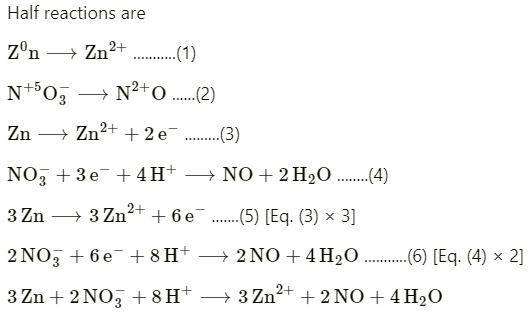
54.
\(\overset { o }{ Z } n\longrightarrow { Z }n^{ 2+ }\)
\(\overset { +5 }{ N } { O }_{ 3 }^{ - }\longrightarrow \overset { 2+ }{ NO } \)
(1) \(\Rightarrow \) Zn \(\rightarrow\) Zn2+ +2e- .....(3)
(2) \(\Rightarrow \) \({ NO }_{ 3 }^{ - }+{ 3e }^{ - }+{ 4H }^{ + }\longrightarrow NO+{ 2H }_{ 2 }O\)......(4)
.png)
55.
\(\overset { +3 }{ C } _{ 2 }{ O }_{ 4 }^{ 2- }\longrightarrow \overset { +4 }{ C } { O }_{ 2 }\)
\(\overset { +6 }{ Cr } _{ 2 }{ O }_{ 7 }^{ 2- }\longrightarrow { Cr }^{ 3+ }\)
(1) \(\Rightarrow \) \({ C }_{ 2 }{ O }_{ 4 }^{ 2- }\longrightarrow { 2CO }_{ 2 }+{ 2e }^{ - }\)
\({ Cr }_{ 2 }{ O }_{ 7 }^{ 2- }\longrightarrow { 2Cr }^{ 3+ }+{ 7H }^{ 2 }O\)
.png)
56.
Half reactions are:
\(\overset { +7 }{ M } { nO }_{ 4 }^{ - }\longrightarrow { Mn }^{ 2+ }\)
and \({ Sn }^{ 2+ }\longrightarrow { Sn }^{ 4+ }\)
(1) \(\Rightarrow \) \({ MnO }_{ 4 }^{ - }+{ 8H }^{ - }+5e^{ - }\longrightarrow { Mn }^{ 2+ }+{ 4H }_{ 2 }O\)
(2) \(\Rightarrow \) \({ Sn }^{ 2+ }\longrightarrow { Sn }^{ 4+ }+{ 2e }^{ - }\)
.png)
ii)
iii)
iv)
57.
| Element | % | Relative number of atoms | Simple Ratio |
| Na | 14.31 | \(\frac { 14.31 }{ 23 } =0.62\) | \(\frac { 0.62 }{ 0.31 } =2\) |
| S | 9.97 | \(\frac { 9.97 }{ 32 } =0.31\) | \(\frac { 0.31 }{ 0.31 } =1\) |
| H | 6.22 | \(\frac { 6.22 }{ 1 } =6.22\) | \(\frac { 6.22 }{ 0.31 } =20\) |
| O | 69.5 | \(\frac { 69.5 }{ 16 } =4.34\) | \(\frac { 4.34 }{ 0.31 } =14\) |
Empirical formula = Na2 SH20 O14
\(\left[ \begin{matrix} { Na }_{ 2 }{ SH }_{ 20 }{ O }_{ 14 } \\ =(2\times 23)+(1\times 32)+(20\times 1)+14(16) \\ =46+32+20+234 \\ =322 \end{matrix} \right] \)
n = \(\frac { molar\quad mass }{ caluclated\quad empirical\quad formula\quad mass } =\frac { 322 }{ 322 } =1\)
Molecular formula = Na2 SH20O14
Since all the hydrogen in the compound are present as water
\(\therefore \) The molecular formula is Na2 SO4 10H2O.
58.
| Element | Percentage | Atomic mass | Relative number of atoms | simple ratio | Whole no |
| C | 76.6 | 12 | \(\frac { 76.6 }{ 12 } =6.38\) | \(\frac { 6.38 }{ 1.06 } =6\) | 6 |
| H | 6.38 | 1 | \(\frac { 6.38 }{ 1 } =6.38\) | \(\frac { 6.38 }{ 1.06 } =6\) | 6 |
| 0 | 17.02 | 16 | \(\frac { 17.02 }{ 16 } =1.06\) | \(1.06\frac { 1.06 }{ 1.06 } =1\) | 1 |
Empirical Formula = C6 H6O
n = \(\frac { molar\ mass }{ calculated\ eprirical\ formula\ mass } \)
= \(\frac { 2\times \ vapour\ density }{ 94 } \frac { 2\times 47 }{ 94 } =1,\)
Molecular formula (C6H6O) x 1 = C6H6O.
59.
Screening effect: The repulsive force between the inner shell electrons and the valence electrons leads to a decrease in the electrostatic attractive forces acting on the valence electrons by the nucleus. Thus, the inner shell electrons act as a shield between the nucleus and the valence electrons. This effect is called shielding effect.
Pauling's scale: Pauling, he assigned arbitrary value of electronegativities for hydrogen and fluorine as 2.2 and 4.0 respectively. Based on this the electronegativity values for other elements can be calculated using the following expression.
\(({ X }_{ A }-{ X }_{ B })=0.182\sqrt { E_{ AB } } -({ E }_{ AA }*{ E }_{ BB })^{ 1/2 }\)
Where EAB' EAA and EBB are the bond dissociation energies of AB, A2 and B2 molecules respectively. The electronegativity of any given element is not a constant and its value depends on the element to which it is covalently bound. The electronegativity values play an important role in predicting the nature of the bond.
60.
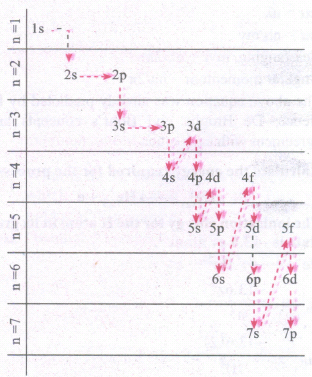
The word Aufbau in German means 'building up'. In the ground state of the atoms, the orbitals are filled in the order of their increasing energies. That is the electrons first occupy the lowest energy orbital available to them.
Once the lower energy orbitals are completely filled, then the electrons enter the next higher energy orbitals. The order of filling of various orbitals as per the Aufbau principle which is in accordance with (n + l) rule.
61.
(c) Assertion is true but reason are false

11th Standard Syllabus & Materials
11th Standard
TN 11th Tamil பீடு பெற நில் - செய்யுள் - காவடிச்சிந்து Important Questions And Answers Study Material - QB365 Set A
NEW11th Standard
TN 11th Tamil பீடு பெற நில் - உரைநடை - மலை இடப்பெயர்கள் : ஓர் ஆய்வு Important Questions And Answers Study Material - QB365 Set A
NEW11th Standard
TN 11th Tamil மாமழை போற்றுதும் - துணைப்பாடம் - யானை டாக்டர் Important Questions And Answers Study Material - QB365 Set A
NEW11th Standard
TN 11th Tamil மாமழை போற்றுதும் - செய்யுள் - ஐங்குறுநூறு Important Questions And Answers Study Material - QB365 Set A



Tamilnadu Stateboard 11th Standard Subjects

Maths

Commerce

Economics

Biology

Business Maths and Statistics

Accountancy

Computer Science

Physics
Chemistry
Maths
Biology
Economics
Physics
Chemistry

History
Business Maths and Statistics

Computer Science
Accountancy

Computer Applications
History
Computer Technology
Commerce
Computer Applications
Computer Technology

Tamil

English

French
Tamilnadu Stateboard Standards
