
 100% FREE ACCESS
11th Standard CBSE Syllabus & Materials
11th Standard CBSE
CBSE 11th Economics PART-A - Presentation of Data - New Sample Question Papers Study Material - QB365 Set A
NEW11th Standard CBSE
CBSE 11th Economics PART-A - Organisation of Data - New Sample Question Papers Study Material - QB365 Set A
NEW11th Standard CBSE
CBSE 11th Economics PART-A - Collection of Data - New Sample Question Papers Study Material - QB365 Set A
NEW11th Standard CBSE
CBSE 11th Economics PART-A - Introduction to Economics and Statistics - New Sample Question Papers Study Material - QB365 Set A
NEW11th Standard CBSE
CBSE 11th Business Studies International Trade Sample Question Papers Study Material - QB365 Set A
NEW11th Standard CBSE
CBSE 11th Business Studies Evolution and Fundamentals of Business Sample Question Papers Study Material - QB365 Set A

Published on: 31/07/2018
Based on the chapter Equilibrium, some of the important questions are prepared in this question paper. It covers one mark, two, three and five marks questions from the book back and PTA question.
Teacher please subscribes and gets the plenty of question paper based on chapter wise and also predefined blueprint. For subscription, please Click Here.
Download CBSE Class 11th Standard CBSE Chemistry question papers, sample papers, important questions, and previous year solved papers in PDF format. Get free study materials, NCERT solutions, and exam preparation resources for Class 11th Standard CBSE Chemistry
Questions + Answers key
Take MCQ Chemistry Test
1.
Dihydrogen gas is obtained from natural gas by partial oxidation with steam as per following endothermic reaction.
\({ CH }_{ 4 }\left( g \right) +{ H }_{ 2 }O\left( g \right) \rightleftharpoons { CO }\left( g \right) +3{ H }_{ 2 }\left( g \right) \)
How will the value of Kp and composition of equilibrium mixture be affected by
(a) increasing the pressure
(b) increasing the temperature
(c) using a catalyst?
2.
Consider the reactions,
\(2{ S }_{ 2 }{ O }_{ 3 }^{ 2- }(aq)+{ I }_{ 2 }(s)\longrightarrow { S }_{ 4 }{ O }_{ 6 }^{ 2- }(aq)+{ 2I }^{ - }(aq)\)
\( { S }_{ 2 }{ O }_{ 3 }^{ 2- }(aq)+2{ Br }_{ 2 }(l)+5{ H }_{ 2 }O(l)\longrightarrow 2{ SO }_{ 4 }^{ 2- }(aq)+4{ Br }^{ - }(aq)+10{ H }^{ + }(aq)\)
Why does the same reductant, thiosulphate react differently with iodine and bromine?
Bromine is a stronger oxidising agent than iodine.
3.
Why does the following reaction occur?
\({ XEO }_{ 6 }^{ 4- }(aq)+{ 2F }^{ - }(aq)+{ 6H }^{ + }(aq)\longrightarrow { Xeo }_{ 3 }(g)+{ F }_{ 2 }(g)+3{ H }_{ 2 }O(l)\)
What conclusion about the compound Na4CeO6 (of which \(XeO_{ 6 }^{ 4- }\)is a part) can be drawn from the reaction?
4.
pKa value of acids A,B,C,D are 1.5, 3.5, 2.0 and 5.0.Which of them is strongest acid?
5.
The reaction, \(CO(g)+3{ H }_{ 2 }(g)\leftrightharpoons { CH }_{ 4 }+{ H }_{ 2 }O(g)\) is at equilibrium at 1300 K in a 1L flask. It also contains 0.30 mole of CO, 0.10 mole of H2 and 0.02 mole of H2 O, and an unknown amount of CH4 in the mixture. The equilibrium constant, Kc for the reaction at the given temperature is 3.90.
6.
Can the following reaction,
\({ Cr }_{ 2 }{ O }_{ 7 }^{ 2- }+{ H }_{ 2 }O\rightleftharpoons { 2Cro }_{ 4 }^{ 2- }+{ 2H }^{ + }\) be regarded as a redox reaction?
7.
Why pH of our blood remains almost constant at 7.4 though we quite often eat spicy food?
8.
Is it possible to get a precipitate of \(Fe(OH{ ) }_{ 3 }\)at pH = 2? given reason.
9.
What will be the pH of 1M\(N{ a }_{ 2 }{ so }_{ 4 }\)solution?
10.
For the reaction,\({ H }_{ 2 }(g)+{ I }_{ 2 }(g)\rightleftharpoons 2HI(g)\) the standard free energy is \(\Delta { G }^{ \circleddash }>0\) . How is the equilibrium constant effected?
11.
How much CH3COONa should be added to 1 L of 0.1 M CH3COOH to make a buffer of pH=4.0?
[Ka =1.8 x 10⁻⁵]
12.
A tank is full of water. Water is coming in as well as going out at same rate. What will happen to level of water in a tank? What is name given to such a state?
13.
50.0 g of CaCO3 are heated to 1073 K in a 5L vessel. What percent of the CaCO3 would decompose at equilibrium? Kp for the reaction.
\({ CaCO }_{ 3 }(s)\rightleftharpoons CaO(s)+{ CO }_{ 2 }(g)\) is 1.15 a/m at 1073 K.
14.
At 700 K, equilibrium constant for the reaction:
\({ H }_{ 2 }(g)+{ I }_{ 2 }(g)\leftrightharpoons 2HI(g)\)
is 54.8. If 0.5 mol L–1 of HI(g) is present at equilibrium at 700 K, what are the concentration of H2(g) and I2(g) assuming that we initially started with HI(g) and allowed it to reach equilibrium at 700K?
15.
What is the minimum volume of water required to dissolve 1g of calcium sulphate at 298 K? (For calcium sulphate, Ksp is 9.1 x 10⁻⁶).
16.
One of the reaction that takes place in producing steel from iron ore is the reduction of iron(II) oxide by carbon monoxide to give iron metal and CO2.
\(Feo(s)+CO(g)\leftrightharpoons Fe(s)+{ CO }_{ 2 }(g); { K }_{ p }=0.265 \ atm \ at \ 1050 \ K\)
What are the equilibrium partial pressures of CO and CO2 at 1050 K if the initial partial pressures are: \({ P }_{ co }=1.4 \ atm\) and \({ PCO }_{ 2 }=0.80\) atm?
17.
If 0.561 g of KOH is dissolved in water to give 200 mL of solution at 298 K. Calculate the concentrations of potassium, hydrogen and hydroxyl ions. What is its pH?
18.
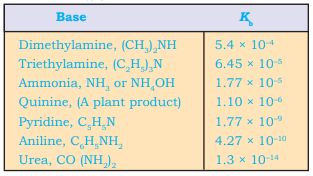
What is the pH of 0.001M aniline solution? The ionization constant of aniline can be taken from Table . Calculate the degree of ionization of aniline in the solution. Also calculate the ionization constant of the conjugate acid of aniline.
19.
Calculate the pH of the following solutions.
0.3 g of Ca(OH)2 dissolved in water to give 500 mL solution.
1.
(i) According to Le Chatelier’s principle, the equilibrium will shift in the backward direction.
(ii) According to Le Chatelier’s principle, as the reaction is endothermic, the equilibrium will shift in the forward direction.
(iii) The equilibrium of the reaction is not affected by the presence of a catalyst. A catalyst only increases the rate of a reaction. Thus, equilibrium will be attained quickly.
2.
\(2{ \overset { +2 }{ S } }_{ 2 }^{ - }\overset { -2 }{ O_{ 3 }^{ 2- } } (aq)+{ \overset { 0 }{ I } }_{ 2 }(s)\longrightarrow { \overset { 2.5 }{ S } }_{ 4 }{ \overset { -2 }{ O_{ 6 }^{ 2- } } }(aq)+{ 2I }^{ - }(aq)\)
\( { \overset { +2 }{ S } }_{ 2 }\overset { -2 }{ O_{ 3 }^{ 2- } } (aq)+2{ \overset { 0 }{ B } r }_{ 2 }(l)+5{ H }_{ 2 }O(l)\longrightarrow 2{ \overset { +6 }{ S } { \overset { -2 }{ O_{ 4 }^{ 2- } } } }(aq)+4{ Br }^{ - }(aq)+10{ H }^{ + }(aq)\)
Bromine is a stronger oxidising agent in comparison to I2. It oxidises S of \({ S }_{ 2 }{ O }_{ 3 }^{ 2- }\)to a higher oxidation state +6 in \({ SO }_{ 4 }^{ 2- }\) .While I2 oxidises S of \({ S }_{ 2 }{ O }_{ 3 }^{ 2- }\)to oxidation state 2.5 in \({ S }_{ 2 }{ O }_{ 6 }^{ 2- }\) .That's why same reductant, thiosulphate react differently with bromine and iodine.
3.
\(\overset { +8 }{ Xe } { O }_{ 6 }^{ 4- }(aq)+\overset { -1 }{ { 2F }^{ - } } (aq)+6{ H }^{ + }(aq)\longrightarrow \overset { +6 }{ Xe } { O }_{ 3 }(g)+\overset { 0 }{ { F }_{ 2 } } +3{ H }_{ 2 }O(l)\)
In the above reaction, oxidation number of Xe in\(XeO_{ 6 }^{ 4- }\) and oxidation number of F increases from -1(in F-) to zero(in F2 ).
Hence \(XeO_{ 6 }^{ 4- }\) or Na4XeO6 is reduced and F- is oxidised.
This reaction occur because Na4XeO6 or\(XeO_{ 6 }^{ 4- }\) is a stronger oxidising agent than fluorine.
4.
Acid A with pKa = 1.5 is strongest acid , Lower the value of pKa stronger will be the acid.
5.
\(CO(g)+3{ H }_{ 2 }(g)\leftrightharpoons { CH }_{ 4 }+{ H }_{ 2 }O(g)\) Kc=3.90 at 1300 K.
\({ K }_{ C }=\frac { \left[ { CH }_{ 4 } \right] \left[ { H }_{ 2 }O \right] }{ \left[ CO \right] \left[ { H }_{ 2 } \right] ^{ 3 } } \)
\(\Rightarrow \ 3.90=\frac { \left[ { CH }_{ 4 } \right] \left[ 0.02 \right] }{ \left[ 0.30 \right] \left[ 0.10 \right] ^{ 3 } } \)
(Molar concentration means number of moles present in 1L and volume of the flask is 1L.)
\(\left[ { CH }_{ 4 } \right] =\frac { 3.90\times 0.30\times (0.10)^{ 3 } }{ 0.02 } =0.0585M\)
\( \left[ { CH }_{ 4 } \right] _{ eq }=5.85\times { 10 }^{ -2 }M\)
6.
In this reaction, oxidation number of Cr in \({ Cr }_{ 2 }{ O }_{ 7 }^{ 2- }\) is +6 and oxidation number of Cr in \({ Cr }_{ 2 }{ O }_{ 7 }^{ 2- }\) is +6. Since, during the reaction, the oxidation number of Cr has neither decreased nor increased, therefore, the above reaction is not a redox reaction.
7.
Blood is a buffer containing carbonic acid (H2CO3) and bicarbonate ions (H2CO3). Small amounts of the acid or base produced from the spicy food do not disturb its pH.
8.
No, because Fe(OH)3 will dissolve in the strongly acidic medium.
9.
Na2So4 is a salt of the strong acid and strong base, thus its aqueous solution will be neutral. Therefore,its pH wii be 7.
10.
ΔG⊝ and K are related as
ΔG⊝= -RT In Kc
When G⊝ > 0means ΔG⊝ is a positive. This can be so only if 1n Kc is negative i.e Kc < 1.
11.
0.018 mol
12.
It will remain the same because rate of inflow is equal to rate of outflow. The state is called of 'equilibrium'.
13.
\({ CaCO }_{ 3 }(s)\rightleftharpoons CaO(s)+{ CO }_{ 2 }(g)\)
Kp = \({ p }_{ { CO }_{ 2 } }\) = 1.15 atm, pV = nRT
\({ N }_{ { CO }_{ 2 } }=\frac { { P }_{ { CO }_{ 2 } } }{ RT } =\frac { 1.15\times 5 }{ 0.082\times 1073 } =0.065mol\)
1 mole of CO2 is obtained by decomposition of 1 mole CaCO3. Therefore, moles of CaCO3 decomposed is equal to the moles of CO2 = 0.065 mol.
Moles of CaCO3 initially present = \(\frac { 50 }{ 100 } =0.5 \ mol\)
[Molecular mass of CaCO3 = 100]
Percent of CaCO3 decomposed \(=\frac { 0.065 }{ 0.5 } \times 100=13\)%
14.
\({ H }_{ 2 }(g)+{ I }_{ 2 }(g)\leftrightharpoons 2HI(g);{ K }_{ c }=54.8\)
\(2HI(g)\leftrightharpoons { H }_{ 2 }(g)+{ I }_{ 2 }(g);{ K' }_{ c }=\frac { 1 }{ { K }_{ c } } =\frac { 1 }{ 54.8 } \)
Again, \( { K' }_{ c }=\frac { \left[ { H }_{ 2 } \right] \left[ { I }_{ 2 } \right] }{ { \left[ HI \right] }^{ 2 } } =\frac { 1 }{ 54.8 } \)
Given, [HI] = 0.5 mol L-1
According to equation, [H2] = [I2] = [x]
\(\frac { x.x }{ \left[ { 0.5 } \right] ^{ 2 } } =\frac { 1 }{ 54.8 } or{ \ x }^{ 2 }=\frac { \left[ { 0.5 } \right] ^{ 2 } }{ 54.8 } =0.00456\)
x = 0.0675 M
Hence, [H2] = [I2] = x = 0.0675 M
15.
\({ CaSO }_{ 4 }\rightleftharpoons { Ca }^{ 2+ }+{ SO }_{ 4 }^{ 2- };{ K }_{ sp }=9.1\times { 10 }^{ -6 }\)
S S S
Where s is the solubility of CaSO4
\({ K }_{ sp }=\left[ { Ca }^{ 2+ } \right] \left[ { SO }_{ 4 }^{ 2- } \right] =S.S={ S }^{ 2 }\)
\(S=\sqrt { { K }_{ sp } } =\sqrt { 9.1\times { 10 }^{ -6 } } \Rightarrow S=3.017\times { 10 }^{ -3 }M\)
Solubility of CaSO4 = 3.017 x 10⁻³ mol-1
= 3.017 x 10-3 x 136 gL-1
(Molar mass of CaSO4 =136 g mol-1)
= 410.3 x 10⁻³ gL-1
410.3x10⁻³ g CaSO4 is dissolved in = 1L
1g CaSO4 is dissolved in = \(\frac { 1\times 1 }{ 410.3\times { 10 }^{ -3 } } \) = 2.437 L
16.
\(Feo(s)+co(g)\leftrightharpoons Fe(s)+{ CO }_{ 2 } (g);\)
Initial pressure 1.4atm 0.80 atm
(Kp=.265 at 1050 K)
\({ Q }_{ p }=\frac { { PCO }_{ 2 } }{ PCO } =\frac { 0.80 }{ 1.4 } =0.571[\because Fe \ and \ Feo \ are \ solids]\)
\(\because { Q }_{ p }>{ K }_{ p }\), the reaction will go in reverse direction. Due to this, pressure of \({ CO }_{ 2 }\) will decrease and that of CO will increase to attain equilibrium.
Suppose p is the decrease in pressure of \({ CO }_{ 2 }\) and p is the increase in pressure of CO. Hence,
pCO2=(0.80−p) and pco=(1.4+p)
\( Now,\ from \ { K }_{ p }=\frac { { pco }_{ 2 } }{ pco } \)
\(\Rightarrow 0.265=\frac { (0.80-p) }{ (1.4+p) }\)
\( p=\frac { 0.429 }{ 1.265 } =0.339 \ atm\)
Hence, at equilibrium,pco2=0.80−0.339=0.461atm and pco=1.4+0.339=1.739 at
17.
\((molar \ mass \ of \ KOH=39+16+1=56 \ g \ { mol }^{ -1 }\)
\(Molarity \ of \ KOH,\)
\( M=\frac { mass \ of \ KOH(g)\times 1000 }{ molar \ mass \ (KOH)\times volume \ of \ solution \ (in \ mL) }\)
\(\Rightarrow M=\frac { 0.561\times 1000 }{ 56\times 200 } =0.05\Rightarrow M=0.05 \ { mol \ L }^{ -1 }\)
\( KOH \ \rightleftharpoons { K }^{ + }+{ OH }^{ - }\)
\(\therefore \ \left[ { K }^{ + } \right] =0.05M \ and \ \left[ { OH }^{ - } \right] =0.05M\)
\(From,\ \left[ { H }^{ + } \right] .\left[ { OH }^{ - } \right] ={ K }_{ w }=1.0\times { 10 }^{ -14 } ...... \left[ 1 \right]\)
\(\left[ { H }^{ + } \right] =\frac { { 1.0\times 10 }^{ 14 } }{ 0.05 } =20\times { 10 }^{ -14 }M=2.0\times { 10 }^{ -13 }M \ ........ \left[ 1 \right] \)
\(pH=-log\left[ { H }^{ + } \right] =-log\left[ { 2.0\times 10 }^{ -13 } \right] =-0.3010+13=12.7....... \left[ 1 \right] \)
18.
\({ C }_{ 6 }{ H }_{ 5 }{ NH }_{ 2 }+{ H }_{ 2 }O\rightleftharpoons { C }_{ 6 }{ H }_{ 5 }{ NH }_{ 3 }^{ + }+{ OH }^{ - }\)
\({ K }_{ b }=\frac { \left[ { C }_{ 6 }{ H }_{ 5 }{ NH }_{ 3 }^{ + } \right] \left[ { OH }^{ - } \right] }{ \left[ { C }_{ 6 }{ H }_{ 5 }{ NH }_{ 2 } \right] } =\frac { \left[ { OH }^{ - } \right] ^{ 2 } }{ \left[ { C }_{ 6 }{ H }_{ 5 }{ NH }_{ 2 } \right] } \)
\(\left[ { OH }^{ - } \right] =\sqrt { { K }_{ a }.C } =\sqrt { 4.27\times { 10 }^{ -10 }\times 0.001 }\)
\( \left[ { OH }^{ - } \right] =6.534\times { 10 }^{ -7 }\)
\(pOH=-log\left[ { 0H }^{ - } \right] =-log\left[ 6.534\times { 10 }^{ -7 } \right]\)
\( pOH=-0.8152+7=6.18\)
\(From,\ pH+pOH=14\)
\( pH=14-6.18=7.82\)
\({ C }_{ 6 }{ H }_{ 5 }{ NH }_{ 2 }+{ H }_{ 2 }O\rightleftharpoons { C }_{ 6 }{ H }_{ 5 }{ NH }_{ 3 }^{ + }+{ OH }^{ - }\)
\(Initial \ conc.\ C \ \ \quad 0\quad 0\)
\( Equili \ conc.C-C\alpha \quad C\alpha \quad C\alpha\)
\( { K }_{ b }=\frac { C\alpha .C\alpha }{ C(1+\alpha ) } \ [(1-\alpha )\approx 1 \ for \ weak \ base]\)
\( { K }_{ b }=C{ \alpha }^{ 2 }\)
\( or \ \alpha =\sqrt { \frac { { K }_{ b } }{ C } } \)
Degree of ionisation,
\(\alpha =\sqrt { \frac { 4.27\times { 10 }^{ -10 } }{ 0.001 } } =6.53\times { 10 }^{ -4 }\)
\( { K }_{ a } \ of \ conjugate \ acid \ of \ aniline,\)
\( { K }_{ a }=\frac { { K }_{ w } }{ { K }_{ b } } =\frac { { 10 }^{ -14 } }{ 4.27\times { 10 }^{ -10 } } =2.34\times { 10 }^{ -5 }\)
19.
Molecular mass of Ca(OH)2
\(=40+\left[ \left( 16+1 \right) \times 2 \right] =74 \ g \ { mol }^{ -1 }\)
\(Molarity,\ M\)
\( =\frac { mass \ of \ Ca\left( { OH } \right) _{ 2 }(g)\times 100 }{ molar \ mass \ ofCa\left( { OH } \right) _{ 2 }\times colume \ of \ solution(mL) \ }\)
\(M=\frac { 0.3\times 100 }{ 74\times 500 } =0.0081\)
\(One \ mole \ of \ Ca\left( { OH } \right) _{ 2 } \ gives \ 2 \ moles \ of{ OH }^{ - }.\)
\( So,\left[ { OH }^{ - } \right] =2\times 0.0081=0.0162M\)
\(pOH=-log\left[ { OH }^{ - } \right] =-log\left[ 0.0162 \right]\)
\( =1.7905\approx 1.79\)
\( From,\ pH+pOH=14\)
\(or \ pH=14-1.79=12.21\)

11th Standard CBSE Syllabus & Materials
11th Standard CBSE
CBSE 11th Business Studies Forms of Business Organisation Sample Question Papers Study Material - QB365 Set A
NEW11th Standard CBSE
CBSE 11th Business Studies Business, Trade and Commerce Sample Question Papers Study Material - QB365 Set A
NEW11th Standard CBSE
CBSE 11th Physics Waves Sample Question Papers Study Material - QB365 Set A
NEW11th Standard CBSE
CBSE 11th Physics Kinetic Theory Sample Question Papers Study Material - QB365 Set A



CBSE 11th Standard CBSE Subjects
CBSE Standards









