
 100% FREE ACCESS
11th Standard CBSE Syllabus & Materials
11th Standard CBSE
CBSE 11th Economics PART-A - Presentation of Data - New Sample Question Papers Study Material - QB365 Set A
NEW11th Standard CBSE
CBSE 11th Economics PART-A - Organisation of Data - New Sample Question Papers Study Material - QB365 Set A
NEW11th Standard CBSE
CBSE 11th Economics PART-A - Collection of Data - New Sample Question Papers Study Material - QB365 Set A
NEW11th Standard CBSE
CBSE 11th Economics PART-A - Introduction to Economics and Statistics - New Sample Question Papers Study Material - QB365 Set A
NEW11th Standard CBSE
CBSE 11th Business Studies International Trade Sample Question Papers Study Material - QB365 Set A
NEW11th Standard CBSE
CBSE 11th Business Studies Evolution and Fundamentals of Business Sample Question Papers Study Material - QB365 Set A

Published on: 14/12/2018
Get 100 percent accurate NCERT Solutions for Class 11 Biology Chapter 19 (Excretory Products and their Elimination) solved by expert Biology teachers. We provide solutions for questions given in Class 11 Biology text-book as per CBSE Board guidelines from the latest NCERT book for Class 11 Biology.
NCERT Grade 11 Biology Chapter 19, Excretory Products and their Elimination is from Unit 5, Human Physiology. Animals accumulate ammonia, urea, uric acid, carbon dioxide, water and ions like Na+, K+, Cl–, phosphate, sulphate, etc., either by metabolic activities or by other means like excess ingestion. These substances have to be removed totally or partially. In this chapter, students will learn the mechanisms of elimination of these substances with special emphasis on common nitrogenous wastes.
Human Excretory System, Urine Formation, Function of the Tubules, Mechanism of Concentration of the Filtrate, Regulation of Kidney Function, Micturition, Role of other Organs in Excretion and Disorders of the Excretory System are the major topics discussed in this chapter.
Excretion in different animals, structure, location, and function of kidneys in humans, three-step detailed processes of urine formation, accessory excretory organs and disorders of the excretory system such as uremia, kidney stone, kidney failure, etc. are discussed in this chapter.
NCERT Grade 11 Biology, Chapter 19, Excretory Products and their Elimination is a part of Unit 5, Human Physiology. Unit 5 is a combination of 7 chapters and holds a total weightage of 20% in the NEET examination and 18 marks in the final examination.
Download CBSE Class 11th Standard CBSE Biology question papers, sample papers, important questions, and previous year solved papers in PDF format. Get free study materials, NCERT solutions, and exam preparation resources for Class 11th Standard CBSE Biology
Questions + Answers key
Take MCQ Biology Test
1.
What is the full form of GFR?
2.
Which phylum shows the presence of malpighian tubules?
3.
What will happen if the stretch receptors of the urinary bladder wall are totally removed? Explain.
4.
Discuss the regulation of kidney function by the heart.
5.
Describe the role of alcohol and caffeine in the concentration of urine.
6.
What will be the effect on the amount of urine released when water is abundant in the body tissues in case of vertebrates?
7.
What is the ratio of the concentrated filtrate to that of the initial filtrate?
8.
How do lungs help in excretion?
9.
Give the name of a vessel of peritubular capillaries that runs parallel to the loop of Henle.
10.
What is meant by the term osmoregulation?
11.
Draw a well labelled diagram of glomerulus.
12.
What is the function of Henle's loop?
13.
Give full form of ANF.Name the organ that secretes it.Under what condition of the body is it released?What is its role in regulating kidney function?
14.
Where do ultrafiltration, reabsorption, and secretion occur in a nephron?
15.
What is ureotelism? Describe the process of formation of urea.
16.
The glomerular filtrate in the loop of Henle gets concentrated in the descending and then gets diluted in the ascending limbs.Explain
17.
Terrestrial animals are generally either ureotelic or uricotelic, not ammonotelic, why ?
18.
Which hormone maintains the volume of urine produced by kidneys?
Anti Diuretic Hormone
Atrial Natriuretic Factor
Testosterone
Adrenal Hormone
19.
What is the average amount of glomerulus filtrate in human in a day?
1.5 litres
18 litres
15 litres
180 liters
20.
What is the average amount of urine produced by human in a day?
1.5 litres
18 litres
15 litres
180 litres
21.
Which is the functional unit of kidneys?
Bowman's capsule
Glomerulus
Nephron
Loop of Henle
22.
Which is the excretory product in eagles?
Ammonia
Urea
Uric Acid
None of these
1.
Glomerular filtration rate (GFR) is a test used to check how well the kidneys are working.
2.
Malpighian tubules are found in phylum arthropoda, which includes the largest number of animals, the animals of this phylum are known as insects, which possess jointed feet or appendages. Animals of this phylum also possess green glands.
3.
As urine collects in the urinary bladder, the muscular walls of the bladder distend to accomodate it.The stretch receptors on the wall of the bladder send signals to the CNS by stimulating the sensory nerve ending in the bladder.It causes an urge to pass out the urine.So if the stretch receptors are totally removed from the bladder, urine will not be collected in the bladder and urination will keep continuing.
4.
Atrial Natriuretic Factor(ANF) is secreted by the atria of heart, when blood flow increases. It causes vasodilation (dilation of blood vessels) and thereby, decrease the blood pressure. ANF works antagonistically to RAAS.
5.
Alcohol inhibits the release of ADH and caffeine interferes with ADH action and sodium reabsorption.Thus both of these artifically dilute the urine.Such compounds which dilute urine are called diuretic substances.
6.
Vertebrates excrete large quantities of dilute urine when water is abundant in the body tissues and vice-versa.
7.
The concentrated urine(filtrate) is nearly four times concentrated than the initial filtrate formed.
8.
Carbon dioxide and water are the waste products removed by the lungs in the expired air
9.
The efferent arteriole forms a capillary network around the renal tubule, which is known as peritubular capillaries. A vessel from this network, known as vasa recta, runs parallel to the Henle's loop forming a U-shaped structure. This is prominent in juxta medullary nephron and is absent or reduced in cortical nephron.
10.
Osmoregulation is the phenomenon of regulation of change in the concentration of body fluids according to the concentration of external environment. It can be clearly seen in most marine invertebrates some freshwater invertebrabes, hagfish, et., but it is found in all animals.
11.
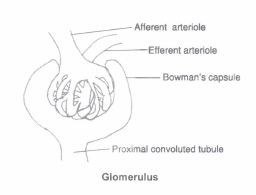
12.
Function of Henle's Loop. Reabsorption in this segment is minimum. However, this region plays a significant role in the maintenance of high osmolarity of medullary interstitial fluid. The descending limb of loop of Henle is permeable to water but almost impermeable to electrolytes. This concentrates the filtrate as it moves down. The ascending limb is impermeable to water but allows transport of electrolytes actively or passively. Therefore, as the concentrated filtrate pass upward, it gets diluted due to the passage of electrolytes to the medullary fluid.
13.
ANF is commonly known as Atrial Natriuretic Factor.
ANF is a hormone produced by the walls of the atria of the heart in response to an increase in blood volume and pressure.It increases sodium excretion and decreases blood pressure.
ANF inhibits release of renin from Juxta Glomerular Apparatus(JGA) and thereby, inhibits NaCl reabsorption by the collecting duct and reduces aldosterone release from the adrenal gland.
Function The function of counter current mechanism is to concentrate NaCl in the intestitial fluid and thereby cause water to diffuse out of the collecting tubules and ducts and concentrate the urine.
14.
i) Ultrafiltration occurs in Bowman's capsule.
ii) Reabsorption occur in PCT, loop of Henle ,DCT and Collecting ducts.
iii) Secretion occurs in PCT, loop of Henle and DCT.
15.
The process of excreting urea is called ureotelism.
Animals, which do not live in a high abundance of water convert toxic ammonia product in the body ijnto urea by the livser and then relese it into the blood. This, in turn, is filtered and excreted out by the kidneys.
16.
The gradient of increasing hyperosmolarity of medullary interstitium is maintained by a counter current mechanism and the proximity between the Henle's loop and vasa recta.
This gradient is mainly caused by NaCl and urea.The transport of these substances facilitated by the special arrangement of Henle's loop and vasa recta is called the counter current mechanism.
NaCl is transported by the ascending limb of Henle's loop, which is exchanged with the descending limb of vasa recta.NaCl is returned to the medullary interstitium by the ascending part of the vasa recta.
But,contrarily, the water diffuses into the blood of ascending limb of vasa recta and is carried away into the general blood circulation.
Permeability to urea is found only in the deeper parts of thin ascending limbs of Henle's loops and collecting ducts.Urea diffuses out of the collecting ducts and enters into the thin.
17.
Terrestrial adaptation requires the production of less toxic nitrogenous wastes like urea and uric acid for the conservation of water. Aquatic animals excrete ammonia which requires a large amount of water to dissolve. The huge quantity of water to dissolve. The huge quantity of water is easily available to such animals from surroundings. However, for terrestrial animals, such a huge quantity of
water is not available, hence they modify NH3 to comparatively less toxic products like urea and uric acid which require less amount of water for their excretíon.
18.
(a)
Anti Diuretic Hormone
19.
(d)
180 liters
20.
(a)
1.5 litres
21.
(c)
Nephron
22.
(c)
Uric Acid

11th Standard CBSE Syllabus & Materials
11th Standard CBSE
CBSE 11th Business Studies Forms of Business Organisation Sample Question Papers Study Material - QB365 Set A
NEW11th Standard CBSE
CBSE 11th Business Studies Business, Trade and Commerce Sample Question Papers Study Material - QB365 Set A
NEW11th Standard CBSE
CBSE 11th Physics Waves Sample Question Papers Study Material - QB365 Set A
NEW11th Standard CBSE
CBSE 11th Physics Kinetic Theory Sample Question Papers Study Material - QB365 Set A



CBSE 11th Standard CBSE Subjects
CBSE Standards









