
 100% FREE ACCESS
7th Standard CBSE Syllabus & Materials
7th Standard CBSE
CBSE 7th Social Science Theme E - Understanding Market - New Sample Question Papers Study Material - QB365 Set A
NEW7th Standard CBSE
CBSE 7th Social Science Theme E - From Barter to Money - New Sample Question Papers Study Material - QB365 Set A
NEW7th Standard CBSE
CBSE 7th Social Science Theme D - The Constitution of India- An Introduction - New Sample Question Papers Study Material - QB365 Set A
NEW7th Standard CBSE
CBSE 7th Social Science Theme D - From the Rulers to the Ruled : Types of Governments - New Sample Question Papers Study Material - QB365 Set A
NEW7th Standard CBSE
CBSE 7th Social Science Theme B - The Age of Reorganisation - New Sample Question Papers Study Material - QB365 Set A
NEW7th Standard CBSE
CBSE 7th Social Science Theme B - The Rise of Empires - New Sample Question Papers Study Material - QB365 Set A

Published on: 02/08/2018
In this chapter Exponents and Powers contains important questions in CBSE 7th Standard Mathematics. It also covered with most important questions in Exponents and Powers.
Teachers can prepared question paper with answer key within five minutes. Please Click Here for subscribe
Download CBSE Class 7th Standard CBSE Mathematics question papers, sample papers, important questions, and previous year solved papers in PDF format. Get free study materials, NCERT solutions, and exam preparation resources for Class 7th Standard CBSE Mathematics
Questions + Answers key
Take MCQ Mathematics Test
1.
Identify the greater number, wherever possible, in each of the following? 53 or 35
2.
Identify the greater number, wherever possible, in each of the following? 43 or 34
3.
Express the following in exponential form: a x a x a x c x c x c x c x d
4.
Express the following in exponential form: b x b x b x b
5.
Express the following in exponential form: t x t
6.
Find the value of 112
7.
Write the number 6.234269 x 10⁶ in the usual form.
8.
Write 8054000000 in standard form
9.
Find m, so that \(\left( \frac { 2 }{ 9 } \right) ^{ 3 }\times \left( \frac { 2 }{ 9 } \right) ^{ 3 }=\left( \frac { 2 }{ 9 } \right) ^{ 2m-1 }\).
10.
If \(\frac { p }{ q } ={ \left( \frac { 3 }{ 4 } \right) }^{ 18 }\div { \left( \frac { 3 }{ 4 } \right) }^{ 17 }\) , then find the value of \({ \left( \frac { p }{ q } \right) }^{ 3 }\)
11.
Express each of the following numbers using exponential notations.
1024
12.
Compare the following numbers: 2.7 x 10¹²; 1.5 x 10⁸
13.
Standard form corresponding to the number 654300100 is
6.543001 X10⁷
6.543001 x10⁸
6.543 x10⁸
6.543001 x 10⁹
14.
If \(\frac { a }{ b } =\left( \frac { 625 }{ 81 } \right) \div \left( \frac { { 5 }^{ 4 } }{ { 3 }^{ 4 } } \right) \), then the value of \(\left( \frac { a }{ b } \right) ^{ 5 }\) is
\(\left( \frac { 5 }{ 3 } \right) ^{ 8 }\)
\(\left( \frac { 3 }{ 5 } \right) ^{ 8 }\)
1
\(\frac { 3 }{ 5 } \)
15.
If (3102 x 3101) ÷ 3101= k- 3100, then the value of k
9
10
11
12
16.
If \(\left( \frac { 5 }{ 3 } \right) ^{ 5 }\times \ \left( \frac { 5 }{ 3 } \right) ^{ 11 }=\left( \frac { 5 }{ 3 } \right) ^{ 8x }\), then the value of x is
3
\(\frac { 1 }{ 2 } \)
1
2
17.
(- 4)4 x (-2)0 x (-1)202 is equal to
64
1
0
256
18.
The reciprocal of \(\left( \frac { -2 }{ 5 } \right) ^{ 2 }\) is
\(\left( \frac { -5 }{ 2 } \right) ^{ 2 }\)
\(\left( \frac { 5 }{ 2 } \right) ^{ 2 }\)
\(\frac { 4 }{ 25 } \)
\(\frac { 25 }{ 4 } \)
19.
\(\left( \frac { 2 }{ 3 } \right) ^{ 3 }\times \left( \frac { 5 }{ 7 } \right) ^{ 3 }\) is equal to
\(\left( \frac { 10 }{ 21 } \right) ^{ 9 }\)
\(\left( \frac { 10 }{ 21 } \right) ^{ 6 }\)
\(\left( \frac { 10 }{ 21 } \right) ^{ 3 }\)
\(\left( \frac { 10 }{ 21 } \right) ^{ 0 }\)
20.
The value of \(\frac { { 10 }^{ 22 }+{ 10 }^{ 20 } }{ 10^{ 20 } } \) is
10
1042
101
1022
21.
For any two non-zero rational numbers x and y, x5 ÷ y5 is equal to.
(x ÷ y)1
(x ÷ y)0
(x ÷ y)5
(x ÷ y)10
22.
Using laws of exponents, solve the following: \(\left[ { \left( \frac { -2 }{ 3 } \right) }^{ 4 }\times \left( \frac { 216 }{ 125 } \right) \right] \div \left[ { \left( \frac { 6 }{ 5 } \right) }^{ 2 }\times \left( \frac { 4 }{ 9 } \right) \right] \)
23.
A light year is a distance that light can travel in one year.
1 light year = 9,460,000,000,000 km
(a) Express one light year in scientific notation.
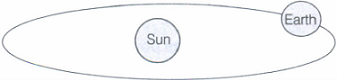
(b) The average distance between Earth and Sun is 1.496 x 10⁸ km. Is the distance between Earth and the Sun greater than, less than or equal to one light year?
1.
We have, 53 or 35
\(\therefore\) 53 = 5 x 5 x 5 = 125 [multiply 5 three times]
and 35 =3 x3 x3 x3 x3= 243 [multiply 3 five times]
\(\because\)243>125 \(\Rightarrow\) 35 > 53
Hence, 35 is greater than 53
2.
We have, 43 or 34 \(\Rightarrow\) 43 = 4 x 4 x 4 = 64
[here, multiply base = 4 three times, since exponent = 3]
and 34 = 3 x 3 x 3 x 3 = 81
[here, multiply base = 3 four times, since exponent = 4]
\(\because\) 81 > 64 \(\Rightarrow\) 34 > 43
Hence, 34 is greater than 43.
3.
a x a x a x c x c x c x c x d = a3 x c4 x d [since, a is multiplied 3 times, c is multiplied 4 times and d is multiplied 1 time]
4.
b x b x b x b = b4 [since, b is multiplied 4 times]
5.
t x t = t2 [since, t is multiplied 2 times]
6.
112 = 11 x 11 = 121
Hence, the value of 112 is 121.
7.
6234269
8.
8.054 x 10⁹
9.
Given, \(\left( \frac { 2 }{ 9 } \right) ^{ 3 }\times \left( \frac { 2 }{ 9 } \right) ^{ 6 }=\left( \frac { 2 }{ 9 } \right) ^{ 2m-1 }\)
We know that. am x an = am+n
Let a=\(\frac { 2 }{ 9 } \)
So, \(\left( \frac { 2 }{ 9 } \right) ^{ 3 }\times \left( \frac { 2 }{ 9 } \right) ^{ 6 }=\left( \frac { 2 }{ 9 } \right) ^{ 3+6 }=\left( \frac { 2 }{ 9 } \right) ^{ 2m-1 }\)
⇒ \(\left( \frac { 2 }{ 9 } \right) ^{ 9 }=\left( \frac { 2 }{ 9 } \right) ^{ 2m-1 }\)
If am =an, then m = n
So, 9=2m-1 ⇒ 9+1 = 2m
∴ m=\(\frac { 10 }{ 2 } \)=5
10.
Given, \(\frac { p }{ q } ={ \left( \frac { 3 }{ 4 } \right) }^{ 18 }\div { \left( \frac { 3 }{ 4 } \right) }^{ 17 }\)
\(\because\) am \(\div\)an =am-n
Let \(a=\frac { 3 }{ 4 } \)
So, \(\frac { p }{ q } ={ \left( \frac { 3 }{ 4 } \right) }^{ 18-17 }={ \left( \frac { 3 }{ 4 } \right) }^{ 1 }=\frac { 3 }{ 4 } \)
\(\therefore\) \({ \left( \frac { p }{ q } \right) }^{ 3 }={ \left( \frac { 3 }{ 4 } \right) }^{ 3 }=\frac { 3\times 3\times 3 }{ 4\times 4\times 4 } =\frac { 27 }{ 64 } \).
11.
Given, 1024
∵ 1024 = 2 x 2 x 2 x 2 x 2 x 2 x 2 x 2 x 2 x 2 = 210
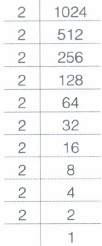
The exponent form of 1024 is 210.
12.
We have, 2.7 x 10¹²; 1.5 x 10⁸
2.7 x 1012 = 2.7 x 10 x 10 x 10 x 10 x 10x 107
=\(\frac { 27 }{ 10 } \) x 10x 10x 10x 10 x 10x 107
= 270000 x 107
and 1.5x108 = \(\frac { 15 }{ 10 } \) x10x107=15x107
\(\because\) 270000 > 15
\(\therefore\)270000x107>15x107
or 2.7 x 10¹²> 1.5x 10⁸
Hence, 2.7 x 10¹²is greater than 1.5 x 10⁸.
13.
(c)
6.543 x10⁸
14.
(c)
1
15.
(c)
11
16.
(d)
2
17.
(d)
256
18.
(a)
\(\left( \frac { -5 }{ 2 } \right) ^{ 2 }\)
19.
(c)
\(\left( \frac { 10 }{ 21 } \right) ^{ 3 }\)
20.
(c)
101
21.
(c)
(x ÷ y)5
22.
\(\frac { 8 }{ 3 } \)
23.
(a) 1 light year = 9.460,000,000,000 km
= 946 x 1010km = \(\frac { 946 }{ 100 } \)x 1010 X 100 km
= 9,46 x 10¹²km.
(b) Average distance between Earth and Sun =1.496 x10⁸ km
\(\therefore\) Distance between Earth and Sun = \(\frac { 1.496 }{ 10000 } \times { 10 }^{ 8 }\times { 10 }^{ 4 }\)km
= 0,0001496 x 10¹²km
\(\Rightarrow\)9.46 > 0.0001496
So, the distance between Earth and Sun less than one light year.

7th Standard CBSE Syllabus & Materials
7th Standard CBSE
CBSE 7th Social Science Theme B - New Beginnings : Cities and States - New Sample Question Papers Study Material - QB365 Set A
NEW7th Standard CBSE
CBSE 7th Social Science Theme A - Climates of India - New Sample Question Papers Study Material - QB365 Set A
NEW7th Standard CBSE
CBSE 7th Social Science Theme A - Geographical Diversity of India - New Sample Question Papers Study Material - QB365 Set A
NEW7th Standard CBSE
CBSE 7th Science Earth, Moon and the Sun - New Sample Question Papers Study Material - QB365 Set A



CBSE 7th Standard CBSE Subjects
CBSE Standards




