
 100% FREE ACCESS
7th Standard CBSE Syllabus & Materials
7th Standard CBSE
CBSE 7th Social Science Theme E - Understanding Market - New Sample Question Papers Study Material - QB365 Set A
NEW7th Standard CBSE
CBSE 7th Social Science Theme E - From Barter to Money - New Sample Question Papers Study Material - QB365 Set A
NEW7th Standard CBSE
CBSE 7th Social Science Theme D - The Constitution of India- An Introduction - New Sample Question Papers Study Material - QB365 Set A
NEW7th Standard CBSE
CBSE 7th Social Science Theme D - From the Rulers to the Ruled : Types of Governments - New Sample Question Papers Study Material - QB365 Set A
NEW7th Standard CBSE
CBSE 7th Social Science Theme B - The Age of Reorganisation - New Sample Question Papers Study Material - QB365 Set A
NEW7th Standard CBSE
CBSE 7th Social Science Theme B - The Rise of Empires - New Sample Question Papers Study Material - QB365 Set A

Published on: 02/03/2019
Fractions and Decimals Important Questions
Download CBSE Class 7th Standard CBSE Mathematics question papers, sample papers, important questions, and previous year solved papers in PDF format. Get free study materials, NCERT solutions, and exam preparation resources for Class 7th Standard CBSE Mathematics
Questions + Answers key
Take MCQ Mathematics Test
1.
In a class of 40 students, \(\frac { 1 }{ 5 } \)of the total number of students like to study English, \(\frac { 2 }{ 5 } \)of the total number like to study Maths and remaining students likes to study Science
(a) How many students like to study English?
(b) How many students like to study Maths?
(c) What fraction of the total number of students like to study Science?
2.
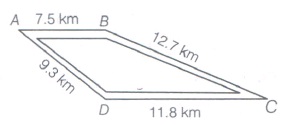
Dinesh went from place A to place B and from there to place C. A is 7.5 km from Band B is 12.7 km from C. Ayub went from place A to place D and from there to place C. D is 9.3 km from A and C is 11.8 km from D. Who travelled more and by how much?
3.
Shade
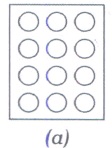
(i) \(\frac{1}{2}\) of the circles in box (a).
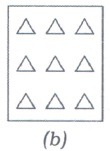
(ii) \(\frac{2}{3}\)of the triangles in box (b).
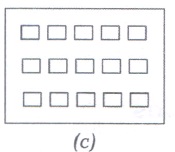
(iii) \(\frac{3}{5}\) of the squares in box (c).
4.
Michael finished colouring a picture in \(\frac{7}{12}\) hr.Vaibhav finished colouring the same picture in \(\frac{3}{4}\)hr.Who worked longer? By what fraction was it longer?
5.
Find 2.7 x 1.35.
6.
The product of two numbers is 20\(\frac { 5 }{ 7 } \) If one of the numbers is 6\(\frac { 2 }{ 3 } \) find the other
7.
Simplify the following sums.\(2\frac{2}{3} +12 \frac{2}{4} +5\frac{1}{2}\)
8.
(i) Provide the number in the box, such that \(\frac{2}{3}\times \Box=\frac{10}{30}\)
(ii) The simplest form of the number obtained in \(\Box\) is ___________.
9.
Salil wants to put a picture in a frame. The picture is 7\(\frac{3}{5}\)cm wide. Tofit in the frame, the picture cannot be more than 7\(\frac{3}{10}\)cm wide. How much should the picture be trimmed?
10.
Find:\(\frac{1}{7}\ of (b)\frac{6}{5}\ (c)\frac{3}{10}\)
11.
Find \(\frac{8}{3}\times\)\(\frac{4}{7}\);\(\frac{3}{4}\times\)\(\frac{2}{3}\)
12.
Evaluate: The place value of 5 in 103.2523 - place value of 2 in 115.552.
13.
Find the following products. \(\frac{1}{9}\times 2\frac{3}{7}\)
14.
Find 20.1\(\times\)4
15.
Find the greater decimal number from the given decimal numbers
70.01or 70.1
16.
Find \(12 \div \frac{3}{4}\)
17.
Find \(\frac{8}{3}\times \frac{4}{7}\)
18.
Multiply and reduce to lowest form and convert into a mixed fraction.\(4\times \frac{1}{3}\)
19.
Find the value of 14\(\frac{1}{2}-6\frac{1}{2}\).
20.
To divide a decimal number by100, we move the decimal point in the number of the left by the two places.
21.
To divide a decimal number by 1000, we have the decimal point in the number to the left by three places.
22.
1.44 \(\div\)1.2 is equal to
1.2
12
0.12
120
23.
A water bottle contains 2litres of water Meenu drank \(\frac{1}{8}\) of water. How much water did Meenu drink?
\(\frac{1}{2}litre\)
\(\frac{1}{8}\ litre\)
\(\frac{1}{4}\ litre\)
None of these
24.
Which of the following is an improper fraction?
\(\frac{2}{7}\)
\(\frac{1}{2}\)
\(\frac{2}{3}\)
\(\frac{73}{10}\)
25.
The product of two fractions is 1, then each of them is:
unit fraction
reciprocal of the other
proper fraction
an improper fraction
26.
The reciprocal of 0 is:
1
0
any number
does not exist
27.
\(\frac { 3 }{ 7 } \) of \(\frac { 2 }{ 5 } \)is equal to
\(\frac { 5 }{ 12 } \)
\(\frac { 5 }{ 35} \)
\(\frac { 1 }{ 35} \)
\(\frac { 6 }{ 35} \)
28.
2.5 ÷ 1000 is equal to
0.025
0.0025
0.2500
25000
29.
Which of the following is a proper fraction?
\(\frac { 4 }{ 3 } \)
\(\frac { 1 }{ 2 } \)
\(\frac { 19 }{ 4 } \)
\(\frac { 11 }{ 5 } \)
30.
In the year 2014, Shantanu gets Rs 3832.5 as his pocket allowance. Find his pockect allowane per day
Rs 9.5
Rs 10.5
Rs 12.5
Rs 11.5
31.
Pictorial representation of \(3\times \frac{2}{3} \)is
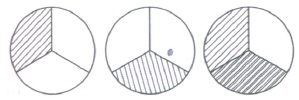
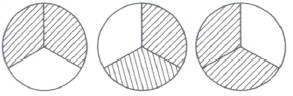
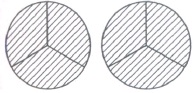
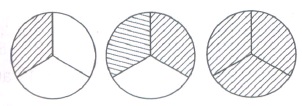
32.
132.11 \(\div\) 1000 =_________
33.
5.123 \(\div\) ______=1
34.
52.7÷_______=0.527
35.
The reciprocal of\(\frac { 3 }{ 7 } \)is_____
36.
\(8.4 \div \)_____=2.1
37.
Find the product of:
\(\frac{8}{11}\)and reciprocal of 1 \(\frac{3}{8}\) .
38.
Write the number in the expanded form 234.34
39.
The reciprocal of an improper fraction
1.
(a) No. of students like to study English
= \(\frac { 1 }{ 5 } \times 40\)
= 8
(b) No. of students like to study Maths
= \(\frac { 2 }{ 5 } \times 40\)
= 2\(\times\) 8
= 16
(c) No. of students who like to study Science
=40 - (8 + 16)
= 40-24
= 16
In part (ii), we know
\(\frac { 2 }{ 5 } \times 40\) = 16
So,\(\frac { 2 }{ 5 } \)of the total number of students like to study Science
2.
Given, distance between A and B = 7.5 km
Distance between Band C = 12.7 km
∴ Distance travelled by Dinesh = AB + BC
= 7.5+ 12.7
= 20.2km
Distance between A and D = 9.3 km
Distance between D and C = 11.8 km
∴ Distance travelled by Ayub = AD + DC
= 9.3+ 11.8
= 21.1 km
Hence, it is clear that 21.1>20.2.
∴ Ayub travelled more distance i.e. 21.1 km.
Now, difference between distances, they both travelled
= (21.1- 20.2) km
=0.9km
Hence, Ayub travelled 0.9 km more than Dinesh.
3.
(i) Number of circles= 12
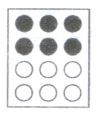
∴ \(\frac{1}{2}\)of the circles in box (a) =\(\frac{1}{2}\times 12=\frac{12}{2}=6\)
Hence, the shaded figure is shown below:
(ii) Number of triangles = 9
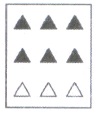
∴ \(\frac{2}{3}\)of the triangles in box (b) =\(\frac{2}{3}\times 9\)
\(=\frac{2\times 9}{3}=\frac{18}{3}=6\)
Hence, the shaded figure is shown below:
(iii)Number of squares = 15
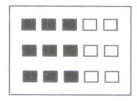
∴ \(\frac{3}{5}\)of the squares in box (c)
=\(\frac{3}{5}\times 15=\frac{45}{5}=9\)
Hence, the shaded figure is shown alongside.
4.
Time taken by Michael to finished colouring the picture \(\frac{7}{12}\)hr
Time taken by Vaibhav to finished colouring the picture = \(\frac{3}{4}\)hr
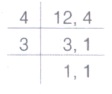
LCM of 12 and 4 = 3 X 4 = 12
On converting these fractions into like fractions, we get
\(\frac{3}{4}=\frac{3\times 3}{4\times 3}=\frac{9}{12} and \frac{7}{12}=\frac{7}{12}\)
It is clear, 9>7 [numerators of fractions]
So, \(\frac{9}{12}>\frac{7}{12} i.e., \frac{3}{4}>\frac{7}{12}\)
So, Vaibhav takes longer time to finish colouring the picture. Difference between time taken by Vaibhav and Michael
\(=\frac{3}{4}-\frac{7}{12}\)
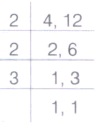
LCM of 4 and 12 = 2 x 2 x3 = 12
\(=\frac{3}{4}-\frac{7}{12}=\frac{3\times 3-7\times 1}{12}\)
=\(\frac{9-7}{12}=\frac{2}{12}=\frac{1}{6}\) [dividing numerator and denominator by 2]
Hence, Vaibhav takes \(\frac{1}{6}\) h more than Michael.
5.
- Multiply 27 and 135. We get 3645.
- In 2.7, there is 1 digit to the right of the decimal point and in 1.35, there are 2 digits to the right of the decimal point.
- So, count 1 + 2 = 3 digits starting from the right most digit (i.e., 5) in 3645 and move towards left.
- We get 3.645.
6.
We have,
Product of two numbers = 20\(\frac { 5 }{ 7 } \)=\(\frac { 145 }{ 7 } \)
One of the number =6\(\frac { 2 }{ 3 } \)=\(\frac { 20 }{ 3 } \)
The other number = (Product of the numbers ÷ One of the numbers)
= \(\frac { 145 }{ 7 } \div \frac { 20 }{ 3 } \)
=\(\frac { 145 }{ 7 } \times \frac { 3 }{ 20 } =\frac { 145\times 3 }{ 7\times 20 } =\frac { 29\times 3 }{ 7\times 4 } =\frac { 87 }{ 28 } =3\frac { 3 }{ 28 } \)
Hence, the other number is 3 \(\frac { 3 }{ 28 } \)
7.
\(2\frac{2}{3}+12\frac{2}{4}+5\frac{1}{2}\)
ஃ \(\frac{(2\times 3)+2}{3}+\frac{(12\times 4)+2}{4}+\frac{(5\times 2)+1}{2}\)
=\(\frac{6+2}{3}+\frac{48+2}{3}+\frac{10+1}{3}=\frac{8}{3}+\frac{50}{4}+\frac{11}{2}\)
=\(\frac{(8\times 4)+(50 \times 3)+(11\times 6)}{12}\) [∵ LCM of 3,4 and 2 is 12]
=\(\frac{32+150+66}{12}=\frac{248}{12}=\frac{124}{6}=\frac{62}{3}=20\frac{2}{3}\)
8.
(i) \(\frac{2}{3}\times \Box=\frac{10}{30}\)
Here, 2 X5 = 10 and 3 X10 = 30
Hence, the required number in the box is \(\frac{5}{10}\).
(ii) Simplest form of \(\frac{5}{10}=\frac{1}{2}\)
9.
Given, width of picture = 7\(\frac{3}{5}\)cm
\(=\frac{7\times5+3}{5}=\frac{35+3}{5}=\frac{38}{5}\)cm
and width of the frame = 7\(\frac{3}{10}\)cm=\(\frac{7\times 10+3}{10}\)
=\(\frac{70+3}{10}=\frac{73}{10}\)cm
ஃ To fit the picture in frame, picture should be trimmed
= Width of the picture - Width of the frame
\(=\frac{38}{5}-\frac{73}{10}=\frac{38\times 2-73\times 1}{10}\) [∵ LCM of 5 and 10=10]
=\(\frac{76-73}{10}=\frac{3}{10}\)cm
Hence,\(\frac{3}{10}\)ern picture should be trimmed.
10.
\(\frac{1}{7}\ of\ \frac{6}{5}=\frac{1}{7}\times\frac{6}{5}=\frac{1\times6}{7\times5}=\frac{6}{35}\)
\(\frac{1}{7}\ of\ \frac{3}{10}=\frac{1}{7}\times\frac{3}{10}=\frac{1\times3}{7\times10}=\frac{3}{70}\)
11.
\(\frac{8}{3}\times\)\(\frac{4}{7}\)=\(\frac{8\times4}{3\times7}\)=\(\frac{32}{21}\)
\(\frac{3}{4}\times\)\(\frac{2}{3}\)=\(\frac{3\times2}{4\times3}\)=\(\frac{1\times1}{2\times1}\)=\(\frac{1}{2}\)
12.
Place value of 5 in 103.2523 - Place value of 2 in 115.552
= 0.0500 - 0.002
= 0.050 - 0.002
= \(\frac { 50 }{ 1000 } -\frac { 2 }{ 1000 } \)
= \(\frac { 50-2 }{ 1000 } =\frac { 48 }{ 1000 } \)
= 0.048
13.
Given, \(\frac{1}{9}\times 2\frac{3}{7}=\frac{1}{9}\times \frac{(2\times 7)+3}{7}=\frac{1}{9}\times \frac{(14+3)}{7}\)
=\(\frac{1}{9}\times \frac{17}{7}=\frac{1\times 17}{9\times 7}=\frac{17}{63}\)
14.
20.1\(\times\)4 =\(\frac { 201 }{ 10 } \times 4=\frac { 804 }{ 10 } \)= 80.4
15.
Given numbers, 70.01 or 70.1
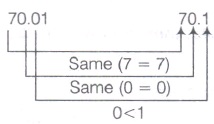
Here, digits to right side of decimal at tenth place are 0 and 1.
1> 0 i.e. 70.01 < 70.1
16.
We have, \(12 \div \frac{3}{4}=12\times \frac{4}{3}= \frac{12\times 4}{3}= \frac{48}{3}=16\) [∵ reciprocal of \( \frac{3}{4} is \frac{4}{3}\)]
17.
We have, \(\frac{8}{3}\times \frac{4}{7}=\frac{8\times 4}{3 \times 7} =\frac{32}{21}\)
18.
We have, \(4\times \frac{1}{3}\)=\( \frac{4\times1}{3}=\frac{4}{3}\)

This is the required lowest form,
Now, dividing 4 (numerator) by 3
(denominator), we get, quotient = 1and remainder = 1
∴ Mixed fraction =Quotient \(\frac{Reminder}{Divisor}=1 \frac{1}{3}\)
19.
8
20.
(a)
21.
(a)
22.
\(1.44\div1.2=\frac{144}{100}\div\frac{12}{10}=\frac{144}{100}\times\frac{10}{12}=\frac{12}{10}=1.2\)
or
\(\frac{1.44}{1.2}=\frac{144}{120}=\frac{12}{10}=1.2\)
23.
Meenu drank water\(=\frac{1}{8}\ of 2=\frac{1}{8}\times2=\frac{1\times2}{8}=\frac{2}{8}=\frac{1}{4}\ litre\)
24.
73>10
25.
(b)
reciprocal of the other
26.
(d)
does not exist
27.
(d)
\(\frac { 6 }{ 35} \)
28.
(b)
0.0025
29.
(b)
\(\frac { 1 }{ 2 } \)
30.
(b)
Rs 10.5
31.
(b)
32.
()
0.13211
33.
()
5.123
34.
()
100
35.
()
\(\frac { 7 }{ 3 } \)
36.
()
4
37.
()
\(\frac{64}{121}\)
38.
()
234.34 = 2\(\times\)100 + 3\(\times\)10 + 4\(\times\)1 +\(\frac { 3 }{ 10 } +\frac { 4 }{ 100 } +\frac { 5 }{ 1000 } \)
39.
()
proper fraction

7th Standard CBSE Syllabus & Materials
7th Standard CBSE
CBSE 7th Social Science Theme B - New Beginnings : Cities and States - New Sample Question Papers Study Material - QB365 Set A
NEW7th Standard CBSE
CBSE 7th Social Science Theme A - Climates of India - New Sample Question Papers Study Material - QB365 Set A
NEW7th Standard CBSE
CBSE 7th Social Science Theme A - Geographical Diversity of India - New Sample Question Papers Study Material - QB365 Set A
NEW7th Standard CBSE
CBSE 7th Science Earth, Moon and the Sun - New Sample Question Papers Study Material - QB365 Set A



CBSE 7th Standard CBSE Subjects
CBSE Standards




