
 100% FREE ACCESS
10th Standard Syllabus & Materials
10th Standard
TN 10th English Prose - 4 - The Attic Important Questions And Answers Study Material - QB365 Set A
NEW10th Standard
TN 10th English Supplementary - 3 - The Story of Mulan Important Questions And Answers Study Material - QB365 Set A
NEW10th Standard
TN 10th English Poem - 3 - I am Every Woman Important Questions And Answers Study Material - QB365 Set A
NEW10th Standard
TN 10th English Prose - 3 - Empowered Women Navigating The World Important Questions And Answers Study Material - QB365 Set A
NEW10th Standard
TN 10th English Supplementary - 2 - Zigzag Important Questions And Answers Study Material - QB365 Set A
NEW10th Standard
TN 10th English Poem - 2 - The Grumble Family Important Questions And Answers Study Material - QB365 Set A

Published on: 28/06/2019
frequently asked five mark questions chapter one
Download Tamil Nadu 10th Standard Maths question papers, model tests, one-mark questions, important questions, and public exam papers in PDF format. Free study materials and answer keys for TN State Board students.
Questions + Answers key
Take MCQ Maths Test1.
Let A = {1, 2, 3, 4, 5}, B = N and f: A \(\rightarrow\)B be defined by f(x) = x2. Find the range of f. Identify the type of function.
2.
f(x) = (1+ x)
g(x) = (2x - 1)
Show that fo(g(x)) = gof(x)
3.
A function f: [-7,6) \(\rightarrow\) R is defined as follows.
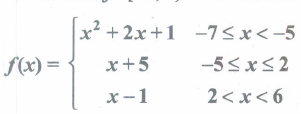
\(\cfrac { 4f(-3)+2f(4) }{ f(-6)-3f(1) } \)
4.
A function f: [-7,6) \(\rightarrow\) R is defined as follows.
f(-7) - f(-3)
5.
A function f: [-7,6) \(\rightarrow\) R is defined as follows.
find 2f(-4) + 3f(2)
6.
Let f = {(2, 7); (3, 4), (7, 9), (-1, 6), (0, 2), (5,3)} be a function from A = {-1,0, 2, 3, 5, 7} to B = {2, 3, 4, 6, 7, 9}. Is this
(i) an one-one function
(ii) an onto function,
(iii) both one and onto function?
7.
If the function f: R⟶ R defined by
\(f(x)=\left\{\begin{array}{l} 2 x+7, x<-2 \\ x^{2}-2,-2 \leq x<3 \\ 3 x-2, x \geq 3 \end{array}\right.\)
(i) f( 4)
(ii) f( -2)
(iii) f(4) + 2f(1)
(iv) \(\frac { f(1)-3f(4) }{ f(-3) } \)
8.
The distance S (in kms) travelled by a particle in time ‘t’ hours is given by S(t) = \(\frac { { t }^{ 2 }+t }{ 2 } \). Find the distance travelled by the particle after
(i) three and half hours.
(ii) eight hours and fifteen minutes.
9.
Forensic scientists can determine the height (in cms) of a person based on the length of their thigh bone. They usually do so using the function h(b) = 2.47b + 54.10 where b is the length of the thigh bone.
(i) Check if the function h is one – one or not
(ii) Also find the height of a person if the length of his thigh bone is 50 cm.
(iii) Find the length of the thigh bone if the height of a person is 147.96 cm.
10.
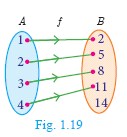
Let A = {1,2,3,4} and B = { 2, 5, 8, 11,14} be two sets. Let f: A ⟶ B be a function given by f(x) = 3x − 1. Represent this function
(i) by arrow diagram
(ii) in a table form
(iii) as a set of ordered pairs
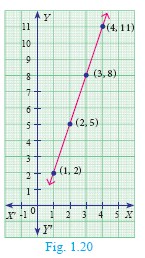
(iv) in a graphical form
11.
Let f be a function from R to R defined by f(x) = 3x - 5. Find the values of a and b given that (a,4) and (1,b) belong to f.
12.
Let f be a function f : N ⟶ N be defined by f(x) = 3x + 2, x \(\in \) N
(i) Find the images of 1, 2, 3
(ii) Find the pre-images of 29, 53
(iii) Identify the type of function
13.
If A = {-2, -1, 0, 1, 2} and f: A ⟶ B is an onto function defined by f(x) = x2 + x + 1 then find B.
14.
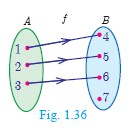
Let A = {1,2,3}, B = {4, 5, 6,7}, and f = {(1, 4),(2, 5),(3, 6)} be a function from A to B. Show that f is one – one but not onto function.
15.
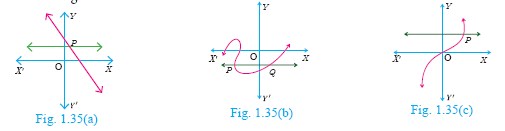
Using horizontal line test (Fig.1.35(a), 1.35(b), 1.35(c)), determine which of the following functions are one – one.
1.
A = {1,2,3,4,5}
B = {1,2,3,4, ... }
f: A \(\rightarrow\)B, f(x) = x2
\(\therefore\) f(1) = 12 = 1
f(2) = 22= 4
f(3) = 32 = 9
f(4) = 42= 16
f(5) = 52= 25
\(\therefore\) Range of f = {1, 4, 9, 16, 25}
Elements in A have been connected with different elements in B. Therefore it is one-one function. But not all the elements in B have preimages in A. Therefore it is not on-to function.
2.
f(x) = 1 + x
g(x) = (2x - 1)
fog(x) = f(g(x) = f(2x - 1)
= 1 + 2x - 1 = 2x ...(1)
gof(x) = g(f(x) = g(1 + x) = 2(1 + x) - 1
= 2 + 2x - 1
= 2x + 1 ...(2)
(1) \(\neq \)(2)
\(\therefore\) fog(x) \(\neq \) gof(x)
It is verified
3.
\(\cfrac { 4f(-3)+2f(4) }{ f(-6)-3f(1) } \)
For f(1) & f(3)
Since 1 & 3 lies between -5 ≤ x ≤2, We take, f(x) = x +5
f(1) = 1 + 5 = 6
f(-3) = -3 +5 = 2
For f(4): Since 4 lies between 2 < x < 6 We take, f(x) = x -1
f(4) = 4 -1 = 3
For f(-6): Since -6 lies between -7≤ x < -5 ,We take, f(x) = x² + 2x +1
f(-6) = (-6)² + 2(-6) + 1 = 36 -12 + 1 = 24 +1 = 25
Now ,\(\cfrac { 4f(-3)+2f(4) }{ f(-6)-3f(1) } \) =\(\frac{ 4(2) +2(3) }{ 25 - 3(6)}\)
= \(\frac{ 8 + 6 }{ 25 -18}\)
= \(\frac{14 }{ 7}\) = 2
Hence, the value of \(\cfrac { 4f(-3)+2f(4) }{ f(-6)-3f(1) } \) = 2
4.
f(-7) = x2 + 2x + 1
= (-7)2 + 2(-7) + 1
= 49 - 14 + 1 = 36
f(3) = x + 5 = -3 + 5 = 2
f(-7) - f(-3) = 36 + 2 = 38
5.
2f(-4) + 3f(2)
f(-4) = x + 5 = -4 + 5 = 1
2f(-4) = 2 x 1 = 2
f(2) = x + 5 = 2 + 5 = 7
3f(2) = 3(7) = 21
∴ 2f(-4) + 3f(2) = 2 + 21 = 23
6.
It is both one-one and onto function
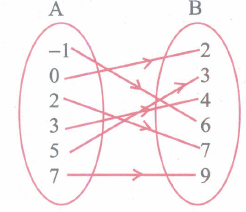
All the elements in A have their separate images in B. All the elements in B have their preimage in A. Therefore it is one-one and onto function.
7.
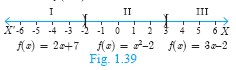
The function f is defined by three values in intervals I, II, III as shown by the side.
For a given value of x = a, find out the interval at which the point a is located, there after find
f(a) using the particular value defined in that interval.
(i) First, we see that, x = 4 lie in the third interval.
Therefore, f(x) = 3x - 2; f(4) = 3(4) = 10
(ii) x = -2 lies in the second interval
Therefore, f(x) = x2 - 2; f(-2) = (-2)2 - 2 = 2
(iii) From (i), f(4) =10.
To find f(1) first we see that x = 1 lies in the second interval.
Therefore, f(x) = x2-2 ⇒ f(1) = 12 - 2 = -1
So, f(4) + 2f(1) = 10 + 2(-1) = 8
(iv) We know that f(1) = -1 and f(4) = 10
For finding f(-3), we see that x = −3, lies in the first interval.
Therefore, f(x) = 2x + 7; thus, f(-3) = 2(-3) + 7 = 1
Hence, \(\frac { f(1)-3f(4) }{ f(-3) } =\frac { -2-3(10) }{ 1 } \) = - 31
8.
The distance travelled by the particle in time t hours is given by S(t)=\(\frac { { t }^{ 2 }+t }{ 2 } \).
(i) t = 3.5 hours. Therefore, S(3.5)=\(\frac { (3.5)^{ 2 }+3.5 }{ 2 } =\frac { 15.75 }{ 2 } \)=7.875
The distance travelled in 3.5 hours is 7.875 kms.
(ii) t = 8.25 hours. Therefore, S(8.25)=\(\frac { (8.25)^{ 2 }+8.25 }{ 2 } =\frac { 76.3125 }{ 2 } \)=38.15625
The distance travelled in 8.25 hours is 38.16 kms, approximately.
9.
(i) To check if h is one – one, we assume that h(b1) = h(b2)
Then we get 2.47b1 + 54.10 = 2.47b2 + 54.10
2.47b1 = 2.47b2
⇒ b1 = b2
Thus, h(b1) = h(b2) ⇒ b1 = b2, So, the function h is one – one.
(ii) If the length of the thigh bone b = 50, then the height is
h(50) = (2.47 x 50) + 54.10 =177.6 cms
(iii) If the height of a person is 147.96 cms, then h(b) = 147.96 and so the length of the thigh bone is given by
2.47b + 54.10 = 147.96.
2. 47 = 147. 96 - 54. 10 = 93. 86
b = \(\frac { 93.86 }{ 2.47 } \)
Therefore, the length of the thigh bone is 38 cm.
10.
A = {1, 2, 3, 4} ; B = {2, 5, 8,11,14}; f(x) = 3x − 1
f(1) = 3(1) –1 = 3 – 1 = 2; f(2) = 3(2) –1 = 6 –1 = 5
f(3) = 3(3) –1 = 9 –1 = 8; f(4) = 4(3) –1 = 12 –1 = 11
(i) Arrow diagram
Let us represent the function f :A ⟶ B by an arrow diagram
(ii) Table form
The given function f can be represented in a tabular form as given below
| x | 1 | 2 | 3 | 4 |
| f(x) | 2 | 5 | 8 | 11 |
(iii) Set of ordered pairs
The function f can be represented as a set of ordered pairs as
f = {(1,2),(2,5),(3,8),(4,11)}
(iv) Graphical form
In the adjacent xy -plane the points
(1,2), (2,5), (3,8), (4,11) are plotted (Fig.1.20).
11.
f(x) = 3x - 5 can be written as f{(x, 3x - 5) |x \(\in \) R }
(a, 4) means the image of a is 4. That is, f(a) = 4
3a - 5 = 4 ⇒ a = 3
(1,b) means the image of 1 is b. That is, f(1) = b ⇒ b =-2
3(1) - 5 = b ⇒ b = -2
12.
The function f : N ⟶ N is defined by f(x) = 3x + 2
(i) If x = 1, f(1) = 3(1) + 2 = 5
If x = 2, f(2) = 3(2) + 2 = 8
If x = 3, f(3) = 3(3) + 2 = 11
The images of 1, 2, 3 are 5, 8, 11 respectively.
(ii) If x is the pre-image of 29, then f(x) = 29, Hence 3x + 2 = 29
3x = 27 ⇒ x = 9
Similarly, if x is the pre-image of 53, then f(x) = 53. Hence 3x + 2 = 53
3x = 51 ⇒ x = 17
Thus the pre-images of 29 and 53 are 9 and 17 respectively.
(iii) Since different elements of N have different images in the co-domain, the function f is a one-one function.
The co-domain of f is N.
But the range of f = {5, 8, 11, 14, 17,....} is a proper subset of N.
Therefore f is not an onto function. That is, f is an into function.
Thus f is a one-one and into function.
13.
Given A = {-2, -1, 0, 1, 2} and f(x) = x2 + x + 1
f(-2) = (-2)2 + (-2) + 1 = 3;
f(-1) = (-1)2 + (-1) + 1 = 1
f(0) = 02 + 0 + 1 = 1;
f(1) = 1 2 + 1 + 1 = 3
f(2) = 22 + 2 + 1 = 7
Therefore, B = {1,3,7}
14.
A = {1, 2, 3}, B = {4, 5, 6, 7}; f = {(1, 4),(2, 5),(3, 6)}
Then f is a function from A to B and for different elements in A, there are different images in B. Hence f is one–one function. Note that the element 7 in the co-domain does not have any pre-image in the domain. Hence f is not onto.
Therefore f is one–one but not an onto function.
15.
The curves in Fig.1.35(a) and Fig.1.35(c) represent a one – one function as the horizontal lines meet the curves in only one point P.
The curve in Fig.1.35(b) does not represent a one–one function, since, the horizontal line meet the curve in two points P and Q.

10th Standard Syllabus & Materials
10th Standard
TN 10th English Prose - 2 - The Night the Ghost Got in Important Questions And Answers Study Material - QB365 Set A
NEW10th Standard
TN 10th English Supplementary - 1 - The Tempest Important Questions And Answers Study Material - QB365 Set A
NEW10th Standard
TN 10th English Poem - 1 - Life Important Questions And Answers Study Material - QB365 Set A
NEW10th Standard
TN 10th English Prose - 1 - His First Flight Important Questions And Answers Study Material - QB365 Set A



Tamilnadu Stateboard 10th Standard Subjects
Tamilnadu Stateboard Standards





