
 100% FREE ACCESS
7th Standard CBSE Syllabus & Materials
7th Standard CBSE
CBSE 7th Social Science Theme E - Understanding Market - New Sample Question Papers Study Material - QB365 Set A
NEW7th Standard CBSE
CBSE 7th Social Science Theme E - From Barter to Money - New Sample Question Papers Study Material - QB365 Set A
NEW7th Standard CBSE
CBSE 7th Social Science Theme D - The Constitution of India- An Introduction - New Sample Question Papers Study Material - QB365 Set A
NEW7th Standard CBSE
CBSE 7th Social Science Theme D - From the Rulers to the Ruled : Types of Governments - New Sample Question Papers Study Material - QB365 Set A
NEW7th Standard CBSE
CBSE 7th Social Science Theme B - The Age of Reorganisation - New Sample Question Papers Study Material - QB365 Set A
NEW7th Standard CBSE
CBSE 7th Social Science Theme B - The Rise of Empires - New Sample Question Papers Study Material - QB365 Set A

Published on: 02/08/2018
From the chapter Inside Our Earth, some of the important questions are covered in this question paper.
Students, subscribe and get plenty of question paper with answer key. For subscription please click here.
Download CBSE Class 7th Standard CBSE Social Science question papers, sample papers, important questions, and previous year solved papers in PDF format. Get free study materials, NCERT solutions, and exam preparation resources for Class 7th Standard CBSE Social Science
Questions + Answers key
Take MCQ Social Science Test
1.
What are the minerals found in your state? Collect some samples to show in your class.
2.
Collect pictures of some monuments and find out which are the rocks used to build them. Three pictures have been collected for you
3.
Differentiate between crust and core
4.
What are minerals? How are they useful for mankind?
5.
What are the uses of rocks?
6.
Name three types of rocks
7.
What are the three layers of the Earth?
8.
The Deccan plateau is made up of
granite
clay
basalt
Both (a) and (c)
9.
Rocks which contain fossils are
sedimentary rocks
metamorphic rocks
igneous rocks
10.
Gold, petroleum and coal are examples of
rocks
minerals
fossils
11.
The innermost layer of the Earth is
crust
core
mantle
12.
The rock which is made up of molten magma is
igneous
sedimentary
metamorphic
13.
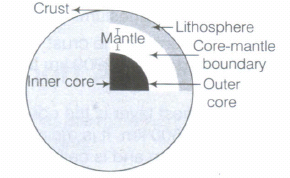
Observe the given picture carefully and answer the questions that follow
(a) What is the uppermost layer of the Earth?
(b) What is the mineral constituent of the oceanic crust?
(c) What is the innermost layer of the Earth?
14.
Explain basic features of the interior of the earth.
15.
Minerals are naturally occurring substances which have certain ..... properties and ..... composition.
16.
The Taj Mahal is made of...........
17.
The Red Fort is made of.........
18.
Igneous and sedimentary rocks can change into ..... rocks.
19.
Any natural mass of mineral matter that makes up the ..... is called a rock.
20.
Name the constituents of oceanic crust.
21.
What are igneous rocks?
22.
What is the Earth's crust made up of?
23.
What is the radius of the core of the Earth?
24.
Name the main mineral constituents of the continental mass.
1.
(i) Red sandstone.
(ii) Students should do this exercise yourself.
Hint: Example of Red sandstone: Silli (stone slab used in roofs of SPS rooms in the foot schools of Delhi).
2.
(a) The Taj Mahal is made up of white marble.
(b) The Red Fort is made up of red sandstone.
(c) The Humayun tomb is made up of red sandstone.
3.
Differences between crust and core are
| Crust | Core |
|---|---|
| It is the uppermost layer of the Earth's surface. | It is the innermost layer of the Earth's surface. |
| The main mineral constituents are silica and alumina i.e. SiAl. | The main mineral constituents are nickel and ferrous i.e. NiFe. |
4.
Minerals are naturally occurring substances which have certain physical properties and definite chemical composition. Minerals are very important to humankind. Some are used as fuels. e.g. coal, natural gas and petroleum. They are also used in industries (iron, aluminium, gold, uranium, etc), in medicine, in fertilisers, etc
5.
Rocks are very useful to us. The hard rocks are used for making roads, houses and buildings.
6.
The three major types of rocks are igneous rocks, sedimentary rocks and metamorphic rocks
7.
Crust, mantle and core are the three types of layers of the Earth.
8.
9.
(b)
metamorphic rocks
10.
(b)
minerals
11.
(b)
core
12.
(a)
igneous
13.
(a) Crust.
(b) Silica and Magnesium (SiMa).
(c) Core is the innermost layer of the Earth
14.
The earth is made up of several concentric layers with one inside another just like an onion. The basic features of the interior of the earth are
(i) Crust It is the uppermost layer over the earth's surface which is the thinnest of all the layers. It is about 35 km on the continental masses and only 5 km on the ocean floors. The continental mass are made up of silica and alumina. It is thus called SiAl (Si-Silica and AI-Alumina). The oceanic crust mainly consists of Silica and Magnesium; it is therefore called SiMa (Si-Silica and Ma-Magnesium.
(ii) Mantle It is just beneath the crust which extends up to a depth of 2900 km below the crust.
(iii) Core The innermost layer is the core with a radius of about 3500 km. It is mainly made up of Nickel and Iron and is called NiFe (Ni-Nickel and Fe-Ferrous i.e. iron). The central core has very high temperature and pressure.
15.
()
physical, definite chemical
16.
()
white marble
17.
()
red sandstone
18.
()
metamorphic
19.
()
Earth's crust
20.
()
The oceanic crust mainly consists of silica and magnesium, it is therefore called SiMa (Si-Silica and Ma-Magnesium).
21.
()
When the molten magma cools, it becomes solid. Rocks thus formed are called igneous rocks. e.g. basalt.
22.
()
The Earth's crust is made of different types of rocks.
23.
()
The radius of the core is 3500 km.
24.
()
The continental mass are made up of silica and alumina. It is thus called SiAl (Si-Silica and AI-Alumina)

7th Standard CBSE Syllabus & Materials
7th Standard CBSE
CBSE 7th Social Science Theme B - New Beginnings : Cities and States - New Sample Question Papers Study Material - QB365 Set A
NEW7th Standard CBSE
CBSE 7th Social Science Theme A - Climates of India - New Sample Question Papers Study Material - QB365 Set A
NEW7th Standard CBSE
CBSE 7th Social Science Theme A - Geographical Diversity of India - New Sample Question Papers Study Material - QB365 Set A
NEW7th Standard CBSE
CBSE 7th Science Earth, Moon and the Sun - New Sample Question Papers Study Material - QB365 Set A



CBSE 7th Standard CBSE Subjects
CBSE Standards




