
 100% FREE ACCESS
10th Standard CBSE Syllabus & Materials
10th Standard CBSE
CBSE 10th Social Science ECO - Globalisation and the Indian Economy - New Model Questions Papers Study Material - QB365 Set A
NEW10th Standard CBSE
CBSE 10th Social Science ECO - Money and Credit - New Model Questions Papers Study Material - QB365 Set A
NEW10th Standard CBSE
CBSE 10th Social Science ECO - Sectors of the Indian Economy - New Model Questions Papers Study Material - QB365 Set A
NEW10th Standard CBSE
CBSE 10th Social Science ECO - Development - New Model Questions Papers Study Material - QB365 Set A
NEW10th Standard CBSE
CBSE 10th Social Science PS - Outcomes of Democracy - New Model Questions Papers Study Material - QB365 Set A
NEW10th Standard CBSE
CBSE 10th Social Science PS - Gender, Religion and Caste - New Model Questions Papers Study Material - QB365 Set A

Published on: 29/12/2018
Class X Model Question
Download CBSE Class 10th Standard CBSE Maths question papers, sample papers, important questions, and previous year solved papers in PDF format. Get free study materials, NCERT solutions, and exam preparation resources for Class 10th Standard CBSE Maths
Questions + Answers key
Take MCQ Maths Test
1.
The king, queen and jack of clubs are removed from a pack of 52 playing cards and then the remaining pack is well shuffled. One card is selected from the remaining cards. Find the probability of getting:
(i) a heart,
(ii) a king,
2.
Evaluate : \(\frac { \cos { { 45 }^{ ° } } }{ \sec { { 30 }^{ ° } } } +\frac { 1 }{ \sec { { 60 }^{ ° } } } \)
3.
Solve the following quadratic equation for x :
x2-2ax-(4b2-a2)=0
4.
If m and n are the zeroes of the polynomial 3x2 + 11x - 4, find the value of \(\frac{m}{n}+\frac{n}{m}\)
5.
A solid ball is exactly fitted inside the cubical box of side a. What is the volume of remaining space inside the cubical box?
6.
A rectangular field is 20 m long and 14 m wide. There is path of equal width all around it. having an area of 111 sq.m. Find the width of the path.
7.
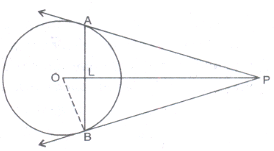
In the given figure, AB is a chord of length 16 cm, of a circle of radius 10 cm. Tangents at A and B intersect at a point P. Find the length of tangent AP.
8.
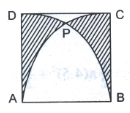
In the adjoining figure, ABCD is a square of side 6cm.Find the area of the shaded region.
9.
Write the volume of a sphere of radius r.
10.
The circumference of a circular field and perimeter of a square field are equal.If the area of the square field is 484m2, then find the length of the diameter of the circular field.
11.
Find the area of a triangle with vertices A (3,0), B(7,0) and C(8,4).
12.
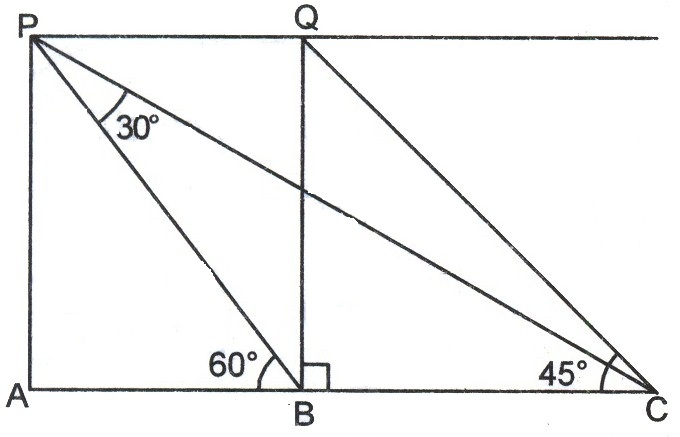
From the figure, find the angle of depression of point C from the point P.
13.
Find the sum of : (i) the first 1000 positive integers (ii) the first n positive integers
14.
If 7 times the 7th term of A.P. is equal to 11 times the 11th term, then find the 18th term.
15.
The probability that it will rain tomorrow is 0.85. What is the probability that it will not rain tomorrow?
16.
Find the roots of quadratic equation \(25x^{2}+20x+7 = 0\) .
17.
A quadrilateral ABCD is drawn to circumscribe a circle.If AB = 12 cm, BC = 15 cm and CD = 14 cm, find AD
18.
Which of the following are AP's ? If they form an AP, then find the common difference d and write three more terms.. 2, \(\frac{5}{2}\) , 3, \(\frac{7}{2}\).......
19.
Find the mean of the following distribution using step deviation method
| Class | 20-30 | 30-40 | 40-50 | 50-60 | 60-70 |
| Frequency | 25 | 40 | 42 | 33 | 10 |
20.
Find the value of sin 60° geometrically.
21.
In the given figure, P and Q are the points on the sides AB and AC respectively of \(\triangle\) ABC, such that AP = 3.5 em, PB = 7 em, AQ = 3 cm and QC = 6 cm. If PQ = 4.5 cm, find BC.
22.
Find the value of k for which the following pair of equations has no solution:
x + 2y = 3, (k-1)x + (k +1)y = (k + 2).
23.
Fin he HCF of 180, 252 and 324 by Euclid's Division algorithm.
24.
A square of side 5 cm is drawn in the interior of another square of side 10 cm and shaded as shown in the following figure.
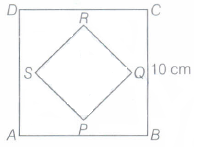
A point is selected at random from the interior of square ABCD. What is the probability that the point will be chosen from the shaded part?
25.
Tangents AP and AQ are drawn to circle with centre O from an external point A.Prove that ㄥPAQ = 2ㄥOPQ.
26.
In the given figure, AC = 24 cm, BC = 10 cm and O is the centre of the circle. Find the area of the shaded region. [Take, \(\pi =3.14\)].
27.
Show that quadrilateral PQRS formed by vertices P(22, 5), Q(7, 10), R(12, 11) and S(3, 24) is not a parallelogram.
28.
How many metres of cloth 1.1 m wide will be required to make a conical tent, whose vertical height is 12 m and base radius is 16 m ? Find also the cost of the cloth used at the rate of Rs. 14 per metre.
29.
Construct a triangle ABC in which BC = 6 cm, AB = 5 cm and angle ABC = 60o. Then construct another triangle whose sides are \(\frac { 3 }{ 4 } \) times the corresponding sides of triangle ABC.
30.
The shadow of a flagstaff is three times as long as the shadow of the flagstaff when the sunrays meet the ground at an angle of 60o . Find the angle between the sunrays and the ground at the time of longer shadow.
31.
The houses in a row are numbered consecutively from 1 to 49. Show that there exists a value of x such that sum of numbers of houses preceding the house numbered x is equal to sum of the numbers of houses following x
32.
If A, B and C are interior angles of a \(\triangle ABC,\) show that \(\sin { \left( \frac { B+C }{ 2 } \right) } =\cos { \frac { A }{ 2 } } .\)
33.
If the zeroes of the polynomial x3-3x2+x+1 are a-b and a+b, then find a and b.
34.
If HCF (253, 440) = 11 and LCM (253, 440) = 253 x R. Find the value of R.
35.
Find the common difference and the next two terms of the AP : 6,12,18,...
36.
A horse is tethered to one corner of a field which is the shape of an equilateral triangle of side 16 m of the length of the rope is 10.5 m, find the area of the field which the horse cannot graze.
37.
Find the area of the triangle ABC with A(1,-4) and the mid-points of sides through A being (2,-1) and (0,-1).
38.
PA and PB are two tangents from an exterior point P to a circle of radius 5 cm. If length of the chord AB is 8 cm, then find the length of the tangent.
39.
A man standing on the bank of a river observes that the angle of elevation of a tree opposite bank is 600.When he moves 50m away from the bank, he find the angle of elevation to be 300.Calculate:
(i)the width of the river and
(ii)the height of the tree
1.
(i) Remaining cards = 52 - 3 = 49
p(heart) =\(\frac {13}{14}\)
(ii) Remaining cards = 52 - 3 = 49
p(king) =\(\frac {3}{49}\)
2.
\(\frac { \cos { { 45 }^{ ° } } }{ \sec { { 30 }^{ ° } } } +\frac { 1 }{ \sec { { 60 }^{ ° } } } =\frac { \frac { 1 }{ \sqrt { 2 } } }{ \frac { 2 }{ \sqrt { 3 } } } +\frac { 1 }{ 2 } \)
\(=\frac { 1 }{ \sqrt { 2 } } \times \frac { \sqrt { 3 } }{ 2 } +\frac { 1 }{ 2 } \)
\(=\frac { \sqrt { 6 } }{ 4 } +\frac { 1 }{ 2 } \)
\(=\frac { \sqrt { 6 } +2 }{ 4 } \)
3.
x2-2ax-(4b2-a2)=0
Given equation can be written as
x2-2ax-+a2-4b2=0
or (x-a)2(2b)2=0
(x-a+2b)(x-a-2b)=0
x=a-2b,x=a+2b
4.
Let p(x) = 3x2 + 11x - 4
= 3x2 + 12x - x - 4
= 3x(x + 4) - 1(x + 4)
= (3x - 1)(x + 4)
So, zeroes are \(m=\frac{1}{3}\) and n = - 4
Now, \(\frac { m }{ n } +\frac { n }{ m } =\frac { \left( \frac { 1 }{ 3 } \right) }{ -4 } +\frac { -4 }{ \left( \frac { 1 }{ 3 } \right) } =\frac { 1 }{ -12 } -12\)
\(=\frac{-145}{12}\)
5.
Diameter of solid ball =Length of edge of cubical box = a
\(\therefore\) Volume of remaining space inside the box=Volume of cubical box-Volume of solid ball.
\(\sqrt { 3 } :\frac { a^{ 3 } }{ 6 } (6-\pi )\)
6.
Area of path = (Area of the field including the path) - (Area of the field encluding the path)
1.5 m.
7.
Let O be the centre of a circle of radius 10 cm.
Here, chord AB = 16 cm
Since OP bisects chord AB
ஃ AL = LB = 8 cm
Consider rt, \(\angle \)ed \(\triangle\)OLB, by using Pythagoras Theorem,
we have OL2 = OB2 - LB2
= 102 - 82 = 100 - 64 = 36
OL = 6 cm
Let PL be x cm
ஃ OP = OL + PL = (6+x)cm
In rt ed BLP, we have
PB2 = BL2 + PL2
PB2 = 82 + x2 ........(i)
⇒ x2 = PB2 - 64
Again, in rt, \(\angle \)ed \(\triangle\)OBP, we have
PB2 = OP2 - OB2
PB2 = (6 x)2 - 102 ......(ii)
From (i) and (ii), we obtain
(6+x)2 - 100 = 64 + x2
36 + x2 + 12x - 100 - 64 - x2 = 0
12x - 128 = 0
\(x={128\over12}={32\over3}cm\)
From (i), we have
PB2 = 64 + \(({32\over3})^2\)
PB2 = \(64+{1024\over9}={576+1024\over9}={1600\over9}\)
PB = \(40\over3\) cm
8.
From P, draw PQ⊥AB, join PA and PB,
In ΔAPQ and Δ BPQ, we have
AP = BP = 6cm
PQ = PQ
ㄥAQP = ㄥBQP=900
⇒ ΔAPQ ~ Δ BPQ
Therefore, \(AQ = BQ={1\over 2}AB\)
\(⇒\ AQ=BQ=3cm\)
Let ㄥPBQ=θ
-S.png)
∴ In rt. Δ QBP, ㄥQ=900
\(⇒\ cos\theta={QB\over PB}\)
\(cos\theta={3\over 6}={1\over 2}\)
⇒ cos θ = cos600
⇒ θ=600
Also, \({PQ\over PB}=sin60^0\)
\(PQ=6\times{\sqrt3\over2}=5.196cm...(i)\)
Now, area of sector BPA=\({60^0\over360^0}\times{22\over 7}\times6\times6\)
=18.857cm2
Area of the portion APB
= 2 X [Area of sector BPA - Area of ΔBPQ]
= 2 x [18.857 - 7.7941= 22.126cm2
Area of the shaded portion = 2 x [Area of quadrant ABC — Area of the portion APB]
\(=2\times\left[{90^0\over 360^0}\times{22\over 7}\times6\times6-22.126\right]\)
=2 x [28.286-22.126]
=12.32cm2
Hence, the required area of the shaded portion is 12.32cm2
9.
\(\frac { 4 }{ 3 } \pi { r }^{ 3 }\)
10.
Area of square field = 484 m2
∴ Side x Side = 22 x 22
⇒ Side = 22 m
∴ Perimeter of square field = 4 X 22 = 88 m
Since circumference of circular field = Perimeter of square field
\(\Rightarrow \pi d=88\Rightarrow \frac { 22 }{ 7 } d=88\)
\(\Rightarrow d=88\times \frac { 7 }{ 22 } =28m\)
Hence, the length of the diameter of the circular field is 28 m.
11.
Area of the required \(\triangle\)ABC
\(=\frac { 1 }{ 2 } \left| 3(0-4)+7(4-0)+8(0-0) \right| \\ =\frac { 1 }{ 2 } \left| 28-12 \right| =8sq.units\)
12.
\(\angle\)BPQ = \(\angle\)ABP
\(\angle\)BPQ = 60o
\(\Rightarrow\) \(\angle\)CPQ + \(\angle\)BPC = 60o
\(\Rightarrow\) \(\angle\)CPQ + 300 = 60o
\(\Rightarrow\) \(\angle\)CPQ = 600 - 300 = 30o
13.
(i) Let S = 1 + 2 + 3 + . . . + 1000
Using the formula \(\mathrm{S}_{n}=\frac{n}{2}(a+l)\) for the sum of the first n terms of an AP, we have
\(S_{1000}=\frac{1000}{2}(1+1000)=500 \times 1001=500500\)
So, the sum of the first 1000 positive integers is 500500.
(ii) Let Sn = 1 + 2 + 3 + . . . + n
Here a = 1 and the last term l is n.
Therefore, \(\mathrm{S}_{n}=\frac{n(1+n)}{2} \text { or } \mathrm{S}_{n}=\frac{n(n+1)}{2}\)
So, the sum of first n positive integers is given by
\(\mathrm{S}_{n}=\frac{n(n+1)}{2}\)
14.
0
15.
probability that it will not rain tomorrow
= 1 - Probability that it will rain tomorrow = 1 - 0.85 = 0.15
16.
no real root
17.
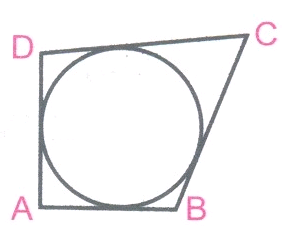
Now, AB + CD = BC + AD
⇒12 + 14 = 15 + AD
⇒ AD = 11 cm
18.
Here, we have
\(a_{2}-a_{1}=\frac{5}{2}-2=\frac{5-4}{2}=\frac{1}{2}\),
\(a_{3}-a_{2}=3-\frac{5}{2}=\frac{6-5}{2}=\frac{1}{2}\)
\(a_{4}-a_{3}=\frac{7}{2}-3=\frac{7-6}{2}=\frac{1}{2}\) and so on.
Since, the difference of any two consecutive terms is same. therefore, the given list of numbers forms an AP and its common difference (d) is \(\frac{1}{2}\).
Now, next three terms of this AP are,
a5 = a4 + d = \(\frac{7}{2}+\frac{1}{2}\)
[\(\because\) a5 = a + 4d = a + 3d + d = a4 + a5]
\(=\frac{7+1}{2}=\frac{8}{2}=4\)
\(a_{6}=a_{5}+d=4+\frac{1}{2}=\frac{9}{2}\)
and \(a_{7}=a_{6}+d=\frac{9}{2}+\frac{1}{2}=\frac{9+1}{2}=\frac{10}{2}=5\)
19.
| Class | Class Marks xi | \(u_{ i }=\frac { x_{ i }-A }{ h } \) | fi | fiui |
| 20-30 | 25 | \(-\frac { 20 }{ 10 } =-2\) | 25 | -50 |
| 30-40 | 35 | \(-\frac { 10 }{ 10 } =-1\) | 40 | -40 |
| 40-50 | 45=A | 0=0 | 42 | 0 |
| 50-60 | 55 | \(\frac { 10 }{ 10 } =1\) | 33 | 33 |
| 60-70 | 65 | \(\frac { 20 }{ 10 } =2\) | 10 | 20 |
| \(\Sigma f_{ i }=150\) | \(\Sigma f_{ i }u_{ i }=-37\) |
Mean = A+ \(\frac { \Sigma f_{ i }u_{ i } }{ \Sigma f_{ i } } \times h\)
= 45 + \(45+\left( \frac { -37 }{ 150 } \right) \times 10\)
= 42.5 approx
20.
Let \(\triangle ABC\) be an equilateral triangle, then
AB = BC = AC = 2a
AD \(\bot\) BC
Also AD is median,
CD = a = BD
\(\angle A=\angle B=\angle C\) = 60°
In \(\triangle ADC\), AC = 2a
DC = a
\(\therefore \quad AD=\sqrt { { \left( 2a \right) }^{ 2 }-{ \left( a \right) }^{ 2 } } =\sqrt { { 3a }^{ 2 } } \)
\(=\sqrt { { 3a } } \)
\(\therefore \quad \sin { { 60 }^{ ° } } =\frac { AD }{ AC } =\frac { \sqrt { { 3a } } }{ 2a } \)
\(\Rightarrow \quad \sin { { 60 }^{ ° } } =\frac { \sqrt { { 3 } } }{ 2 } \)
21.
\(\frac { AP }{ AB } =\frac { 3.5 }{ 10.5 } =\frac { 1 }{ 3 } \)
\(\Rightarrow \frac { AQ }{ AC } =\frac { 3 }{ 9 } =\frac { 1 }{ 3 } \)
In \(\triangle\)ABC, \( \frac { AP }{ AB } =\frac { AQ }{ AC } \)and \(\angle\)A is common
\(\triangle\)APQ~\(\triangle\)ABC (By SAS)
\(\therefore \frac { AP }{ AB } =\frac { AQ }{ BC } \)
\(\Rightarrow \frac { 1 }{ 3 } =\frac { 4.5 }{ BC } \Rightarrow BC=13.5 cm.\)
22.
For x + 2y = 3
a1 = 1, b1 = 2 ,c1 = - 3
For (k-1)x + (k +1)y= (k + 2)
a2 = (k - 1), b2= (k + 1), c2 = - (k + 2)
For no solution, \(\frac { { a }_{ 1 } }{ { a }_{ 2 } } =\frac { { b }_{ 1 } }{ { b }_{ 2 } } \neq \frac { c_{ 1 } }{ { c }_{ 2 } } \)
\(\Rightarrow \quad \frac { 1 }{ k-1 } =\frac { 2 }{ k+1 } \neq \frac { 3 }{ k+2 } \)
I II III
From I and II, \(\frac { 1 }{ k-1 } =\frac { 2 }{ k+1 } \)
\(\Rightarrow\) k + 1 = 2k - 2
\(\therefore\) k = 3
From II and III, \(\frac { 2 }{ k+1 } \neq \frac { 3 }{ k+2 } \)
\(\Rightarrow\) 2(k + 2) \(\neq\) 3(k + 1)
\(\Rightarrow\) 2k+4\(\neq\)3k+3
\(\therefore\) k \(\neq\) 1
From I and III, \(\frac { 1 }{ k-1 } \neq \frac { 3 }{ k+2 } \)
\(\Rightarrow \quad k+2\neq 3k-3\)
\(\therefore \quad k\neq -\frac { 5 }{ 2 } \)
Hence, k = 3 but k \(\neq\)1 and \(\\ \\ k\neq -\frac { 5 }{ 2 } \)
23.
HCF of 324 and 252 = 36
HCF of 36 and 180 = 36
∴ HCF of 180, 252 and 324 is 36
24.
Area of the square ABCD=(BC)2=102=100 cm2
Now, the area of the square PQRS=(side)2=(5)2=25 cm2
P(the point will be chosen from the shaded part)
=\(\frac { Area \ of \ the \ square \ PQRS }{ Area \ of \ the \ square \ ABCD } =\frac { 25 }{ 100 } =0.25\)
25.
Given A circle of centre O. Two tangents AP and AQ are drawn to the circle from an external point A.

To prove ㄥPAQ = 2ㄥOPQ
Construction Join OPand OQ.
Proof We know that, tangents drawn from an external point to a circle are equal in length.
AP = AQ
ㄥAPQ=ㄥAQP=x
In ∆APQ, ㄥPAQ = 1800-(ㄥAPQ+ㄥAQP)
= 180° - (x + x)
= 180° - 2x
∵ OP丄AP
∴ ㄥOPA=900 ⇒ ㄥOPQ+ㄥAPQ=900
⇒ ㄥOPQ + x = 900
⇒ ㄥOPQ = 900 - x
⇒ 2ㄥOPQ = 1800 - 2x
From Eqs. (i) and (ii), we have
ㄥPAQ = 2ㄥOPQ
26.
Given, AC = 24 cm, BC = 10cm and AOB is a diameter.
Here, \(\angle ACB={ 90 }^{ o }\) [since, angle in semi - circle is right angle]
In right angled delta ACB,
\(AB=\sqrt { { AC }^{ 2 }+{ BC }^{ 2 } } \) [by Pythagoras theorem]
\(=\sqrt { { 24 }^{ 2 }+{ 10 }^{ 2 } } \\ =\sqrt { 576+100 } =\sqrt { 676 } =26\quad cm\)
Therefore, Radius of circle, \(r=\frac { AB }{ 2 } =\frac { 26 }{ 2 } =13cm\)
= Area of semi-circle - Area of delta ABC
\(=\frac { 1 }{ 2 } \times { \pi r }^{ 2 }-\frac { 1 }{ 2 } \times BC\times AC\\ =\frac { 1 }{ 2 } \times 3.14\times 13\times 13-\frac { 1 }{ 2 } \times 10\times 24\\ =\frac { 530.66 }{ 2 } -120=265.33-120=145.33{ cm }^{ 2 }\)
Hence, the area of the shaded region is 145.33 cm2
27.
Given vertices of a quadrilateral are P(22, 5), Q(7, 10), R(12, 11) and S(3, 24).
Now, PQ = \(\sqrt { { (7-22) }^{ 2 }+{ (10-5) }^{ 2 } } \) [\(\because \) distance=\(\sqrt { { \left( { x }_{ 2 }-{ x }_{ 1 } \right) }^{ 2 }-{ \left( { y }_{ 2 }-{ y }_{ 1 } \right) }^{ 2 } } \)]
=\(\sqrt { { (-15) }^{ 2 }+{ (5) }^{ 2 } } =\sqrt { 225+25 } \)
=\(\sqrt { 250 } =5\sqrt { 10 } \quad \) units
QR = \(\sqrt { { (12-7) }^{ 2 }+{ (11-10) }^{ 2 } } =\sqrt { { \left( 5 \right) }^{ 2 }+{ \left( 1 \right) }^{ 2 } } =\sqrt { 25+1 } =\sqrt { 26 } \) units
RS =\(\sqrt { { (3-12) }^{ 2 }+{ (24-11) }^{ 2 } } =\sqrt { { \left( -9 \right) }^{ 2 }+{ \left( 13 \right) }^{ 2 } } \)
= \(\sqrt { 81+169 } =\sqrt { 250 } =5\sqrt { 10 } \) units
and SP = \(\sqrt { { (22-3) }^{ 2 }+{ (5-24) }^{ 2 } } =\sqrt { { \left( 19 \right) }^{ 2 }+{ \left( -19 \right) }^{ 2 } } \)
= \(19\sqrt { 1+1 } =19\sqrt { 2 } \) units
Here, we see that opposite sides of a parallelogram are not equal i.e. \(QR\neq SP\)Hence, given vertices of a parallelogram are not formed a parallelogram.
Hence proved.
28.
914.29 m, Rs. 12800.06
29.
Given: ΔABC in which BC = 6 cm, AB = 5 cm and ∠ABC = 60o.
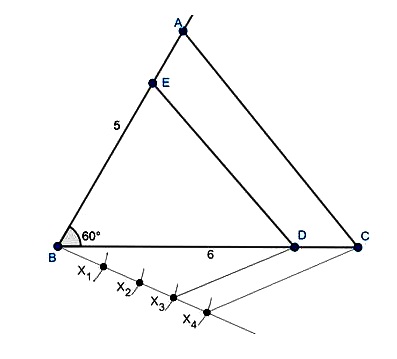
Required: ΔA'BC ∼ ΔABC with \(\frac { 3 }{ 4 } \) (reduced) scale-factor.
Steps of Construction :
1. Draw line segment BC = 6 cm.
2. At B, construct an angle ∠CBY = 60o.
3. With B as centre cut off BA = 5 cm and join AC.
4. Through B, construct an acute angle ∠CBX (<90o).
5. Mark four points B1, B2, B3 and B4 such that BB1 = B1B2 = B2B3 = B3B4.
6. Join B4C.
7. Through B3, draw B3C'||B4C, intersecting BC in C'.
8. Through C', draw C'A'||CA, intersecting BA in A'. Hence, ΔA'BC' is the required triangle.
30.
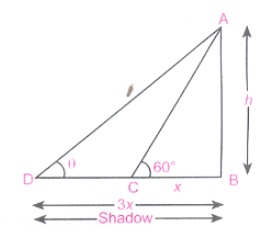
In rt. ΔABC, tan60o = \(\frac { AB }{ BC } =\frac { h }{ x } \)
⇒ \(\sqrt { 3 } =\frac { h }{ x } \Rightarrow h=\sqrt { 3 } x\)
In rt. ∆ABD, tanፀ = \(\frac { AB }{ BD } \)
⇒ tanፀ = \(\frac { h }{ 3x } \)
⇒ tanፀ = \(\frac { \sqrt { 3 } x }{ 3x } =\frac { 1 }{ \sqrt { 3 } } \)⇒ ፀ = 30o
31.
The arrangement of houses is
1,2,3, ..............x-I, x, x + 1,...... 49.
S1= 1 + 2 + 3 + ...x-I
\(=\left( \frac { x-1 }{ 2 } \right) \left\lfloor 2\times 1+(x-2)1 \right\rfloor \)
\(=\left( \frac { x-1 }{ 2 } \right) [x]\)
\(=\frac { x(x-1) }{ 2 } \)
\(S_{ 2 }=x+1,x+2..49\)
\(= \frac { \left( 49-x \right) }{ 2 } [2(x+1)+(49-x-1])\)
32.
We know that, sum of all angles of a triangle is equal to 1800 .
i .e . A + B + C = 1800
\(\Rightarrow \frac { A }{ 2 } +\frac { B }{ 2 } +\frac { C }{ 2 } ={ 90 }^{ 0 }\) [on dividing both sides by 2]
\(\Rightarrow \frac { B }{ 2 } +\frac { C }{ 2 } ={ 90 }^{ 0 }-\frac { A }{ 2 } \)
On taking sin both sides, we get
\(\sin { \left( \frac { B+C }{ 2 } \right) } =\sin { \left( { 90 }^{ 0 }-\frac { A }{ 2 } \right) } \)
\(\sin { \left( \frac { B+C }{ 2 } \right) } =\cos { \frac { A }{ 2 } } \left[ \because \sin { ({ 90 }^{ 0 }-\theta ) } =\cos { \theta } \right] \)
Hence proved.
33.
Given, (a-b),a and (a+b) are the zeroes of the polynomial x3-3x2+x+1.
On comparing given polynomial with
Ax3+Bx2+cx2+D, we get
A=1, B=-3, C=1 and D=1
Now, sum of zeroes=(a-b)+a+(a+b)=-B/A
⇒ \(3a=\frac { -(-3) }{ 1 } =3\) [∵ B=-3, A=1]
⇒ 3A=3⇒A=1
Sum of product of zeroes taken two at a time
=a(a-b)+a(a+b)+(a+b)(a-b)=\(\frac { C }{ A } \)
⇒ a2-ab+a2+ab+a2-b2=1/1 [∵ C=1, A=1]
⇒ 3a2-b2=1⇒3(1)2-b2=1 [from Eq.(i)]
⇒ 3-b2=1⇒b2=2⇒b=\( \pm \sqrt { 2 } \)
Hence, a=1 and b=\( \pm \sqrt { 2 } \)
34.
Given, HCF (253, 440) = 11 and LCM (253, 440)
= 253 x R
\(\therefore LCM(253,440)=\frac { 253\times 440 }{ HCF(253,440) } \)
\(\Rightarrow 253\times R=\frac { 253\times 440 }{ 11 } \)
R = 40
35.
d = 6, The next two terms are 24 and 30.
36.
\(\left( 64\sqrt { 3 } -\frac { 231 }{ 4 } \right) { m }^{ 2 }\)
37.
Let the coordinates of B and C be (a,b) and (x,y) respectively
Then \(\left( \frac { 1+a }{ 2 } ,\frac { -4+b }{ 2 } \right) \) =(2.-1)
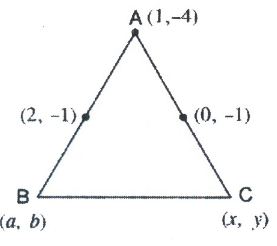
\(\Rightarrow \) \(\frac { 1+a }{ 2 } =2\quad and\quad \frac { -4+b }{ 2 } =-1\)
\(\Rightarrow \) 1+a=4 and -4+b=-2
\(\Rightarrow \) a=3 and b=2
Also \(\left( \frac { 1+x }{ 2 } ,\frac { -4+y }{ 2 } \right) \)=(0,-1)
\(\Rightarrow \) \(\frac { 1+x }{ 2 } =0\quad and\quad \frac { -4+y }{ 2 } =-1\)
\(\Rightarrow \) 1+x=0 and -4+y=-2
\(\Rightarrow \) x=-1 and y=2
Thus the coordinates of the vertices of ABC are A(1,-4),B(3,2) and C(-1,2)
Area of ABC =\(\frac { 1 }{ 2 } \) |1(2-2)+3(2+4)+(-1)(-4-2)|
= \(\frac { 1 }{ 2 } \)|0+18+6|
= \(\frac { 1 }{ 2 } \)(24)=12 sq.units
38.
\(6\frac { 2 }{ 3 } \)cm
39.
(i)50m
(ii)2.13m

10th Standard CBSE Syllabus & Materials
10th Standard CBSE
CBSE 10th Social Science PS - Federalism - New Model Questions Papers Study Material - QB365 Set A
NEW10th Standard CBSE
CBSE 10th Social Science PS - Power Sharing - New Model Questions Papers Study Material - QB365 Set A
NEW10th Standard CBSE
CBSE 10th Social Science GEO - Manufacturing Industries - New Model Questions Papers Study Material - QB365 Set A
NEW10th Standard CBSE
CBSE 10th Social Science GEO - Minerals and Energy Resources - New Model Questions Papers Study Material - QB365 Set A



CBSE 10th Standard CBSE Subjects
CBSE Standards





