
 100% FREE ACCESS
11th Standard CBSE Syllabus & Materials
11th Standard CBSE
CBSE 11th Economics PART-A - Presentation of Data - New Sample Question Papers Study Material - QB365 Set A
NEW11th Standard CBSE
CBSE 11th Economics PART-A - Organisation of Data - New Sample Question Papers Study Material - QB365 Set A
NEW11th Standard CBSE
CBSE 11th Economics PART-A - Collection of Data - New Sample Question Papers Study Material - QB365 Set A
NEW11th Standard CBSE
CBSE 11th Economics PART-A - Introduction to Economics and Statistics - New Sample Question Papers Study Material - QB365 Set A
NEW11th Standard CBSE
CBSE 11th Business Studies International Trade Sample Question Papers Study Material - QB365 Set A
NEW11th Standard CBSE
CBSE 11th Business Studies Evolution and Fundamentals of Business Sample Question Papers Study Material - QB365 Set A

Published on: 15/02/2019
Structure of Atom Important Questions
Download CBSE Class 11th Standard CBSE Chemistry question papers, sample papers, important questions, and previous year solved papers in PDF format. Get free study materials, NCERT solutions, and exam preparation resources for Class 11th Standard CBSE Chemistry
Questions + Answers key
Take MCQ Chemistry Test
1.
An electron beam after hitting a neutral crystal produces a diffraction pattern? What do you conclude?
2.
What is the difference between ground state and excited state?
3.
Calculate the approximate charge in coulomb and approximate mass in kilogram of the nucleus of lithium 7 isotope.
4.
In Rutherford’s experiment, generally the thin foil of heavy atoms, like gold, platinum etc. have been used to be bombarded by the α-particles. If the thin foil of light atoms like aluminium etc. is used, what difference would be observed from the above results ?
5.
The unpaired electrons in Al and Si are present in 3p orbital. Which electrons will experience more effective nuclear charge from the nucleus ?
6.
A hydrogen atom has only one electron, so mutual repulsion between electrons is absent. However, in multielectron atom mutual repulsion between the electrons is significant.
How does this affect the energy of an electron in the orbitals of the same principle quantum number in a multielectron atom?
7.
What must be the velocity of a beam of electrons if they are to display a de-Broglie wavelength of 10-8m?
8.
Write the electronic configurations of the following ions.
a) H-
b) Na+
c) O2-
d) F-
9.
Indicate the number of unpaired electrons in : (a) P, (b) Si, (c) Cr, (d) Fe and (e) Kr.
10.
Dual behaviour of matter proposed by de Broglie led to the discovery of electron microscope often used for the highly magnified images of biological molecules and other type of material. If the velocity of the electron in this microscope is 1.6 × 10⁶ ms–1, calculate de Broglie wavelength associated with this electron.
11.
How are \({ d }_{ xy }\ \)and \(d{ x }^{ 2 }-{ y }^{ 2 }\) orbitals related?
12.
The bromine atom possesses 35 electrons. It contains 6 electrons in 2p orbital, 6 electrons in 3p orbital and 5 electron in 4p orbital. Which of these electron experiences the lowest effective nuclear charge ?
13.
Nitrogen laser produces a radiation at a wavelength of 337.1 nm. If the number of photons emitted is 5.6 × 1024, calculate the power of this laser.
14.
(i) The energy associated with the first orbit in the hydrogen atom is –2.18 × 10⁻¹⁸ J atom–1. What is the energy associated with the fifth orbit?
(ii) Calculate the radius of Bohr’s fifth orbit for hydrogen atom.
15.
Explain why uncertainty principle is significant only for the motion of sub-atomic particle but is negligible for the macroscopic objects?
16.
Wavelengths of different radiations are given below.
\(\lambda (A)=300\ nm,\ \lambda (B)=300\ \mu m,\ \lambda (C)=\ 3\ nm,\lambda (D)=30\overset { \circ }{ A } \)
Arrange these radiations in the increasing order of their energies.
17.
The magnitude of charge on the electron is \(4.8\times { 10 }^{ -10 }\) esu. What is the charge on the nucleus of a helium atom?
18.
Neutrons can be found in all atomic nuclei except in one case. Which is this atomic nucleus and what does it consist of ?
19.
Which of the following will not show deflection from the path on passing through an electric field? Proton, cathode rays, electron, neutron
20.
Calculate the de Broglie wavelength of an electron moving with 1% of the speed of light?
21.
The quantum number of six electrons are given below. Arrange them in order of increasing energies. if any of these combinations(s) has/have the same energy lists \(n=4,l=1,{ m }_{ 1 }=0{ ,m }_{ s }=+\frac { 1 }{ 2 } \)
22.
What is the total number of orbitals associated with the principal quantum number n = 3 ?
23.
How many electrons in an atom may have the following quantum numbers?
(a) n = 4, ms = – ½
(b) n = 3, l = 0
24.
According to de-Broglie, matter should exhibit dual behaviour, that is both particle and wave like properties.However, a cricket ball of mass 100g does not move like a wave when it is thrown by a bowler at a speed of 100km/h.Calculate the wavelength of the ball and explain why it does not show wave nature?
25.
State and explain the following:
(i) Aufbau principle
(ii) Pauli exclusion principle.
(iii) Hund's rule of maximum multiplicity.
26.
Find (a) the total number and (b) the total mass of protons in 34 mg of NH3 at STP. (Mass of 1p = 1.6726 x 10⁻²⁷kg)
Will the answer change if the temperature and pressure are changed?
27.
If the velocity of the electron in Bohr's first orbit is 2.19 x 10⁶ ms-1 , calculate the de-Broglie wavelength associated with it.
28.
Which of the following orbitals are possible? 1p, 2s, 2p and 3f.
29.
A photon of wavelength 4 x 10⁻⁷ m strikes on the metal surface, the work function of the metal being 2.13 eV.
(a) Calculate the kinetic energy of the emission.
(b) Calculate the velocity of the photoelectron (1 eV = 1.6020 x 10⁻¹⁹ J).
30.
The Balmer series in the spectrum of hydrogen atom falls in _______.
ultraviolet region
visible region
infrared region
none of these
1.
Electron has wave nature.
2.
Ground state means the lowest energy state. When the electrons absorb energy and jump to outer orbits, this state is called excited state.
3.
Nucleus of Li atom has 3 protons and 4 neutrons.
Charge on one proton =1.60 x 10⁻¹⁹ coulombs
Charge on 3 protons (i.e. charge on nucleus)
= \(3\times 1.60\times 10^{ -19 }C=4.80\times 10^{ -19 }C\)
Mass of proton mass of neutron \(\simeq 1.67\times 10^{ -27 }kg\)
Mass of nucleus = \(7\times 1.67\times 10^{ -27 }kg\)
= \(11.69\times 10^{ -27 }kg\)
4.
Heavy atoms such as gold, platinum have nucleus. Heavy nucleus contains large amount of positive charge. When a beam of \(\alpha \)-particles is shot at a thin gold foil, most of them pass through without much effect.
Some however, are deflected back or by small angles due to enormous repulsive force of heavy nucleus. If light aluminium foil is used, the number of \(\alpha \) -particles deflected back or those deflected by small angles will be negligible.
5.
Nuclear charge is defined as the net positive charge experienced by an electron in a multielectron atom. The higher the atomic number, the higher is the nuclear charge. Silicon has 14 protons while aluminium has 13 protons. Hence, silicon has a larger nuclear charge of (+14) than aluminium, which has a nuclear charge of (+13). Thus, the electrons in the 3p orbital of silicon will experience a more effective nuclear charge than aluminium.
\({ 13 }^{ Al }={ 1s }^{ 2 },{ 2s }^{ 2 },{ 2p }^{ 6 },{ 3s }^{ 2 },{ 3p }^{ 1 }\)
\({ 14 }^{ Si }={ 1s }^{ 2 },{ 2s }^{ 2 },{ 2p }^{ 6 },{ 3s }^{ 2 },{ 3p }^{ 2 }\)
6.
In a hydrogen atom, the energy of an electron is determined by the value of n and in a multielectron atom, it is determined by n + 1. hence, for a given principal quantum, electrons of s,p,d and f-orbitals have different energy (for,p,d and f = 0,1,2 and 3 respectively).
7.
\(0.7244\times { 10 }^{ 5 }{ ms }^{ -1 }\)
8.
a) 1H = 1s1, H- = 1s2
b) 11Na = 1s22s2, 2p6, 3s1, Na+ = 1s22s22p6
c) 8O = 1s22s2, 2p2, 2p4, O2- = 1s22s22p6
d) 9F = 1s22s2,2p5, F- = 1s22s22p6.
9.
(a) 15P = 1s2, 2s2, 2p6, 3s2, 3p3. 3 unpaired electrons.
(b) 14Si = 1s2, 2s2, 2p6, 3s2, 3p2. 2 unpaired electrons.
(c) 14Cr = 1s2, 2s2, 2p6, 3s2, 3p6, 3d5, 4s1. 6 unpaired electrons.
(d) 26Fe = 1s2, 2s2, 2p6, 3s2, 3p6, 3d6, 4s2. 4 unpaired electrons
(e) 36Kr = 1s2, 2s2, 2p6, 3s2, 3p6, 3d10, 4s2, 4p6. No unpaired electrons.
10.
Given velocity of electron =1.6 x 10⁶ m sec-1
mass of elecron = 9.11 x 10⁻³¹ kg
Using de-Broglie wavelength,
\(\lambda =\frac { h }{ mv } =3.5\times 10^{ -11 } \ m\)
\(= \frac { 6.626\times 10^{ -34 } }{ 9.11\times 10^{ -31 }\times 1.6\times 10^{ 6 } }\)
\(=0.455\times 10^{ -9 } \ m=0.455\times 10^{ -12 } \ m\)
\( \lambda =455\ pm\)
11.
The dxy orbital is exactly like dx2−y2 orbital except that its lobes are at an angle of 45o to the lobes of dx2−y2 orbital.
12.
Nuclear charge experienced by an electron (present in a multi-electron atom) is dependant upon the distance between the nucleus and the orbital, in which the electron is present. As the distance increases, the effective nuclear charge will decreases. Among p-orbitals, 4p orbitals are farthest from the nucleus of bromine atom with (+35) charge. Hence, the electrons in the 4p orbital will experience the lowest effective nuclear charge. These electrons are shielded by electrons present in the 2p and 3p orbitals along with the s-orbitals. Therefore, they will experience the lowest nuclear charge.
13.
If n photons are emitted by a laser, the total energy of the photons emitted is equal to the power of the laser
Energy of 1photon, \(E=\frac { hc }{ \lambda } \)
\(=\frac { 6.626\times10^{ -34 }Js\times3.0\times10^{ 8 }ms^{ -1 } }{ 337.1\times10^{ -9 }m } (1nm=10^{ -9 }m)\)
= 0.05896 x 10⁻¹⁷J
Energy of 5.6 x 1024 photons
= 0.05896 x 10-17 x 5.6 x 1024 J
= 0.3302 x 10⁷ J
= 3.302 x 10⁶ J
14.
(i) E3 nergy in nth orbit, En = \(\frac { -2.18 \ \times \ 10^{ -18 } }{ n^{ 2 } } \)
Energy in fifth orbit,
\(E_{ 5 }=\frac { -2.18 \ \times \ 10^{ -18 } }{ 5^{ 2 } } \)J = -8.72 x 10⁻²⁰J
(ii) For H-atom, radius of nth orbit,
rn = 0.529 x n2A
Radius of 5th Bohr orbit,
r5 = 0.529 x 52 = 13.225 A
= 1.3225 nm
15.
The energy of photon is sufficient to disturb a sub-automic particle so that there is uncertainty in the measurement of position and momentum of the sub-atomic particle. However the energy is insufficient to disturb a macroscopic object.
16.
(A) \(\lambda =300nm=300\times { 10 }^{ -9 }m\)
(B) \(\lambda =300\mu m=300\times { 10 }^{ -6 }m\)
(C) \(\lambda =3nm=3\times { 10 }^{ -9 }m\)
(D) \(\lambda =30\overset { \circ }{ A } =30\times { 10 }^{ -9 }m=3\times { 10 }^{ -9 }m\)
\(\because \) Energy, \(E=\frac { hc }{ \lambda } orE\propto \frac { 1 }{ \lambda } \)
\(\therefore \) Increasing order of energy is B
17.
Helium nucleus contains 2 protons and charge of a proton is same as that of an electron.
Therefore, the charge on the nucleus of a helium atom is (+2)×4.8×10−10=+9.6×10⁻¹⁰ esu
18.
In case of hydrogen atom, there is no neutron. It consists of only one proton
19.
Neutron is a neutral practice. Hence it will not be deflected on passing through an electric field.
20.
According to de Broglie equation,\(\lambda =\frac { h }{ mv } \)
Mass of electron = 9.1 x 10⁻³¹ kg; Planck's constant = 6.626 x 10⁻³⁴ kgm2s-1
Velocity of electron = 1% of speed of light = 3.0 x 108 x 0.01 = 3 x 10⁶ me-1
Wavelength of electron (\(\lambda \)) =\(\frac { h }{ mv } =\frac { (6.626x10^{ -34 }kgm^{ 2 }s^{ -1 }) }{ (9.1x10^{ -31 }kg)x(3x10^{ 6 }ms^{ -1 }) } \)
= 2.43 x 10⁻¹⁰ m.
21.
| Quantum number | Subshell notation | n+1 |
| \(n=4,l=1,{ m }_{ 1 }=0{ ,m }_{ s }=+\cfrac { 1 }{ 2 } \) | 4p | 4+1=5 |
22.
For n = 3, the possible values of l are 0, 1 and 2. Thus there is one 3s orbital (n = 3, l = 0 and ml = 0); there are three 3p orbitals (n = 3, l = 1 and ml = –1, 0, +1); there are five 3d orbitals (n = 3, l = 2 and ml = –2, –1, 0, +1+, +2).
Therefore, the total number of orbitals is 1+3+5 = 9
The same value can also be obtained by using the relation; number of orbitals = n2, i.e. 32 = 9
23.
(i) Total electrons if n = 4 = \(2n^{2}\),2 x \(4^{2}=32\)
half of the total electrons,i.e 16 electrons have ms = – ½
(ii) n = 3, l = 0 it is 3s-orbital and it can have two electron.
24.
Given, m = 100g = 0.1kg
v = 100km/h = \(\frac { 100\times 1000 }{ 60\times 60 } =\frac { 1000 }{ 36 } { ms }^{ -1 }\)
From de-Broglie equation, wavelength,
\(\lambda =\frac { h }{ mv } =\frac { 6.626\times { 10 }^{ -34 }{ kgm }^{ 2 }{ s }^{ -1 } }{ 0.1kg\times \frac { 100 }{ 36 } { ms }^{ -1 } } =238.5\times { 10 }^{ -36 }m\)
As the wavelength is very small so wave nature cannot be detected.
25.
(i) Aufbau Principle: In the ground state of the atoms, the orbitals are filled in the order of their increasing energies. In other words, electrons first occupy the lowest-energy orbital available to them and enter into higher energy orbitals only after the lower energy orbitals are filled.
The order in which the energies of the orbitals increase and hence the order in which the orbitals are filled is as follows:
15, 25, 2p, 3s, 3p, 4s, 3d, 4p, 55, 4d, 5p, 6s, 4f, 5d, 6p, 75, Sf, 6d, 7p .......
(ii) Pauli Exclusion Principle: An orbital can have maximum of two electrons and
these must have opposite signs.
For example: Two electrons in an orbital can be represented by
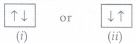
The two electrons have opposite spin, if one is revolving clockwise, the other is revolving anticlockwise or vice versa.
(iii) Hund's Rule of Maximum Multiplicity: Electron pairing in p, d and f orbitals cannot occur until each orbital of a given subshell contains one electron each or is single occupied.
For example: For the element nitrogen which contains 7 electrons, the following configuration can be written.
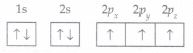
Total spin of unpaired electrons \(=\frac { 1 }{ 2 } +\frac { 1 }{ 2 } +\frac { 1 }{ 2 } =1\frac { 1 }{ 2 } \)
26.
1 mole of NH3 =10 moles of protons
= \(6.022\times 10^{ 23 }\times 10 \ protons\)
1 mole of NH3 (or 17g) contains 6.022 x 1024 protons
34 mg or 34 x 10-3 g NH3 will contain
\(=\frac { 34\times { 10 }^{ -3 }\times 6.022\times { 10 }^{ 24 } }{ 17 }\)
\(=12.044\times 10^{ 21 } \ protons\)
\(=1.2044\times 10^{ 22 } \ protons\)
Mass of 1 proton = 1.6726x10⁻²⁷kg
Mass of 1.2044 x 1022 x 1.6726 x 10-27kg
= 2.01447 x 10⁻⁵kg
27.
We know that, mass of electron = 9.11 x 10⁻³¹ kg
h = 6.626 x 10⁻³⁴ Js
Wavelength,
\(\lambda =\frac { h }{ mv } =\frac { 6.626\times{ 10 }^{ -34 }kg \ { m }^{ 2 }{ s }^{ -1 } }{ 9.11\times{ 10 }^{ -31 }kg\times2.19\times{ 10 }^{ 6 }\times m{ s }^{ -1 } }\)
\( \lambda =3.32\times{ 10 }^{ -10 }m=332pm\)
28.
1p is not possible because if n = 1 then l = 0 only and for p, l = 1
2s is possible because if n = 2 then l = 0, 1 and for s, l = 0
2p is possible because if n = 2 then l = 0, 1 and for p, l = 1
3f is not possible because if n = 3 then l = 0, 1 and 2 and for f, l = 3.
29.
(a) Kinetic energy of an ejected electron,
KE = hv - hv0
hv = 3.10 eV (Energy of striking photon)
hv0 = W0 = 2.13 eV (Work function of the metal)
KE \(=\frac { 1 }{ 2 } m{ v }^{ 2 }\) = 3,10 - 2.13 = 0.97 eV
(b) \(KE=\frac { 1 }{ 2 } m{ v }^{ 2 }=0.97 \ eV\)
\( \frac { 1 }{ 2 } m{ v }^{ 2 }=0.97\times1.602\times{ 10 }^{ -19 }\)
\( [\because \ 1 \ eV=1.602\times{ 10 }^{ -19 }J]c\)
\( \frac { 1 }{ 2 } \times9.11\times{ 10 }^{ -31 }kg\times{ v }^{ 2 }=0.97\times1.602\times{ 10 }^{ -19 }J\)
\( [\because Mass \ of \ 1{ e }^{ - }=9.11\times{ 10 }^{ -31 }kg]\)
\( { v }^{ 2 }=\frac { 0.97\times1.602\times{ 10 }^{ -19 }\times2J }{ 9.11\times{ 10 }^{ -31 }kg } =0.341\times{ 10 }^{ 12 }\)
\( v=0.584\times{ 10 }^{ 6 }=5.84\times{ 10 }^{ 5 }m{ s }^{ -1 }\)
30.
(b)
visible region

11th Standard CBSE Syllabus & Materials
11th Standard CBSE
CBSE 11th Business Studies Forms of Business Organisation Sample Question Papers Study Material - QB365 Set A
NEW11th Standard CBSE
CBSE 11th Business Studies Business, Trade and Commerce Sample Question Papers Study Material - QB365 Set A
NEW11th Standard CBSE
CBSE 11th Physics Waves Sample Question Papers Study Material - QB365 Set A
NEW11th Standard CBSE
CBSE 11th Physics Kinetic Theory Sample Question Papers Study Material - QB365 Set A



CBSE 11th Standard CBSE Subjects
CBSE Standards









