
 100% FREE ACCESS
7th Standard CBSE Syllabus & Materials
7th Standard CBSE
CBSE 7th Social Science Theme E - Understanding Market - New Sample Question Papers Study Material - QB365 Set A
NEW7th Standard CBSE
CBSE 7th Social Science Theme E - From Barter to Money - New Sample Question Papers Study Material - QB365 Set A
NEW7th Standard CBSE
CBSE 7th Social Science Theme D - The Constitution of India- An Introduction - New Sample Question Papers Study Material - QB365 Set A
NEW7th Standard CBSE
CBSE 7th Social Science Theme D - From the Rulers to the Ruled : Types of Governments - New Sample Question Papers Study Material - QB365 Set A
NEW7th Standard CBSE
CBSE 7th Social Science Theme B - The Age of Reorganisation - New Sample Question Papers Study Material - QB365 Set A
NEW7th Standard CBSE
CBSE 7th Social Science Theme B - The Rise of Empires - New Sample Question Papers Study Material - QB365 Set A

Published on: 30/07/2018
In Rulers And Buildings contains important questions in CBSE 7th Standard Social Science. It also covered with the most important questions in Rulers And Buildings.
Teachers please subscribe Now and Create Unlimited 7th Standard Social Science question papers with answer keys. For subscription, please Click Here.
Download CBSE Class 7th Standard CBSE Social Science question papers, sample papers, important questions, and previous year solved papers in PDF format. Get free study materials, NCERT solutions, and exam preparation resources for Class 7th Standard CBSE Social Science
Questions + Answers key
Take MCQ Social Science Test
1.
Explain with an example how the Mughal emperors were inspired by the regional architectural styles in the construction of their buildings.
2.
Trace out the architectural similarity between the temples at Vrindavan and monuments of Fatehpur Sikri, Agra.
3.
Write a short note on the Kandariya Mahadeva temple.
4.
What kind of structures were constructed by kings and their officers between the 8th and the 18th centuries?
5.
What is Pietra-dura?
6.
The throne balcony in the Diwani-i-am in Delhi was completed in
1495
1565
1648
1650
7.
Which of the following techniques was used in the construction of arc of the Quwwat-al-Islam mosque at Delhi?
Trabeate
Corbelled
Arcuate
None of these
8.
Early 9th century the Pandyan king Shrimara Shrivallabha invaded
Afghanistan
Multan
Myanmar
Sri Lanka
9.
Persian court chronicles described the Sultan as the
shadow of God
shadow of Padshah
shadow of deities
shadow of truth
10.
The Trabeate style was used in the construction of temples, mosques, tombs and in buildings attached to
large dome
large minarets
large stepped-wells
large superstructures
11.
Mughal rulers were particularly skilled in adapting regional architectural styles.
12.
Shah Jahan's capital city was at Agra.
13.
Chola king Rajendra I built a temple of Shiva.
14.
Limestone was not known to the Mughals.
15.
Rulers offered patronage to the learned and pious.
16.
Access to the river
17.
Ceremonial hall of public and private audience
18.
Eight paradise
19.
The Mughals liked
20.
Tall gateway
21.
The Golden temple with the holy sarovar is located at ____________
22.
The central towering dome and the tall gateway is called as __________
23.
A large reservoir just outside Delhi-i-Kuhna was called Hauz-i-Sultani which means _____________
24.
Rajarajadeva honoured god named _________
25.
Qutb Minar was built by the ruler named ___________
26.
Why king's destroyed temples of others?
27.
Observe the given pictures and answer the question that follows.
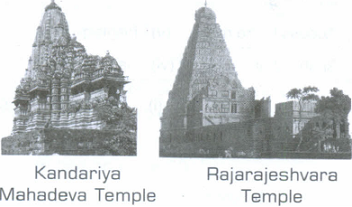
What differences do you notice between the Shikharas of the two temples? Can you make out that the Shikhara of the Rajarajeshvara temple is twice as high as that of the Kandariya Mahadeva?
28.
Why did the king Rajarajadeva take the God's name?
29.
What was the significance of worshipping deities of king and allies together in the royal temples?
30.
What was mahamandapa?
31.
What is Chahar bagh?
32.
What is qibla?
1.
The Mughal empire lasted in India from 1526 to 1764 and its architecture was a mix of the Islamic, Persian, Turkish and Indian subcontinent.
In Bengal, the local rulers had developed a roof that was designed to resemble a thatched hut. The Mughals liked this Bangia dome and used it in their architecture.
In Akbar's capital at Fatehpur Sikri, many of the buildings showed the influence of the architectural styles of Gujarat and Malwa.
2.
The architectural styles of the Mughal palaces at Fatehpur Sikri and temples at Vrindavan are very similar. The interior of temple Govind Deva at Vrindavan consists of intersecting arches that made the high ceiling roof. Similar roofs can be seen in the monument of Fatehpur Sikri.
This style of architecture is from North-West Iran (Khurasan). Apart from architecture, some temples of Vrindavan and monuments of Fatehpur Sikri are made of red sandstone.
3.
King Dhangadeva of the Chandela dynasty in 999 constructed the Kandariya Mahadeva temple dedicated to Shiva. The temple had an ornamented gateway that led to an entrance. There was a main hall known as Mahamandapa where dances are performed. The statue of the main deity was kept in the main shrine known as garbhagriha. This was the place for ritual worship where only the king, his immediate family members and priests gathered before the deity.
4.
Between 8th and the 18th centuries the kings and their officers built following two kinds of structures (i) There were forts, palaces, gardens, residences and tombs which were safe, protected places of rest in this world and the text.
(ii) Structures meant for public activity including temples, mosques, tanks, wells, caravan, serais and bazaars were also built.
5.
Pietra-dura or Parchin Kari in South Asia is a term for the inlay technique of using cut and fitted, highly polished coloured stone to create images. It is considered a decorative art.
6.
(c)
1648
7.
(b)
Corbelled
8.
(d)
Sri Lanka
9.
(a)
shadow of God
10.
(c)
large stepped-wells
11.
(a)
12.
(a)
13.
(a)
14.
(b)
15.
(a)
16.
()
Dara Shukoh
17.
()
Diwan-i-khas or diwan-i-am
18.
()
Hasht bihisht
19.
()
Banqla dome
20.
()
Pishtaq
21.
()
Amritsar
22.
()
Pishtaq
23.
()
King's reservoir
24.
()
Rajarajeshvaram
25.
()
Qutbuddin Aybak
26.
Kings built temples to demonstrate their devotion to God and their power and wealth. It is not surprising that whenever they attacked one another's kingdoms, they often targeted these temples.
The early 9th century Pandyan king Shrimara Shrivallabha invaded Sri Lanka and defeated Sena I. According to a Buddhist monk and chronicler Dhamma Kitti, " he removed all the valuables" ... The statue of the Buddha made entirely of gold in various monasteries were all seized.
Similarly in the early 11th century, the Chola king Rajendra I built a Shiva temple in his capital and filled it with prized statues seized from defeated rulers.
Sultan Mahmud also destroyed Somnath temple, he there by tried to win credit as a great hero of Islam. In middle ages, most of the rulers displayed their political might and military success by attacking and looting the places of worship of defeated rulers.
27.
Rajarajeshvara temple It had the tallest Shikhara among all of the temples of that time. It has a top of about 90 tonnes. It is a Shiva temple. The quadrangular sanctum has a two-tiered pyramidal roof; in front of the sanctum is the namaskara mandapam. The main Shikhara is the tallest under which the deity of the temple is kept.
Kandariya Mahadeva The Shikhara of this temple is homogeneous. But with time, secondary shikharas, smaller and narrower, were plated on the sides of the main Shikhara. They are heterogeneous shikharas. Some tertiary Sikharas sometimes exist near the ends of the side or in the corners. Under the main Shikhara, the main deity is situated.
28.
()
The king Rajarajadeva took the God's name because it was auspicious and he wanted to appear like God.
29.
()
Worshipping the deities of king and allies together in royal temples meant that they brought the just rule of the Gods on earth.
30.
()
The main hall where dances were performed was known as mahamandapa
31.
()
Chahar bagh is a formal garden of Sultan.
32.
()
Qibla is the direction faced by Muslims at prayer.

7th Standard CBSE Syllabus & Materials
7th Standard CBSE
CBSE 7th Social Science Theme B - New Beginnings : Cities and States - New Sample Question Papers Study Material - QB365 Set A
NEW7th Standard CBSE
CBSE 7th Social Science Theme A - Climates of India - New Sample Question Papers Study Material - QB365 Set A
NEW7th Standard CBSE
CBSE 7th Social Science Theme A - Geographical Diversity of India - New Sample Question Papers Study Material - QB365 Set A
NEW7th Standard CBSE
CBSE 7th Science Earth, Moon and the Sun - New Sample Question Papers Study Material - QB365 Set A



CBSE 7th Standard CBSE Subjects
CBSE Standards




