
 100% FREE ACCESS
7th Standard CBSE Syllabus & Materials
7th Standard CBSE
CBSE 7th Social Science Theme E - Understanding Market - New Sample Question Papers Study Material - QB365 Set A
NEW7th Standard CBSE
CBSE 7th Social Science Theme E - From Barter to Money - New Sample Question Papers Study Material - QB365 Set A
NEW7th Standard CBSE
CBSE 7th Social Science Theme D - The Constitution of India- An Introduction - New Sample Question Papers Study Material - QB365 Set A
NEW7th Standard CBSE
CBSE 7th Social Science Theme D - From the Rulers to the Ruled : Types of Governments - New Sample Question Papers Study Material - QB365 Set A
NEW7th Standard CBSE
CBSE 7th Social Science Theme B - The Age of Reorganisation - New Sample Question Papers Study Material - QB365 Set A
NEW7th Standard CBSE
CBSE 7th Social Science Theme B - The Rise of Empires - New Sample Question Papers Study Material - QB365 Set A

Published on: 30/07/2018
Some of the important questions are prepared from this chapter The Creation of an Empire the Mughal Dynasty.
For parents, Please subscribe and get the plenty of question with answer for your children practice. For Subscription please Click here.
Download CBSE Class 7th Standard CBSE Social Science question papers, sample papers, important questions, and previous year solved papers in PDF format. Get free study materials, NCERT solutions, and exam preparation resources for Class 7th Standard CBSE Social Science
Questions + Answers key
Take MCQ Social Science Test
1.
Describe jagirdars and their duties.
2.
Analyse the Mughal relations with other rulers, especially the Rajputs.
3.
Why did the Mughals emphasise their Timurid and not their Mongol descent?
4.
Shahjahan
5.
Humayun
6.
Subedar
7.
Rathor Rajput
8.
Mongol
9.
The Mughals used the term Zamindars to describe all __________
10.
____________ was the ruler of the Mongol tribes; China and Central Asia.
11.
Many Rajputs married their daughters into Mughal families in order to get ____________
12.
Abul Fazl, Akbar's friend, and counselor helped him frame the idea of _________ so that he could govern a society composed of many religions, cultures, and castes.
13.
The five Deccan Sultanate were Berar, Khandesh, Ahmadnagar, ____________and _____________
14.
During Sultan Suleyman's rule, the Ottoman state expanded into
Asia
Europe
America
Australia
15.
The mother of Jahangir was the daughter of the Rajput ruler of
Jodhpur
Jaipur
Amber
Ajmer
16.
Those who joined Mughal Service were enrolled as
Mansabdars
Jagirdars
Subedars
Muqtis
17.
The Sisodiya capital of Chittor was seized in the year
1565
1568
1570
1562
18.
Babur defeated the king of Delhi
Genghis Khan
Safavid
Timur
Ibrahim Lodi
19.
What was zat?
20.
Who was 'Sadr' in Akbar's administration?
21.
Who defeated Ibrahim Lodi and his Afghan supporters in 1526?
22.
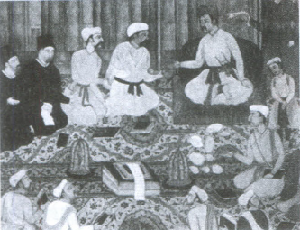
Can you identify the Jesuit priests in the given below picture?
23.
Give an account of the Mughal relations with other rulers? How Shivaji reacted against Aurangzeb?
24.
Akbar used to held religious discussions at Fatehpur Sikri.
25.
The Marathas fought Guerrilla warfare
26.
Prince Khurram is known as Jahangir
27.
Akbar was the regent of Bairam Khan
28.
Military Commanders were also known as Faujdars.
29.
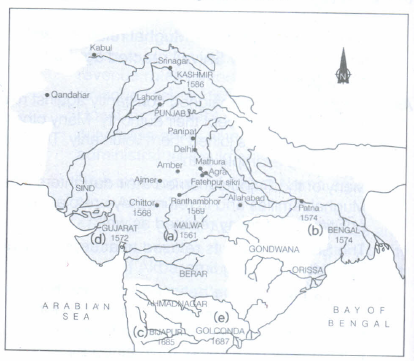
On the map of India, mark the following areas of military campaigns under Akbar and Aurangzeb.
(a) Malwa (1561)
(b) Bengal (1574)
(c) Bijapur (1685)
(d) Gujarat (1572)
(e) Golconda (1687)
1.
In Akbar's time, jagirs were carelessly assessed so that their revenues were roughly equal to the salary of the mansabdar. Mansabdars received their salaries as revenue assignments called jagirs. By Aurangzeb' time situation changed and the actual revenue collected was often less than the granted sum. There was also a huge increase in the number of mansabdars which led to a shortage in the number of jagirs.
As a result, many jagirdars tried to extract as much revenue as possible while they had a jagir. It led to the tremendous sufferings of the peasantry.
2.
The Mughal rulers constantly campaigned against rulers who were not ready to accept their authority. Gradually, when the Mughals became powerful, many other rulers joined them willingly.
Many Rajputs offered their daughters into Mughal families in order to gain high positions or offices. The Sisodiya Rajputs refused to accept Mughal authority for a long time. Mughals never humiliated their opponents, even though they got defeated by them. This quality enabled them to extend their influence.
3.
The Mughal rulers were descendants of two great lineages of rulers. From their mother's side, they were descendants of Genghis Khan, ruler of the Mongol tribes. From their father's side, they were the successors of Timur, the ruler of Iran, Iraq and modern day Turkey.
However, the Mughals did not like to be called Mongol because Mongol's especially Genghis Khan's, memory was associated with the massacre of innumerable people. It was also linked with the Uzbegs, their Mongols competitors. On the other hand, the Mughals were proud of their Timurid ancestry, because Timur captured Delhi in 1398.
4.
()
Seized Orchha
5.
()
SherKhan defeated him
6.
()
Governor
7.
()
Marwar
8.
()
Uzbeg
9.
()
Intermediaries
10.
()
Genghis Khan
11.
()
high positions
12.
()
administration
13.
()
Bijapur, Golconda
14.
(b)
Europe
15.
(c)
Amber
16.
(a)
Mansabdars
17.
(b)
1568
18.
(d)
Ibrahim Lodi
19.
()
Rank and salary were determined by a numerical value called zat. The higher, the zat, the more prestigious was the noble's position in court and the larger his salary.
20.
()
The minister in charge of religious and charitable patronage was known as Sadr in Akbar's administration
21.
()
Babur defeated Ibrahim Lodi and his Afghan supporters in 1526 at Panipat
22.
The two men in the black dress with black cap are the Jesuit priests; At the time of Akbar Jesuits like Fr. Rudolf Acquaviva, Fr. Antony Monserrate and Francis Henriques and many others came to India.
The Society of Jesus is a Christian male religious congregation of the Catholic Church. The members of this society are called the Jesuits. Jesuits work in education, intellectual research, and cultural pursuits. They also promote social justice. They are sometimes referred to as 'God's soldiers.
The headquarter of the above society, its assembly or council is in Rome. These Jesuit priests came on a regular basis to discuss their religion in the Ibadat Khana of Akbar's palace with Akbar and other notable religions priests.
23.
Mughal rulers campaigned constantly against rulers who refused to accept their authority. Many other rulers like Rajputs joined them voluntarily. The Rajputs are a good example of this.
Many of the Rajputs married their daughters into Mughal families and in return they are placed in key positions. But many resisted as well.
The Sisodiya Rajputs refused to accept Mughal authority for a long time.
The careful balance between defeating but not humiliating their opponent kings and chieftains enabled the Mughals to expand their kingdoms. But this attitude was not maintained by all the emperors.
Aurangzeb insulted Shivaji when he came to Agra to accept Mughal authority. The consequence of this insult was that Shivaji declared himself an independent king and resumed his rivalry against the Mughals.
24.
(a)
25.
(a)
26.
(b)
27.
(b)
28.
(a)
29.

7th Standard CBSE Syllabus & Materials
7th Standard CBSE
CBSE 7th Social Science Theme B - New Beginnings : Cities and States - New Sample Question Papers Study Material - QB365 Set A
NEW7th Standard CBSE
CBSE 7th Social Science Theme A - Climates of India - New Sample Question Papers Study Material - QB365 Set A
NEW7th Standard CBSE
CBSE 7th Social Science Theme A - Geographical Diversity of India - New Sample Question Papers Study Material - QB365 Set A
NEW7th Standard CBSE
CBSE 7th Science Earth, Moon and the Sun - New Sample Question Papers Study Material - QB365 Set A



CBSE 7th Standard CBSE Subjects
CBSE Standards




