
 100% FREE ACCESS
7th Standard CBSE Syllabus & Materials
7th Standard CBSE
CBSE 7th Social Science Theme E - Understanding Market - New Sample Question Papers Study Material - QB365 Set A
NEW7th Standard CBSE
CBSE 7th Social Science Theme E - From Barter to Money - New Sample Question Papers Study Material - QB365 Set A
NEW7th Standard CBSE
CBSE 7th Social Science Theme D - The Constitution of India- An Introduction - New Sample Question Papers Study Material - QB365 Set A
NEW7th Standard CBSE
CBSE 7th Social Science Theme D - From the Rulers to the Ruled : Types of Governments - New Sample Question Papers Study Material - QB365 Set A
NEW7th Standard CBSE
CBSE 7th Social Science Theme B - The Age of Reorganisation - New Sample Question Papers Study Material - QB365 Set A
NEW7th Standard CBSE
CBSE 7th Social Science Theme B - The Rise of Empires - New Sample Question Papers Study Material - QB365 Set A

Published on: 31/07/2018
Some of the important questions are prepared from this chapter Tribes, Nomads And Settled Communities. The important questions are covers from the Higher Order Thinking Questions and Value Based Questions.
Download CBSE Class 7th Standard CBSE Social Science question papers, sample papers, important questions, and previous year solved papers in PDF format. Get free study materials, NCERT solutions, and exam preparation resources for Class 7th Standard CBSE Social Science
Questions + Answers key
Take MCQ Social Science Test
1.
Write a note on the Mongols?
2.
What do you know about the religion of the Ahoms?
3.
How can you say that Garha Katanga is a rich state?
4.
In what ways was the history of the Gonds different from that of the Ahoms? Were there any similarities?
5.
Why do you think the Mughals tried to conquer the land of the Ahoms?
6.
The difference between the high and low and between the rich and poor,_________
7.
Each village under Ahom had to send a number of paiks by_______
8.
The forced workers were called as________
9.
The_________mentions that Garha Katanga had 70,000 villages.
10.
The new castes emerging within varnas were called______________
11.
Sultan Alauddin Khalji used the Banjaras to transport grain to the city markets.
12.
The Gonds were Nomadic pastoralists.
13.
The Bhils lived in the North-Eastern part of the subcontinent.
14.
The Chaurasi in Gond states contained several cities.
15.
Tribal societies had rich oral traditions.
16.
Who was Bir Narain?
Ruler of Punjab
Son of Rani Durgawati
Ruler of Multan
Ruler of Sind
17.
In Western Himalayas lived the Shephered tribe of
Balochis
Khokhar
Gaddis
None of these
18.
The Ahoms also introduced new methods of
wheat cultivation
rice cultivation
barley cultivation
maize cultivation
19.
Notable trader-nomads are called as
Bhils
Cheros
Santhals
Banjaras
20.
Under the Delhi Sultans and the Mughals, social hierarchy of society
grew
remained constant
decreased
were not run
21.
How Nomads and mobile people lived?
22.
Throw light on the major features of tribal societies.
23.
Plot the location of the tribes mentioned in this chapter on a map. For any two, discuss whether their mode of livelihood was suited to the geography and the environment of the area where they lived.
24.
What are known as buranjis?
25.
Name the important tribes that largely lived in Orissa and Bengal.
26.
Whom Akbar made a noble in Punjab?
27.
What is a clan?
28.
Where did the tribes settle?
1.
The best known pastoral and hunter-gatherer tribe in history were the Mongols. They inhabited the grasslands (steppes) of Central Asia and the forested areas further north. By 1206, Genghis Khan had united the Mongol and Turkish tribes into a powerful military force and expanded the empire. His successors also maintained a vast empire. It included parts of Russia, Eastern Europe and also China and much of West Asia. The Mongols had well-organised military and administrative systems which was supported by different ethnic and religious groups.
2.
The Ahoms originally worshipped their own tribal gods. The influence of the Brahmans increased during the first half of the 17th century. At the time of king Sib Singh (1714-1744), Hinduism became the predominant religion of Ahoms. King granted lands to the temple and Brahmanas. But the Ahoms kings did not completely give up their traditional, belief, although they adopted Hinduism. They maintained the combination of both the religious customs.
3.
Garha Katanga was a rich state. It earned wealth by trapping and exporting wild animals to other kingdoms. In 1565, the Mughal forces under Asaf Khan attacked this state.
The Mughal forces were resisted by Rani Durgawati and thereafter by her son. The Mughals annexed part of Garha Katanga. By defeating the Gonds the Mughals looted huge quantity of precious coins and large numbers of elephants. From this fact, we can assume that Garha Katanga is a rich state.
4.
History of the Gonds was different from the Ahom in the following way
| Gonds | Ahoms |
| i) They lived in Gondwana | They lived in Brahmaputra valley |
| ii) Practised shifting cultivation | Did not practice shifting cultivation |
| iii) Kingdoms were comparatively larger | There were smaller kingdoms. |
| iv) Kingdoms were divided into garhs. | Ahoms built centralised state. |
| v) Did not use firearms | Used firearms for the first time. |
5.
The Ahoms built a large state and used firearms as early as the 1530s. In 1662, the Mughals under Mir Jumla attacked the Ahom kingdom. The Ahom state was large and big source of revenue. The land were fertile and produced a variety of crops. This is why the Mughals wanted to conquer the land of the Ahoms.
6.
()
increased
7.
()
rotation
8.
()
paiks
9.
()
Akbar Nama
10.
()
Jatis
11.
(a)
12.
(b)
13.
(b)
14.
(b)
15.
(a)
16.
(b)
Son of Rani Durgawati
17.
(c)
Gaddis
18.
(b)
rice cultivation
19.
(d)
Banjaras
20.
(a)
grew
21.
Nomadic pastoralists moved over long distances with their animals. They lived on milk 'and other pastoral products. They bought and sold these goods as they moved from one place to another. They carried them on the back of their animals. The Banjaras were the most important trader nomads.
Sultan Alauddin Khalji and Mughal Emperor Jahangir used the Banjaras to transport grain to the city markets.
Many pastoral tribes reared and sold animals like cattle and horses, to the prosperous people. Different castes of petty pedlars travelled from village to village and sold ropes, seeds, straw matting and coarse socks. Mendicants acted as wandering merchants.
22.
Unlike the varna system of society, the tribal societies do not follow social rituals prescribed by the Brahmanas. They were also not divided into unequal castes, classes.
Members of each societies of tribes are united by kinship bonds. Most of them carryon cultivation. Many others were hunter-gatherer or herders. Some other were nomadic and moved from place to place. Most of them combined these activities to make full use of the natural resources. A tribal group controlled land and pastures jointly and divided these amongst households according to its own rules.Sometimes they clashed with the more powerful caste-based societies. The tribes retained their freedom and preserved their separate culture. The caste based societies and the tribal societies also depended on each other for their diverse needs.
23.
Several tribes live in different parts of India. See the map given below
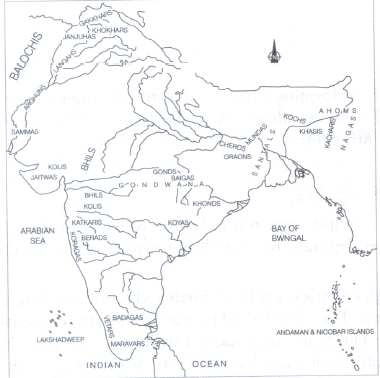
These tribes settled temporarily at the places which suited them as per their need and livelihood. Whenever, they found the environment or their mode of living unfavourable, they migrated to other suitable places.
(i) The Khokhar tribes are from the Punjab region of Pakistan and North Western India. They were designated as an agricultural tribal and were usually classified as Jat and Rajput. There were several subdivisions of the Khohhan bribe, e.g., Bandial, Bhachan, Dhaulka, Ganjial, Jalap etc. All of them were mainly dependent on their fertle land for livelihood.
(ii) The Gaddia are people who normally reside in the Mandi, Kangra and Bilaspur district of Himachal Pradesh. Their main occupation is Shepherding. They make their livelihood by rearing and selling sheep, goats, mules and horses. They spent their winter in the low hills of Siwalik range, grazing their flocks in forests. By April, they moved on to higher mountain meadows when the snow melted. By September, they again began their return movement.
24.
()
In Ahom society, historical works are known as buranjis which were first written in the Ahom language and then in Assamese.
25.
()
The Mundas and Santals were the important tribes that largely lived in Orissa and Bengal.
26.
()
The Gakkhar's chief Kamal Khan Gakkhar was made a noble (mansabdar) by Emperor Akbar.
27.
()
A clan is a group of families or households claiming descent from a common ancestor.
28.
()
The tribes settled in forests, hills, deserts and places which are difficult to reach.

7th Standard CBSE Syllabus & Materials
7th Standard CBSE
CBSE 7th Social Science Theme B - New Beginnings : Cities and States - New Sample Question Papers Study Material - QB365 Set A
NEW7th Standard CBSE
CBSE 7th Social Science Theme A - Climates of India - New Sample Question Papers Study Material - QB365 Set A
NEW7th Standard CBSE
CBSE 7th Social Science Theme A - Geographical Diversity of India - New Sample Question Papers Study Material - QB365 Set A
NEW7th Standard CBSE
CBSE 7th Science Earth, Moon and the Sun - New Sample Question Papers Study Material - QB365 Set A



CBSE 7th Standard CBSE Subjects
CBSE Standards




