
 100% FREE ACCESS
11th Standard CBSE Syllabus & Materials
11th Standard CBSE
CBSE 11th Economics PART-A - Presentation of Data - New Sample Question Papers Study Material - QB365 Set A
NEW11th Standard CBSE
CBSE 11th Economics PART-A - Organisation of Data - New Sample Question Papers Study Material - QB365 Set A
NEW11th Standard CBSE
CBSE 11th Economics PART-A - Collection of Data - New Sample Question Papers Study Material - QB365 Set A
NEW11th Standard CBSE
CBSE 11th Economics PART-A - Introduction to Economics and Statistics - New Sample Question Papers Study Material - QB365 Set A
NEW11th Standard CBSE
CBSE 11th Business Studies International Trade Sample Question Papers Study Material - QB365 Set A
NEW11th Standard CBSE
CBSE 11th Business Studies Evolution and Fundamentals of Business Sample Question Papers Study Material - QB365 Set A

Published on: 01/08/2018
Based on the chapter Hydrocarbons, some of the important questions are prepared in this question paper. It covers one mark, two, three and five marks questions from the book back and PTA question.
Students, subscribe and get plenty of question paper with answer key. For subscription please click here.
Download CBSE Class 11th Standard CBSE Chemistry question papers, sample papers, important questions, and previous year solved papers in PDF format. Get free study materials, NCERT solutions, and exam preparation resources for Class 11th Standard CBSE Chemistry
Questions + Answers key
Take MCQ Chemistry Test
1.
n-propylmagnesium bromide on hydrolysis gives propane. Is there any other Grignard reagent which also gives propane? If so, give its name, structure and equation for the reaction.
2.
Why do the C- C bonds rather than C - H bonds break during cracking of alkanes?
3.
Identify the structure of A and B
\({ CH }_{ 3 }-CH_{ 2 }COOH \ \underrightarrow { KOH } \ A\underrightarrow { \ Kobbe's \ electrolysis } \ B\)
\({ CH }_{ 3 }-CH_{ 2 }COOH \ \underrightarrow { KOH } { \ CH }_{ 3 }CH_{ 2 }COO^{ - }{ K }^{ + } \ \underrightarrow { Kolbe's \ electolysis } { \ CH }_{ 3 }CH_{ 2 }CH_{ 2 }{ CH }_{ 3 }\\ \quad \quad \quad \quad \quad \quad \quad \quad \quad \quad \quad \quad \quad \quad \quad A\quad \quad \quad \quad \quad \quad \quad \quad \quad \quad \quad \quad \quad \quad \quad \quad \quad B\)
4.
Out of benzene, m–dinitrobenzene and toluene which will undergo nitration most easily and why?
5.
Why do you alkenes prefer to undergo electrophilic addition reaction while arenes prefer electrophilic substitution reactions? Explain.
6.
On converting benzene to toluene, state whether there will be a rise or fall in the melting point.
7.
Write chemical equation for combustion reaction of toluene.
8.
Why does benzene undergo electrophilic substitution reactions easily and nucleophilic substitutions with difficulty?
9.
Explain why p-xylene has higher melting point than the corresponding ortho or meta- isomers.
10.
Explain the reasons for extra ordinary stability of benzene in spite of presence of three double bonds in it.
11.
What is electrophile in sulphonation?
12.
Which of the following compounds will show cis-trans isomerism?
CH2= CBr2
13.
Which of the following compounds will show cis-trans isomerism?
(CH3)2C=CH-C2H5
14.
How would you distinguish between Propene and Propyne.
15.
Rotation around carbon-carbon single bond of ethane is not completely free. Justify the statement.
16.
In the presence of peroxide, addition of HBr to propene takes place according to anti-Markownikoff's rule but peroxide effect is not seen in the case of HCl and HI. Explain.
17.
An alkane has a molecule mass of 72. Give all the possible structural isomers along with their IUPAC names.
18.
Arrange the following set of compounds in order of their decreasing relative reactivity with an electrophile, E+.
(i) Chlorobenzene, 2, 4-dinitrochlorobenzene, p-nitrochlorobenzene
(ii) Toluene, \(p-{ H }_{ 3 }C-{ C }_{ 6 }{ H }_{ 4 }-{ NO }_{ 2 },\)
\(p-{ O }_{ 2 }N-{ C }_{ 6 }{ H }_{ 4 }-{ NO }_{ 2 }\)
Also explain ur answer.
1.
Iso - propylmagnesium bromide (CH3)2CHMgBr,
(CH3)2CHMgBr+H2O⟶CH3CH2CH3+Mg(OH)Br
2.
Since the bond dissociation energy of C - C bonds (348 KJ mol-1) is lower than bond dissociation energy of C -H bonds (414 KJ mol-1), therefore during cracking of alkanes, C - C bonds break more easily than C - H bonds.
3.
A⟶CH3−CH2COO−−K+;
B⟶CH3−CH2−CH2−CH3
Butane
4.
Nitration of benzene is an electrophilic substitution reaction. Presence of electron releasing group such as - CH3 activates the benzene nucleus towards electrophilic substitution while presence of electron withdrawing group such as -NO2 deactivates the benzene nucleus towards electrophilic substitution.
Therefore, the ease of nitration decrease in the order
Toluene > benzene > m-dinitrobenzene
Thus, toluene will undergo nitration most easily.
5.
Alkenes are rich source of loosely held \(\pi \) electrons, due to which they show electrophilic addition reaction. Electrophilic addition reactions of alkenes are accompanied by large energy changes so these are energetically favourable than that of Electrophilic substitution reactions.
In special conditions alkenes also undergo free radical substitution reactions.
In arenes during electrophilic addition reactions aromatic character of benzene ring is destroyed while during electrophilic substitution reactions of areans are enegetically more favourable than that of electrophilic addition reaction.
That's why alkenes prefer to undergo electrophilic addition reaction while arenes prefer electrophilic substitution reactions.
6.
On converting benzene to toluene, there is a fall in the melting point although toluene has the higher molecular mass. This is because the planar molecules of benzene can pack more closely in the crystal lattice and the cohesive forces are strong, whereas the methyl group in toluene prevents such close packing.
7.
C7H8(g)+9O2(g) \(\overset{Δ}→\)7CO2+4H2O(g)
8.
Benzene is a planar molecule having delocalized electrons above and below the plane of ring. Hence, it is electron-rich. As a result, it is highly attractive to electron deficient species i.e., electrophiles.
Therefore, it undergoes electrophilic substitution reactions very easily.

Nucleophiles are electron-rich. Hence, they are repelled by benzene. Hence, benzene undergoes nucleophilic substitutions with difficulty.
9.
The para-isomer has a more symmetrical structure, allowing it to fit better into the crystal lattice than the other or meta-isomer.
10.
It is due to resonance, 6 π−electrons are delocalised.
11.
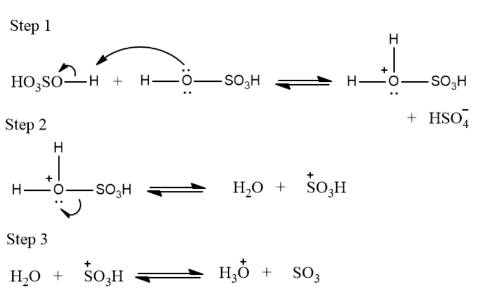
12.
For exhibiting cis-trans (or geometrical isomerism, a molecule must fulfil the following condition.
The groups attached to each double bonded carbon atom must be different.
13.
For exhibiting cis-trans (or geometrical isomerism, a molecule must fulfil the following condition.
It must have atlest one double bond.
14.
Upon treatment with ammoniacal of AgNO3 . Propyne would give white ppt. whereas propene does not react.
15.
Rotation around C-C single bond is not completely free and it is restricted due to repulsions between the electron clouds of C-H bonds in the adjacent carbon atoms. Therefore, ethane exixts in infinate number of conformations. Out of these, two extreme conformations are staggered and eclipsed.
16.
Peroxide effect is not observed in addition of HCl and HI. This is due to fact that the H__Cl bond being stronger (430.5 kJ mol-1) than H__Br bond (363.7 kJ mol-1) is not cleaved by the free radical whreas the H___I bond is weaker (296.8 kJ mol-1) and iodine free radicals combine to form iodine molecules instead of adding to the double bond.
17.
The general formula of alkanes is CnH2n+2=12xn+1x(2n+2)=72 or 12n+2n+2=72 or n=5
Thus, the molecular formula of the alkane is C5H12. For structural isomers and their IUPAC names.
18.
Presence of electron releasing group(or activating group) increases the electron density in benzene nucleus. Therefore, electrophile will attack
benzene nucleus easily. But, the presence of electron withdrawing group like -NO2 decrease the electron density in benzene ring. Therefore, electrophile will attack
benzene nucleus with difficulty. The order of reactivity towards electrophile, E+ in order of their decreasing relative reactivity is
(i) Chlorobenzene > p-nitrochlorobenzene > 2, 4- dinitrochlorobenzene
(ii) Toluene > \(p-{ CH }_{ 3 }-{ C }_{ 6 }{ H }_{ 4 }-{ NO }_{ 2 }>p-{ O }_{ 2 }N-{ C }_{ 6 }{ H }_{ 4 }-{ NO }_{ 2 }\)

11th Standard CBSE Syllabus & Materials
11th Standard CBSE
CBSE 11th Business Studies Forms of Business Organisation Sample Question Papers Study Material - QB365 Set A
NEW11th Standard CBSE
CBSE 11th Business Studies Business, Trade and Commerce Sample Question Papers Study Material - QB365 Set A
NEW11th Standard CBSE
CBSE 11th Physics Waves Sample Question Papers Study Material - QB365 Set A
NEW11th Standard CBSE
CBSE 11th Physics Kinetic Theory Sample Question Papers Study Material - QB365 Set A



CBSE 11th Standard CBSE Subjects
CBSE Standards









