
 100% FREE ACCESS
11th Standard CBSE Syllabus & Materials
11th Standard CBSE
CBSE 11th Economics PART-A - Presentation of Data - New Sample Question Papers Study Material - QB365 Set A
NEW11th Standard CBSE
CBSE 11th Economics PART-A - Organisation of Data - New Sample Question Papers Study Material - QB365 Set A
NEW11th Standard CBSE
CBSE 11th Economics PART-A - Collection of Data - New Sample Question Papers Study Material - QB365 Set A
NEW11th Standard CBSE
CBSE 11th Economics PART-A - Introduction to Economics and Statistics - New Sample Question Papers Study Material - QB365 Set A
NEW11th Standard CBSE
CBSE 11th Business Studies International Trade Sample Question Papers Study Material - QB365 Set A
NEW11th Standard CBSE
CBSE 11th Business Studies Evolution and Fundamentals of Business Sample Question Papers Study Material - QB365 Set A

Published on: 31/07/2018
In this question paper, some of the important one mark, two and five marks questions from the chapter Hydrogen are covered.
The questions are prepared from the book back and PTA question.
Students, subscribe and get plenty of question paper with answer key. For subscription please click here.
Download CBSE Class 11th Standard CBSE Chemistry question papers, sample papers, important questions, and previous year solved papers in PDF format. Get free study materials, NCERT solutions, and exam preparation resources for Class 11th Standard CBSE Chemistry
Questions + Answers key
Take MCQ Chemistry Test
1.
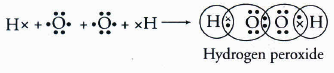
Write the Lewis structure of hydrogen peroxide.
2.
What type of elements forms interstitial hydrides?
3.
Why is dihydrogen not preferred in balloons these days?
4.
Which gaseous compound on treatment with dihydrogen produces methanol?
5.
Why does hard water not form lather with soap?
6.
Why is hydrogen peroxide stored in wax lined bottles?
7.
Classify the following as covalent, ionic or interstitial hydrides.
CaH2, LaH2 RbH, GeH2, TiH2, NaH, NH3
8.
Name the compound each in which hydrogen exists in negative oxidation state
9.
Why does hydrogen occur in a diatomic form rather than in a monoatomic form under normal conditions?
10.
Calculate the concentration in g/L of a 20 volume H2O2 solution
11.
What is the difference between the terms 'hydrolysis' and 'hydration'?
12.
10mL of a given solution of \({ H }_{ 2 }{ O }_{ 2 }\) contains 0.91 g of \({ H }_{ 2 }{ O }_{ 2 }\).Express its strength in volume.
13.
Find the volume strength of 1.6 N H2 O2 solution
14.
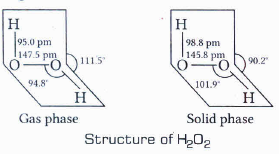
Compare the structure of H2O and H2O2.
15.
Hydrogen peroxide acts both as an oxidising agent as well as a reducing agent in alkaline solution towards certain first row transition metal ions. Illustrate both these properties of \({ H }_{ 2 }{ O }_{ 2 }\) using chemical equations.
16.
Why is hydrated barium peroxide used in the preparation of hydrogen peroxide instead of anhydrous barium peroxide?
17.
Rohan heard that instructions were given to the laboratory attendent to store particular chemical, i.e. keep it in the dark room, add some urea in it, and keep it away from dust. This chemical acts as an oxidising as well as a reducing agent in both acidic and alkaline media.This chemical is important for use in the pollution control treatment of domestic and industrial effluents.
Explain why such precautions are taken for storing this chemical.
18.
Sodium forms a crystalline ionic solid with dihydrogen. The solid is non-conducting in nature. It reacts violently with water to produce dihydrogen gas. Write the formula of this compound and its reaction with water. What will happen on electrolysis of the melt of this solid?
19.
Calculate the normality of a solution of 1 L of hydrogen peroxide labelled 30 volumes.
20.
Calculate the mass of oxygen which will be liberated by the decomposition of 200mL of this solution.
21.
What mass of hydrogen peroxide will be present in 2L of a 5M solution?
22.
What do you expect the nature of hydrides is, if formed by elements of atomic numbers 15, 19, 23, 44 with dry dilhydrogen? Compare their behaviour towards water.
1.
()
the Lewis structure of hydrogen peroxide is
2.
()
d-block and f-block elements.
3.
()
Dihydrogen is highly combustible and hence, is likely to catch fire in the presence of excess of air. That's why it is not preferred in balloons now a days.
4.
()
Carbon monoxide.
5.
()
Hard water contains salts of calcium and magnesium ions. Hard water does not give lather with soap and forms scum/precipitate with soap. Soap containing sodium stearate(C17 H35 COONA)reacts with hard water to precipitate out as Ca/Mg stearate.
2C17 H35 COONA(aq) + M2+ (aq) \(\rightarrow \)
(C17 H35Coo)2M\(\downarrow \) + 2Na+ (aq) (Where, M is Ca/Mg)
It is therfore, unsuitable for laundry.
6.
()
Hydrogen peroxide is decomposed by rough surfaces of glass, alkali oxides present in it and light to form
\({ H }_{ 2 }O \ and \ { O }_{ 2 } \ { 2H }_{ 2 }{ O }_{ 2 }\rightarrow { 2H }_{ 2 }O+{ O }_{ 2 }\)
To prevent this decomposition, \({ H }_{ 2 }{ O }_{ 2 }\)is usually stored in coloured paraffin wax coated plastic or teflon bottles.
7.
()
Covalent hydrides GeH2, NH3
Ionic hydrides CaH2, RbH, NaH
Interstitial hydrides TiH2, LaH2
8.
()
NaH, here oxidation state of hydrogen is -1.
9.
()
Hydrogen atom has only one electron in its 1s-orbital. So, to achieve stable inert gas configuration of helium, it exists as diatomic molecule and is called dihydrogen.
10.
59.91 g/L
11.
Interaction of H+ and OH- ions of H2O with the anion and the cation of a salt respectively to yield the original acid and the original base is called hydrolysis.
eg.
\(Na2CO3+2H2O\rightarrow 2NaOH+H_{ 2 }CO_{ 3 }\\ Salt\quad \quad \quad \quad \quad \quad Base\quad \quad \quad Acid\)
Hydration, on the other hand, means addition of H2O to ions or moleclues to form hydrated ions or hydrated.
\(KCl(s)+H_{ 2 }O(l)\rightarrow K^{ + }(aq)+cl^{ - }(aq)\\ Salt\)
\(\\ CuSo_{ 4 }(s)+5H_{ 2 }O(l)\rightarrow \ CuSO_{ 4 }.5H_{ 2 }O(s)\\ Colourless\quad \quad \quad \quad \quad \quad \quad \quad Blue\)
12.
68 g of \({ H }_{ 2 }{ O }_{ 2 }\)produce \({ O }_{ 2 }\)= 22700 mL at NTP
\(\therefore \) 0.91 g of \({ H }_{ 2 }{ O }_{ 2 }\)will produce \({ O }_{ 2 }\)=\(\frac { 22700\times0.91 }{ 68 } \) = 303 mL at NTP
\(\therefore \) Volume strength \(\approx \) 303/10 \(\approx \) 30
13.
27.2 g/L
14.
In water, oxygen is sp3 -hybridised. Due to stronger lone pair-lone pair repulsions than bond pair-bond pair repulsion, the HOH bond angle decreases from 109.5o to 104.5o. Thus, water is a bent molecule as shown in figure.

It is a highly polar molecule. Hydrogen peroxide has a non-planar structure. Dipole moment value of H2O2 suggests that all the four atoms in H2O2 do not lie in a plane. The structure of H2O2 in gas phase, can be compared with a book open at angle 111.5o.The H-O-O bind angle is 94.8o.
15.
Oxidising agent
\({ 2Cr(OH) }_{ 3 }+4NaOH+3{ H }_{ 2 }{ O }_{ 2 }\rightarrow 2Na_{ 2 }CrO_{ 4 }+8{ H }_{ 2 }O\)
Here,\({ Cr }^{ 3+ }\) gets oxidised to \({ Cr }^{6+ }\)
Reducing agent
\(2K_{ 3 }[Fe(CN)_{ 6 }]+2KOH+{ H }_{ 2 }{ O }_{ 2 }\rightarrow 2{ K }_{ 4 }[Fe(CN)_{ 6 }]+2{ H }_{ 2 }O+{ O }_{ 2 }\)
Here, \({ Fe }^{ 3+ }\) gets reduced to \({ Fe }^{ 2+ }\)
16.
Anhydrous \(BaO_{ 2 }\) is not used because the \(BaSO_{ 4 }\)formed during the reaction forms a protective layer around unreacted \(BaO_{ 2 }\) and the reaction stops after sometime.
17.
\({ H }_{ 2 }O_{ 2 }\) decomposes slowly on exposure to light and dust particles. In the presence of metal surfaces or traces of alkali present in glass containers, the traces of alkali present in glass containers, the decomposition of \({ H }_{ 2 }O_{ 2 }\) is catalysed. It is, therefore, stored in wax lined glass or plastic vessels in dark. Urea is added as a negative catalyst or stabiliser to check its decomposition.
\({ 2H }_{ 2 }O_{ 2 }(l)\overset { hv }{ \rightarrow } { 2H }_{ 2 }O(l)+{ O }_{ 2 }(g)\)
18.
Sodium reacts with dihydrogen to form sodium hydride which is a crystalline ionic solid.
\(2Na+H_{ 2 }\rightarrow 2Na^{ + }H^{ - }\)
It reacts violently with water to produce H2 gas
\(2NaH+2H_{ 2 }O\rightarrow 2NaOH+2H_{ 2 }\uparrow \)
In solid state NaH does not conduct electricity. When electrolysed in its molten state, it gives H2 at anode and Na at cathode.
19.
5.28 N
20.
0.2 L(or 200 mL) of 5M solution will contain
\(\frac { 340\times0.2 }{ 2 } =34g{ H }_{ 2 }{ O }_{ 2 }\)
\(\underset { 2\times 34=68g }{ { 2H }_{ 2 }O_{ 2 } } \rightarrow { 2H }_{ 2 }O+\underset { 2\times 16=32g }{ { O }_{ 2 } } \)
\(\because \ 68g \ { H }_{ 2 }O_{ 2 }\) on decomposition will give 32g\(O_{ 2 }\)
\(\therefore \ 34g \ { H }_{ 2 }O_{ 2 }\) on decomposition will give
\(\frac { 32\times 34 }{ 68 } =16g{ O }_{ 2 }\)
21.
Molar mass of \({ H }_{ 2 }{ O }_{ 2 }=34 \ gmol^{ -1 }\)
1L of 5M solution of \({ H }_{ 2 }O_{ 2 }\)will contain 34 x 5g \({ H }_{ 2 }O_{ 2 }\)
2L of 5M solution of \({ H }_{ 2 }O_{ 2 }\)will contain 34 x 5 x 2 = 340g \({ H }_{ 2 }O_{ 2 }\)
Mass of \({ H }_{ 2 }O_{ 2 }\)present in 2L of 5 molar solution = 340g
22.
(a) Element with Z = 15, belongs to p-block. It forms covalent hydride, PH3
(b) Element with Z = 19 belongs to s-block. It forms ionic or saline hydride, KH
(c) Element5 with Z = 23 belongs to d-block and Vth group elements. It forms interstitial hydride, VH1.6. It is non-stoichiometric hydride.
(d) Element with Z = 44 belongsto d-block and VIIth group elements. It is ruthinium. It does not form any hydride (hydride gap). Only ionic hydride, KH reacts violently with water producing dihydrogen gas
\(KH(s)+H_{ 2 }O(aq)\rightarrow KOH(aq)+H_{ 2 }(g)\)

11th Standard CBSE Syllabus & Materials
11th Standard CBSE
CBSE 11th Business Studies Forms of Business Organisation Sample Question Papers Study Material - QB365 Set A
NEW11th Standard CBSE
CBSE 11th Business Studies Business, Trade and Commerce Sample Question Papers Study Material - QB365 Set A
NEW11th Standard CBSE
CBSE 11th Physics Waves Sample Question Papers Study Material - QB365 Set A
NEW11th Standard CBSE
CBSE 11th Physics Kinetic Theory Sample Question Papers Study Material - QB365 Set A



CBSE 11th Standard CBSE Subjects
CBSE Standards









