
 100% FREE ACCESS
10th Standard CBSE Syllabus & Materials
10th Standard CBSE
CBSE 10th Social Science ECO - Globalisation and the Indian Economy - New Model Questions Papers Study Material - QB365 Set A
NEW10th Standard CBSE
CBSE 10th Social Science ECO - Money and Credit - New Model Questions Papers Study Material - QB365 Set A
NEW10th Standard CBSE
CBSE 10th Social Science ECO - Sectors of the Indian Economy - New Model Questions Papers Study Material - QB365 Set A
NEW10th Standard CBSE
CBSE 10th Social Science ECO - Development - New Model Questions Papers Study Material - QB365 Set A
NEW10th Standard CBSE
CBSE 10th Social Science PS - Outcomes of Democracy - New Model Questions Papers Study Material - QB365 Set A
NEW10th Standard CBSE
CBSE 10th Social Science PS - Gender, Religion and Caste - New Model Questions Papers Study Material - QB365 Set A

Published on: 31/07/2018
Some of the important questions from the chapter Areas Related to Circles covered in this question paper. The questions are prepared from the book back and PTA question.
For parents, Please subscribe and get the plenty of question with answer for your children practice. For Subscription please Click here.
Download CBSE Class 10th Standard CBSE Maths question papers, sample papers, important questions, and previous year solved papers in PDF format. Get free study materials, NCERT solutions, and exam preparation resources for Class 10th Standard CBSE Maths
Questions + Answers key
Take MCQ Maths Test
1.
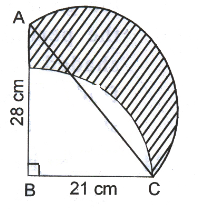
In the figure given alongside, ABC is a right triangle, \(\angle B={ 90 }^{ ° }\) , AB = 28 cm and Bc = 21 cm. With AC as diameter a semicircle is drawn and with BC as radius a quarter circle is drawn. Find the area of the shaded region.
2.
Two circles touch internally. The sum of their areas is \(116\pi \ \ sq.cm\) and the distance between their centres is 6 cm. Find the radii of the circles.
3.
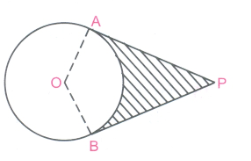
An elastic belt is placed round the rim of a pulley of radius 5 cm. One point on the belt is pulled directly away from the centre O of the pulley until it is at P, 10 cm away from O. Find the length of the belt that is in contact with the rim of the pulley. Also find the shaded area . ( Use \(\pi =3.14,\sqrt { 3 } =1.73)\)
4.
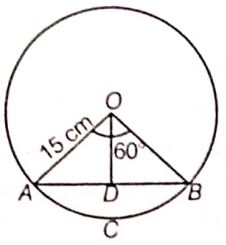
A chord of a circle of radius 15 cm subtends an angle of \(60^o\) at the centre. Find the areas of the corresponding minor and major segments of the circle. \((Use\ \pi = 3.14\) and \(\sqrt3=1.73)\)
5.
If circumference of a circle is 44 cm, then what will be the area of the circle?
6.
A thin wire is in the shape of a circle of radius 77 cm. It is bent into a square. Find the side of the square \(\left( Taking,\pi =\frac { 22 }{ 7 } \right) \)
7.
What is the perimeter of the sector with radius 10.5 ern and sector angle 60\(°\)?
8.
The circumference of a two circles are in the ratio 2 : 3. Find the ratio of their areas.
9.
What will be the perimeter of a quadrant of a circle of radius r?
10.
If area of circle is 301.84 cm2, then find the radius of circle.
11.
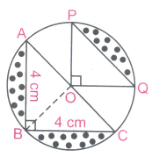
In the given figure, O is the centre and AOC is a diameter of the circle. Find :
(i) The sum of the areas of the two shaded segments made by the chords AB and BC.
(ii) The area of the shaded segment made by the chorod PQ. \(\left( Use\ \pi =\frac { 22 }{ 7 } \right) \)
12.
The perimeter of a sector of a circle of radius 5.2 cm is 16.4 cm. Find the area of the sector.
13.
If the circumference of a circle is increased by 50% then find percentage increases in its area.
14.
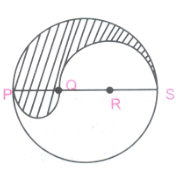
PQRS is a dimeter of a circle of radius 6 cm. The lengths PQ, QR are equal. Semicircles are drawn on PQ and QS as diameters. Find the perimeter of the shaded region.
15.
AB is one of the direct common tangent of two circles of radii 12 cm and 4 cm respectively touching each other. Find the area of the region enclosed by the circles and the tangent.
16.
The short and long hands of a clock are 4 cm and 6 cm long respectively. Find the sum of the distances travelled by their tips in two days. \([\pi = 22/7]\)
17.
The minute hand of a clock is \(\sqrt {21}\) cm long. Find the area described by the minute hand on the face of the clock between 7.00 am and 7.05 am. \([Use\ \pi={22\over 7}]\)
18.
A chord of a circle of radius 14 cm subtends a right angle at the centre. What is the area of the mirror sector? \([\pi\ = {22\over 7}]\)
19.
Two circles touch internally. The sum of their areas is \(116\pi \quad { cm }^{ 2 }\) and distance between their centers is 6 cm. Find the radii of the circles.
20.
Nandhini made a design on a square chart paper ABCD, made of square, semicircular arcs and arcs of quadrant of circles (see igure).Calculate the total shaded area in given figure.
21.
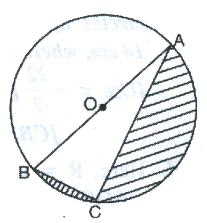
In figure, AC=24cm, BC=10cm and O is the centre of the circle.Find the area of the shaded region.[Use \(\pi\)=3.14]
22.
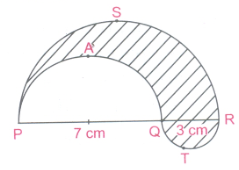
In fig., PSR, RTQ and PAQ are three semicircles of diameters 10 cm, 3 cm and 7 cm respectively. Find the perimeter of the shaded region. [ Use \(\pi\) = 3.14]
23.
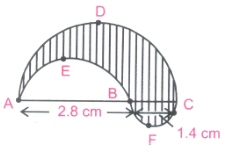
In the fig., find the perimeter of shaded region where ADC, AEB and BFC are semicircles on diameters AC, AB and BC respectively.
1.
428.75 cm2
2.
10 cm, 4 cm
3.
In right-angled triangle OAP,
\({OA\over OP}=cos\angle AOP\)
-s.png)
\(⇒\ \ {5\over 10}= cosㄥAOP\)
⇒ ㄥAOP=600
Similarly, ㄥAOP=600
ㄥAOB=600+600=1200
Length of arc (AB)=\({\theta\over 360^0}\times2\pi r\)
\(={120^0\over 360^0}\times2\times\pi\times5\)
\(={10\pi\over 3}cm\)
Length of the belt that is in the contact with the rim of pulley
= circumference of circle - length of arc AB
\(=2\pi\times5-{10\pi\over 3}={20\pi\over 3}cm\)
Area of sector
OAQB=\(={\theta\over 360^0}\times\pi r^2\)
\(={120^0\over 360^0}\times\pi5\times\times5cm^2={25\over 3}\pi cm^2\)
Area of quadrilateral OAPB
= 2 x area of triangle OAP
\(2\times{1\over 2}\times OA\times AP\)
\(=5\times5\sqrt3cm=25\sqrt3cm^2\)
Area of shaded region
\(=\left(25\sqrt3-{25\pi\over 3}\right)cm^2\)
4.
Given, chord AB subtends an angle 60° at the centre.
\(\therefore\) \(\angle\)AOB = 60° and OA = OB [radii of circle]
\(\therefore\) \(\angle\)OBA = \(\angle\)OAB = x [say]
[\(\because\) angles opposite to equal sides are also equal]
In \(\Delta\)AOB,
\(\angle\)AOB + \(\angle\)OBA + \(\angle\)OAB = 180°
[by angle sum property of triangle]
\(\Rightarrow\) 60° + x + x = 180° \(\Rightarrow\) 2x = 180° - 60°
\(\begin{array}{ll} \Rightarrow & x=\frac{120^{\circ}}{2}=60^{\circ} \\ \end{array}\)
\(\begin{array}{ll} \Rightarrow & \angle O B A=\angle O A B=60^{\circ}=\angle A O B \end{array}\)
\(\therefore\)\(\Delta\)AOB is an equilateral triangle.
Now, area of \(\Delta A O B=\frac{\sqrt{3}}{4} \times(15)^2\)
\(\left[\because \text { area of equilateral triangle }=\frac{\sqrt{3}}{4}(\text { side })^2\right]\)
= 56.25 \(\times\)1.73 = 97.3125 cm2
Area of sector OACBO =\(\begin{aligned} & =\frac{\theta}{360^{\circ}} \times \pi r^2=\frac{60^{\circ}}{360^{\circ}} \times 3.14 \times(15)^2 \\ \end{aligned}\)
\(\begin{aligned} & =\frac{3.14 \times 225}{6}=\frac{706.5}{6}=117.75 \mathrm{~cm}^2 \end{aligned}\)
\(\therefore\) Area of minor segment ACBDA
= Area of sector OACBO - Area of \(\Delta\)AOB
= 117.75 - 97.3125 = 20.4375 cm2
Now, area of major segment
= Area of circle - Area of minor segment
= \(\pi\)(15)2 - 20.4375 = 3.14 \(\times\) 225 - 20.4375
= 706.5 - 20.4375 = 686.0625 cm2
5.
Circumference of a circle = 44 cm
Sum of two sides of a square is 22 cm.
Radius of the circle = \(\frac { 44 }{ 2\times \frac { 22 }{ 7 } } =7\quad cm\)
Area of the circle = \(\pi { r }^{ 2 }=\frac { 22 }{ 7 } \times 7\times 7\)
= 154cm2
6.
Perimeter of the circle = Perimeter of square
Let side of square be x cm.
\(\begin{aligned} & 2 \pi \mathrm{r}=4 \mathrm{x} \\ \end{aligned}\)
\(\begin{aligned} & \Rightarrow \quad 2 \times \frac{22}{7} \times 77=4 x \\ \end{aligned}\)
\(\begin{aligned} & \therefore \quad x=\frac{2 \times 22 \times 11}{4}=121 \end{aligned}\)
Side of the square = 121 cm.
7.
Perimeter of the sector = r + r + \(\frac { 2\pi r\theta }{ { 360 }^{ ° } } \)
= 10.5 + 10.5 + 2 \(\times \frac { 22 }{ 7 } \times \frac { 10.5\times 60 }{ 360 } \)
= 21 + 11 = 32 cm.
8.
4 : 9
9.
Perimeter of a quadrant = \(r+r+\frac { 1 }{ 4 } \times 2\pi r\)
\(=2r+\frac { 1 }{ 2 } \pi r=\frac { r }{ 2 } (\pi +4)\)
10.
9.8 cm
11.
\((i) \ \frac { 32 }{ 7 } { cm }^{ 2 } \\ (ii) \ \frac { 16 }{ 7 } { cm }^{ 2 }\)
12.
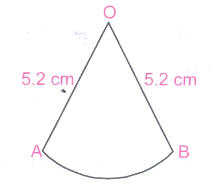
Perimeter ofa sector OAB = 16.4cm
⇒ OA+AB + 0B 16.4cm
⇒ 5.2 cm + 5.2 cm + AB = 16.4cm
⇒ 10.4 cm + AB 16.4cm
⇒ AB = (16.4- 10.4)cm
Length of the arc = 6.0 cm
Area of the sector=\({lr\over 2}={6.0\times5.2\over2}\)
=6.0 x 2.3cm2
=15.6cm2
13.
Let radius of the circle = R
∴ Circumference = 2πR and area = πR2
New circumference
\(=2\pi R+\frac { 50 }{ 100 } 2\pi R=3\pi R\)
∴ New Radius \(=\frac { 3 }{ 2 } R\)
New area \(=\pi \times \left( \frac { 3 }{ 2 } R \right) ^{ 2 }=\frac { 9 }{ 4 } \pi { R }^{ 2 }\)
Increase in area\(=\frac { 9 }{ 4 } \pi { R }^{ 2 }-\pi { R }^{ 2 }=\frac { 5 }{ 4 } \pi { R }^{ 2 }\)
%increase in area\(=\frac { \frac { 5 }{ 4 } \pi { R }^{ 2 } }{ \pi { R }^{ 2 } } \times 100\)=125%
14.
Diagonal = \(BD=\sqrt {DC^2+BC^2}\)
\(=\sqrt{12^2+5^2}=13cm\)
⇒ Diameter of circle = 13cm
⇒ Radius=\({13\over 2}cm=6.5cm\)
Area of circle=πr2=3.14 x (6.5)2
=3.14 x 42.25=132.665cm2
Area of rectangle ABCD=5 x 12=60cm2
∴ Area of shaded portion=132.665-60=72.665cm2
15.
Let tangent touches the circles with centre O and O' at the points A and B respectively.
-s.png)
⇒ ㄥ1 = ㄥ2 = 900
[Tangent makes 900 angle with the radius at the point of contact]
Through O' draw O'M I I AB meeting OA in M
⇒ O'M I I AB.Thus ABO'M is a rectangle with
AM = O'B = 4cm
In ΔOMO'
OM=OA-AM
= (12 — 4) cm = 8cm
and 00' = OP+ O'P= 12+4= 16cm
⇒ OO'2 = 0M2 + (O'M)2
⇒ 162 = 82 + (O'M)2
⇒ x2 = 162-82 = (16-8) (16 + 8)
= 8 x 24 = 8 x 8 x 3
\(⇒\ x=\sqrt{8\times8\times3}=8\sqrt3cm\)
Area ABO'O = area of rectangle ABO'M + area of AOMO'
=AM x O'M+\({1\over 2}\)x OM x O'M
\(=4\times8\sqrt3+{1\over 2}\times8\times8\sqrt3\)
\(=32\sqrt3+32\sqrt3=64\sqrt3cm\)
Now ΔOMO' is a right triangle with ㄥM=900
\({O'M\over OO'}={8\sqrt3\over 16}=cos(ㄥ3)\)
\(⇒\ ㄥ3=30^0\ and\ {OM\over OO'}=cosㄥ4\)
\(⇒ {8\over 16}cos\angle4\)
⇒ ㄥ4=600 ⇒ㄥAOP=600
= angle of sector AOP
ㄥ3 = 300 ⇒ ㄥMO'O = 300 = 900 + ㄥMO'O = 900 + 300
= 1200 = angle of sector BOP
Area of the portion enclosed between the circles and the tangents is
= area of the trapezium ABO'O - 2 X area of the sectors
= 64√3 cm2 - (area of sector AOP + area of sector BO'P)
=64√3 cm2 - (area of sector AOP+area of sector BO'P)
\(=64\sqrt3cm^3-\left[{60^0\over 360^0}\times\pi\times12^2+{120^0\over 360^0}\times\pi\times 4^2\right]cm^2\)
\(=64\sqrt{3}cm^2-{\pi\over 6}\times8[18+2\times2]cm^2\)
\(=64\sqrt3cm^2-{4\pi\over 3}\times2[9+2]cm^2\)
\(=\left[64\sqrt3-{8\over 3}\times{22\over 7}\right]cm^2\)
\(=\left[64\times1.73-{88\over 3}\times{22\over 7}\right]cm^2\)
=[110.72-92.1904]=18.5296cm2
16.
Short hand completes I round in 12 hours
ஃ Distance covered by tip of short hand in 12 hours
= circumference of circle = 2 x \(22\over7\) x 4 = \(176\over7\) cm
ஃ Distance covered in 2 days (48 hours) = 4 x cm x
Long hand completes 1 round in I hour
ஃ Distance covered by the tip of long hand in 1 hour = 2 x \(22\over7\) x 6 =\(264\over7\) cm
Distance covered in 2 days = 48 x \(264\over7\) cm
Total distance covered = \({4\times176\over7}+{48\times264\over7}\) = 1910.86 cm
17.
Time taken by minute hand to make one circle = 60 minutes.
\(\therefore\) Angle described in 60 minutes = \(360^o\)
Angle described in 5 minutes [i.e., from 7.00 a.m. to 7.05 a.m.] = \({360^o\over 60^o}\times 5=30^o\)
Radius of circle = length of minute hand = \(\sqrt {21}cm\)
Area swept = \({\theta \over 360^o}\times r^2={30^oover 360^o}\times {22\over 7}\times \sqrt{21}\times \sqrt {21}={1\over 12}\times {22\over 7}\times 21 = {11\over 2}\ cm^2=5.5 cm^2\)
18.
Area of the sector = \({\theta \pi r^2\over 360^O}1={90^o\over 360^o}\times \pi \times (14)^2\)
= \({1\over 4}\times {22\over 7}\times 14\times 14\)
= \(154\ cm^2\)
-S.png)
19.
4 cm and 6 cm
20.
Here ABCD is a square of side = 28 cm
There are four small squares each of side = 14 cm
Now, in each small square, we have a quadrant of radius 14 cm and a semicircle of radius 7 cm.
= 4 x {area of quadrant - area of semicircle}
= 4 x \(\left\{ \frac { 1 }{ 4 } \times \pi \times 14\times 14-\frac { 1 }{ 2 } \times \pi \times 7\times 7 \right\} { cm }^{ 2 }\)
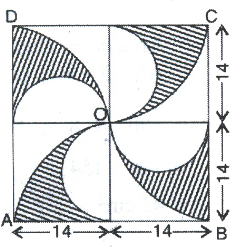
= \(4\pi\left\{ 49-\frac { 49 }{ 2 } \right\} \)cm2
= 4 x \({22\over7}\times{49\over2}\)
= 308 m2
21.
Here, AC = 24 cm, BC = 10 cm and AOB is a diameter.
Since angle in semicircle is a right angle i.e., \(\angle \)ACB = 90°
ஃ AB = \(\sqrt{AC^2+BC^2}\)
= \(\sqrt{24^2+10^2}\) = \(\sqrt{576+100}\)
= \(\sqrt{676}\) = 26 cm
ஃ RAdius, area of circle = \(26\over2\) = 13 cm
Now, Area of semicircle
= Area of semicircle - Area of \(\triangle\)ABC
= \(1\over2\)\(\pi\)r2 - \(1\over2\) x BC x BC
= \(1\over2\) x 3.14 x 13 x 13 - \(1\over2\) x 24 x 10
= \(530.66\over2\) - 120
= 265.33 - 120 = 145.33 cm2
22.
Diameter of Semicircle PSR, PAQ and QTR are 10 cm, 7 cm and 3 cm respectively.
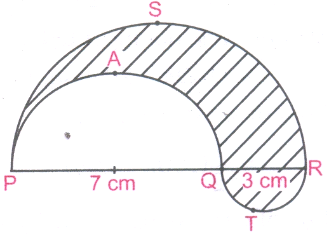
Perimeter of shaded region
= length of arc PSR + length of arc PAQ + length of arc QTR
= [\(\pi\)(5) + \(\pi\)(3.5) + \(\pi\)(1.5)] cm
= x 10 cm = 3.14 x 10 cm = 31.4 cm
23.
Length of semicircle ADC = \(\pi\times{4.2\over 2}cm=2.1\pi cm\)
Length of semicircle AEB\(=\pi\times{2.8\over2}cm=1.4\pi cm\)
Length of semicircle BFC=\(\pi\times{1.4\over2}cm=0.7\pi cm\)
∴ Perimeter of shaded region = 2.1π+1.4π+0.7π=4.2π cm=13.2cm

10th Standard CBSE Syllabus & Materials
10th Standard CBSE
CBSE 10th Social Science PS - Federalism - New Model Questions Papers Study Material - QB365 Set A
NEW10th Standard CBSE
CBSE 10th Social Science PS - Power Sharing - New Model Questions Papers Study Material - QB365 Set A
NEW10th Standard CBSE
CBSE 10th Social Science GEO - Manufacturing Industries - New Model Questions Papers Study Material - QB365 Set A
NEW10th Standard CBSE
CBSE 10th Social Science GEO - Minerals and Energy Resources - New Model Questions Papers Study Material - QB365 Set A



CBSE 10th Standard CBSE Subjects
CBSE Standards





