
 100% FREE ACCESS
10th Standard CBSE Syllabus & Materials
10th Standard CBSE
CBSE 10th Social Science ECO - Globalisation and the Indian Economy - New Model Questions Papers Study Material - QB365 Set A
NEW10th Standard CBSE
CBSE 10th Social Science ECO - Money and Credit - New Model Questions Papers Study Material - QB365 Set A
NEW10th Standard CBSE
CBSE 10th Social Science ECO - Sectors of the Indian Economy - New Model Questions Papers Study Material - QB365 Set A
NEW10th Standard CBSE
CBSE 10th Social Science ECO - Development - New Model Questions Papers Study Material - QB365 Set A
NEW10th Standard CBSE
CBSE 10th Social Science PS - Outcomes of Democracy - New Model Questions Papers Study Material - QB365 Set A
NEW10th Standard CBSE
CBSE 10th Social Science PS - Gender, Religion and Caste - New Model Questions Papers Study Material - QB365 Set A

Published on: 31/07/2018
Based on the Coordinate Geometry, some of the important questions are prepared in this question paper. It covers one mark, two, three and five marks questions from the book back and PTA question.
Download CBSE Class 10th Standard CBSE Maths question papers, sample papers, important questions, and previous year solved papers in PDF format. Get free study materials, NCERT solutions, and exam preparation resources for Class 10th Standard CBSE Maths
Questions + Answers key
Take MCQ Maths Test
1.
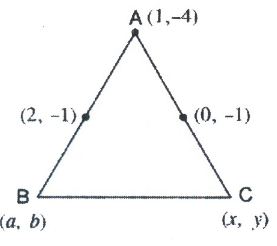
Find the area of the triangle ABC with A(1,-4) and the mid-points of sides through A being (2,-1) and (0,-1).
2.
The centre C, of a circle has the coordinates (4,5) and one point on the circumference is (8,10). Find the coordinates of the other end of the diameter of the circle through this point.
3.
Prove that (2,-2),(-2,1) and (5,2) are vertices of a right-angled triangle. Find the area of the triangle and the length of the hypotenuse.
4.
Find the distance between the following pairs of points: (-5,7),(-1,3)
5.
Find the centroid of a triangle whose vertices are (3, -7), (-8, 6) and (5, 10).
6.
State whether the following statement is true or false. Justify your answer.
"Point P(0,-7) is the point of intersection of y-axis and perpendicular bisector of line segment joining the points A(-1,0) and B(7,-6)."
7.
Find the coordinates of the perpendicular bisector of the line segment joining the points A(1,5) and B(4,6), cuts the y-axis.
8.
If two vertices of a triangle are at (-3,1), (0,-2) and centroid is at origin then find the coordinates of third vertex.
9.
If the vertices of a triangle are (8,7), (8,-2) and (2,-2), then find the coordinates of its centroid.
10.
If \(P({a\over2},3)\) is the mid-point of the line segment joining the points Q(-5,4) and R(-1,2) then find the value of a.
11.
Find the coordinates of the point equidistant from A(1,2), B(3,-4) and C(5,-6)
12.
If the area of the triangle with vertices (x,0), (1,1) and (0,2) is 4 square units then find the value of x.
13.
Find the distance between \(A\left( 0,\ \sqrt { 3 } \right) \ and\ B\left( \sqrt { 3 } +1,\ 1 \right) \)
14.
Does the point P(-2, 4) lie on a circle of radius 6 units and centre C(3, 5)?
15.
If the distance between the point (4, p) and (1, 0) is 5, then find the value of p.
16.
A circle drawn with origin as the centre passes through \(\left( \frac { 5 }{ 2 } ,0 \right) \). Does the point \(\left( \frac { 5 }{ 2 } ,\frac { 5 }{ 2 } \right) \) lies in its interior or exterior?
17.
If A and B are the points(-6,7) and (-1,-5) respectively then find the distance 2AB.
18.
Find the distance between the points \((-{8\over5},2) \ and \ ({2\over5},2)\)
19.
If the points A (6, 1), B(8, 2), C(9, 4) and D(p, 3) are the vertices of a parallelogram, taken in order, then find the value of p.
20.
(i) Plot the points M (5, - 3) and N (-3, - 3).
(ii) What is the length of MN?
(iii) Find the coordinates of points A, Band C lying on MN such that MA = AB = BC = CN.
21.
ABCD is a parallelogram with vertices A (x1,y1), B(x2,y2) and C(x3y3). Find the coordinates of the fourth vertex D in terms of x1,x2,x3,y1,y2 and y3
22.
Find the coordinates of centre of circle passing through the point (0,0), (-2,1) and (-3,2). Also, find its radius.
23.
Find the vertices of a triangle, the mid-points of whose sides are (3,1), (5,6) and (-3,2).
1.
Let the coordinates of B and C be (a,b) and (x,y) respectively
Then \(\left( \frac { 1+a }{ 2 } ,\frac { -4+b }{ 2 } \right) \) =(2.-1)
\(\Rightarrow \) \(\frac { 1+a }{ 2 } =2\quad and\quad \frac { -4+b }{ 2 } =-1\)
\(\Rightarrow \) 1+a=4 and -4+b=-2
\(\Rightarrow \) a=3 and b=2
Also \(\left( \frac { 1+x }{ 2 } ,\frac { -4+y }{ 2 } \right) \)=(0,-1)
\(\Rightarrow \) \(\frac { 1+x }{ 2 } =0\quad and\quad \frac { -4+y }{ 2 } =-1\)
\(\Rightarrow \) 1+x=0 and -4+y=-2
\(\Rightarrow \) x=-1 and y=2
Thus the coordinates of the vertices of ABC are A(1,-4),B(3,2) and C(-1,2)
Area of ABC =\(\frac { 1 }{ 2 } \) |1(2-2)+3(2+4)+(-1)(-4-2)|
= \(\frac { 1 }{ 2 } \)|0+18+6|
= \(\frac { 1 }{ 2 } \)(24)=12 sq.units
2.
(0,0)
3.
Let P(2, - 2). Q (-2. l) and R(5, 2) are vertices of the right-angled triangle.
PQ = \(\sqrt { (-2-2)^{ 2 }+[1=(-2)]^{ 2 } } \)
= \(\sqrt { 16+9 } \) =\(\sqrt { 25 } \)=5 units
QR= \(\sqrt { [5-(-2)]^{ 2 }+(2-1)^{ 2 } } \)
\(\sqrt { { 7 }^{ 2 }+1^{ 2 } } =\sqrt { 49+1 } =\sqrt { 50 } \) units
PR= \(\sqrt { (2-5)^{ 2 }+(-2-2)^{ 2 } } \)
= \(\sqrt { { 3 }^{ 2 }+4^{ 2 } } =\sqrt { 9+6 } \)
= \(\sqrt { 25 } \) =5 units
PQ2+PR2=52+52 =50 =QR2
\(\therefore \triangle \) PQR is right angled traingle
Hypotenuse =\(\sqrt { 50 } \) units =5 \(\sqrt { 2 } \)units
Area of \(\triangle \) PQR
=\(\frac { 1 }{ 2 } \) |x1(y2-y3)+x2(y3-y2)+x3(y1-y2)|
= \(\frac { 1 }{ 2 } \)|2(1-2)+(-2){2-(-2)}+5(-2-1)|
= \(\frac { 1 }{ 2 } \)2(-1)+(-2)(4)+5(-3)|
= \(\frac { 1 }{ 2 } \) |-25|=\(\frac { 25 }{ 2 } \) sq.units
4.
Let A(-5,7) and B(-1,3)
\(AB=\sqrt{(-1+5)^2+(3-7)^2}\)=\(\sqrt{16+16}\)=\(\sqrt{32}\)
=\(\sqrt{16X2}=4\sqrt2 units\)
5.
Here, (x1, y1)=(3, -7), (x2, y2) = (-8, 6) and (x3, y3) = (5, 10)
\(\therefore \) Coordinates of the centroid of a triangle are \(\left( \frac { 3-8+5 }{ 3 } ,\frac { -7+6+10 }{ 3 } \right) \) i.e. (0, 3).
\(\therefore\) centroid of triangle\(=\left( \frac { { x }_{ 1 }+{ x }_{ 2 }+{ x }_{ 3 } }{ 3 } ,\frac { { y }_{ 1 }+{ y }_{ 2 }+{ y }_{ 3 } }{ 3 } \right) \)
6.
True.
Here, P(0, -7) lies the y-axis
\(\left| PA \right| =\sqrt { { \left( -1-0 \right) }^{ 2 }+{ \left( 0+7 \right) }^{ 2 } } \)
\(=\sqrt { 1+49 } =\sqrt { 50 } \) units
\(\left| PB \right| =\sqrt { { \left( -7-0 \right) }^{ 2 }+{ \left( -6+7 \right) }^{ 2 } } \)
\(=\sqrt { 49+1 } =\sqrt { 50 } \) units
P(0, -7) lies on the y-axis and its distance from both A(-1, 0) and B(7, -6) is \(\sqrt { 50 } \) units.
7.
Here, P (0, y), A (1, 5) and B (4, 6) AP=BP
⇒ \(\sqrt { \left( 0-1 \right) ^{ 2 }+\left( y-5 \right) ^{ 2 } } =\sqrt { \left( 0-4 \right) ^{ 2 }+\left( y-6 \right) ^{ 2 } } \)
⇒ 1+y2+25-10y=16+y2+36-12y
⇒ 2y=26
⇒ y=13
Thus, required point is (0,13).
8.
Let (x,y) be the coordinates of third vertex of the triangle.
\(\therefore \frac { x-3+0 }{ 3 } =0\) and \(\frac { y+1-2 }{ 3 } =0\)
\(\Rightarrow \ x=3\ \) and x=1
Hence, the coordinates of the third vertex is (3,1).
9.
Coordinates of the centroid are :
\(\left( \frac { 8+8+2 }{ 3 } ,\frac { 7-2-2 }{ 3 } \right) i.e.,(6,1)\)
10.
\({-5-1\over2}={a\over2}\)
-6=a
a=-6
11.
(11,2)
12.
Area of triangle
=\(\frac{1}{2}\)|x1(y2-y3)+x2(y3-y1)+x3(y1-y2)
⇒\(\frac{1}{2}\)|x(1-2)+1(2-0)+0(0-1)|=4
⇒ |-x+2|=8 ⇒ -x+2=土8
⇒ -x=8-2 or -x=-8-2
⇒ x=-6 or x=10
13.
\(2\sqrt { 2 } \ \ units\)
14.
No
15.
The given points are (1,0) and (4, p)
\(\mathrm{d}=\sqrt{\left(\mathrm{x}_2-\mathrm{x}_1\right)^2+\left(\mathrm{y}_2-\mathrm{y}_1\right)^2}\)
\( \Rightarrow 5=\sqrt{(4-1)^2+\mathrm{p}^2}\)
\( \Rightarrow 25=(4-1)^2+\mathrm{p}^2\)
\(\Rightarrow 25-9=\mathrm{p}^2 \)
\( \Rightarrow \mathrm{p}^2=16\)
\( \Rightarrow \mathrm{p}=+4,-4\)
p=±4
16.
No
17.
A(-6,7),B(-1,-5)
Let x1=-6,y1=7;x2=-1,y2=-5
Distance, \(AB=\sqrt { \left( { x }_{ 2 }-{ x }_{ 1 } \right) ^{ 2 }+\left( { y }_{ 2 }-{ y }_{ 1 } \right) ^{ 2 } } \)
\(=\sqrt { { 5 }^{ 2 }+\left( -12 \right) ^{ 2 } } =\sqrt { 25+144 } =\sqrt { 169 } =13\)
2AB=2x13=26
18.
Distance between \((-{8\over5},2) \ and \ ({2\over5},2)\)
=\(\sqrt{(-{8\over5}-{2\over5})^2+(2-2)^2}=\sqrt4=2\)
19.
Given vertices of a parallelogram are A (6, 1), B(8, 2), C(9, 4) and D(p, 3).
Here, we have to find the value of p i.e. vertex D (p, 3).
We know that diagonals of a parallelogram bisect each other.
\(\therefore \) Coordinates of mid-point of diagonal AC = Coordinates of mid-point of diagonal BD
\(\Rightarrow \left( \frac { 6+9 }{ 2 } ,\frac { 1+4 }{ 2 } \right) =\left( \frac { 8+p }{ 2 } ,\frac { 2+3 }{ 2 } \right)\)
\(\Rightarrow \left( \frac { 15 }{ 2 } ,\frac { 5 }{ 2 } \right) =\left( \frac { 8+p }{ 2 } ,\frac { 5 }{ 2 } \right) \)
On equating x-coordinate from both sides, we get
\(\frac { 15 }{ 2 } =\frac { 8+p }{ 2 } \)
\(\Rightarrow 15=8+p\quad \)
\(\Rightarrow p=15-8\quad \)
\(\Rightarrow p=7\quad \)
Hence, the required value of p is 7.
20.
Given, coordinates of point M = (5,-3) and coordinates of point N = (-3,-3)
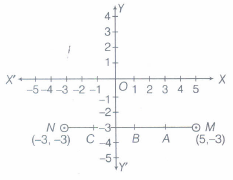
(ii) Length of MN = Perpendicular distance of M from negative Y-axis + Perpendicular distance of N from negative Y-axis
= Abscissa of M +Abscissa of N (without sign)
= 5 + 3 = 8 units
(iii) Here, points A, 11 and C divide MN into 4 equal parts of length\(\frac { 8 }{ 4 } \), i.e. 2 units.
\(\therefore \) Coordinates of A = (3, - 3)
Coordinates of B = (1,-3)
and coordinates of C = (-1, - 3)
21.
Let the coordinates of the fourth vertex D be D(x, y). We know that diagonals of a parallelogram bisect each other.
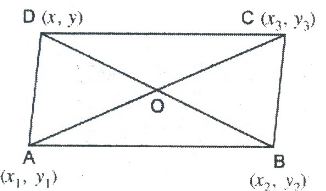
Therefore mid point of AC=midpoint of BD
\(\Rightarrow \) \(\left( \frac { { x }_{ 1 }+{ x }_{ 3 } }{ 2 } ,\frac { { y }_{ 1 }+y_{ 3 } }{ 2 } \right) =\left( \frac { { x }+{ x }_{ 2 } }{ 2 } ,\frac { { y }+y_{ 2 } }{ 2 } \right) \)
\(\Rightarrow \) \(\frac { { x }_{ 1 }+{ x }_{ 3 } }{ 2 } =\frac { { x }+{ x }_{ 2 } }{ 2 } \)
and \(\frac { y_{ 1 }+y_{ 3 } }{ 2 } =\frac { { y }+{ y }_{ 2 } }{ 2 } \)
\(\Rightarrow \) x1+x3=x+x2 and y1+y3=y+y2
\(\Rightarrow \) x=x1+x3 +x2 and y=y1+y3-y2
Hence,the coordinates of the fourth vertex in terms of x1,x2,x3,y1,y2 and y3 are
(x1+x3-x2,y1+y3-y2)
22.
Let the coordinates of the centre C of circle passing through the points P(0,0, Q(-2,1) and R(-3,2) and C(x,y).
∴ |PC| = |QC| = |RC| = radius --- (i)
|PC| = \(\sqrt { { (x-0) }^{ 2 }+({ y-0) }^{ 2 } } =\sqrt { { x }^{ 2 }+{ y }^{ 2 } } \)
\(|QC|\ =\ \sqrt { { (x+2) }^{ 2 }+({ y-1) }^{ 2 } } \)
\(=\ \sqrt { { { x }^{ 2 }+4+4x+{ y }^{ 2 }+1-2y } } \)
\(=\sqrt { { { x }^{ 2 }+4x-2y+{ y }^{ 2 }+5 } } \)
\(|RC|\ =\ \sqrt { { (x+3) }^{ 2 }+({ y-2) }^{ 2 } } \)
\(=\sqrt { { { x }^{ 2 }+9+6x+{ y }^{ 2 }+4-4y } } \)
\(=\sqrt { { { x }^{ 2 }+6x-4y+{ y }^{ 2 }+ }13 } \)
From (i), we get
PC2=QC2=RC2
⇒ x2+y2=x2+4x-2y+y2+5
=x2+6x-4y+y2+13
⇒ 4x-2y=-5 ---(ii)
and 6x-4y=-13 --- (iii)
Multiplying (ii) by 2 and subtracting from (iii), we have
-2x=-3 ⇒ \(x=\frac{3}{2}\)
From (ii), we have
\(4\times \frac{3}{2}-2y\)=-5 ⇒ 6-2y=-5}
⇒ \(y=\frac{11}{2}\)
Hence,the coordinates of the centre of circle of circle are C\((\frac{3}{2},\frac{11}{2})\) and radius = \(\sqrt { \frac { 9 }{ 4 } +\frac { 121 }{ 4 } } =\sqrt { \frac { 130 }{ 4 } } =\frac { \sqrt { 130 } }{ 2 } \)units.
23.
Let the vertices of △ABC be A(x1,y1), B(x2,y2) and C(x3, y3). Let D(3, 1), F.(5, 6) and F(- 3, 2) be the mid-points of BC, CA and AB respectively.
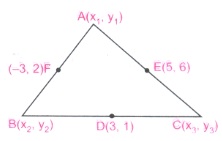
then \(\frac { { x }_{ 2 }+{ x }_{ 3 } }{ 2 } =3\ \Rightarrow \ { x }_{ 2 }+{ x }_{ 3 }=6\) ---- (i)
\(\frac { y_{ 2 }+{ y }_{ 3 } }{ 2 } =3\ \Rightarrow \ { y }_{ 2 }+{ y }_{ 3 }=2\) --- (ii)
\(\frac { { x }_{ 2 }+{ x }_{ 3 } }{ 2 } =5\ \Rightarrow \ { x }_{ 3 }+{ x }_{ 1 }=10\) --- (iii) and \(\frac { y_{ 3 }+{ y }_{ 1 } }{ 2 } =6\ \Rightarrow \ { y }_{ 1 }+{ y }_{ 3 }=12\) --- (iv)
\(\frac { { x }_{ 1 }+{ x }_{ 2 } }{ 2 } =-3\ \Rightarrow \ { x }_{ 1 }+{ x }_{ 2 }=-6\) --- (v) and \(\frac { y_{ 1 }+{ y }_{ 2 } }{ 2 } =2\ \Rightarrow \ { y }_{ 1 }+{ y }_{ 2 }=4\) --- (vi)
Adding (i), (iii) and (v), we get
2(x1+x2+x3) = 10 ⇒ x1+x2+x3=5 --- (vii)
Subtrcting (i), (iii), (v) separtely from (vii), we get x1=-1 , x2=-5, x3=11
Adding (ii), (iv) and (vi), we get
2(y1+y2+y3) = 18 ⇒ y1+y2+y3=9 --- (viii)
Subtracting (ii), (iv) and (vi) separetely from (viii), we get y1=7, y2=-3, y3=5.
Hence, the vertices of the triangle ABC are A(-1,7), B(-5,-3) and C(11,5).

10th Standard CBSE Syllabus & Materials
10th Standard CBSE
CBSE 10th Social Science PS - Federalism - New Model Questions Papers Study Material - QB365 Set A
NEW10th Standard CBSE
CBSE 10th Social Science PS - Power Sharing - New Model Questions Papers Study Material - QB365 Set A
NEW10th Standard CBSE
CBSE 10th Social Science GEO - Manufacturing Industries - New Model Questions Papers Study Material - QB365 Set A
NEW10th Standard CBSE
CBSE 10th Social Science GEO - Minerals and Energy Resources - New Model Questions Papers Study Material - QB365 Set A



CBSE 10th Standard CBSE Subjects
CBSE Standards





