
 100% FREE ACCESS
10th Standard CBSE Syllabus & Materials
10th Standard CBSE
CBSE 10th Social Science ECO - Globalisation and the Indian Economy - New Model Questions Papers Study Material - QB365 Set A
NEW10th Standard CBSE
CBSE 10th Social Science ECO - Money and Credit - New Model Questions Papers Study Material - QB365 Set A
NEW10th Standard CBSE
CBSE 10th Social Science ECO - Sectors of the Indian Economy - New Model Questions Papers Study Material - QB365 Set A
NEW10th Standard CBSE
CBSE 10th Social Science ECO - Development - New Model Questions Papers Study Material - QB365 Set A
NEW10th Standard CBSE
CBSE 10th Social Science PS - Outcomes of Democracy - New Model Questions Papers Study Material - QB365 Set A
NEW10th Standard CBSE
CBSE 10th Social Science PS - Gender, Religion and Caste - New Model Questions Papers Study Material - QB365 Set A

Published on: 31/07/2018
The chapter Electricity contains the important question paper in CBSE 10th Standard Science. It covers the question paper from the value based question.
Download CBSE Class 10th Standard CBSE Science question papers, sample papers, important questions, and previous year solved papers in PDF format. Get free study materials, NCERT solutions, and exam preparation resources for Class 10th Standard CBSE Science
Questions + Answers key
Take MCQ Science Test
1.
Two conducting wires of the same material and of equal lengths and equal diameters are first connected in series and then parallel in a circuit across the same potential difference. The ratio of heat produced in series and parallel combination would be
1:2
2:1
1:4
4:1
2.
Which of the following terms does not represent electrical power in a circuit?
I2R
IR2
VI
V2/R
3.
Unit of electric power may also be expressed as
volt ampere
kilowatt hour
watt second
joule second
4.
An electric kettle consumes 1 Kw of electric power when operated at 220 V. A fuse wire of what rating must be used for it?
1A
2A
4A
5A
5.
A current of 1 A is drawn by a filament of an electric bulb. Number of electrons passing through a cross section of the filament in 16 seconds would be roughly
1020
1016
1018
1023
6.
If I is the current through a wire and 1 is the charge of electron, then no. of electrons in t seconds will be
1/It
It/1
\(\frac { 11 }{ t } \)
It1
7.
Ohm's law is valid only when
Graph between V and I is a straight line
Temperature increases
Temperature decreases
Temperature remains constant.
8.
The commonly used safety fuse wire is made of
Lead
Copper
Nickel
An alloy of tin and lead
9.
The unit of specific resistance is
Ohm per meter
Ohm
Ohm per second
Ohm meter
10.
Materials which allow larger current to flow through them are called
Alloy
Semiconductors
Insulators
Conductors
11.
An electric heater of resistance 8 \(\Omega\) draws 15 A from the service mains 2 hours. Calculate the rate at which heat is developed in the heater.
12.
Show how you would connect three resistors, each of resistance 6 Ω, so that the combination has a resistance of (i) 9 Ω, (ii) 4 Ω.
13.
A wire of resistance 10 ohm is bent in the form of a closed circle. What is the effective resistance between the two points at the ends of any diameter of the circle?
14.
Why is parallel arrangement used in domestic wiring?
15.
Give the unit of electric resistance
16.
What is a voltmeter?
17.
What is an ammeter?
18.
What determines the rate at which energy is delivered by a current?
19.
What is meant by the statement, "Potential difference between points A and B in an electric field is 1 volt"?
20.
Give differences between conductors and insulators.
21.
(i) Draw a schematic diagram of a circuit consisting of a battery of five 2 V cells, a 5 Ohm resistor, a 10 Ohm resistor and a 15 Ohm resistor, and a plug key, all connected in series.
(ii) Calculate the electric current passing through the above circuit when the key is closed.
22.
(a) State Ohm's Law.
(b) Draw a schematic diagram of the circuit for studying Ohm's Law.
23.
(a) Distinguish between the terms "overloading and short circuiting" as used in domestic circuits.
(b) Why are the coils of electric toasters made of an alloy rather than a pure metal?
24.
Two lamps, one related 60W at 220 W at 220V and the other 40 W at 220 V, are connected in parallel to the electric supply at 220V.
(a) Draw a circuit diagram to show the connections.
(b) Calculate the current drawn from the electric supply.
(c) Calculate the total energy consumed by the two lamps together when they operate for one hour.
25.
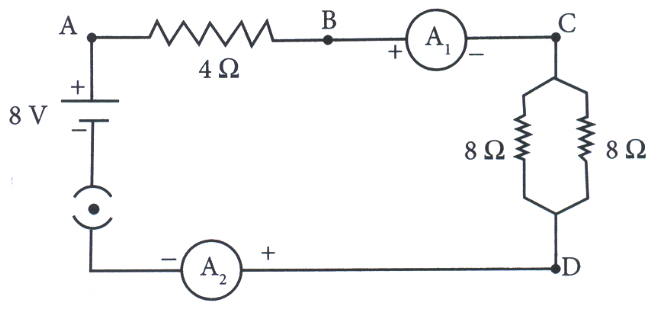
Find out the following in the electric circuit given in Figure
(a) Effective resistance of two 8 \(\Omega\) resistors in the combination
(b)Current flowing through 4 \(\Omega\) resistor
(c) Potential difference across 8 \(\Omega\) resistance
(d) Power dissipated in 4 \(\Omega\) resistor
(e) Difference in ammeter readings, if any.
26.
How will you infer with the help of an experiment that the same current flows through every part of the circuit containing three resistances in series connected to a battery?
1.
(c)
1:4
2.
(b)
IR2
3.
(a)
volt ampere
4.
(d)
5A
5.
(a)
1020
6.
(b)
It/1
7.
(a)
Graph between V and I is a straight line
8.
(a)
Lead
9.
(d)
Ohm meter
10.
(d)
Conductors
11.
Given, Resistance, R = 8 \(\Omega\) , Current, J = 15 A
Time, t = 2 h = 7200 s
\(\therefore\) Heat developed. H = J2Rr
=15 \(\times\)15 \(\times\) 8 \(\times\) 7200 J
\(\therefore\) Rate of heat developed.
\(P=\frac{H}{t}=\frac{15\times 15\times 8 \times 7200}{7200}\)
= 1800 W or 1800J/s
Thus, the rate at which heat is developed in the heater is 1800 joule per second.
12.
(i) If two 6 \(\Omega\) resistors are connected in parallel, then the equivalent resistance is \(\left ( \frac{6}{2} \right )=3 \Omega \)
This combination is connected in series with a 6 \(\Omega\) resistor to get overall equivalent resistance of (6+3) =9 \(\Omega\).
(ii) Equivalent resistance of two 6 \(\Omega\) resistances connected in series, R'=6+6= 12 \(\Omega\). Now, 12 \(\Omega\) and 6 \(\Omega\) resistors are connected in parallel.
Equivalent resistance, \(R_{eq}=\frac{12\times 6}{12+6}=\frac{72}{18}=4 \quad \Omega \)
13.
As the wire is bent in the form of a closed circle, it will be have like two resistors of 5\(\Omega \) each, connected in parallel. Therefore, the equivalent resistance can be calculated as:
\(\frac { 1 }{ R_{ eq } } =\frac { 1 }{ { R }_{ 1 } } +\frac { 1 }{ { R }_{ 2 } } \)
\(\frac { 1 }{ R_{ eq } } =\frac { 1 }{ 5 } +\frac { 1 }{ 5 } \)=\(\frac { 1 }{ R_{ eq } } =\frac { 2 }{ 5 } \)
\(\frac { 1 }{ R_{ eq } } =\frac { 5 }{ 2 } =2.5\Omega \)
The effective resistance between the two points at the ends of an diameter of the circle is 2.5 \(\Omega \).
14.
(a) All the appliances work at the same voltage as that of the electric supply.
(b) If one of the other appliances is out of order, all the other appliances keep on working as the circuit is not broken.
15.
Ohm (1Ω)
16.
A measuring instrument used to measure potential difference between two points in an electric circuit.
17.
A measuring instrument used to measure electric current.
18.
Electrical power determines the rate at which the energy is delivered by a current
19.
It means that 1 joule of work will be done in order to move 1 coulomb of charge from point A to B.
20.
| Conductors | Insulators |
| 1. Materials that allow electricity to pass through them. | Materials that do not allow electricity to pass through them. |
| 2. These materials have loosely bounded free electrons. |
These materials do not have loosely bounded free electrons. |
| 3. Eg., metals and graphite. | E.g., non-metals, rubber, plastic etc. |
21.
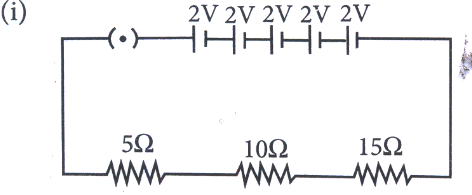
(ii) When the key is closed, total voltage applied across the circuit will be = 2 ✕ 5V = 10 V
Total resistance (R) applied across the circuit in Ohms = 5+10+15= \(30\Omega \)
By Ohm's Law,
Current (I) = \(\frac { V }{ R } \)
\(I=\frac { 10 }{ 30 } =0.33A\)
22.
(a) Ohm's Law states that at constant temperature, current flowing through a conductor is directly proportional to the potential difference across its ends.
-s.png)
23.
(a) Short circuiting is the term used for defining the situation in which the neutral and live wires of an electric circuit come in direct contact. When too many electrical appliances are connected to a single socket, the appliances drawn much more current or power that the permissible limit from the main supply. This situation is termed as overloading.
(b) Resistivity of an alloy is much higher than its constituent metals Moreover, alloys do not oxidise as easily as the constituent metals at high temperature. Because of these reasons, coils of electric testers are made of an alloy rather than a pure meta.
24.
(a)
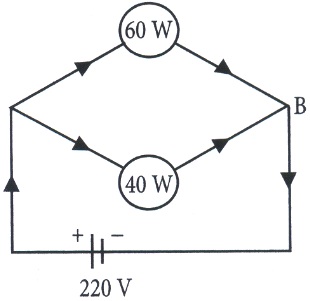
(b) Electric current flowing through a bulb = \(\frac { Power\quad of\quad the\quad bulb }{ Voltage\quad across\quad the\quad bulb } \)
\(i.e.,\quad I=\frac { P }{ V } \)
Therefore, \({ I }_{ 60 }=\frac { 60W }{ 220V } =\frac { 3 }{ 11 } A\quad and\quad { I }_{ 40 }=\frac { 40W }{ 220V } =\frac { 2 }{ 11 } A\)
Therefore, total current flowing through the circuit \(={ I }_{ 60 }+{ I }_{ 40 }=\frac { 3 }{ 11 } +\frac { 2 }{ 11 } =\frac { 5 }{ 11 } A=0.45A\)
(c) Total energy consumed = Power \(\times \) Time
That is, E = P \(\times \) T
= (40W+60W)\(\times \)1h
= 100 Wh
= 0.1 kWh
25.
(a) Since two \(8\Omega \) resistors are in parallel, their effective resistance (\({ R }_{ P }\)) is given by,
\(\frac { 1 }{ { R }_{ P } } =\frac { 1 }{ 8 } +\frac { 1 }{ 8 } +\frac { 1 }{ 4 } \) or \({ R }_{ P }=4\Omega \)
(b) Total resistance in the circuit
\(R=4\Omega +{ R }_{ P }=4\Omega +4\Omega =84\Omega \)
Current through the electric circuit
\(I=\frac { V }{ R } =\frac { 8V }{ 8\Omega } =1A\)
(c) The potential difference \(4\Omega \) resistor V
I \(=IR=1\times 4=4V\)
(d) Power dissipated in \(4\Omega \) resistor P=\({ (I) }^{ 2 }\)
\(R={ (1) }^{ 2 }(4)=4W\)
(e) There is no difference in the readings of ammeters \({ A }_{ 1 }\) and \({ A }_{ 2 }\) as same current flows through all elements in a series circuit.
26.
A number of resistors are said to be connected in series, if these are joined end to end and the same, current flows through each one of them when a potential difference is applied across the combination. If we connect ammeter first between the point A and R1, then between R1 and R2:R2 and R3 and lastly between R3 and the point B; it is same as current.

10th Standard CBSE Syllabus & Materials
10th Standard CBSE
CBSE 10th Social Science PS - Federalism - New Model Questions Papers Study Material - QB365 Set A
NEW10th Standard CBSE
CBSE 10th Social Science PS - Power Sharing - New Model Questions Papers Study Material - QB365 Set A
NEW10th Standard CBSE
CBSE 10th Social Science GEO - Manufacturing Industries - New Model Questions Papers Study Material - QB365 Set A
NEW10th Standard CBSE
CBSE 10th Social Science GEO - Minerals and Energy Resources - New Model Questions Papers Study Material - QB365 Set A



CBSE 10th Standard CBSE Subjects
CBSE Standards





