
 100% FREE ACCESS
10th Standard CBSE Syllabus & Materials
10th Standard CBSE
CBSE 10th Social Science ECO - Globalisation and the Indian Economy - New Model Questions Papers Study Material - QB365 Set A
NEW10th Standard CBSE
CBSE 10th Social Science ECO - Money and Credit - New Model Questions Papers Study Material - QB365 Set A
NEW10th Standard CBSE
CBSE 10th Social Science ECO - Sectors of the Indian Economy - New Model Questions Papers Study Material - QB365 Set A
NEW10th Standard CBSE
CBSE 10th Social Science ECO - Development - New Model Questions Papers Study Material - QB365 Set A
NEW10th Standard CBSE
CBSE 10th Social Science PS - Outcomes of Democracy - New Model Questions Papers Study Material - QB365 Set A
NEW10th Standard CBSE
CBSE 10th Social Science PS - Gender, Religion and Caste - New Model Questions Papers Study Material - QB365 Set A

Published on: 30/07/2018
Probability - Important Question Paper
Download CBSE Class 10th Standard CBSE Maths question papers, sample papers, important questions, and previous year solved papers in PDF format. Get free study materials, NCERT solutions, and exam preparation resources for Class 10th Standard CBSE Maths
Questions + Answers key
Take MCQ Maths Test
1.
In the word 'ASSASSINATION' the probability of getting a vowel is..........
2.
Probability of an event E+Probability of the event 'not E' = .............
3.
Probability of getting 6 with single die is.........
4.
Sum of the probabilities of each outcome in an experiment is...........
5.
The sum of the probabilities of all the elementary events of an experiment is _______________
6.
Probability of an event E + Probability of the event 'not E' = --------------
7.
Cards marked with number 3, 4, 5,.........., 50 are placed in a box and mixed thoroughly. A card is drawn at random from the box. Find the probability that the selected card bears a perfect square number.
8.
If a die is thrown once, find the probability of getting a number less than 3 and greater than 2.
9.
A card is drawn at random from a well-shuffled deck of 52 cards. Find the probability of getting a club.
10.
Cards bearing numbers 3 to 20 are placed in a bag and mixed thoroughly. A card is taken out from the bag at random. What is the probability that the number on the card taken out is an even number?
11.
Why is tossing a coin considered to be a fair way of deciding which team should get the ball at the beginning of a football game?
12.
A card is drawn from a well shuffled deck of 52 cards.Find the probability of getting:
(i)A king of red colour
(ii)A face card
(iii)The queen of diamonds.
13.
From a pack of 52 playing cards, Jacks, Queens and Kings of red colours are removed. From the remaining, a card is drawn at random. Find the probability that drawn card is : (i) a black king (ii) a card of red colour (iii) a card of black colour
14.
The king, queen and jack of clubs are removed from a deck of 52 playing cards and then well-shuffled. One card is selected from the remaining cards. Find the probability of getting
(i) a heart (ii) a king (iii) a club (iv) the '10' of hearts
15.
A bag contains 5 red balls and some blue balls. If the probability of drawing a blue ball from the bag is thrice that of a red ball, find the number of blue balls in the bag.
16.
A card is drawn at random from a well-shuffled deck of playing cards. Find the probability that the card drawn is
(i) a king or a jack (ii) a non-ace
(iii) a red card (iv) neither a king nor a queen
17.
A die is thrown twice. What is the probability that
(i) 5 will not come up either time?
(ii) 5 will come up at least once?
[Hint : Throwing a die twice and throwing two dice simultaneously are treated as the same experiment]
18.
A lot consists of 144 ball pens of which 20 are defective and the others are good. Nuri will buy a pen if it is good, but will not buy if it is defective. The shopkeeper draws one pen at random and gives it to her. What is the probability that (i) She will buy it ? (ii) She will not buy it ?
19.
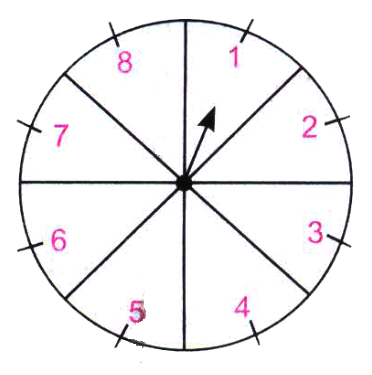
A game of chance consists of spinning an arrow which comes to rest pointing at one of the numbers 1, 2, 3, 4, 5, 6, 7, 8 (see Fig.), and these are equally likely outcomes. What is the probability that it will point at
(i) 8 ?
(ii) an odd number?
(iii) a number greater than 2?
(iv) a number less than 9?
20.
A box contains 5 red marbles, 8 white marbles and 4 green marbles. One marble is taken out of the box at random. What is the probability that the marble taken out will be (i) red? (ii) white? (iii) not green?
21.
A child's game has 8 triangles of which 3 are blue and rest are red, and 10 squares of which 6 are blue and rest are red. One piece is lost at random. Find the probability that it is a
(i) triangle (ii) square
(iii) square of blue colour (iv) triangle of red colour
22.
Queen, King and Jack are face cards.
23.
P(E)+P(\(\overset{-}{E}\))=1.
24.
Probability of an event cannot be negative.
25.
Set of all possible outcomes of the experiment is called the sample space.
26.
For any event E, P(E)+P(\(\overset { - }{ E } \))
1.
()
\(6\over13\)
2.
()
1
3.
()
1/6
4.
()
1
5.
()
1,(e.g. Suppose a die is thrown, then P(getting1) + P(getting2) + P(getting 3) + P(getting 4)+ P(gerting 5) + P(getting 6) =1)
6.
()
1, because the Sum of probabilities of complementary events is equal to one.
7.
Possible outcomes are 4, 9, 16, 25, 36, 49, i.e. 6.
\(\Rightarrow\) P(perfect square number) = \(\frac{6}{48}\)or \(\frac{1}{8}\)
8.
0
9.
Total number of cards in a deck of card = 52
Number of clubs = 13
\(\therefore\) Probability of drawing a club = \(\frac{13}{52}\)
= \(\frac{1}{4}\)
10.
Total number of cards = 18
Even numbers from 3 to 20 are 4, 6, 8, 10, 12, 14, 16, 18, 20 = 9 numbers
Probability that the number on the card taken out is an even number
\(=\frac{Number \ \ of \ \ favourable \ \ outcomes}{Total \ \ number \ \ of \ \ outcomes}=\frac{9}{18}=\frac{1}{2}\)
11.
When we toss a coin,we get either head or tail which are equally likely outcomes. Hence, the result of the toss of a coin is completely unpredictable or unbiased. So, tossing a coin is a fair way of deciding.
12.
(i)Total number of cards=52
Number of red coloured kings=2
p(a king of red colour)=\({2\over52}={1\over26}\)
(ii)Number of face cards=12
p(a face card)\(={12\over52}={3\over13}\)
(iii)Number of queen of diamonds=1
p(the queen of diamonds)\(={1\over52}\)
13.
Number of cards left in pack=52-6
=46
(i)let A=black king is drawn
Number of black king in the pack=2
\(\therefore\ P(A)={2\over 46}={1\over 23}\)
(ii)B=a card of red colour is drawn
No.of red cards left in the pack = 26-6=20
\(\therefore\ P(B)={20\over 46}={10\over 23}\)
(iii)Let C = A card of black colour is drawn
No. of black card in the pack =26
\(\therefore\ P(C)={26\over46}={13\over 23}\)
14.
Card removed = king, queen and jack of clubs = 3
Cards left = 52- 3 = 49
(i) Number. of hearts = 13
Probability of drawing a heart = \(\frac {13}{49}\)
(ii) Number of king = 4
Number of kings left = 4 - 1 = 3
Probability of drawing a king = \(\frac {3}{49}\)
(iii) 3 clubs are removed
Number of clubs left=13-3=10
Probability of drawing a club = \(\frac {10}{49}\)
(iv) There is only one '10' of hearts.
\(\therefore\)Probability of drawing a '10' of hearts =\(\frac {1}{49}\)
15.
Let the number of blue balls be x.
Total number of balls in the bag = 5 + x
\(\therefore\) Probability of drawing a red ball = \(\frac{5}{5+x}\) and probability of drawing a blue ball = \(\frac{x}{5+x}\)
Given probability of drawing a blue ball = 3 X probability of drawing a red ball
\(3\times\frac{5}{5+x}=\frac{x}{5+x}\Rightarrow15=x\)
\(\Rightarrow\) Number of blue balls = 15
16.
Total number of playing cards = 52
(i) Favourable cases for a king or a jack are 8 (4 kings + 4 jacks)
\(\therefore\) Probability of drawing a king or a jack = \(\frac{8}{52}=\frac{2}{13}\)
(ii) Favourable cases for a non-ace are 48 (52 cards - 4 aces)
\(\therefore\) Probability of drawing a non-ace = \(\frac{48}{52}=\frac{12}{13}\)
(iii) Favourable cases for a red cards are 26 (13 hearts + 13 diamonds)
\(\therefore\) Probability of drawing a red card = \(\frac{26}{52}=\frac{1}{2}\)
(iv) Favourable cases for neither a king nor a queen are 44 (52 cards - 4 kings - 4 queen)
\(\therefore\) Probability of drawing neither a king nor a queen = \(\frac{44}{52}=\frac{11}{13}\)
17.
Total number of outcomes = 36
(i) Let E = Event of getting 5 on atleast one die
Then, E would consist of 11 outcomes, namely (1,5), (2, 5), (3, 5), (4, 5), (5, 5), (6, 6), (5, 1), (5, 2), (5, 3), (5, 4) and (5, 6).
\(\therefore\) Number of outcomes favourable to E = 11
Hence, probability that 5 will come up atleast once,
\(P(E)=\frac{11}{36}\)
(ii) Probability that 5 will not come up either time,
\(P(\bar{E})=1-P(E)=1-\frac{11}{36}=\frac{25}{36}\)
18.
Total number of ball pens = 144
\(\therefore\) Number of all possible outcomes = 144
(i) Let E = event of getting a good ball pen
Then, number of outcomes favourable to E
= Total number of ball pens - Defective ball pens
= 144 - 20 = 124
She will buy a pen, if it is a good pen.
\(\therefore\) Required probability = \(P(E)=\frac{124}{144}=\frac{31}{36}\)
(ii) She will not buy a pen, if it is not a good pen.
\(\therefore\) Required probability
= 1 - Probability of getting a good pen
\([\because P(E)+P(\bar{E})=1]\)
\(=1-P(E)=1-\frac{31}{36}=\frac{5}{36}\)
19.
Total number of points on the circle = 8
(i) Let E1 = Event of getting arrow at number 8
\(\therefore\) Number of outcomes favourable to E1 = 1
Probability that arrow cones at number 8,
\(P\left(E_1\right)=\frac{1}{8}\)
(ii) Let E2 = Event of getting arrow at an odd number
Here, odd numbers are 1, 3, 5 and 7.
\(\therefore\) Number of outcomes favourable to E2 = 4
Probability that arrow comes at an odd number,
\(P\left(E_2\right)=\frac{4}{8}=\frac{1}{2}\)
(iii) Let E3 = Event of getting arrow at a number greater than 2, i.e. at 3, 4, 5, 6, 7 or 8
\(\therefore\) Number of outcomes favourable to E3 = 6
Probability that arrow comes at a number greater than 2,
\(P\left(E_3\right)=\frac{6}{8}=\frac{3}{4}\)
(iv) P(a number less than 9) = \(\frac{8}{8}\)=1
20.
Total number of marbles = 5 + 8 + 4 = 17
(i) P(red marble) = \(\frac{5}{17}\)
(ii) P(white marble) = \(\frac{8}{17}\)
(iii) Let E3 = Event of drawing a marble which is not green = Event of drawing either red or white marble
\(\therefore\) Number of outcomes favourable to E3 = 5 + 8 = 13
So, probability of taken out not a green marble,
P(E3)=\(\frac{13}{17}\)
21.
Total number of pieces = 8 + 10 = 18
(i) No.of triangles = 8. Hence, P(triangle is lost) = \(\frac{8}{18}=\frac{4}{9}\)
(ii) No.of squares = 10. Hence, P(square is lost) = \(\frac{10}{18}=\frac{5}{9}\)
(iii) No.of squares of blue colour = 6. So, P(square of blue colour is lost) = \(\frac{6}{18}=\frac{1}{3}\)
(iv) No.of triangles of red colour = 8 - 3 = 5. So, P(triangle of red colour is lost) = \(\frac{5}{18}\)
22.
(a)
23.
(a)
24.
(a)
25.
(a)
26.
(a)

10th Standard CBSE Syllabus & Materials
10th Standard CBSE
CBSE 10th Social Science PS - Federalism - New Model Questions Papers Study Material - QB365 Set A
NEW10th Standard CBSE
CBSE 10th Social Science PS - Power Sharing - New Model Questions Papers Study Material - QB365 Set A
NEW10th Standard CBSE
CBSE 10th Social Science GEO - Manufacturing Industries - New Model Questions Papers Study Material - QB365 Set A
NEW10th Standard CBSE
CBSE 10th Social Science GEO - Minerals and Energy Resources - New Model Questions Papers Study Material - QB365 Set A



CBSE 10th Standard CBSE Subjects
CBSE Standards





