
 100% FREE ACCESS
11th Standard Syllabus & Materials
11th Standard
TN 11th Tamil இயற்கை வேளாண்மை,சுற்றுச்சூழல் -செய்யுள் - மனோன்மணீயம் Important Questions And Answers Study Material - QB365 Set A
NEW11th Standard
TN 11th Tamil என்னுயிர் என்பேன் -துணைப்பாடம் - இசைத்தமிழர் இருவர் Important Questions And Answers Study Material - QB365 Set A
NEW11th Standard
TN 11th Tamil மொழி கலை -செய்யுள் - ஒவ்வொரு புல்லையும் Important Questions And Answers Study Material - QB365 Set A
NEW11th Standard
TN 11th Tamil பீடு பெற நில் - இலக்கணம் - பகுபத உறுப்புகள் Important Questions And Answers Study Material - QB365 Set A
NEW11th Standard
TN 11th Tamil பீடு பெற நில் - துணைப்பாடம் - வாடிவாசல் Important Questions And Answers Study Material - QB365 Set A
NEW11th Standard
TN 11th Tamil பீடு பெற நில் - செய்யுள் - குறுந்தொகை Important Questions And Answers Study Material - QB365 Set A

Published on: 30/09/2018
Important questions -chapter 5,6
Download Tamil Nadu 11th Standard Physics question papers, model tests, one-mark questions, important questions, and public exam papers in PDF format. Free study materials and answer keys for TN State Board students.
Questions + Answers key
Take MCQ Physics Test1.
If a person moves from Chennai to Trichy, his weight
increases
decreases
remains same
increases and then decreases
2.
The magnitude of the Sun’s gravitational field as experienced by Earth is
same over the year
decreases in the month of January and increases in the month of July
decreases in the month of July and increases in the month of January
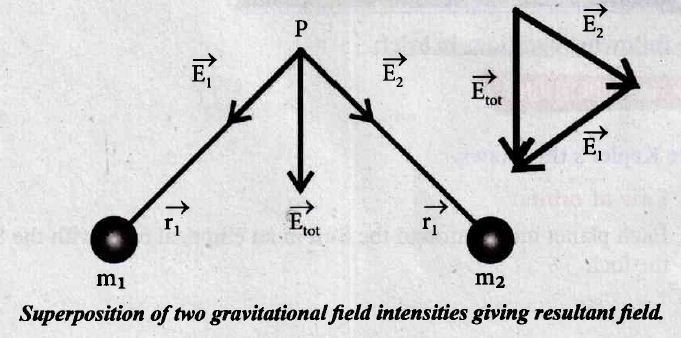
increases during day time and decreases during night time
3.
If the mass and radius of the Earth are both doubled, then the acceleration due to gravity g'
remains same
\({g\over 2}\)
2g
4g
4.
The work done by the Sun’s gravitational force on the Earth is
always zero
always positive
can be positive or negative
always negative
5.
The linear momentum and position vector of the planet is perpendicular to each other at
perihelion and aphelion
at all points
only at perihelion
no point
6.
Unit of moment of inertia _____________.
kgm
mkg-2
kgm2
kgm-1
7.
Infinitesimal quantity means _____________.
collective particles
extremely small
nothing
extremely larger
8.
Sliding of the object occurs when _____________.
Vtrans
Vtrans=Vrot
Vtrans>Vrot
Vtrans=0
9.
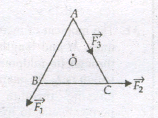
ABC is an equilateral triangle with O as its centre.\(\overrightarrow{F_1},\overrightarrow{F_2}\ and\ \overrightarrow{F_3}\)represent three forces acting along the sides AB, BC and AC respectively. If the total torque about O is zero then the magnitude of \(\overrightarrow{F_3}\) is ______________.
F1 + F2
F1 - F2
\({F_1+F_2\over 2}\)
2(F1 + F2)
10.
A body is rolling down an inclined plane. Its translational and rotational kinetic energies are equal. The body is a _____________.
solid sphere
hollow sphere
solid cylinder
hollow cylinder
11.
The speed of a solid sphere after rolling down from rest without sliding on an inclined plane of vertical height h is,
\( \sqrt \frac{4}{3}gh\)
\( \sqrt \frac{10}{7}gh\)
\(\sqrt{2gh}\)
\( \sqrt \frac{1}{2}gh\)
12.
The ratio of the acceleration for a solid sphere (mass m and radius R) rolling down an incline of angle \(\theta\) without slipping and slipping down the incline without rolling is,
5: 7
2: 3
2: 5
7: 5
13.
A disc of the moment of inertia Ia is rotating in a horizontal plane about its symmetry axis with a constant angular speed \(\omega\). Another disc initially at rest of moment of inertia Ib is dropped coaxially on to the rotating disc. Then, both the discs rotate with the same constant angular speed. The loss of kinetic energy due to friction in this process is,
\(\frac { 1 }{ 2 } \frac { { I }_{ b }^{ 2 } }{ 2({ I }_{ a }+{ I }_{ b }) } { \omega }^{ 2 }\)
\(\frac { { I }_{ b }^{ 2 } }{ ({ I }_{ a }+{ I }_{ b }) } { \omega }^{ 2 }\)
\(\frac { { ({ I }_{ b }-{ I }_{ a }) }^{ 2 } }{ ({ I }_{ a }+{ I }_{ b }) } { \omega }^{ 2 }\)
\(\frac { 1 }{ 2 } \frac { { { I }_{ b }{ I }_{ b } } }{ ({ I }_{ a }+{ I }_{ b }) } { \omega }^{ 2 }\)
14.
A closed cylindrical container is partially filled with water. As the container rotates in a horizontal plane about a perpendicular bisector, its moment of inertia
increases
decreases
remains constant
depends on direction of rotation
15.
A rope is wound around a hollow cylinder of mass 3 kg and radius 40 cm. What is the angular acceleration of the cylinder if the rope is pulled with a force 30 N?
0.25 rad s-2
25 rad s-2
5 ms-2
25 ms-2
16.
Four particles, each of mass M and equidistant from each other, move along a circle of radius R under the action of their mutual gravitational attraction. Calculate the speed of each particle.
17.
If the Earth has no tilt, what happens to the seasons of the Earth?
18.
Define gravitational potential.
19.
Which component of linear momentum does not contribute to angular momentum?
20.
Can the couple acting on a rigid body produce translator motion?
21.
State the principle of moments of rotational equilibrium.
22.
When an object be in mechanical equilibrium?
23.
Three blocks of uniform thickness and masses m, m and 2m are placed at three corners of a triangle having co-ordinates (2.5, 1.5) (3.5, 1.5) and (3, 3) respectively. Find the centre of mass of the system.
24.
Why centripetal force cannot do work?
25.
State the torque about an axis is independent of the origin.
26.
An object is thrown from Earth in such a way that it reaches a point at infinity with non-zero kinetic energy [K.E(r=\(\infty\))= \({1\over 2}MV_{\infty}^2\)], with what velocity should the object be thrown from Earth?
27.
Explain the variation of g with altitude.
28.
How will you prove that Earth itself is spinning?
29.
What is meant by superposition of gravitational field?
30.
A disc of mass 500 g and radius 10 cm can freely rotate about a fixed axis as shown in figure. light and inextensible string is wound several turns around it and 100 g body is suspended at its free end. Find the acceleration of this mass. [Given: The string makes the disc to rotate and does not slip over it. g = 10ms-2]
31.
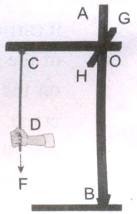
Three mutually perpendicular beams AB, OC, GH are fixed to form a structure which is fixed to the ground firmly as shown in the Figure. One string is tied to the point C and its free end D is pulled with a force F. Find the magnitude and direction of the torque produced by the force,
(i) about the points D, C, O and B
(ii) about the axis CD, OC, AB and GH.
32.
A car weighs 1800 kg. The distance between its front and back axies is 1.8 m. Its centre of gravity is 1.05 m behind the front axle. Determine the force exerted by the level ground on each front and back wheel.
33.
A star of mass twice the solar mass and radius 106 km rotates about its axis with an angular speed of 10-6 rad s-1. What is the angular speed of the star when it collapses (due to inward gravitational force) to a radius of 104 km? Solar mass 1.99 x 1030 kg.
34.
Calculate the moment of inertia of a cylinder of length 1.5m, radius 0.05m and density 8 X 10³ kg m-3 about the axis of the cylinder.
35.
The diameter of a solid disc is 0.5m and its mass is 16kg. What torque will increase Its angular velocity from zero to 120 rotations/minute in 8 seconds?
36.
What is rolling motion?
37.
Explain how the torque can be expressed as a vector product of two vectors, how is the direction and magnitude of torque is determined?
38.
Explain in detail the Eratosthenes method of finding the radius of Earth.
39.
Explain how Newton arrived at his law of gravitation from Kepler’s third law.
40.
From a complete ring of mass M and radius R, a sector angle \(\theta\) is removed. What is the moment of inertia of the incomplete ring about axis passing through the center of the ring and perpendicular to the plane of the ring?
41.
Derive an expression for center of mass for distributed point masses.
42.
Calculate the CG of plane lamina by pivoting method.
43.
A uniform disc of mass 100g has a diameter of 10 cm, Calculate the total energy of the disc when rolling along a horizontal table with a velocity of 20 cms-1. (take the surface of table as reference).
44.
Write an expression for the kinetic energy of a body in pure rolling.
45.
Obtain the relation between Torque and angular acceleration.
1.
(b)
decreases
2.
(c)
decreases in the month of July and increases in the month of January
3.
g = \(\frac{GM_e}{R^2_e}\)
Me = 2 Me Re= 2 Re then,
g' = \(\frac{G \times 2M_e}{(2R_e)^2}\) = \(2 \frac{Gm_e}{4R_e^2}\)
\(2 \frac{Gm_e}{4R_e^2}\) = \(\cfrac g2\)
4.
(c)
can be positive or negative
5.
(a)
perihelion and aphelion
6.
(c)
kgm2
7.
(b)
extremely small
8.
(c)
Vtrans>Vrot
9.
Let x be the distance of each scale of the \(\Delta\)ABC from the centre 6. Then total torque about O will be
\(F_{1} \times x+F_{2} \times x-F_{3} \times x=\mathrm{O} \text { or } F_{1}+F_{2}=F_{3} \)
10.
(d)
hollow cylinder
11.
Potential energy = Translational kinetic energy + Rotational kinetic energy
\(m g h=\frac{1}{2} m v^{2}+\frac{1}{2} I \omega^{2} \)
\(=\frac{1}{2} m v^{2}+\frac{1}{2} \times \frac{2}{5} M R^{2} \times \frac{v^{2}}{R^{2}}\left[\omega=\frac{v}{R}\right] \)
\(=\frac{1}{2} m v^{2}+\frac{1}{5} m v^{2} \)
\(=\frac{5 m v^{2}+2 m v^{2}}{10}=\frac{7 m v^{2}}{10} \)
\(m g h=\frac{7 m v^{2}}{10} \)
\(g h=\frac{7 v^{2}}{10} \)
\(\therefore v^{2}=\frac{10 g h}{7} \)
\(\therefore v=\frac{\sqrt{10 g h}}{7} \)
12.
Acceleration of the solid sphere while rolling down without slipping
\(a_{1}=\frac{g \sin \theta}{1+\frac{k^{2}}{r^{2}}}\)
Acceleration developed while slipping down \(a_{2}=g \sin \theta\)
\(\text { Required ratio } \frac{a_{1}}{a_{2}}=\frac{g \sin \theta}{1+\frac{k^{2}}{r^{2}}} / g \sin \theta\)
\(\frac{a_{1}}{a_{2}}=\frac{1}{1+\frac{k^{2}}{r^{2}}}\)
\(\text { For a solid sphere } \frac{k^{2}}{r^{2}}=\frac{2}{5}\)
\(\therefore \text { Ratio of accelerations } \frac{a_{1}}{a_{2}}=\frac{1}{1+\frac{2}{5}}\)
\(=\frac{1}{5+\frac{2}{5}}=\frac{1}{\frac{7}{5}}=\frac{5}{7}\)
\(\therefore a_{1}: a_{2}=5: 7 \)
13.
The moments of inertia of two discs are Ia and Ib respectively The angular velocity of the disc A is \(\omega\).
The sum of kinetic energies of two discs before coming in contact is \(k_{1}=\frac{1}{2} I_{a} \omega_{1}^{2}+\frac{1}{2} I_{b} \omega_{2}^{2}\)
\(\text { But angular velocity of the disc be is } \omega_{2}=0 \ \text {(rest)}\)
\(\therefore k_{1}=\frac{1}{2} I_{a} \omega_{1}^{2}\)
The final kinetic energy of the two discs system \(k_{2}=\frac{1}{2} \frac{I_{a}^{2} \omega_{1}^{2}}{I_{a}+I_{b}}\)
The loss of kinetic energy is
\(k_{1}-k_{2} =\frac{1}{2} I_{a} \omega^{2}-\frac{1}{2}\left[\frac{I a^{2} \omega_{1}^{2}}{I_{a}+I_{2 b}}\right] \)
\(=\frac{1}{2} \frac{\left[I_{1}\left(I_{a}+I_{b}\right) \omega^{2}-I_{a}^{2} \omega^{2}\right]}{I_{a}+I_{b}} \)
\(k_{1}-k_{2} =\frac{1}{2} \frac{I_{a} b}{\left(I_{a}+I_{b}\right)} \omega^{2} \)
14.
(a)
increases
15.
\(m=3 \mathrm{~kg} \quad r=40 \times 10^{-2} \mathrm{~m}=0.4 \mathrm{~m}\)
\(\text { Force }=30 N\)
Moment of inertia of a hollow-cylinder I= MR2
\(=3 \times\left(40 \times 10^{-2}\right)^{2} \)
\(=3 \times 0.4 \times 0.4=0.48 \mathrm{kgm}^{2} \)
\( F R =I \alpha \)
\(30 \times 40 \times 10^{-2}=0.48 d \)
\(d=\frac{12}{0.48}=\frac{1200}{48}=25 \mathrm{rad} \mathrm{s}^{-2} \)
\(\alpha=25 \mathrm{rad} \mathrm{s}^{-2} \)
16.
The gravitational potential energy
\(\mathrm{V} =-\frac{G M^{2}}{R}\left[1+\frac{4}{\sqrt{2}}\right]
\)
\(\mathrm{V} =-\frac{G M^{2}}{R}[1+2 \sqrt{2}]
\)
\(\text {Gravitational potential } \mathrm{V}_{\mathrm{o}}(\mathrm{r}) =-\frac{4 G M}{R}\)
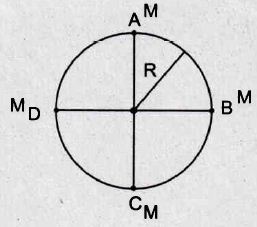
Centripetal acceleration \(a=\frac{V^{2}}{R}\)
Centripetal force \(=\frac{M V^{2}}{R}\)
\(\therefore\) Speed \(V=\frac{1}{2} \sqrt{\frac{G M}{R}(1+2 \sqrt{2})}\)
17.
If the Earth has us tilt then there would not be seasons of the Earth.
18.
The gravitational potential at a distance r due to a mass is defined as the amount of work required to bring unit mass from infinity to the distance r and it is denoted as V(r).
\(\mathrm{V}(\mathrm{r})=-\frac{\mathrm{Gm}}{r}\)
19.
Radial Component.
20.
No. It can produce only rotatory motion.
21.
\(\sum { \bar { \tau } } =0\)
22.
A rigid body is said to be in mechanical equilibrium when both its linear momentum and angular momentum remain constant.
23.
\({x}_{CM}={m(2.5)+m(3.5)+2m(3)\over m+m+2m}=3\)
\({y}_{CM}={m(1.5)+m(1.5)+2m(3)\over m+m+2m}=2.25\)
24.
The centripetal force cannot do work on the object since it is always perpendicular to the velocity.
25.
(i) The torque of a force about an axis is independent of the choice of the origin as long as it is chosen on that axis itself.
(ii) Let O be the origin on the axis AB, which is the rotational axis of a rigid body. F is the force acting at the point P. Now, choose another point O' anywhere on the axis.
(iii) The torque of F about O' is,
\(\overset { \rightarrow }{ O'P } \times \overset { \rightarrow }{ F } =(\overset { \rightarrow }{ O'O } +\overset { \rightarrow }{ OP } )\times \overset { \rightarrow }{ F } \)
=\((\overset { \rightarrow }{ O'O } \times \overset { \rightarrow }{ F } )+(\overset { \rightarrow }{ OP } \times \overset { \rightarrow }{ F } )\)
(iv) As \(\overset { \rightarrow }{ O'O } \times \overset { \rightarrow }{ F } \) is perpendicular to \(\overset { \rightarrow }{ O'O } \) this term will not have a component along AB. Thus, the component of \(\overset { \rightarrow }{ O'P } \times \overset { \rightarrow }{ F } \) is equal to that of \(\overset { \rightarrow }{ OP } \times \overset { \rightarrow }{ F } \).
26.
At Earth's surface \(\mathrm{KE}=\frac{1}{2} \mathrm{M} v_{\mathrm{e}}^{2}, \mathrm{P} . \mathrm{E}=-\frac{\mathrm{GMM}_{\mathrm{E}}}{\mathrm{R}_{\mathrm{E}}}\)
At infinity K.E = \(\frac{1}{2} M V_{\infty}^{2}, \mathrm{P} . \mathrm{E}=\mathrm{O}\)
By law of conservation of energy,
\(\frac{1}{2} \mathrm{Mv}_{\mathrm{e}}^{2}-\frac{\mathrm{GMM}_{\mathrm{E}}}{\mathrm{R}_{\mathrm{E}}} =\frac{1}{2} \mathrm{M} v_{\infty}^{2}
\)
\(v_{\mathrm{e}}^{2} =v_{\infty}^{2}+\frac{2 \mathrm{GM}_{\mathrm{E}}}{\mathrm{R}_{\mathrm{E}}}
\)
\(\text {But } \mathrm{GM}_{\mathrm{E}} =\mathrm{qR_{ \textrm {E } } ^ { 2 }}
\)
\(\therefore v_{\mathrm{e}}^{2} =v_{\infty}^{2}+2 \mathrm{gR}_{\mathrm{E}}
\)
\(v_{\mathrm{c}} =\sqrt{\mathrm{v}_{\infty}^{2}+2 \mathrm{gR}}\)
27.
Consider an object of mass m at a height h from the surface of the Earth. Acceleration experienced by the object due to Earth is
g' = \(\frac { GM }{ ({ R }_{ e }+h)^{ 2 } } \) ..........(1)
g'= \(\frac { GM }{ { R }_{ e }^{ 2 }\left( 1+\frac { h }{ { R }_{ e } } \right) ^{ 2 } } \)
g'=\(\frac { GM }{ { R }_{ e }^{ 2 } } \left( 1+\frac { h }{ { R }_{ e } } \right) ^{ 2 }\)
If h << Re
We can use Binomial expansion. Taking the terms up to first order
g'= \(\frac { GM }{ { R }_{ e }^{ 2 } } \left( 1-2\frac { h }{ { R }_{ e } } \right) \)
g' = \(g\left( 1-2\frac { h }{ { R }_{ e } } \right) \) .....(2)
We find that g'< g. This means that as altitude h increases, the acceleration due to gravity g decreases.
28.
Due to Earth's spinning motion, the stars in sky appear to move in circular motion about the pole star.
29.
Consider 'n' particles of masses \(m_{1}, m_{2}, \ldots \ldots m_{n}\), distributed in space at positions \(\overrightarrow{r_{1}}, \overrightarrow{r_{2}}, \overrightarrow{r_{3}}, \ldots .\) etc, with respect to point P. The total gravitational field at a point P due to all the masses is given by the vector sum of the gravitational field due to the individual masses. This principle is known as superposition of gravitational fields.
\(\vec{E}_{\text {total }} =\vec{E}_{1}+\vec{E}_{2}+\ldots \vec{E}_{n}
\)
\(=-\frac{G m_{1}}{r_{1}^{2}} \hat{r}_{1}-\frac{G m_{2}}{r_{2}^{2}} \hat{r}_{2}-\ldots-\frac{G m_{n}}{r_{n}^{2}} \hat{r}_{n}=-\sum_{i=1}^{n} \frac{G m_{i}}{r_{i}^{2}} \hat{r}_{i}\)
30.
Let the mass of the disc be ml and its radius R. The mass of the suspended body is m2.
m1 = 500 g = 500\(\times\)10-3 kg =0.5 kg
m2 = 100 g = 100\(\times\)10-3 kg = 0.1 kg
R= 10cm= 10\(\times\)10-2m=0.1 m
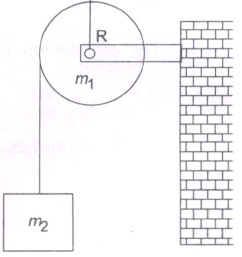
As the light inextensible string is wound around the disc several times it makes the disc rotate without slipping over it. The translational acceleration of m2 and tangential acceleration of m1 will be the same. Let us draw the free body diagram (FBD) of m1 and m2 separately.
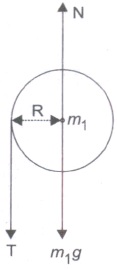
FBD of the disc: Its gravitational force (m1g) acts downward and normal force N exerted by the fixed support at the center acts upward. The tension T acts downward at the edge. The gravitational force (m1g) and the normal force (N) cancel each other. (m1g) = N. The tension T produces a torque (RT), which produces a rotational motion in the disc with angular acceleration,
\((\alpha=\frac{a}{R})\). Here, a is the linear acceleration of a point at the edge of the disc. If the moment of inertia of the disc is I and its radius of gyration is K, then
\(RT=I\alpha; RT=(m_1 K^{2})\frac{a}{R}\)
\(T=(m_1K^{2})\frac{a}{R^{2}}\)
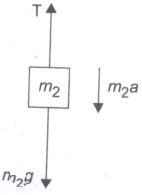
FBD of the body: Its gravitational force (m2g) acts downward and the tension T acts upward. As (T < m2g), there is a resultant force (m2a) acting on it downward.
m2g - T= m2a
\(m_2g-(m_1 K^{2})\frac{a}{R^{2}}=m_1 a\)
\(m_2 g=(m_1 k^{2})\frac{a}{R^{2}}+m_2 a\)
\(m_2 g=(m_1 k^{2})\frac{a}{R^{2}}+m_2 a\)
\(m_2 g=[(m_1 \frac{K^{2}}{R^{2}})+m_2]a\)
\(a=\frac{m_2}{(m_1 \frac{k_2}{R_2})+m_2}g\)
The expression \((\frac{K^{2}}{R^{2}})\) for a disc rotating about an axis passing through the center and perpendicular to the plane is, \(\frac{K^{2}}{R^{2}}=\frac{1}{2}\). Now the expression for acceleration further simplifies as
\(a=\frac{m}{[(\frac{m_1}{2})+m_2]}g; a=\frac{2m_2}{[m_1+2m_2]}g\)
substituting the values \(a=\frac{2\times 0.1}{[0.5+0.2]}\times 10=\frac{0.2}{0.7}\times 10\)
a = 2.857 ms-2.
31.
(i) Torque about point D is zero. (as F passes through D).
Torque about point C is zero. (as F passes through C).
Torque about point O is \((\overrightarrow {OC})\times \overrightarrow{F}\) and direction is along GH.
Torque about point B is \((\overrightarrow {BD})\times \overrightarrow{F}\) and direction is along GH.
(The perpendicular distance of \(\overrightarrow {BD}\) with respect to \(\overrightarrow {F}\) is \(\overrightarrow {OC}\).
(ii) Torque about axis CD is zero (as F is parallel to CD).
Torque about axis OC is zero (as F intersects OC).
Torque about axis AB is zero (as F is parallel to AB).
Torque about axis GH is \((\overrightarrow {OC})\times \overrightarrow{F}\) and direction is along GH.
32.
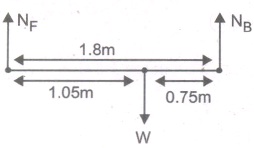
For translational equilibrium of car
NF + NB = W = \(1800 \times 9.8=17640 N\)
For rotational equilibrium of car
1.05 NF = 0.75 NB
1.05 NF = 0.75 (17640-NF)
1.8 NF = 13230
NF = 13230/1.8 = 7350 N
NB = 17640 - 7350 = 10290 N
Force on each front wheel = \(\frac{7350}{2}\) = 3675 N
Force on each back wheel = \(\frac {10290}{2}=5145 N\)
33.
During collapse, the total angular momentum of an isolated star is conserved, hence
l1ω1 = I2ω2
or\(\frac{2}{5}\) MR12ω1 = \(\frac{2}{5}\)MR22ω2 [∵ I=\(\frac{2}{5}\)MR2]
or R12ω1 = R22ω2 ∴ ω2 = \(\frac { R_{ 1 }^{ 2 } }{ R^{ 2 }_{ 2 } } \) ω1
But R1 = 10-6km, R2 = 104 , ω1 = 10-6s-1
∴ ω2 = \(\frac { \left( { 10 }^{ 6 } \right) ^{ 2 } }{ \left( { 10 }^{ 4 } \right) ^{ 2 } } \times \)10-6 =0.01 rad s-1
34.
Here R = 0.05m, l = 1.5 m,
\(\rho=8\times10^3\) kgm-3
Mass of cylinder M = Volume \(\times\) density
\(=\pi R^2l.\rho\)
= 3.14 \(\times\) (0.05)2 \(\times\) 1.5 \(\times\) 8 \(\times\) 103
= 94.2 kg
M.I. of the cylinder about its own axis, \(I={1\over2}MR^2\)
\(={1\over2}\times94.2\times(0.05)^2=0.1175\) kgm2
35.
Given: diameter = 0.5m, Mass = 16 kg
Formula: Moment of inertia of solid disc
I = \(\frac { 1 }{ 2 } \)MR2 = \(\frac { 1 }{ 2 } \times 16\times \left[ \frac { { 0.5 } }{ 2 } \right] ^{ 2 }\)= \(\frac { 1 }{ 2 } \)
Angular velocity \(\omega \) = \(\frac { 120\times 2\pi }{ 60 } \) = \(4\pi \)
And change in angular momentum \(\Delta L=I\omega -0=I\omega \)
Angular impulse \(\tau \times t=\Delta L\Rightarrow \tau =\frac { \Delta L }{ t } =\frac { 1 }{ 8 } \times \frac { 1 }{ 2 } \times 4\pi =\frac { \pi }{ 4 } Nm\quad \)
36.
It is the combination of pure translational and pure rotational motion.
1. The rolling motion is the most commonly observed motion in daily life. The motion of wheel is an example of rolling motion.
2. Round objects like ring, disc, sphere etc. are most suitable for rolling. Let us study the rolling of a disc on a horizontal surface. Consider a point P on the edge of the disc.
3. While rolling, the point undergoes translational motion along with its center of mass and rotational motion with respect to its center of mass.
37.
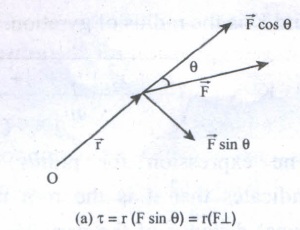
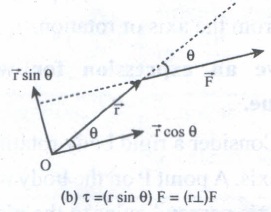
(i) For direction, the vector rule or right hand rule is used
ፒ = r Fsin\(\theta\)
(ii) The expression for the magnitude of torque can be written in two different ways by associating sinፀ either with r or F in the following manner
\(\tau =r(F\ sin\theta )=r\times (F\bot )\)
\(\tau =(r\ sin\theta )F=(r\bot )\times F\)
(iii) Here, (F sinፀ) is the component of \(\overset { \rightarrow }{ F } \) perpendicular \(\overset { \rightarrow }{ r } \). Similarly, (r sinፀ) is the component of \(\overset { \rightarrow }{ r } \) perpendicular to \(\overset { \rightarrow }{ F } \).
38.
During noon time of summer solstice the Suns rays cast no shadow in the city Syne which was located 500 miles away from Alexandria. At the same day and same time in Alexandria the Suns rays made 7.2 degree with local vertical as shown in the figure. This difference of 7.2 degree was due to the curvature of the Earth.
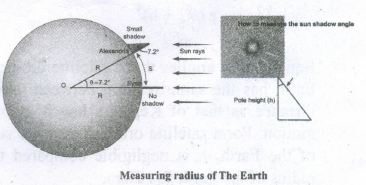
The angle 7.2 degree is equivalent to radian
So rad
If S is the length of the arc between the cities. of Syne and Alexandria; and if R is radius of Earth, then
S = R\(\theta \) = 500 miles,
So radius of the Earth
R =\(\frac { 500 }{ \theta } \)miles
R =500 \(\frac { miles }{ \frac { 1 }{ 8 } } \)
R = 4000 miles
1 mile is equal to 1.609 km. So, he measured the radius of the Earth to be equal to R = 6436 km, which is amazingly close to the correct value of 6378 km.
39.
Newton's inverse square Law:
Newton considered the orbits of the planets as circular. For circular orbit of radius r,' the centripetal acceleration towards the center is
\(a=\frac { { V }^{ 2 } }{ r } \) ...(1)
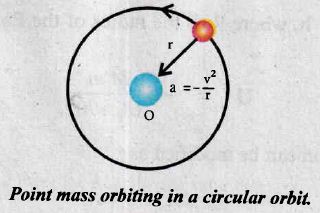
Here v is the velocity and r, the distance of the planet from the center of the orbit.
The velocity in terms of known quantities r and T, is
v = \(\frac { 2\pi r }{ T } \) ...(2)
Here T is the time period of revolution of the planet. Substituting this value of v in equation we get,
a = \(\frac { \left( \frac { 2\pi }{ T } \right) ^{ 2 } }{ r } =-\frac { 4\pi ^{ 2 }t }{ { T }^{ 2 } } \) ...(3)
Substituting the value of 'a' from (3) in Newton's second law, F = ma, where 'm' is the mass of the planet
F = \(\frac { 4\pi mr }{ { T }^{ 2 } } \) ...(4)
From Kepler's third law
\(\frac { r^{ 3 } }{ { T }^{ 2 } } \) = k(constant) ...(5)
\(\frac { r }{ { T }^{ 2 } } =\frac { k }{ { r }^{ 2 } } \) ....(6)
By substituting equation (6) in the force expression, we can arrive at the law of gravitation
\(F=\frac { 4\pi ^{ 2 }mk }{ { r }^{ 2 } } \) ...(7)
Here negative sign implies that the force is attractive arid it acts towards the center. In equation (7), mass of the planet 'm'. comes explicitly. But Newton strongly felt that according to his third law, if Earth is attracted by the Sun, then the Sun must also be attracted by the Earth with the same magnitude of force. So he felt that the Sun's mass (M) should also occur explicitly in the expression for force. From this insight, he equated the constant 4π2k to GM which turned out to be the law of gravitation
F = \(-\frac { GMm }{ { r }^{ 2 } } \)
Again the negative sign in the above equation implies that the gravitational force is attractive.
40.
Let R be the radius of the ring and M be the total mass of the complete ring.
Let m be the mass of the section removed from the ring then, mass of the incomplete ring is M-m
Let us introduce a positive integer (n), such that, \(n\theta=360^{0} \), or \(n=\frac{360^{0}}{\theta}\)
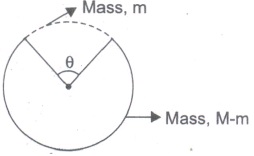
mass of incomplete ring=M - m
\(m=\frac{M}{360}\times \theta\)
∴ Mass of complete ring = \(M-\frac{M}{360}\times \theta\)
Mass of incomplete ring = \(M-\frac{M}{n}=M(\frac{n-1}{n})\)
For example, (a) when \(\theta=60^{0}; n=\frac{360^{0}}{60^{0}}=6\)
∴ n-1 =5
Mass of incomplete ring = \(\frac{5}{6}M\)
(b)when \(\theta=30^{0}; n=\frac{360^{0}}{30^{0}}=12\)
n-1=11
Mass of incomplete ring = \(\frac{11}{12}M\)
The moment of inertia of the incomplete ring is, I=\(M \frac{(n-1)}{n}R^{2}.\)
41.
A point mass is a hypothetical point particle which has non-zero mass and no size or shape. To find the center of mass for a collection ofn point masses, say, m1, m2, m3 ... mn we have to first choose an origin and an appropriate co-ordinate system as shown in Figure. Let, x1, x2, x3 ... xn be the X-coordinates of the positions of these point masses in the X direction from the origin.
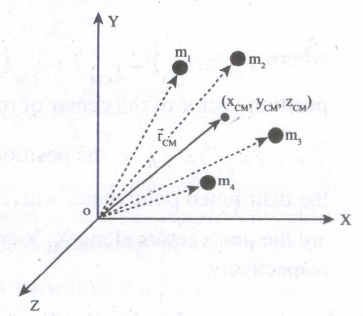
The equation for the X coordinate of the center of mass is,
\({ x }_{ cm }=\frac { \sum { { m }_{ i }{ x }_{ i } } }{ \sum { { m }_{ i } } } \)
where, \(\sum { { m }_{ i } } \) is the total mass M of all the particles, (\(\sum { { m }_{ i } } =M\)). Hence,
\({ x }_{ CM }=\frac { \sum { { m }_{ i }{ x }_{ i } } }{ M } \)
Similarly, we can also find y and z coordinates of the center of mass for these distributed point masses as indicated in Figure.
\({ y }_{ CM }=\frac { \sum { { m }_{ i }{ y }_{ i } } }{ M } \)
\({ z }_{ CM }=\frac { \sum { { m }_{ i }{ z }_{ i } } }{ M } \)
Hence, the position of center of mass of these point masses in a Cartesian coordinate system is (xCM, yCM zCM) In general, the position of center of mass can be written in a vector form as,
\(\overset { \rightarrow }{ r_{ CM } } =\frac { \sum { { m }_{ i } } \overset { \rightarrow }{ r } i }{ M } \)
where, \(\overset { \rightarrow }{ r_{ CM } } ={ x }_{ CM }\hat { i } +{ y }_{ CM }\hat { j } +{ z }_{ CM }\hat { k } \) is the position vector of the center of mass and \(\overset { \rightarrow }{ { r }_{ i } } ={ x }_{ i }\hat { i } +{ y }_{ i }\hat { j } +{ z }_{ i }\hat { k } \) is the position vector of the distributed point mass; where \(\hat { i } ,\hat { j } \) and \(\hat { k } \) are the unit vectors along X, Y and Z-axes respectively.
42.
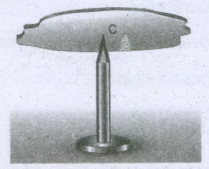
We can also determine the centre of gravity of a uniform lamina of even an irregular shape by pivoting it at various points by trial and error. The lamina remains horizontal when pivoted at the point where the net gravitational force acts, which is the centre of gravity as shown in the figure. When a body is supported at the centre of gravity, the sum of the torques acting on all the point masses of the rigid body becomes zero. Moreover, the weight is compensated by the normal reaction force exerted by the pivot. The body is in static equilibrium and hence it remains horizontal.
43.
Mass of the disc m = 100 g = 6.1 kg.
Diameter of the disc d = 10 cm.
Radius of the disc r = 5 cm = 0.05m
Rolling with a velocity v = 20 cms-1 = 0.20 ms-1
Total energy of the disc ETot = ?
ETot = Translational K energy + rotational K.E
M.I of the disc about its own axis,
\(I=\frac { 1 }{ 2 } { mr }^{ 2 }\)
\(v=r\omega \ \therefore { \omega }^{ 2 }=\frac { { v }^{ 2 } }{ { r }^{ 2 } } \)
Rotational K.E = \(I=\frac { 1 }{ 2 } I{ \omega }^{ 2 }=\frac { 1 }{ 2 } \times \left( \frac { 1 }{ 2 } { mr }^{ 2 } \right) \times \left( \frac { { v }^{ 2 } }{ { r }^{ 2 } } \right) \)
\(=\frac { 1 }{ 4 } { mv }^{ 2 }\)
T.E. \(=\frac { 1 }{ 2 } { mv }^{ 2 }+\frac { 1 }{ 4 } { mv }^{ 2 }=\frac { 3 }{ 4 } { mv }^{ 2 }\)
T.E. of the disc ETot = \(\frac{3}{4}\) \(\times\) 0.1 \(\times\) 0.20 \(\times\) 0.20
= 0.003 J
44.
(i) The total kinetic energy (KE) can be written as the sum of kinetic energy due to translational motion (KETRANS) and kinetic energy due to rotational motion (KEROT)
KE = KETRANS + KEROT
(ii) If the mass of the rolling object is M, the velocity of center of mass is vCM its moment of inertia about center of mass is ICM and angular velocity is ω, then
KE = \(\frac { 1 }{ 2 } Mv^{ 2 }_{ CM }+\frac { 1 }{ 2 } { I }_{ CM }\omega ^{ 2 }\)
(iii) With center of mass as reference:
The moment of inertia (lCM) of a rolling object about the center of mass is,
ICM= MK2 and vCM= Rω. Here, K is radius of gyration.
\(KE=\frac { 1 }{ 2 } Mv^{ 2 }_{ CM }+\frac { 1 }{ 2 } \left( MK^{ 2 } \right) \frac { v^{ 2 }_{ CM } }{ R^{ 2 } } \\ \\ \)
\(KE=\frac { 1 }{ 2 } Mv^{ 2 }_{ CM }+\frac { 1 }{ 2 } Mv^{ 2 }_{ CM }\left( \frac { { K }^{ 2 } }{ R^{ 2 } } \right) \)
\(KE=\frac { 1 }{ 2 } Mv^{ 2 }_{ CM }\left( 1+\frac { K^{ 2 } }{ R^{ 2 } } \right) \)
(iv) With point of contact as reference: We can also arrive at the same expression by taking the momentary rotation happening with respect to the point of contact (another approach to rolling). if we take the point of contact as 0, then,
\(KE=\frac { 1 }{ 2 } { I }_{ 0 }\omega ^{ 2 }\)
Here, Io is the moment of inertia of the object about the point of contact. By parallel axis theorem, Io = ICM+ MR2. Further we can write, Io = MK2 + MR2. With vCM= Rω or
\(\omega =\frac { { v }_{ CM } }{ R } \)
\(KE=\frac { 1 }{ 2 } \left( MK^{ 2 }+MR^{ 2 } \right) \frac { v^{ 2 }_{ CM } }{ { R }^{ 2 } } \)
\(KE=\frac { 1 }{ 2 } Mv^{ 2 }_{ CM }\left( 1+\frac { { K }^{ 2 } }{ R^{ 2 } } \right) \)
(vi) K.E. in pure rolling can be determined by anyone of the following two cases.
(a) The combination of translational motion and rotational motion about the center of mass. (or)
(b) The momentary rotational motion about the point of contact.
45.
(i) Consider a rigid body rotating about a fixed axis. A point mass m in the body will execute a circular motion about a fixed axis.
(ii) A tangential force \(\vec F\) acting on the point mass produces the necessary torque for this rotation. This force \(\vec F\) is perpendicular to the position vector \(\vec r\) of the point mass.
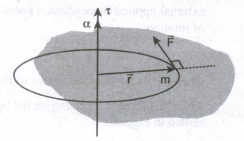
iii) The torque produced by the force on the point mass m about the axis can be written as,
\(\tau =rFsin90=rF\quad \left[ \because sin90=1 \right] \)
\(\tau =rma\ \left[ \because \left( F=ma \right) \right] \)
\(\tau =rmr\alpha =mr^{ 2 }\alpha \ \left[ \because \left( a=r\alpha \right) \right] \)
\(\tau =\left( mr^{ 2 } \right) \alpha \)
(iv) Hence, the torque of the force acting on the point mass produces an angular acceleration (a) in the point mass about the axis of rotation.
In vector notation,
\(\vec \tau =\left( mr^{ 2 } \right) \vec \alpha\)
(v) The directions of \(\tau \) and \(\alpha\) are along the axis of rotation. If the direction of \(\tau\) is in the direction of \(\alpha\), it produces angular acceleration. On the other hand if \(\tau \) is opposite to \(\alpha\) angular deceleration or retardation is produced on the point mass.
(vi) The term mr2 in equations is called moment of inertia (I) of the point mass. A rigid body is made up of many such point masses. Hence, the moment of inertia of a rigid body is the sum of moments of inertia of all such individual point masses that constitute the body \(\left( I=\sum { { m }_{ i }{ r }_{ i }^{ 2 } } \right) \) Hence, torque for the rigid body can be written as,
\(\vec \tau =\left( \sum { m_{ i }{ r }_{ i }^{ 2 } } \right) \vec a\)
\(\vec \tau = I \vec a\)

11th Standard Syllabus & Materials
11th Standard
TN 11th Tamil பீடு பெற நில் - செய்யுள் - காவடிச்சிந்து Important Questions And Answers Study Material - QB365 Set A
NEW11th Standard
TN 11th Tamil பீடு பெற நில் - உரைநடை - மலை இடப்பெயர்கள் : ஓர் ஆய்வு Important Questions And Answers Study Material - QB365 Set A
NEW11th Standard
TN 11th Tamil மாமழை போற்றுதும் - துணைப்பாடம் - யானை டாக்டர் Important Questions And Answers Study Material - QB365 Set A
NEW11th Standard
TN 11th Tamil மாமழை போற்றுதும் - செய்யுள் - ஐங்குறுநூறு Important Questions And Answers Study Material - QB365 Set A



Tamilnadu Stateboard 11th Standard Subjects

Maths

Commerce

Economics

Biology

Business Maths and Statistics

Accountancy

Computer Science
Physics

Chemistry
Maths
Biology
Economics
Physics
Chemistry

History
Business Maths and Statistics

Computer Science
Accountancy

Computer Applications
History
Computer Technology
Commerce
Computer Applications
Computer Technology

Tamil

English

French
Tamilnadu Stateboard Standards

