
 100% FREE ACCESS
11th Standard CBSE Syllabus & Materials
11th Standard CBSE
CBSE 11th Economics PART-A - Presentation of Data - New Sample Question Papers Study Material - QB365 Set A
NEW11th Standard CBSE
CBSE 11th Economics PART-A - Organisation of Data - New Sample Question Papers Study Material - QB365 Set A
NEW11th Standard CBSE
CBSE 11th Economics PART-A - Collection of Data - New Sample Question Papers Study Material - QB365 Set A
NEW11th Standard CBSE
CBSE 11th Economics PART-A - Introduction to Economics and Statistics - New Sample Question Papers Study Material - QB365 Set A
NEW11th Standard CBSE
CBSE 11th Business Studies International Trade Sample Question Papers Study Material - QB365 Set A
NEW11th Standard CBSE
CBSE 11th Business Studies Evolution and Fundamentals of Business Sample Question Papers Study Material - QB365 Set A

Published on: 15/12/2018
From this post, it covers the questions from the chapter Introduction to Three Dimensional Geometry. Get 100 percent accurate in Class 11 Maths Chapter 12 (Introduction to Three Dimensional Geometry) solved by expert Maths teachers. We provide step by step solutions for questions given in Class 11 maths text-book as per CBSE Board guidelines from the latest NCERT book for Class 11 maths. The topics and sub-topics in Chapter 12 Introduction to Three Dimensional Geometry
12.1 Introduction
12.2 Coordinate Axes and Coordinate Planes in Three Dimensional Space
12.3 Coordinates of a Point in Space
12.4 Distance between Two Points
12.5 Section Formula.
All the questions are prepared by the guidelines of expert teachers based on the current academic syllabus.
Download CBSE Class 11th Standard CBSE Mathematics question papers, sample papers, important questions, and previous year solved papers in PDF format. Get free study materials, NCERT solutions, and exam preparation resources for Class 11th Standard CBSE Mathematics
Questions + Answers key
Take MCQ Mathematics Test
1.
Find the coordinates of the point which divides the line segment joining the points (3, -2, 5) and (3, 4, 2) in the ratio 2 : 1 externally.
2.
Find the equation of the set of points which are equidistant from the points A(1, 3, -1) and B(4, - 1, 7).
3.
Find the distance between the following pairs of points: (1, -1, 0) and (2, 1, 2)
4.
Find the distance between the following pairs of points: (-1, 3, -4) and (1, - 3, 4)
5.
Prove by using distance formula that the point A(1, 2, 3), B(-1, -1, -1) and C(3, 5, 7) are collinear.
6.
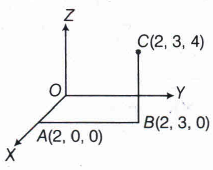
Locate the point (2,3,4) in space.
7.
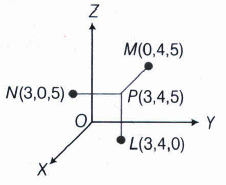
Let L,M,N be the feet of the perpendicules drawn from the point P (3,4,5) on the XY,YZ and ZX-planes, respectively. Find the distance of these points L,M,N from the point P.
8.
Find the locus of a point which moves such that the sum of its distance from points \(A(0,0,-\propto )\) and \(B(0,0,\propto )\) is constant.
9.
Find the equation of set of point P such that \({ PA }^{ 2 }+{ PB }^{ 2 }={ 2k }^{ 2 }\) , where A and B are the points (3,4,5) and (-1,3,-7), respectively.
10.
Find the centroid of a triangle, the mid-point of whose sides are D(1, 2, -3), E (3, 0, 1) and F(-1, 1, -4).
11.
The mid-point of the sides of a triangle are (1, 5, -1), (0, 4, -2) and (2, 3, 4) find its vertices and also find the centroid of the triangle.
12.
Find the coordinates of a point on y-axis which are at a distance of \(5\sqrt { 2 } \) from the point P(3, -2,5).
13.
Show that the coordinates of the centroid of a triangle with vertices A(x1,x 2,x3)., b(y1,y 2,y 3), c(z1,z2,z 3) are \(\left[ \frac { x1+x2+x3 }{ 3 } ,\frac { y1+y2+y3 }{ 3 } ,\frac { z1+z2+z3 }{ 3 } \right] \)
14.
Find the locus of the point which is equidistant from A(3, 4, 0) and B(5, 2, -3).
15.
In the three dimensional space the equation x2 - 7x + 12 = 0 represents ______.
pair of straight lines
curves
planes
none of these
16.
If (3, 4, -1) and (-1, 2, 3) be the endpoints of a diameter of a sphere. Then radius of sphere is equal to ______.
2
4
5
6
17.
The points (3, 3, 3), (0, 6, 3), (1, 7, 7) and (4, 4, 7) are vertices of ______.
a rectangle
a square
a parallelogram
a rhombus
18.
The ratio in which the line joining the points (a, b, c) and (-4, 3, -6) is divided by XY-plane is ______.
c : 6
6 : c
2 : 4
b : 3
19.
The ratio in which the line joining (4, -3, 2) and (6, -5, -1) is divided by YZ-plane is _______.
2 : 3
2 : -3
-2 : 3
none of these
1.
Let P(x, y, z) be any point which divides the line segment joining points A(3, -2, 5) and B(3, 4, 2) in the ratio 2 : 1 externally.
Then,
\(x=\frac { 2\times 3+\left( -1 \right) \times 3 }{ 2+\left( -1 \right) } =\frac { 6-3 }{ 1 } =3\)
\(y=\frac { 2\times 4+\left( -1 \right) \times -2 }{ 2+\left( -1 \right) } =\frac { 8+2 }{ 1 } =10\)
\(z=\frac { 2\times 2+\left( -1 \right) \times 5 }{ 2+\left( -1 \right) } =\frac { 4-5 }{ 1 } =-1\)
\(\therefore\) Coordinates of P are (3, 10, - 1)
2.
6x - 8y + 16z - 55 = 0
3.
3 units
4.
Let A (- 1, 3, - 4) and B(1, - 3, 4) be two points. Then
AB = \(\sqrt { { \left( 1-\left( -1 \right) \right) }^{ 2 }+{ \left( -3-3 \right) }^{ 2 }+{ \left( 4-\left( -4 \right) \right) }^{ 2 } } \)
\(=\sqrt { 4+36+64 } \)
\(=\sqrt { 104 } \)
\(=2\sqrt { 26 } \)
5.
Here AB = \(\sqrt { { \left( -1-1 \right) }^{ 2 }+{ \left( -1-2 \right) }^{ 2 }+{ \left( -1-3 \right) }^{ 2 } } =\sqrt { 4+9+16 } =\sqrt { 29 } \)
BC = \(\sqrt { { \left( 3-\left( -1 \right) \right) }^{ 2 }+{ \left( 5-\left( -1 \right) \right) }^{ 2 }+{ \left( 7-\left( -1 \right) \right) }^{ 2 } } \)
= \(\sqrt { { \left( 3+1 \right) }^{ 2 }+{ \left( 5+1 \right) }^{ 2 }+{ \left( 7+1 \right) }^{ 2 } } =\sqrt { 16+36+64 } =\sqrt { 116 } =2\sqrt { 29 } \)
AC = \(\sqrt { { \left( 3-1 \right) }^{ 2 }+{ \left( 5-2 \right) }^{ 2 }+{ \left( 7-3 \right) }^{ 2 } } =\sqrt { 4+9+16 } =\sqrt { 29 } \)
Now BC = AB + AC
Thus, A, B, and C are collinear points.
6.
Given point is (2,3,4). Here, x-coordinate i.e. 2 is positive. So, we take a point A in positive direction of X -axis at a distance 2 from O. Thus, point A be (2,0,0). From point A, we drw a line perpendicular to X-axis which will be parallel to Y-axis and take point B at a distance 3 from A in positive direction.Thus, point B be (2,3,0).Draw a line prallel to Z-axis from point B, which is perpendicular to XY-plane and take point C at this line in positive direction at a distance 4 units from B. Thus, point C(2,3,4) is the required location of given point in space, which is shown in the figure.
7.
L is the foot of perpendicular drwn from the point P(3,4,5) to the XY-plane.
Therefore, the coordinate of the point L are (3,4,0). The distance between the points (3,4,5) and (3,4,0) is 5 units. Similarly, the lengths of the foot of perpendiculars on YZ and ZX-planes are 3 and 4 units, respectively.
8.
Let P(x,y,z) be the required point. According to question, AP+BP=K, where k be any arbitrary constant
\(\Rightarrow \sqrt { { \left( x-0 \right) }^{ 2 }+{ \left( y-0 \right) }^{ 2 }+{ \left( z+\propto \right) }^{ 2 } } +\sqrt { { \left( x-0 \right) }^{ 2 }+{ \left( y-0 \right) }^{ 2 }+{ \left( z+\propto \right) }^{ 2 } } =K\)
\({ 4k }^{ 2 }{ x }^{ 2 }+{ 4k }^{ 2 }{ y }^{ 2 }+{ 4 }{ z }^{ 2 }({ K }^{ 2 }-{ 4\propto }^{ 2 })\quad +\quad K^{ 2 }({ 4\propto }^{ 2 }-{ K }^{ 2 })=0\)
9.
\(Given\quad points\quad are\quad A(3,4,5)\quad and\quad B(-1,3,-7).\)
\(Let\quad the\quad coordinates\quad of\quad point\quad P\quad be\quad (x,y,z).\)
\(Then, { PA }^{ 2 }={ (x-3) }^{ 2 }+{ (y-4) }^{ 2 }+{ (z-5) }^{ 2 }\)
\( \left[ \because distance\quad =\sqrt { { ({ x }_{ 2 }-{ x }_{ 1 }) }^{ 2 }+{ ({ y }_{ 2 }-{ y }_{ 1 }) }^{ 2 }+{ ({ z }_{ 2 }-{ z }_{ 1 }) }^{ 2 } } \right] \)
\(and \quad { PB }^{ 2 }={ (x+1) }^{ 2 }+{ (y-3) }^{ 2 }+{ (z+7) }^{ 2 }\)
\(By\quad the\quad given\quad condition\quad { PA }^{ 2 }+{ PB }^{ 2 }={ 2k }^{ 2 },\)
\( { (x-3) }^{ 2 }+{ (y-4) }^{ 2 }+{ (z-5) }^{ 2 }+{ (x+1) }^{ 2 }+{ (y-3) }^{ 2 }+{ (z+7) }^{ 2 }={ 2k }^{ 2 }\)
\(\Rightarrow { x }^{ 2 }+9-6x+{ y }^{ 2 }+16-8y+{ z }^{ 2 }+25-10z\)
\(+{ x }^{ 2 }+2x+1+{ y }^{ 2 }+9-6y+{ z }^{ 2 }+49+14z={ 2k }^{ 2 }\)
\(\Rightarrow { 2x }^{ 2 }+{ 2y }^{ 2 }+{ 2z }^{ 2 }-4x-14y+4z={ 2k }^{ 2 }-109\)
\(which\quad is\quad the\quad required\quad equation.\)
10.
The centroid of a triangle is equal to the centroid of the triangle formed by mid-points of its sides.
(1, 1, -2)
11.
The vertices of the triangle are A(1, 2, 3), B(3, 4, 5) and C(-1, 6, 7). Also, centroid of the triangles is G(1, 4, 1/3).
12.
Let Q(O,y, 0) be any point on y-axis. Then
\(PQ=\sqrt { (0-3)2+(y+2)2+(0-5)2 } \)
\(=\sqrt { 9+y2+4+4y+25 } \)
\(=\sqrt { y2+4y+38 } \)
But \(\sqrt { y2+4y+38 } =5\sqrt { 2 } \)
y2 + 4y + 38 = 50 \(\Rightarrow \\ \) y2 + 4y - 12 = 0 \(\Rightarrow \\ \) (y - 2) (y + 6) = 0
\(\Rightarrow \\ \) y = 2, -6
Thus coordinates of point Q are (0, 2, 0) and (0, -6,0).
13.
Here A (x1, y1, z1) B (x2, y2, z2)and C (x3, y3, z3 )be three vertices of \(\triangle \)ABC, then coordinates of point D are
\(\left[ \frac { x1+x2+x3 }{ 2 } ,\frac { y1+y2+y3 }{ 2 } ,\frac { z1+z2+z3 }{ 2 } \right] \)
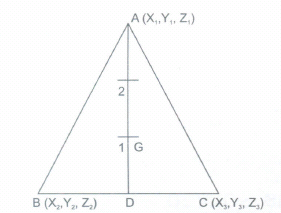
Let Gbe the centroid of ABC. Then Gdivides AD in the ratio 2 : 1. So the coordinates of G are
\(\left[ \frac { x1+2\left( \frac { x2+x3 }{ 2 } \right) }{ 1+2 } ,\frac { y1+2\left( \frac { y2+y3 }{ 2 } \right) }{ 1+2 } ,\frac { z1+2\left( \frac { z2+z3 }{ 2 } \right) }{ 1+2 } \right] \)
\(\Rightarrow \left( \frac { x1+x2+x3 }{ 3 } ,\frac { y1+y2+y3 }{ 3 } ,\frac { z1+z2+z3 }{ 3 } \right) \)
14.
Let P(x, y, z) be any point which is equidistant from A(3, 4, 0) and B(5, 2, -3).
Now PA = PB => PA2 = PB2
\(\therefore \)(x - 3)2 + (y - 4)2 + (z - 0)2
= (x - 5)2 + (y - 2)2 + (z + 3)2
=> x2+ 9 - 6x + y2 + 16 - 8y + Z2
= x2 + 25 -10x + y2 + 4 - 4y + Z2+ 9 + 6z
=> 4x - 4y - 6z - 13 = O.
15.
(c)
planes
16.
(d)
6
17.
(b)
a square
18.
(a)
c : 6
19.
(c)
-2 : 3

11th Standard CBSE Syllabus & Materials
11th Standard CBSE
CBSE 11th Business Studies Forms of Business Organisation Sample Question Papers Study Material - QB365 Set A
NEW11th Standard CBSE
CBSE 11th Business Studies Business, Trade and Commerce Sample Question Papers Study Material - QB365 Set A
NEW11th Standard CBSE
CBSE 11th Physics Waves Sample Question Papers Study Material - QB365 Set A
NEW11th Standard CBSE
CBSE 11th Physics Kinetic Theory Sample Question Papers Study Material - QB365 Set A



CBSE 11th Standard CBSE Subjects
CBSE Standards









