
 100% FREE ACCESS
11th Standard CBSE Syllabus & Materials
11th Standard CBSE
CBSE 11th Economics PART-A - Presentation of Data - New Sample Question Papers Study Material - QB365 Set A
NEW11th Standard CBSE
CBSE 11th Economics PART-A - Organisation of Data - New Sample Question Papers Study Material - QB365 Set A
NEW11th Standard CBSE
CBSE 11th Economics PART-A - Collection of Data - New Sample Question Papers Study Material - QB365 Set A
NEW11th Standard CBSE
CBSE 11th Economics PART-A - Introduction to Economics and Statistics - New Sample Question Papers Study Material - QB365 Set A
NEW11th Standard CBSE
CBSE 11th Business Studies International Trade Sample Question Papers Study Material - QB365 Set A
NEW11th Standard CBSE
CBSE 11th Business Studies Evolution and Fundamentals of Business Sample Question Papers Study Material - QB365 Set A

Published on: 01/08/2018
In this question paper, some of the important one mark, two and five marks questions from the chapter Introduction to Three Dimensional Geometry are covered.
Teachers can prepared question paper with answer key within five minutes. Please Click Here for getting the question paper with answer key.
Download CBSE Class 11th Standard CBSE Mathematics question papers, sample papers, important questions, and previous year solved papers in PDF format. Get free study materials, NCERT solutions, and exam preparation resources for Class 11th Standard CBSE Mathematics
Questions + Answers key
Take MCQ Mathematics Test
1.
Show that the points (0,7,10), (-1,6,6) and (-4,9,6) are the vertices of a right angled isosceles triangle.
2.
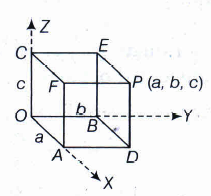
In the given figure, if the coordinates of point P are (a,b,c), then write the coordinates of A,D,B,C and E.
3.
If origin is the centroid of a \(\Delta ABC\) with vertices \(A(\alpha ,1,3) \ B(-2,\beta ,-5) \ and \ C(4,7,\gamma )\), then find the values of \(\alpha ,\beta \ and \ \gamma \) .
4.
Find the coordinates of a point equidistant from the four points O(0,0,0), A(l,0,0), B(0,m,0), and C(0,0,n)
5.
Three students are standing in a park with signboards "SAVE ENVIRONMENT". "DONT'T LITTER", "KEEP YOUR PLACE CLEAN". Their positions are marked by the points A(0, 7, 10), B(-1, 6, 6) and C(-4, 9, 6). The three students are holding GREEN coloured ribbon together. Does the ribbons form sides of a right angled triangle? Do you feel the need to promote? What message is given from this question to the society?
6.
Find the equation of the set of points which are equidistant from the points (1, 2, 3) and (3, 2, –1).
7.
Find the point on X-axis which is equidistant from the points A(3,2,2) and B(5,5,4)
8.
Find the centroid of a triangle, the mid-point of whose sides are D(1, 2, -3), E (3, 0, 1) and F(-1, 1, -4).
9.
Let L,M,N be the feet of the perpendiculars drawn from a point P(3,4,5) on the X,Y and Z-axes respectively.Find the coordinates of L, M and N.
10.
Three points A(3, 2, 0), B(5, 3, 2) and C(-9, 6, -3) are forming a triangle . The bisector Ad of
11.
Verify that (-1, 2, 1), (1, -2, 5), (4, -7, 8) and (2, -3, 4) are the vertices of a parallelogram.
Tp prove a quadrilateral is a parallelogram, we have to prove that its diagonal bisect each other
12.
Show that the points (-1,-6,10), (1,-3,4) (-5,-1,1) and (-7,-4,7) are the vertices of a rhombus.
13.
Three points A(1,2,3), B(0,4,1) and C(-1,-1,-3) are the vertices of \(\Delta ABC\). Find the point in which the bisector of \(\angle BAC\) meets BC.
14.
Show that \(\Delta ABC\) with vertices A(0,4,1), B(2,3,-1), and C(4,5,0) is right angled.
15.
Prove that the points (0, -1, -7), (2, 1, -9) and (6, 5, -13) are collinear. Find the ratio in which the first point divides the join of the other two.
1.
Let A(0,7,10), B(-1,6,6) and C(-4,9,6) be the given points.
Then AB= \(=\sqrt { { (-1- }0)^{ 2 }+({ 6-7) }^{ 2 }+(6-{ 10 })^{ 2 } } \) [using the distance formula]
\(=\sqrt { 1+1+16 } =\sqrt { 18 } =3\sqrt { 2 } \)units
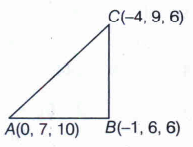
\(BC=\sqrt { { (-4+1 })^{ 2 }+{ (9- }6)^{ 2 }+{ (6-6 })^{ 2 } } \)
\(=\sqrt { 9+9+0 } =\sqrt { 18 } =3\sqrt { 2 } units\)
\(and\quad AC=\sqrt { { (-4-0) }^{ 2 }+{ (9-7) }^{ 2 }+{ (6-10) }^{ 2 } } =\sqrt { 16+4+16 }\)
\( \Rightarrow AC=\sqrt { 36 } =6\quad units\)
\(Now,\quad { AB }^{ 2 }+{ BC }^{ 2 }=(3\sqrt { 2 } { ) }^{ 2 }+(3\sqrt { 2 } { ) }^{ 2 }=18+18=36\quad units\)
\(\therefore { AB }^{ 2 }+{ BC }^{ 2 }={ AC }^{ 2 }\)
\( Also,\quad AB={ BC }^{ 2 }={ AC }^{ 2 }\)
Hence, ABC is a right angled isosceles triangle.
2.
Given, the coordinates of point P are (a,b,c).
Which shows that, OA = a, OB = b and OC = c.
Now, point A lies on X-axis, so its coordinates are (a,0,0). Point D lies in XY-plane, so its coordinates are (a,b,0). Point B lies on Y-axis, so its coordinates are (0,b,0).
Point C lies on Z - axis, so its coordinate are (0,0,c) and point E lies in YZ-plane, so its coordinate are (0,b,c).
Hence, the coordinates of required points are
A(a,0,0), D(a,b,0), B(0,b,0), C(0,0,c) and E(0,b,c).
3.
Coordinates of centroid of a \(\Delta ABC\) = (0,0,0)
\(\Rightarrow \left( \frac { \alpha -2+4 }{ 3 } ,\frac { 1+\beta +7 }{ 3 } ,\frac { 3-5+\gamma }{ 3 } \right) =(0,0,0)\)
\(\alpha =-2,\quad \beta =-8,\quad \gamma =2\)
4.
\(Let\quad P(x,y,z)\quad be\quad required\quad point.\)
\(Then,\quad OP=PA=PB=PC\)
\(Now,\quad OP=PA\Rightarrow { OP }^{ 2 }={ PA }^{ 2 }\)
\(\Rightarrow { (0-x) }^{ 2 }+{ (0-y) }^{ 2 }+{ (0-z) }^{ 2 }={ x-1 }^{ 2 }+{ y-0 }^{ 2 }+{ (z-0) }^{ 2 }\)
\( \Rightarrow { x }^{ 2 }+{ y }^{ 2 }+{ z }^{ 2 }={ x }^{ 2 }-2lx+{ l }^{ 2 }+{ y }^{ 2 }+{ z }^{ 2 }\)
\(\Rightarrow 2lx={ l }^{ 2 }\Rightarrow x=\frac { 1 }{ 2 } \)
\(Similarly,\quad OP=PB\Rightarrow y=\frac { m }{ 2 } and\quad OP=PC\Rightarrow x=\frac { n }{ 2 } \)
\(Hence,\quad the\quad coordinates\quad of\quad the\quad required\quad point\quad are\quad \left( \frac { 1 }{ 2 } ,\frac { m }{ 2 } ,\frac { n }{ 2 } \right) .\)
5.
Yes, ;et A(0, 7, 10), B(-1, 6, 6) and C(-4, 9, 6) be the vertices of a triangle. Then,
Side \(AB=\sqrt { { \left( 0+1 \right) }^{ 2 }+{ \left( 7-6 \right) }^{ 2 }+{ \left( 10-6 \right) }^{ 2 } }\)
\( [\therefore \quad distance\quad =\sqrt { { \left( { x }_{ 1 }-{ x }_{ 2 } \right) }^{ 2 }+{ \left( { y }_{ 1 }-{ y }_{ 2 } \right) }^{ 2 }+{ \left( { z }_{ 1 }-{ z }_{ 2 } \right) }^{ 2 } } ]\)
\(\Rightarrow AB=\sqrt { { 1 }^{ 2 }+{ 1 }^{ 2 }+{ 4 }^{ 2 } } =\sqrt { 1+1+16 } =\sqrt { 18 } =\sqrt [ 3 ]{ 2 } units\)
\(Side\quad BC=\sqrt { { \left( -1+4 \right) }^{ 2 }+{ \left( 6-9 \right) }^{ 2 }+{ \left( 6-6 \right) }^{ 2 } } =\sqrt { { 3 }^{ 2 }+{ 3 }^{ 2 }+0 } \)
\(\Rightarrow BC=\sqrt { 9+9+0 } =\sqrt { 18 } =\sqrt [ 3 ]{ 2 } units\)
\(and\quad side\quad CA=\sqrt { { \left( -4-0 \right) }^{ 2 }+{ \left( 9-7 \right) }^{ 2 }+{ \left( 6-10 \right) }^{ 2 } } \)
\(=\sqrt { { 4 }^{ 2 }+{ 2 }^{ 2 }+{ 4 }^{ 2 } } \)
\( \Rightarrow CA=\sqrt { 16+4+16 } =\sqrt { 36 } =6\quad units\)
\(Now, { AB }^{ 2 }+{ BC }^{ 2 }={ \left( \sqrt [ 3 ]{ 2 } \right) }^{ 2 }+{ \left( \sqrt [ 3 ]{ 2 } \right) }^{ 2 }{ =6 }^{ 2 }={ CA }^{ 2 }\)
Hence, \(\Delta ABC\) is right angled triangle at B.
Yes, this question gives us message to protect our environment and help us to follow these in our daily lives to make ourselvegs healthy.
6.
Let A(x, y, z) be any point which is equidistant from points A(1, 2, 3) and B (3, 2, -1).
Then AB = \(\sqrt { { \left( x-1 \right) }^{ 2 }+{ \left( y-2 \right) }^{ 2 }+{ \left( z-3 \right) }^{ 2 } } \)
AC = \(\sqrt { { \left( x-3 \right) }^{ 2 }+{ \left( y-2 \right) }^{ 2 }+{ \left( z+1 \right) }^{ 2 } } \)
It is given that AB = AC
\(\therefore\) \(\sqrt { { \left( x-1 \right) }^{ 2 }+{ \left( y-2 \right) }^{ 2 }+{ \left( z-3 \right) }^{ 2 } } \)= \(\sqrt { { \left( x-3 \right) }^{ 2 }+{ \left( y-2 \right) }^{ 2 }+{ \left( z+1 \right) }^{ 2 } } \)
\(\Rightarrow { \left( x-1 \right) }^{ 2 }+{ \left( y-2 \right) }^{ 2 }+{ \left( z-3 \right) }^{ 2 }\ =\ { \left( x-3 \right) }^{ 2 }+{ \left( y-2 \right) }^{ 2 }+{ \left( z+1 \right) }^{ 2 }\)
\(\Rightarrow\) x2+ 1 - 2x + z2 + 9 - 6z = x2 + 9 - 6x + z2 + 1 + 2z
\(\Rightarrow\) - 2x - 6z + 10 = - 6x + 2z + 10
\(\Rightarrow\) -2x - 6z + 6x - 2z = 0
\(\Rightarrow\) 4x - 8z = 0
\(\Rightarrow\) x - 2z = 0.
7.
Let the point on X-axis be P(x,0,0).
\(Then,\quad { (x-3) }^{ 2 }+{ (0-2) }^{ 2 }+{ (0-2) }^{ 2 }\)
\(={ (x-5) }^{ 2 }+{ (0-5) }^{ 2 }+{ (0-4) }^{ 2 }\)
\(Ans.\left( \frac { 49 }{ 4 } ,0,0 \right) \)
8.
The centroid of a triangle is equal to the centroid of the triangle formed by mid-points of its sides.
(1, 1, -2)
9.
L(3,0,0), M(0,4,0) and N(0,0,5)
10.
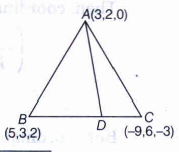
Since, AD is the bisector of \(\angle B A C\)
\(\Rightarrow \ \frac{B D}{D C}=\frac{A B}{A C}\)
\(\text { Now, } A B=\sqrt{(5-3)^{2}+(3-2)^{2}+(2-0)^{2}} \)
\([\because \text { distance } \left.=\sqrt{\left(x_{2}-x_{1}\right)^{2}+\left(y_{2}-y_{1}\right)^{2}+\left(z_{2}-z_{1}\right)^{2}}\right] \)
\(=\sqrt{2^{2}+1^{2}+2^{2}}=\sqrt{4+1+4}=\sqrt{9}=3 \text { units } \)
\(\text { and } A C =\sqrt{(-9-3)^{2}+(6-2)^{2}+(-3-0)^{2}}\)
\(=\sqrt{(-12)^{2}+(4)^{2}+(-3)^{2}} \)
\(=\sqrt{144+16+9}=\sqrt{169}=13 \text { units }\)
\(Then, from Eq. (i), \frac{B D}{D C}=\frac{3}{13}\)
\(\left[\frac{3(-9)+13(5)}{3+13}, \frac{3(6)+13(3)}{3+13}, \frac{3(-3)+13(2)}{3+13}\right]\)
\(=\left(\frac{-27+65}{16}, \frac{18+39}{16}, \frac{-9+26}{16}\right)=\left(\frac{38}{16}, \frac{57}{16}, \frac{17}{16}\right)=\left(\frac{19}{8}, \frac{57}{16}, \frac{17}{16}\right)\)
11.
Let A(-1, 2, 1), B(1, -2, 5), C(4, -7, 8) and D(2, -3, 4) be the vertices of a quadrilateral ABCD.
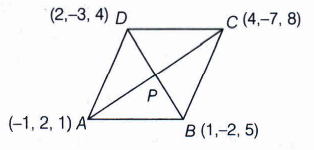
\(Then\quad the\quad mid\quad point\quad AC\)
\(=\left( \frac { -1+4 }{ 2 } ,\frac { 2-7 }{ 2 } ,\frac { 1+8 }{ 2 } \right) =\left( \frac { -3 }{ 2 } ,\frac { -5 }{ 2 } ,\frac { 9 }{ 2 } \right) \)
\(\left[ \because coordinates\quad of\quad mid-point=\left( \frac { { x }_{ 1 }+{ x }_{ 2 } }{ 2 } ,\frac { { { y }_{ 1 }+ }{ y }_{ 2 } }{ 2 } ,\frac { { z }_{ 1 }+{ z }_{ 2 } }{ 2 } \right) \right] \)
\(and\quad mid\quad point\quad BD=\left( \frac { 1+2 }{ 2 } ,\frac { -2-3 }{ 2 } ,\frac { 5+4 }{ 2 } \right)\)
\(=\left( \frac { 3 }{ 2 } ,\frac { -5 }{ 2 } ,\frac { 9 }{ 2 } \right) \)
Here, mid-point of both the diagonals are same i.e they bisect each other. Hence ABCD is a parallelogram
12.
Show that AB=BC=CD=DA AND AC \(\neq \) BD
13.
\(\left( \frac { -3 }{ 10 } ,\frac { 5 }{ 2 } ,\frac { -1 }{ 5 } \right) \)
14.
\(Show\quad that\quad { AB }^{ 2 }+{ BC }^{ 2 }={ AC }^{ 2 }\)
15.
1:3 externally

11th Standard CBSE Syllabus & Materials
11th Standard CBSE
CBSE 11th Business Studies Forms of Business Organisation Sample Question Papers Study Material - QB365 Set A
NEW11th Standard CBSE
CBSE 11th Business Studies Business, Trade and Commerce Sample Question Papers Study Material - QB365 Set A
NEW11th Standard CBSE
CBSE 11th Physics Waves Sample Question Papers Study Material - QB365 Set A
NEW11th Standard CBSE
CBSE 11th Physics Kinetic Theory Sample Question Papers Study Material - QB365 Set A



CBSE 11th Standard CBSE Subjects
CBSE Standards









