
 100% FREE ACCESS
11th Standard CBSE Syllabus & Materials
11th Standard CBSE
CBSE 11th Economics PART-A - Presentation of Data - New Sample Question Papers Study Material - QB365 Set A
NEW11th Standard CBSE
CBSE 11th Economics PART-A - Organisation of Data - New Sample Question Papers Study Material - QB365 Set A
NEW11th Standard CBSE
CBSE 11th Economics PART-A - Collection of Data - New Sample Question Papers Study Material - QB365 Set A
NEW11th Standard CBSE
CBSE 11th Economics PART-A - Introduction to Economics and Statistics - New Sample Question Papers Study Material - QB365 Set A
NEW11th Standard CBSE
CBSE 11th Business Studies International Trade Sample Question Papers Study Material - QB365 Set A
NEW11th Standard CBSE
CBSE 11th Business Studies Evolution and Fundamentals of Business Sample Question Papers Study Material - QB365 Set A

Published on: 05/03/2019
Laws of Motion Important Questions
Download CBSE Class 11th Standard CBSE Physics question papers, sample papers, important questions, and previous year solved papers in PDF format. Get free study materials, NCERT solutions, and exam preparation resources for Class 11th Standard CBSE Physics
Questions + Answers key
Take MCQ Physics Test
1.
Why does a heavy rifle not kick as strongly as a light rifle using the same cartridges?
2.
A monkey of mass 40 kg climbs on a rope which can stand a maximum tension of 600 N. In which of the following cases will the rope break: the monkey climbs down with an acceleration of 4 ms-2
(Ignore the mass of the rope).
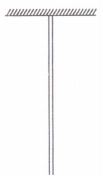
3.
Explain why
(a) a horse cannot pull a cart and run in empty space,
(b) passengers are thrown forward from their seats when a speeding bus stops suddenly,
(c) it is easier to pull a lawn mower than to push it,
(d) a cricketer moves his hands backwards while holding a catch.
4.
A ball of 1 g released down an inclined plane describe a circle of radius 10 cm in the vertical plane on reaching the bottom. What is the minimum height of the inclined plane?
5.
If, in Exercise, the speed of the stone is increased beyond the maximum permissible value, and the string breaks suddenly, which of the following correctly describes the trajectory of the stone after the string breaks :
(a) the stone moves radially outwards,
(b) the stone flies off tangentially from the instant the string breaks,
(c) the stone flies off at an angle with the tangent whose magnitude depends on the speed of the particle ?
6.
Carts with rubber tyres are easier to ply than those with iron types. Explain.
7.
Why is static friction called a self-adjusting force?
8.
A passenger of mass 72.2 kg is riding in an elevator while standing on a platform scale. What does the scale read when the elevator cab is
(i) descending with constant velocity
(ii) ascending with constant acceleration, 3.5 m/s2?
9.
A force of 36 dyne is inclined to the horizontal at an angle of 60\(^0\) . Find the acceleration in a mass of 18 g that moves in a horizontal diraction.
10.
Calculate the force acting on a body which changes the momentum of the body at the rate of 1 kg m/s2.
11.
A table with smooth horizontal surface is fixed in a cabin that rotates with angular speed \(\omega\) in a circular path of radius R. A smooth groove AB of length L (<< R) made on the surface of the table
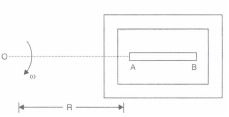
A small particle is kept at the point A in the groove and is released to move, find the time taken by the particle to reach the point B.
12.
A bird is sitting on the floor of a closed glass cage and the cage is in the hand of a girl. Will the girl experience any change in the weight of the cage when the bird
(i) starts flying in the cage with a constant velocity
(ii)flies upwards with acceleration
(iii)flies downwards with acceleration?
13.
In a rotor, a hollow vertical cylinder rotates about its axis and a person rests against the inner wall. At a particular speed of the rotor, the floor below the person is removed and the person hangs resting against the wall without
any floor.If the radius of the rotor is 2 m and the coefficient of static friction between the wall and the person is 0.2.
(i) Find the minimum speed at which the floor may be removed.
(ii) What type of speciality is associated with this question? [take g = 10 m/s2]
14.
Ten one-rupee coins are put on top of each other on a table. Each coin has mass m. Give the magnitude and direction of the reaction of the 6th coin on the 7th coin.(counted from the bottom)
15.
An artificial satellite of mass 2500 kg is orbiting around the earth with a speed of 4 kms-1 at a distance of 10-4 from the earth. Calculate the centripetal force action on it.
16.
A uniform rod is made to lean between a rough vertical wall and the ground. Show that the least angle at which the rod can be leaned without slipping is given by \(\theta =tan ^{-1}({1-\mu_1 \mu_2\over 2\mu_2})\) where \(\mu\)1 and \(\mu\)2 stand for the coefficient of friction between
(i) the rod and the wall and
(ii) the rod and the ground.
17.
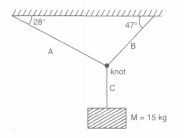
A block of mass 15 kg hangs from three chords as shown in figure. What are the tensions ill the chords?
18.
If 28 x 1023 molecules of a gas strike a surface of area 14 cm2 normally per second with velocity of 500 ms-1 and rebound in the opposite direction with the same speed find the pressure exerted by the gas on the surface if mass of each molecule is 5 x 10-23 g.
19.
A block of mass m is held against a rough vertical wall by pressing it with a finger. If the coefficient of friction between the block and the wall is J..land the acceleration due to gravity is g, calculate the minimum force required to be applied by finger to hold the block against the wall?
20.
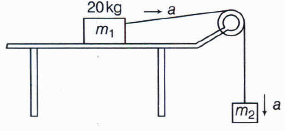
A body of mass m1 equal to 20 kg is placed on a smooth horizontal table. This body is connected to a string which passes over a frictionless pulley. The string also carries another body of mass m2 equal to 10 kg at the other end. Find out the acceleration which will be produced when the nail fixed on the table is removed, also find out the tension in the string during the motion of the bodies. What is the= result, when the bodies stop? Take g = 10 N/kg.
21.
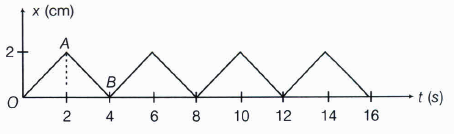
Figure below shows the position-time graph of a body of mass 0.04 kg. Suggest a suitable physical context for this motion. What is the time between two consecutive impulses received by the body? What is the magnitude of each impulse?
22.
A man of mass 70 kg stands on a weighing scale in a lift which is moving
(a) upwards with a uniform speed of 10 m s-1 ,
(b) downwards with a uniform acceleration of 5 m s-2 ,
(c) upwards with a uniform acceleration of 5 m s-2 . What would be the readings on the scale in each case?
(d) What would be the reading if the lift mechanism failed and it hurtled down freely under gravity ?
23.
Two boys A and b jumped from a certain height. Boy A fell on a cemented floor and got injured. Boy B fell on a heap of sand and was not injured. Boy B started laughing at boy A. Satish was also watching both the boys. He immediately took boy A to the nearby dispensary. The doctor treated the boy A.
(i) Why was boy A injured and the boy B?
(ii) What values are shown by Satish?
1.
The recoil speed of rifle V = \(mv\over M\) is inversely proportional to its mass. So for a heavy rifle the kick is less stronger.
2.
When the monkey is climbing down with an acceleration, then
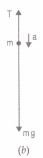
mg - T=ma
\(\Rightarrow\)T=mg - ma = m (g - a)
or T=40 kg x (10 - 4) ms-2 = 240 N
The rope will not break.
3.
(i) When a horse is trying to pull a cart, he pushes the ground backward at an angle from the horizontal. According to Newton's third law of motion, the ground also apply equal reaction force on the feet of the horse in opposite direction. The vertical component of reaction balances the weight of the horse and horizontal component is responsible for motion of the cart. In empty space, there is no reaction force, therefore, a horse cannot pull a cart.
(ii) When bus is moving, the passengers sitting in it are also in motion and moving with the speed of the bus. When bus stops suddenly then lower part of the body of passengers which is in contact with the bus slow down with the bus but upper part of the bodies of the passengers continue to remain in motion in initial direction due to its inertia of motion and hence are thrown forward.
(iii) In pulling a lawn mower, a force F is applied in upward direction, making an angle e with the horizontal [Fig.(a)].Its vertical component in upward direction decreasing the effective weight of the mower.
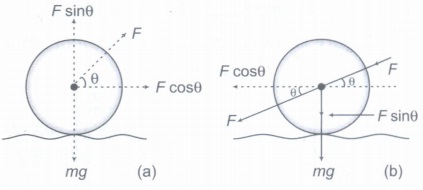
In pushing a lawn mower, a force F is applied in downward direction, making an angle \(\theta\) with the horizontal. Its vertical component is in downward direction increasing the effective weight of the mower. Therefore, it is easier to pull a lawn mower than to push it.
(iv) In holding a catch, the impulse imparted to the hands = F x \(\triangle\)t = change in momentum of the ball when a cricketer lowers his hands to take a catch, he increases the time taken to stop the ball. As time t increases the force F applied on the hands of the cricketer by the ball decreases and his hands feel less hurt.
4.
25 cm
5.
(i) The part correctly describes the trajectory of the stone after the spring breaks because when a stone tied to one end of a string is whirled round in a circle then velocity of the stone at any point is along the tangent at that point. If the string breaks suddenly, then stone flies off tangentially, along the direction of its velocity.
(ii) The part correctly describes the trajectory of the stone after the spring breaks because when a stone tied to one end of a string is whirled round in a circle then velocity of the stone at any point is along the tangent at that point. If the string breaks suddenly, then stone flies off tangentially, along the direction of its velocity.
(iii) The part correctly describes the trajectory of the stone after the spring breaks because when a stone tied to one end of a string is whirled round in a circle then velocity of the stone at any point is along the tangent at that point. If the string breaks suddenly, then stone flies off tangentially, along the direction of its velocity.
6.
The carts with rubber tyres are easier to ply than those with iron types because the coefficient of friction between rubber and concrete is less than between iron and the road.
7.
As the applied force increases, the static friction also increases and becomes equal to the applied force to make the object stationery. That is why static friction is called a self-adjusting force.
8.
Given, mass, m = 72.2 kg
Gravity acceleration, g = 9.8 m/s2
Scale reading = apparent weight = R = ?
(i) While descending with constant velocity, a = 0
\(\therefore \) R = mg
R = 72.2 x 9.8
\(\Longrightarrow \) R = 707.56 N
(ii) While ascending with a = 3.2 m/s2
R = m ( g + a )
R = 72.2 ( 9.8 + 3.2 ) = 938.6 N
9.
Given, F = 36 dyne at an angle of 6000 .
∴∴ Component of force along x-direction
Fx = F cos 6000 = 36 x 1/2 = 18 dyne
But Fx = max ,
ax = \(\frac{F_x}{m} =\frac {18}{18} = 1\) cm/s2
10.
We know that, F = rate of change of momentum
F = 1 kg-m/s2 = 1 N
11.
Let us analyse the motion of particle with respect to table which is moving with cabin with an angular speed of \(\omega\) . Along AB centrifugal force of magnitude m\(\omega^2\) R will act at A on the particle which can be treated as constant from A to B as L < < R.
\(\therefore\)acceleration of particle along AB with respect to cabin a = \(\omega^2\) R (constant) Required time' t' is given by
\(S=ut+{1\over 2}at^2\)
\(\Rightarrow L=0+{1\over2}\times \omega^2Rt^2\)
\(\Rightarrow t=\sqrt{2L\over \omega^2R}\)
12.
In a closed glass cage, air inside is bound with the cage. Therefore,
(i) there would be no change in weight of the cage if the bird flies with a constant velocity.
(ii) the cage becomes heavier, when bird flies upwards with an acceleration.
(iii) the cage appears lighter, when bird flies downwards with an acceleration.
13.
The situation is shown in figure below
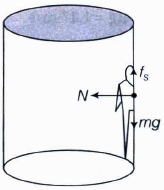
(i) When the floor is removed, the forces on the person are
(a) weight mg downward.
(b) normal force N due to the wall towards the centre.
(c) frictional force Is parallel to the wall, upwards.
The person is moving in a circle with a uniform speed, so its acceleration is v2 /r towards the centre. Newton's law for the horizontal direction (second law) and for the vertical direction (first law) give
\(N=m{ v }^{ 2 }/r\quad \quad ...(i)\)
\(\\ { f }_{ s }=mg\quad \quad \quad ...(ii)\)
For the minimum speed, when the floor may be removed, the friction is limiting one and so equals \({ \mu }_{ s }N\)
This gives
\({ \mu }_{ s }N=mg\)
\(\\ \frac { { \mu }_{ s }m{ v }^{ 2 } }{ r } =mg\)
\(\\ v=\sqrt { \frac { rg }{ { \mu }_{ s } } } =\sqrt { \frac { 2m\times 10m/{ s }^{ 2 } }{ 0.2 } } =10m/s\)
14.
\(\because \) Mass of each coin = m
Number of total coins = 10
(iii) Reaction of the 6th coin on the 7th coin
= -(force exerted on 6th coin)
= -(weight of 4 coins)
= -4 mg N (vertically upward)
15.
Given, r =104 km = 104 \(\times \) 1000 m = 107 m,
m = 2500 kg
v = 4 kms-1 = 4\(\times \)103 ms-1
Now,centripeta force is F = \(\frac { m{ v }^{ 2 } }{ r } \)
F = \(\frac { 2500\times (4\times { 10 }^{ 3 }{ ) }^{ 2 } }{ { 10 }^{ 7 } } =\frac { 2500\times 16\times { 10 }^{ 6 } }{ { 10 }^{ 7 } }\)
\( \\ F=\quad \frac { 250\times 16\times { 10 }^{ 7 } }{ { 10 }^{ 7 } }\)
\(= 4000N\)
16.
Figure shows the various forces acting on the rod AB when it is leaning between the wall and the ground without slipping.
Since the rod is in equilibrium, the net force as well as the net torque on it must each be zero. Considering the forces acting on the rod: we have
\(R_1+(-F')=0 or \ R_1 =\mu_2 R_2\) and \(R_2+F+(-W)=0 or \ R_2 +\mu_1 R_1=W\)
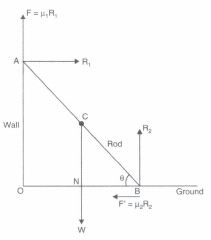
Considering next the moments of all forces about A, we have
R2 x 0 B = W x 0 N + \(\mu\)2R2 x OA or R2 x A B cos\(\theta =W \times {AB cos \theta \over 2}+\mu_2 R_2 \times AB sin \theta\)
\(or \ (R_2 -{W\over 2})cos \theta =(\mu_2 R_2)sin \theta\)
\(or \ tan \theta ={({R_2-{W\over 2}})\over \mu_2 R_2}\)
Now W= R2 + \(\mu\)1R1 = R2 + \(\mu\)1 ( \(\mu\)2 R2)
=R2 (1 +\(\mu\)1\(\mu\)2)
\(\therefore R_2-W/2 =R_2-{R_2\over 2}(1+\mu_1 \mu_2)\)
\(={R_2 \over 2}-{R_2\over 2}\mu_1 \mu_2={R_2 \over 2}(1-\mu_1 \mu_2)\)
\(\therefore tan \theta ={R_2\over 2}{(1-\mu_1 \mu_2)\over \mu_2 R_2}={(1-\mu_1\mu_2)\over 2\mu_2}\)
or \(\theta= tan^{-1} \{ {(1-\mu_1\mu_2)\over 2\mu_2} \}\)
17.
The free-body diagram of the given problem is shown in the figure (a).
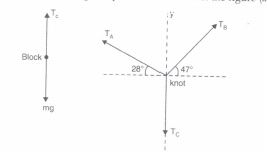
mg = 15 x 9.8 = 147 N
Since block is at rest, so Tc = mg = 15 x 9.8 = 147 N
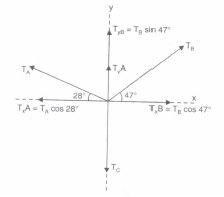
Resolve TA and TB into x and y components. x-component of TA is given by
TxA = - TA cos 28° = - TA (0.8830)
= - 0.8830 TA
y-component of TA is given by
TyA = TA sin 28° = 0.4690 TA
Similarly, x-component of TB is given by
TxB = TB cos 47° = 0.6820 TB
and y-component of TB is given by
TyB = TB sin 47° = 0.7310 TB.
These components are represented
Since the knot is in equilibrium, so
(i)\(\sum\)x-components of tensions = 0
i.e., TxA + TxB = 0
or - 0.8830 TA + 0.6820 TB = 0
or TA =\({0.6820\over0.8830}\) TB = 0.772 TB ...(i)
(ii)\(\sum\)y-components of tensions = 0
i.e., TYA + TyB - Tc = 0
or 0.4690 TA + 0.7310 TB - 147 = 0
or 0.4690 TA + 0.7310 TB = 147
Substituting the value of equation (i), we get
0.4690 x 0.772 TB + 0.7310 TB = 147
or 1.093 TB =147
or TB = \({147\over1.093}\) = 134.5 N
Now substituting the values of TB in eqn. (i), we get
TA = 0.772 x 134.5 N = 103.8 N
Thus, TA = 103.8 N; TB = 134.5 Nand Tc = 147 N.
18.
Let the direction in which the molecules rebound after striking the surface be taken as positive.
=Momentum of each molecule after striking the surface
= mv2 = 5 x 10-26 kg x 500 ms-1
Momentum of each molecule before striking the surface
= mv1 = 5 x 10-26 kg x (- 500)
28 x 1023 molecules strike the surface per second.
∴ Change in momentum of the molecules due to striking the surface in 1second
28 x 1023 [(5 x 10-26 x 500) - 5 x 10-26 (- 500)] kg ms-1
= 28 x 1023 x 5 x 10-26 x 1000 kg ms-1
= 140 kg ms-1
∴ Rate of change of momentum
=\(\frac { 140kg\ { ms }^{ -1 } }{ 1s } \) =140 kg ms-2
But rate of change of momentum is equal to the impressed force.
∴ Force exerted by the surface on the molecule
= 140 kg ms-2 = 140
By Newton's third law of motion, this must also be the magnitude of the force exerted by the molecules on the surface.
∴ Force exerted by the molecules on the surface
=140 N
Area of the surface = 14 cm2
= 14 x 10-4 m2
∴ Pressure on the surface
\(\frac { Force }{ Area } =\frac { 140N }{ 14\times { 10 }^{ -4 }{ m }^{ 2 } } \)
= 105 N m-2.
19.
Given mass of the block = m
Coefficient of friction between the block and the wall = \(\mu \)
Let a force F be applied on the block 10 hold the block against the wall. The normal reaction of mass be Nand force offriction acting upward be f· In equilibrium, vertical and horizontal forces should be balanced separately.
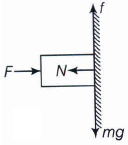
f = mg ...(i)
F = N ..(ii)
But force of friction (f) = \(\mu N\)
=\(\mu N\) [using Eq(ii)] .....(iii)
From Eqs. (i) and (iii),we get
\(\mu F=mg\ or\ F=\frac { mg }{ \mu } \)
20.
When the nail fixed on the table is removed, system of two bodies moves with an acceleration a in the forward direction. The acceleration can be found by using
Newton's second law. Draw the FBD for each body as shown in the figure
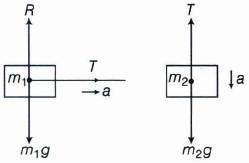
For mass m1, T = m1a ....(i)
For mass m2, m2g - T = m2a .....(ii)
Adding Eqs. (i) and (ii), we get
m1a + m2a = m2g
a = \(\frac { { m }_{ 2 }g }{ { m }_{ 1 }+{ m }_{ 2 } } =\frac { 10\times 10 }{ 20+10 } =\frac { 100 }{ 30 } =3.33m/{ s }^{ 2 }\)
Tension, T = m1a = 10 x 3.33 = 33.3 N
When the bodies stop, acceleration, a will be zero. Suppose, the tension becomes T. As the net force on each body is zero, so for body m2
T = m2g = 10 x 10 = 100N
21.
Mass of the body,m = 0.04 kg
The position time graph OA from t = 0 to t = 2s is a straight line therefore body is moving with a constant velocity.
Velocity of the body,v=Slope of x-t graph
= \(\frac { 2-0 }{ 2-0 } =1cm/s={ 10 }^{ -2 }m/s\quad [\because 1\quad cm={ 10 }^{ -2 }m]\)
Part AB of position time graph is also a straight line.Therefore velocity of the body
\({ v }^{ \prime }=\frac { 0-2 }{ 0-2 } =-1\quad cm/s=-{ 10 }^{ -2 }cm/s\)
Negative sign shows that the direction of velocity is reversed after 2 s and it is being repeated.
A suitable physical context for this motion is a ball moving with a constant velocity of 10-2 m/s between two walls located at x=0 and at x=2m and rebounded repeadedtly on striking each wall.
magnitude of the impulse imparted to the ball after every two seconds
= chage in momentum of teh ball
= mv - mv' = m(v - v')
= \(0.04[{ 10 }^{ -2 }-(-{ 10 }^{ -2 })]=8\times { 10 }^{ -4 }kg-m/s\)
22.
When a man is standing on a weighing scale, it will read the normal reaction R as apparent weight.
Given , mass of man (m) = 70 kg
In each case the weighing scale will read the reaction R, i.e. the apparent weight.
(i) As lift is moving upward with a uniform speed, therefore, its acceleration a = 0
\(\therefore \) Normal reaction w = R = mg = 70 x 10 N = 700 N
w acts vertically downwards and R acts vertically upwards.
\(\therefore \) Reading on weighing scale = \(\frac { 700 }{ 10 } \) = 70 kg
(ii) Acceleration of the lift, a = 5 m/ s2 (\(\downarrow \) )
\(\therefore \) Normal reaction, R = m (g - a) = 70 ( 10 - 5) N
= 70 x 5N = 350 N
\(\therefore \) Reading on weighing scale = \(\frac { 350\quad N }{ 10\quad m/{ s }^{ 2 } } \) = 35 kg
(iii) Acceleration of the lift, a = 5 m/s2 (\(\uparrow \) )
\(\therefore\) Normal reaction R = m ( g + a )
= 70 ( 10 + 5 ) = 1050 N
\(\therefore\) Reading on weighing scale = \(\frac { 1050N }{ 10m/{ s }^{ 2 } } \) = 105 kg
(iv) Acceleration of the lift when it is falling freely under gravity
a = g (\(\downarrow\) )
\(\therefore\) Normal reaction, R = m ( g - g ) = 0
\(\therefore\) Reading on weighing scale = 0
23.
(i) Boy A fell on the cemented floor and come to rest abruptly. So, the change in momentum of boy A took place in small interval of time. Hence, a large force was exerted on the boy A by the floor. Therefore, he got injured.
On the other hand, the sand under the weight of boy B yielded and the change in momentum of boy B took place in large interval of time. Therefore, less force was exerted on boy B by the floor and he was not injured.
(ii) Satish is concerned about the welfare of others.He understands his duty to help the needy people.

11th Standard CBSE Syllabus & Materials
11th Standard CBSE
CBSE 11th Business Studies Forms of Business Organisation Sample Question Papers Study Material - QB365 Set A
NEW11th Standard CBSE
CBSE 11th Business Studies Business, Trade and Commerce Sample Question Papers Study Material - QB365 Set A
NEW11th Standard CBSE
CBSE 11th Physics Waves Sample Question Papers Study Material - QB365 Set A
NEW11th Standard CBSE
CBSE 11th Physics Kinetic Theory Sample Question Papers Study Material - QB365 Set A



CBSE 11th Standard CBSE Subjects
CBSE Standards









