
 100% FREE ACCESS
11th Standard CBSE Syllabus & Materials
11th Standard CBSE
CBSE 11th Economics PART-A - Presentation of Data - New Sample Question Papers Study Material - QB365 Set A
NEW11th Standard CBSE
CBSE 11th Economics PART-A - Organisation of Data - New Sample Question Papers Study Material - QB365 Set A
NEW11th Standard CBSE
CBSE 11th Economics PART-A - Collection of Data - New Sample Question Papers Study Material - QB365 Set A
NEW11th Standard CBSE
CBSE 11th Economics PART-A - Introduction to Economics and Statistics - New Sample Question Papers Study Material - QB365 Set A
NEW11th Standard CBSE
CBSE 11th Business Studies International Trade Sample Question Papers Study Material - QB365 Set A
NEW11th Standard CBSE
CBSE 11th Business Studies Evolution and Fundamentals of Business Sample Question Papers Study Material - QB365 Set A

Published on: 30/07/2018
The chapter Laws of Motion contains the important question in CBSE 11th Standard Physics. It covers one mark, two, three and five marks questions from the book back and PTA question.
For parents, Please subscribe and get the plenty of question with answer for your children practice. For Subscription please Click here.
Download CBSE Class 11th Standard CBSE Physics question papers, sample papers, important questions, and previous year solved papers in PDF format. Get free study materials, NCERT solutions, and exam preparation resources for Class 11th Standard CBSE Physics
Questions + Answers key
Take MCQ Physics Test
1.
A shell of mass 0.020 kg is fired by a gun of mass 100 kg. If the muzzle speed of the shell is 80 m s-1, what is the recoil speed of the gun ?
2.
A ball of 1 g released down an inclined plane describe a circle of radius 10 cm in the vertical plane on reaching the bottom. What is the minimum height of the inclined plane?
3.
If the speed of stone is increased beyond the maximum permissible value and the string breaks suddenly, which of the following correctly describes the trajectory of the stone after the string breaks the stone flies off at an angle with the tangent whose magnitude depends on the speed of the particle?
4.
If, in Exercise, the speed of the stone is increased beyond the maximum permissible value, and the string breaks suddenly, which of the following correctly describes the trajectory of the stone after the string breaks :
(a) the stone moves radially outwards,
(b) the stone flies off tangentially from the instant the string breaks,
(c) the stone flies off at an angle with the tangent whose magnitude depends on the speed of the particle ?
5.
Carts with rubber tyres are easier to ply than those with iron types. Explain.
6.
A heavy points mass tied to the end of string is whirled in a horizontal circle of radius 20 cm with a constant angular speed. What is angular speed if the centripetal acceleration is 980 cms-2 ?
7.
A body is moving in a circular path such that its speed always remains constant. Should there be a force action on the body?
8.
Calculate them impulse necessary to step 1500 kg car travelling at 90 km/h.
9.
A woman throws an object of mass 500 g with a speed of 25 m/s.
(i) What is the impulse imparted to the objects?
(ii) If the object hits a wall and rebounds with half the original speed, what is the change in momentum of the object ?
10.
Why are porcelain objects wrapped in paper or straw before packing for transportation ?
11.
An impulse is applied to a moving object with a force at an angle of 20\(^0\) w.r.t. velocity vector. what is the angle between the impulse vector and change in momentum vector ?
12.
A body is acted upon by a number of external forces. Can it remain at rest ?
13.
A force of 36 dyne is inclined to the horizontal at an angle of 60\(^0\) . Find the acceleration in a mass of 18 g that moves in a horizontal diraction.
14.
Calculate the force acting on a body which changes the momentum of the body at the rate of 1 kg m/s2.
15.
Bodies of larger mass need greater initial effort to put them in motion. why ?
16.
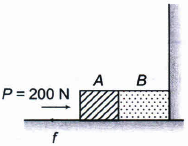
Two bodies A and B of masses 5 kg and 10 kg in contact with each other rest on a table is against a rigid wall as shown in figure. The coefficient of friction between the bodies and the table 0.15.A force of 200 N is applied horizontally at A What are (i) the reaction of the partition or wall (ii) the action- reaction forces between A and B? What happens when the partition is removed? Does the answer to (ii) change, when the bodies are in motion? Ignore difference between \({ \mu }_{ s }\) and \({ \mu }_{ k }\) ?
17.
A stream of water flowing horizontally with a speed of 15 m/ s gushes out of a tube of cross-sectional area 10-2 m2 and hits a vertical wall nearby. What is the force exerted on the wall by the impact of water, assuming it does not rebound ?
18.
A pebble of mass 0.05 kg is thrown vertically upwards. Give the direction and magnitude of the net force on the pebble,
(a) during its upward motion,
(b) during its downward motion,
(c) at the highest point where it is momentarily at rest.
Do your answers change if the pebble was thrown at an angle of 45° with the horizontal direction? Ignore air resistance
19.
A stone of mass 0.25 kg tied to the end of a string is whirled round in a circle of radius 1.5 m with a speed of 40 rev./min in a horizontal plane. What is the tension in the string ? What is the maximum speed with which the stone can be whirled around if the string can withstand a maximum tension of 200 N ?
20.
Given the action force, describe the reaction force for each situation.
(i) You push forward on a book with 5.2 N
(ii) A boat exerts a force of 450 N on the water.
(iii) A hockey player hits the boards with a force of 180 N towards the boards.
21.
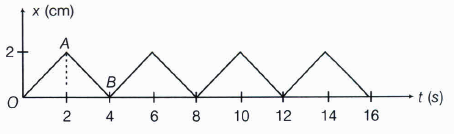
Figure below shows the position-time graph of a body of mass 0.04 kg. Suggest a suitable physical context for this motion. What is the time between two consecutive impulses received by the body? What is the magnitude of each impulse?
22.
A circular motion addict of mass 80 kg rides a Ferris wheel around in a vertical circle of radius 10m at a constant speed of 6.1 m/s.
(i) what is the period of the motion? What is the magnitude of the normal force on the addict from the seat when both go through
(ii) the highest point of the circular path
(iii) the lowest point?
23.
Give the magnitude and direction of the net force acting on
(i) a drop of rain falling down with a constant speed.
(ii) a cork of mass 10 g floating on water
(iii) a kite skillfully held stationary in the sky.
(iv) a car moving with a constant velocity of 30 km / h on a rough road.
(v) a high speed electron in space far from all gravitational (material) objects and free of electric and magnetic fields.
1.
m = 0.02 kg, M = 100 kg, v = 80 m s-1, V = ?
\(V=-{mv\over M}=-{0.020 kg \times 80 ms^{-1}\over 100kg}\)
= 0.016 m / s-1=- 1.6 cm s-1
Negative sign indicates that the gun moves in a direction opposite to the direction of motion of the bullet.
2.
25 cm
3.
The part correctly describes the trajectory of the stone after the spring breaks because when a stone tied to one end of a string is whirled round in a circle then velocity of the stone at any point is along the tangent at that point. If the string breaks suddenly, then stone flies off tangentially, along the direction of its velocity.
4.
(i) The part correctly describes the trajectory of the stone after the spring breaks because when a stone tied to one end of a string is whirled round in a circle then velocity of the stone at any point is along the tangent at that point. If the string breaks suddenly, then stone flies off tangentially, along the direction of its velocity.
(ii) The part correctly describes the trajectory of the stone after the spring breaks because when a stone tied to one end of a string is whirled round in a circle then velocity of the stone at any point is along the tangent at that point. If the string breaks suddenly, then stone flies off tangentially, along the direction of its velocity.
(iii) The part correctly describes the trajectory of the stone after the spring breaks because when a stone tied to one end of a string is whirled round in a circle then velocity of the stone at any point is along the tangent at that point. If the string breaks suddenly, then stone flies off tangentially, along the direction of its velocity.
5.
The carts with rubber tyres are easier to ply than those with iron types because the coefficient of friction between rubber and concrete is less than between iron and the road.
6.
Here, radius r =20 cm
Centripetal acceleration, = 980 cms-2
We know that centripetal acceleration, a = rω2
\(\omega =\sqrt { \frac { a }{ r } } =\sqrt { \frac { 980 }{ 20 } }\)
\(\omega =\sqrt { 49 } =7rad/s\)
7.
When a body is moving along a circular path, speed always remains constant and a centripetal force is acting on the body.
8.
Step 1: Given that:
The mass(m) of the car= 1500kg
Initial velocity of the car(u) = 90kmh−1=90 × 518 ms−1 =25ms−1
Final velocity of the car(v) = 0
Step 2: Calculation of impulse:
We have,
Impulse= Change in momentum of the body = mv−mu
Thus, Impulse on the car will be;
= 1500kg × 0 − 1500kg × 25ms−1
=−37500kgms−1
=−3.75×10⁴kgms−1
Thus,Impulse on the car will be 3.75 × 10⁴kgms−1
9.
Given, Mass of the object (m) = 500 g = 0.5 kg
Speed of the object (v) = 25 m/s
(i) Impulse imparted to the object
= change in the momentum = mv - mu
= m ( v - u ) = 0.5 ( 25 - 0) = 12.5 N-s
(ii) Velocity of the object after rebounding = -\(\frac { 25 }{ 2 } \) m/s
v' = -12.5 m/s
\(\therefore \) Change in momentum = m ( v' - v )
= 0.5 ( - 12.5 - 25 ) = -18.75 N-s
10.
Porcelain objects are wrapped in paper or straw before packing to reduce the chances during transportation. During transportation sudden jerks or even fall can take place. Forces are created at the point of collision and the force takes longer time to reach the porcelain objects through paper or straw for same change in momentum as F = \({ \Delta p }/{ \Delta t }\) and therefore a lesser force acts on object.
11.
Impulse and change in momentum are along the same direction. Therefore, angle between these two vectors is zero degree.
12.
Yes, if the external forces acting on the body caan be represented in magnitude and direction by the sides of a closed polygon taken in the same order.
13.
Given, F = 36 dyne at an angle of 6000 .
∴∴ Component of force along x-direction
Fx = F cos 6000 = 36 x 1/2 = 18 dyne
But Fx = max ,
ax = \(\frac{F_x}{m} =\frac {18}{18} = 1\) cm/s2
14.
We know that, F = rate of change of momentum
F = 1 kg-m/s2 = 1 N
15.
According to the Newton's second law of motion. F = ma, for given acceleration a if m is large. F should be more i.e. greater force will be required to put a larger mass in motion.
16.
Mass of body A(ml) = 5 kg
Mass of body B(m2) =10 kg
Coefficient of friction between the bodies and the table (\(\mu \)) = 015
Force applied horizontally at A, F = 200 N
(i) Reaction of partition
Limiting friction acting to the left
f =\(\mu \)R =\(\mu \)(m1 + m2)g
= 0.15(5+ 10) x 9.8 = 22.05N
\(\therefore\) Net force acting on the partition towards the right
F' =F - f
= 200 - 22.05 = 177.95 N
According to the Newton's third law of motion,
Reaction of partition = Net force acting on the partition
= 177.95 N [towards the left]
(ii) Action-reaction forces between A and B Let t. be the force of limiting friction acting on body A and FI be the net force applied by body A on body B.
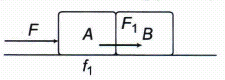
f1 = \(\mu \) R1
= \(\mu \)m1g [.: R1 = m1g]
= 0.15 x 5 x 9.8
= 7.35 N (towards the left).
Net force applied by body A on body B,
F1 = F - f1 = 200 -7.35
= 192.65 N [towards the right]
According to Newton's third law of motion, reaction force applied by body B on body, i.e.
A = F1 = 192.65 N (towards left)
17.
Given, Speed of the stream of water, \(\nu \) = 15 m/s
Area of cross-section of the tube, A = 10-2 m2
Volume of water coming out per second from the tube
V = A\(\nu \) = 10-2 x 15 = 15 x 10-2 m3
Density of water = 103 kg/m3
\(\therefore \) Mass of the water coming out of the tube per second
m = V\(\rho \) \(\left[ \because Density=\frac { mass }{ volume } \right] \)
= 15 x 10-2 x 103 kg
= 150 kg/s
Force exerted on the wall by the impact of water = change in momentum per second
= m\(\nu \) = 150 x 15 N
= 2250 N
18.
When an object is thrown vertically upwards or it falls vertically downward under gravity, then an acceleration g = 10 m/s2 acts downward due to the earth's gravitational pull.
Mass of pebble (m) = 0.05 kg
(i) During upward motion
Net force acting on pebble (F) = ma = 0.05 x 10 N
= 0.50 N (vertically downwards)
(ii) During downward motion
Net force acting on pebble (F) = ma = 0.05 x 10 N
= 0.50 N (vertically downward)
(iii) At the highest point
Net force acting on pebble
(F) = ma = 0.05 x 10 N
= 0.50 N (vertically downward)
If pebble was thrown at an angle of 45\(^0\) with the horizontal direction, then acceleration acting on it and therefore force acting on it will remain unchanged, i.e. 0.50 N (vertically downward).
19.
Mass of stone, m = 0.25 kg, Radius of the string, r = 1.5 m
Frequency, v = 40rev/min = \(\frac { 40 }{ 60 } \) rev/s = \(\frac { 2 }{ 3 } \) rev/s
Centripetal force required for circular motion is obtained from the tension in the string.
\(\therefore \) Tension in the string = Centripetal force
T = \(mr{ \omega }^{ 2 }\)
\(= mr\left( 2\pi n \right) ^{ 2 } \ \left[ \therefore \omega =2\pi v \right] \)
\(= mr4\pi ^{ 2 }{ v }^{ 2 }\)
\(T=0.25\times 1.5\times 4\times \left( \frac { 22 }{ 7 } \right) ^{ 2 }\times \left( \frac { 2 }{ 3 } \right) ^{ 2 }= 6.6N\)
Maximum tension which can be withstand by the string
\({ T }_{ max }=200\quad N=\frac { mv^{ 2 }max }{ r } \)
\(\\ { v }_{ max }=\sqrt { \frac { { T }_{ max }\times r }{ m } } =\sqrt { \frac { 200\times 1.5 }{ 0.25 } } =34.6{ m }/{ s }\)
20.
(i) 5.2 N backward
(ii) 450 N on the boat
(iii) 180 N on the hockey stick
21.
Mass of the body,m = 0.04 kg
The position time graph OA from t = 0 to t = 2s is a straight line therefore body is moving with a constant velocity.
Velocity of the body,v=Slope of x-t graph
= \(\frac { 2-0 }{ 2-0 } =1cm/s={ 10 }^{ -2 }m/s\quad [\because 1\quad cm={ 10 }^{ -2 }m]\)
Part AB of position time graph is also a straight line.Therefore velocity of the body
\({ v }^{ \prime }=\frac { 0-2 }{ 0-2 } =-1\quad cm/s=-{ 10 }^{ -2 }cm/s\)
Negative sign shows that the direction of velocity is reversed after 2 s and it is being repeated.
A suitable physical context for this motion is a ball moving with a constant velocity of 10-2 m/s between two walls located at x=0 and at x=2m and rebounded repeadedtly on striking each wall.
magnitude of the impulse imparted to the ball after every two seconds
= chage in momentum of teh ball
= mv - mv' = m(v - v')
= \(0.04[{ 10 }^{ -2 }-(-{ 10 }^{ -2 })]=8\times { 10 }^{ -4 }kg-m/s\)
22.
Step 1: Given
Mass =80 kg, circle of radius =10 m, speed =6.1 m/s
Step 2: Determining the concept
This problem is based on the concept of uniform circular motion. Uniform circular motion is a motion in which an object moves in a circular path with constant velocity. Also, it involves Newton's second law of motion.
Formula:
The velocity in uniform circular motion is given by,
\(\mathrm{v}=\frac{2 \pi \mathrm{R}}{\mathrm{T}}\)
where, v is the velocity, R is the radius and T is the time period
According to Newton's second law of motion
\(\mathrm{F}_{\mathrm{N}}-\mathrm{mg}=\mathrm{ma}_{\mathrm{c}}\)
where \({ }^{a_c}\) is an acceleration, g is an acceleration due to gravity, m is mass, \({ }^{F_N}\) is the normal force and R is the radius.
Step 3: (a) Determining the period of the motion
Using equation (i) the time can be written as,
\(\mathrm{T}=2 \pi \mathrm{R} / \mathrm{V}-2 \pi(10 \mathrm{M}) /(6.1 \mathrm{~m} / \mathrm{s})=10 \mathrm{~s}\)
Hence, the period of the motion is $10 \mathrm{~s}$.
Step 4: (b)Determining the magnitude of the normal force on the addict from the seat when both go through the highest point of the circular path
In this case, Normal force \({ }^{F_N}\)is directed upward, gravitational force mg is to downward and acceleration is also directed to the down. Thus, by using Newton's 2nd law,
\(\mathrm{F}_{\mathrm{N}}-\mathrm{mg}=\mathrm{ma}_{\mathrm{c}}\) (Centripetal acceleration is due to the circular motion)
\(\mathrm{F}_{\mathrm{N}}=\mathrm{m}\left(\mathrm{g}-\mathrm{v}^2 / \mathrm{R}\right)=486 \mathrm{~N} \approx 4.9 \times 10^2 \mathrm{~N}\)
Hence, the magnitude of the normal force on the addict from the seat when both go through the highest point of the circular path is \({ }^{4.9 \times 10^2 \mathrm{~N}}\).
Step 5: (c) Determining the magnitude of the normal force on the addict from the seat when both go through the lowest point
Now, reverse both the normal force direction and the acceleration direction
Thus, \(\mathrm{F}=\mathrm{m}\left(\mathrm{g}+\mathrm{v}^2 / \mathrm{R}\right)-1081 \mathrm{~N} \approx 1.1 \mathrm{kN}\)
Hence, the magnitude of the normal force on the addict from the seat when both go through the lowest point is \({ }^{1.1 \mathrm{kN}}.\)
23.
Force F = ma, therefore force acting on a particle in unaccelerated (a = 0) motion is zero.
(i) As drop of rain is falling downward with a constant speed, therefore its acceleration is zero.
According to Newton's second law of motion, net force acting on drop F = ma = 0.
(ii) In floating condition, the weight of the body is balanced by the upthrust. Therefore, net force acting on a cork floating on water = 0
(iii) As kite is held stationary in the sky, therefore acceleration of the kite is zero. Therefore, net force acting on the car F = ma = 0.
(iv) As car is moving with a constant velocity, therefore, its acceleration is zero. i.e., a = 0 therefore, net force acting on the car F = ma = 0.
(v) As electron is in a space where there is no electric field, magnetic field and gravitational (material) objects, therefore, no electric, magnetic and gravitational force is acting on it. Hence, net force acting on electron is zero.

11th Standard CBSE Syllabus & Materials
11th Standard CBSE
CBSE 11th Business Studies Forms of Business Organisation Sample Question Papers Study Material - QB365 Set A
NEW11th Standard CBSE
CBSE 11th Business Studies Business, Trade and Commerce Sample Question Papers Study Material - QB365 Set A
NEW11th Standard CBSE
CBSE 11th Physics Waves Sample Question Papers Study Material - QB365 Set A
NEW11th Standard CBSE
CBSE 11th Physics Kinetic Theory Sample Question Papers Study Material - QB365 Set A



CBSE 11th Standard CBSE Subjects
CBSE Standards









