
 100% FREE ACCESS
7th Standard CBSE Syllabus & Materials
7th Standard CBSE
CBSE 7th Social Science Theme E - Understanding Market - New Sample Question Papers Study Material - QB365 Set A
NEW7th Standard CBSE
CBSE 7th Social Science Theme E - From Barter to Money - New Sample Question Papers Study Material - QB365 Set A
NEW7th Standard CBSE
CBSE 7th Social Science Theme D - The Constitution of India- An Introduction - New Sample Question Papers Study Material - QB365 Set A
NEW7th Standard CBSE
CBSE 7th Social Science Theme D - From the Rulers to the Ruled : Types of Governments - New Sample Question Papers Study Material - QB365 Set A
NEW7th Standard CBSE
CBSE 7th Social Science Theme B - The Age of Reorganisation - New Sample Question Papers Study Material - QB365 Set A
NEW7th Standard CBSE
CBSE 7th Social Science Theme B - The Rise of Empires - New Sample Question Papers Study Material - QB365 Set A

Published on: 30/07/2018
From the chapter Lines and Angle, some of the important questions are covered in this question paper. The questions are covers from the Higher Order Thinking Questions and Value Based Questions.
Download CBSE Class 7th Standard CBSE Mathematics question papers, sample papers, important questions, and previous year solved papers in PDF format. Get free study materials, NCERT solutions, and exam preparation resources for Class 7th Standard CBSE Mathematics
Questions + Answers key
Take MCQ Mathematics Test
1.
Can two acute angles form a linear pair?
2.
What will be the measure of the supplement of each one of the following angles? 90°
3.
What is the measure of the complement of each of the following angles? 41 °
4.
What is the measure of the complement of each of the following angles? 45°
5.
Can two obtuse angles be complement to each other?
6.
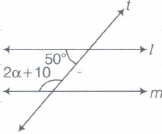
In the given figure, find the value of \(\alpha\).
7.
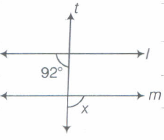
In the given figure, find the value of x.
8.
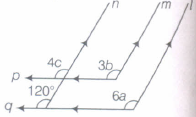
In the adjoining figure, I, m and n are parallel lines and the lines p and q are also parallel. Find the values of a, b and c.
9.
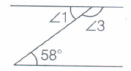
In the following figure, \(\angle \)2=58°. Find \(\angle \)1 and \(\angle \)3
10.
Find the angle which is equal to its supplement.
11.
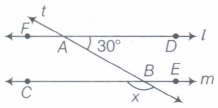
In the given figure, the value of x = _______________
12.
The supplement of an acute is always _____________ angle.
13.
If sum of measures of two angles is 180°, then they are ___________________
14.
If two adjacent angles are supplementary, then they form a ________________
15.
If two angles are supplementary, then the sum of their measures is _____________
16.
One obtuse angle and one acute angle can make a pair of supplementary angles.
17.
Interior angles on the same side of a transversal with two distinct parallel lines are complementary angles.
18.
Vertically opposite angles are either both acute angles or both obtuse angles.
19.
Two right angles are always supplementary to each other.
20.
One obtuse and one acute angle can make a pair of complementary angles.
21.
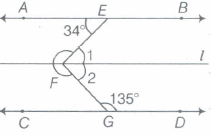
In the given figure, AB II CD. Find the reflex \(\angle\)EFG.
22.
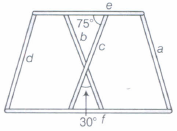
Iron rodes a, b, c, d, e and f are making a design of a bridge as shown in figure , in which a || b, c || d, e || f. Find the marked angles between d and f
23.
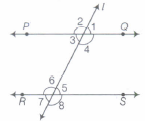
In the given figure, PQ II RS. If \(\angle\)1 = (2a + b)° and \(\angle\)6 = (3a - b)°, then the measure of \(\angle\)2 in terms of b is
(2+b)°
(3-b)°
(108-b)°
(180-b)°
24.
In the following figure, \(\alpha\) = 35°, then the value of b is
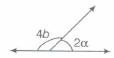
27.5
26.5
29
28.5
25.
If two supplementary angles are in the ratio of 1 : 2, then the bigger angle is
120°
125°
110°
90°
26.
In the following figure, the value of x is
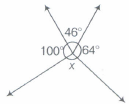
110°
46°
64°
150°
27.
The angle, which makes a linear pair with an angle of 58° is of
122°
123°
119°
69°
1.
No, two acute angles cannot form a linear pair because the sum of two angles forming a linear pair is always 180° but the sum of two acute angles is always less than 180°.
2.
Let the supplement angle of 90° be x°,
We know that, the sum of two supplementary angles is 180°
\(\therefore\) x°+ 90° = 180° \(\Rightarrow\) x° = 180° - 90° = 90°
Hence, the supplement angle of 90° is 90°.
3.
The complement angle of 41° is 49°
4.
Let the complement angle of 45° be x°.
We know that, the sum of two complementary angles is 90°.
\(\therefore\) x°+ 45° = 90°
\(\Rightarrow\) x° = 90° - 45° = 45°
[transposing 45° to RHS]
Hence, the complement angle of 45° is 45°.
5.
No, two obtuse angles can never be complement to each other because their sum cannot be 90°, as an obtuse angle has its measure greater than 90°.
e.g. 105° and 135° are two obtuse angles.
Their sum =105° + 135° = 240° \(\neq \) 90°
Therefore, two obtuse angles cannot be complement to each other.
6.
60°
7.
88°
8.
Given, l || m || n and p || q
\(\therefore \quad \angle 6a=120°\) [corresponding angles]
\(\Rightarrow \quad \angle a=\frac { 120° }{ 6 } =20°\)
Similarly, \(\angle\)4c=120° [corresponding angles]
\(\Rightarrow \quad \angle c=\frac { 120° }{ 4 } =30°\quad and\quad \angle 3b=\angle 4c\)
[ corresponding angles]
\(\Rightarrow \quad \angle b=\frac { 4\times 30° }{ 3 } \Rightarrow b=40°\)
9.
Given, \(\angle \)2 = 58° \(\Rightarrow\) \(\angle \)1 = \(\angle \)2 [alternate angles]
Also, \(\angle \)1 + \(\angle \)3 =180° [linear pair]
\(\therefore\) 58°+ \(\angle \)3=180° \(\Rightarrow\) \(\angle \)3=180°-58°
\(\Rightarrow\) \(\angle \)3 =122°
So, \(\angle \)1 = 58° and \(\angle \)3 = 122°
10.
Let the angle be x°,
Therefore, its supplement be 180°- x°,
Since, the angle is equal to its supplement.
\(\therefore\) x°=180°-x°
On transposing x° from RHS to LHS, we get
x°+ x°= 180° \(\Rightarrow\) 2x° = 180°
On dividing both sides by 2, we get
\(\therefore \quad { x }^{ ° }=\frac { 180° }{ 2 } =90°\)
Hence, the required angle is 90°.
11.
()
150°
12.
()
obtuse
13.
()
supplementary
14.
()
linear pair.
15.
()
180°
16.
(a)
17.
(b)
18.
(a)
19.
(a)
20.
(b)
21.
281°
22.
Angle between d and f +
Angle between d and e = 180°
[\(\because\) pair of cointerior angles]
\(\therefore\) Angle between d and f = 180° - 105°= 75°
23.
(c)
(108-b)°
24.
(a)
27.5
25.
(a)
120°
26.
(d)
150°
27.
(a)
122°

7th Standard CBSE Syllabus & Materials
7th Standard CBSE
CBSE 7th Social Science Theme B - New Beginnings : Cities and States - New Sample Question Papers Study Material - QB365 Set A
NEW7th Standard CBSE
CBSE 7th Social Science Theme A - Climates of India - New Sample Question Papers Study Material - QB365 Set A
NEW7th Standard CBSE
CBSE 7th Social Science Theme A - Geographical Diversity of India - New Sample Question Papers Study Material - QB365 Set A
NEW7th Standard CBSE
CBSE 7th Science Earth, Moon and the Sun - New Sample Question Papers Study Material - QB365 Set A



CBSE 7th Standard CBSE Subjects
CBSE Standards




