
 100% FREE ACCESS
10th Standard CBSE Syllabus & Materials
10th Standard CBSE
CBSE 10th Social Science ECO - Globalisation and the Indian Economy - New Model Questions Papers Study Material - QB365 Set A
NEW10th Standard CBSE
CBSE 10th Social Science ECO - Money and Credit - New Model Questions Papers Study Material - QB365 Set A
NEW10th Standard CBSE
CBSE 10th Social Science ECO - Sectors of the Indian Economy - New Model Questions Papers Study Material - QB365 Set A
NEW10th Standard CBSE
CBSE 10th Social Science ECO - Development - New Model Questions Papers Study Material - QB365 Set A
NEW10th Standard CBSE
CBSE 10th Social Science PS - Outcomes of Democracy - New Model Questions Papers Study Material - QB365 Set A
NEW10th Standard CBSE
CBSE 10th Social Science PS - Gender, Religion and Caste - New Model Questions Papers Study Material - QB365 Set A

Published on: 30/07/2018
Some of the important questions are prepared from this chapter Manufacturing Industries. The important questions are covers from the Higher Order Thinking Questions and Value based questions.
Download CBSE Class 10th Standard CBSE Social Science question papers, sample papers, important questions, and previous year solved papers in PDF format. Get free study materials, NCERT solutions, and exam preparation resources for Class 10th Standard CBSE Social Science
Questions + Answers key
Take MCQ Social Science Test
1.
Which of the following does not affect the location of industries?
Per capita income
Labour
Raw material
Energy
2.
NTPC is the Abbreviation of
National Textile Production company
National Technology Production Company
National Thermal Power Corporation
National Tuberculosis Prevention Corporation
3.
Iron and Steel is a
an agro base industry
a chemical industry
basic industry
tertiary industry
4.
Which one of the following industries uses bauxite as a raw material?
Aluminium Smelting
Cement
Jute
Steel
5.
Which one of the following industries uses limestone as a raw material?
Aluminium
Cement
Sugar
Jute
6.
Distinguish between an integrated steel plant and a mini-steel plants stating three points of distinction.
7.
Explain any three factors that influence the location of an industry.
8.
Differentiate between heavy and light industries.
9.
Name the important raw materials used in the manufacturing of cement?
10.
Explain any three objectives of the 'National Jute Policy 2005'.
11.
Explain the distribution of cotton textile industries.
12.
How are industries classified according to their main role in economy?
13.
Explain the different varieties of fertilizers produced.
14.
Why is it important for us to improve our weaving sector instead of exporting yarn in large quantities?
15.
What are the relative advantage of the Chotanagpur plateau for the development of iron and steel industry?
16.
Differentiate between spinning and weaving sectors of cotton textiles industries in India.
17.
Mention the major drawbacks and problems of cotton textile industry in India.
18.
State one negative effect of industrialization.
19.
Name the industry which is the largest consumer of chemicals.
20.
What is the effect of liberalization and foreign direct investment on the iron and steel industry of India?
21.
Which factors influence the location of an industry?
22.
In which sector are the manufacturing industries placed?
1.
(a)
Per capita income
2.
(c)
National Thermal Power Corporation
3.
(c)
basic industry
4.
(a)
Aluminium Smelting
5.
(b)
Cement
6.
Following are the points of distinction:
(a) An integrated steel plant is larger than mini steel plant.
(b) Mini steel plant uses steel scrap and sponge iron while integrated steel plant use basic raw materials, i.e. iron ore for making steel.
(c) Mini steel plant produces mild and alloy steel plant produces only steel.
7.
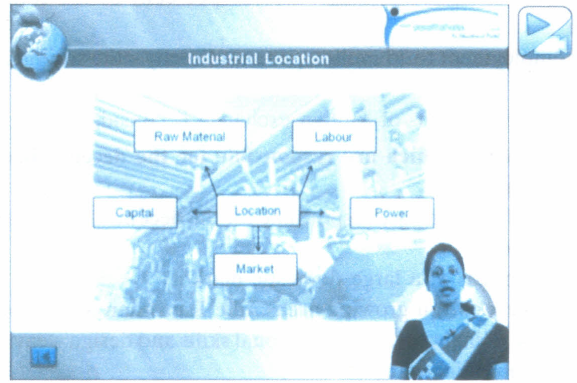
Following are the three factors that influence the location of an industry.
(a) Nearness to raw materials, i.e. coal, iron etc, is an important factor of industrial location.
(b) Market offers an important locational factor.
(c) Besides, plenty of capital can attract an industry to any location
8.
(i) Heavy industries are those in which raw materials used and the finished products are heavy and spacious where as in light industries raw materials and finished products are light in weight.
(ii) Normally women labourers are not employed in heavy industries where as they are employed in light industries.
(iii) Iron and Steel Industry, Heavy Machines Industry and Cement Industry are heavy industries. Textile Industry, Telephone Industry, and Ceiling Fan Industry etc. are light industries.
9.
Manufacturing of cement requires heavy, low value, and weight losing material. It is primarily a raw material oriented industry. Limestone is the main raw material. The location of a cement plant depends mostly on the limestone deposits. The other raw materials are seashells, slag from steel plants and slag from fertilizer, silica, and aluminium are important ingredients. Gypsum is necessary to regulate the setting time of cement.
10.
(i) Increasing jute productivity,
(ii) Improving its quality,
(iii) Ensuring good prices for crops to the jute farmers.
(iv) Enhancing the yield per hectare of jute crops.
11.
(a) There are about 1946 cotton and human made fibre textile mills in the country as on 30th November 2011. Of this 80% are in the private sector, the rest in the public and cooperative sectors.
(b) Cotton textile industries are spread over 80 towns and cities in India, but most of them are concentrated in Maharashtra, Gujarat, West Bengal, Uttar Pradesh, Madhya Pradesh and Tamil Nadu.
(c) While spinning continued to be concentrated in Maharashtra, Gujarat and Tamil Nadu weaving is in decentralized sector.
12.
(i) Basic or key Industries: These industries provide basic materials for other industries like iron and steel, copper smelting and aluminium smelting.
(ii) Consumer industries: These industries produce goods for direct use of consumers. E.g. sugar, toothpaste, paper, sewing machine, fans etc.
13.
(i) Nitrogenous fertilizers like urea: India is the third largest producer of nitrogenous fertilizers. There are 57 fertilizer industries in India producing nitrogenous and complex nitrogenous fertilizers in which 29 industries produce urea.
(ii) Phosphatic fertilizers and ammonium phosphate : There are 9 ammonium sulphate plants as a by-product and 68 other small plants produce single super phosphate in India.
(iii) Complex fertilizers, which have the combination of nitrogen, phosphate, and potash.
As a result of Green Revolution the demand for fertilizers increased thus the industry spread to several parts of India.
States - Gujarat, Tamil Nadu, Uttar Pradesh, Punjab and Kerala produce more than half of the total fertilizer production in India.
14.
India products good quality of long staple cotton (9232 lakh bales in 2004-05), still she needs cotton from import. India exports cotton yarn. If home weaving sector is developed it could earn much benefit through proper utilization of cotton yarn.
15.
(i) This region is rich in the raw material needed to produce the steel such as iron ore, coal, limestone, etc.
(ii) These raw material are heavy and bulky therefore difficult and costly to transport to the plant.
(iii) This region has well connected railway lines which after easy transportation of the finished products for their distribution to the markets and consumers.
(iv) This region gets its power supply from Damodar valley.
(v) Availability of cheap labour from surrounding regions.
16.
(i) While spinning continues to be centralized in Maharashtra, Gujarat and Tamil Nadu, weaving is highly decentralized in other states.
(ii) India has world class production and quality in spinning, but weaving supplies low quality of fabric because they are fragmented small units.
(iii) Our spinning mills are competitive at the global level but the weaving, knitting units produce textile for local market.
(iv) Yarn produced in spinning sector is exported to Japan while weaving sector cannot use this high quality yarn produced therefore they import fabric.
(v) The share international trade of yarn produced in spinning sector (25%) is much larger than the trade of cotton garments (4%).
17.
Cotton textile industry in India suffers from some problems:
(i) India has world class production and quality in spinning, but weaving supplies low quality of fabric because they are fragmented small units. This mismatch is major drawback.
(ii) Many of our spinners export cotton yarn while apparel/garment manufactures have to import fabric.
(iii) Although we the production of staple cotton has increased but we still need to import good quality staple cotton.
(iv) Cotton textile industries face the problem of erratic Power Supply which decreases the labour productivity.
(v) Machinery needs to be upgraded in the weaving and processing sectors in particular.
(vi) Output of labour is low due to poor machines and power supply.
(vii) There is a stiff competition with the synthetic fibre industry.
18.
Pollution is one of the negative effects of industrialization.
19.
The chemical industry is its own largest consumer.
20.
Liberalization and foreign direct investment has led to a boost in the iron and steel industry in India.
21.
Cost, government policies and specialized labour influence the location of industry.
22.
Manufacturing industries are placed in the secondary sector.

10th Standard CBSE Syllabus & Materials
10th Standard CBSE
CBSE 10th Social Science PS - Federalism - New Model Questions Papers Study Material - QB365 Set A
NEW10th Standard CBSE
CBSE 10th Social Science PS - Power Sharing - New Model Questions Papers Study Material - QB365 Set A
NEW10th Standard CBSE
CBSE 10th Social Science GEO - Manufacturing Industries - New Model Questions Papers Study Material - QB365 Set A
NEW10th Standard CBSE
CBSE 10th Social Science GEO - Minerals and Energy Resources - New Model Questions Papers Study Material - QB365 Set A



CBSE 10th Standard CBSE Subjects
CBSE Standards





