
 100% FREE ACCESS
10th Standard CBSE Syllabus & Materials
10th Standard CBSE
CBSE 10th Social Science ECO - Globalisation and the Indian Economy - New Model Questions Papers Study Material - QB365 Set A
NEW10th Standard CBSE
CBSE 10th Social Science ECO - Money and Credit - New Model Questions Papers Study Material - QB365 Set A
NEW10th Standard CBSE
CBSE 10th Social Science ECO - Sectors of the Indian Economy - New Model Questions Papers Study Material - QB365 Set A
NEW10th Standard CBSE
CBSE 10th Social Science ECO - Development - New Model Questions Papers Study Material - QB365 Set A
NEW10th Standard CBSE
CBSE 10th Social Science PS - Outcomes of Democracy - New Model Questions Papers Study Material - QB365 Set A
NEW10th Standard CBSE
CBSE 10th Social Science PS - Gender, Religion and Caste - New Model Questions Papers Study Material - QB365 Set A

Published on: 30/07/2018
Based on the current academic syllabus, some of the important questions are prepared from the chapter Metals and Non-Metals.
The important questions are covers from the Higher Order Thinking Questions and Value Based Questions.
Download CBSE Class 10th Standard CBSE Science question papers, sample papers, important questions, and previous year solved papers in PDF format. Get free study materials, NCERT solutions, and exam preparation resources for Class 10th Standard CBSE Science
Questions + Answers key
Take MCQ Science Test
1.
Explain why calcium metal after reacting With water starts floating on its surface. Write the chemical equation for the reaction.
2.
Name the metal which reacts with a very dilute HNO3 to evolve hydrogen gas.
3.
Name a non-metal which is lustrous and a metal which is non-lustrous.
4.
State two physical properties of gold which are of extreme use to jewellers.
5.
Name a reducing agent that may be used to obtain manganese from manganese dioxide.
6.
What are ionic bonds?
7.
Name the constituents of solder alloy. Which property of solder makes it suitable for welding electrical wires?
8.
What are amphoteric oxides? Give two examples of amphoteric oxides.
9.
Why do ionic compounds have high melting points?
10.
Explain the meanings of malleable and ductile.
11.
Which of the following can undergo a chemical reaction?
MgSO4 + Fe
ZnSO4 + Fe
MgSO4 + Pb
CuSO4 + Fe
12.
Electrical wires have a coating of an insulating material. The material, generally used is
Sulphur
Graphite
PVC
All can be used
13.
Although metals form basic oxides, which of the following metals form an amphoteric oxide?
Na
Ca
Al
Cu
14.
Which among the following alloys contain mercury as one of its constituents?
Stainless steel
Alnico
Solder
Zinc amalgam
15.
Which among the following statements is incorrect for magnesium metal?
It burns in oxygen with a dazzling white flame.
It reacts with cold water to form magnesium oxide and evolves hydrogen gas
It reacts with hot water to form magnesium hydroxide and evolves hydrogen gas.
It reacts with steam to form magnesium hydroxide and evolves hydrogen gas.
16.
Alloys are homogeneous mixtures of a metal with a metal or nonmetal. Which among the following alloys contain non-metal as one of its constituents?
Brass
Bronze
Amalgam
Steel
17.
The composition of aqua-regia is
Dil.HCl : Conc.HNO3 [3 : 1]
Conc.HCl : Dil.HNO3 [3 : 1]
Conc.HCl : Conc.HNO3 [3 : 1]
Dil.HCl : Dil.HNO3 [3 : 1]
18.
Which one of the following metals do not react with cold as well as hot water?
Na
Ca
Mg
Fe
19.
The ability of metals to be drawn into thin wire is known as
Ductility
malleability
Sonorousity
conductivity
20.
Which of the following pairs will give displacement reactions?
NaCl solution and copper metal
MgCl2 solution and aluminium metal
FeSO4 solution and silver metal
AgNO3 solution and copper metal
21.
(a) What is an 'activity series' of metals? Arrange the metals Zn, Mg, Al, Cu and Fe in a decreasing order of reactivity.
(b) What would you observe when you put
(i) Some zinc pieces into blue copper sulphate solution?
(ii) Some copper pieces into green ferrous sulphate solution?
(c) Name a metal which combines with hydrogen gas. Name the compound formed.
22.
Explain the following
(a) Reactivity of Al decreases if it is dipped in HNO3.
(b) Carbon cannot reduce the oxides of Na or Mg
(c) NaCl is not a conductor of electricity in solid state whereas it does conduct electricity in aqueous solution as well as in molten state.
(d) Iron articles are galvanised
(e) Metals like Na, K, Ca and Mg are never found in their free state in nature.
23.
Write three differences between metals and non-metals on the basis of chemical properties.
24.
List three properties of sodium in which it differs from the general physical properties of most metals.
25.
Point out any 3 differences between calcination and roasting.
26.
State five points of differences between ionic compound and covalent compound.
27.
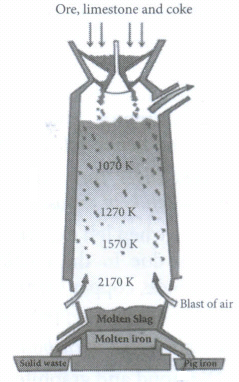
(a) Name the chief ore of iron. Write its formula.
(b) How is an iron ore concentrated? Describe it briefly.
(c) Draw a labelled diagram of the blast furnace used in the extraction of iron from its concentrated ore.
1.
Calcium starts floating because the bubbles of hydrogen gas formed sticks to the surface of the metal.
Ca + 2H2O \(\rightarrow \) Ca(OH)2 + H2
2.
Manganese or Magnesium.
3.
Non-metal (lustrous) = Iodine (I)
Metal (non-lustrous) = Sodium (Na)
4.
Malleability, ductility, lustrous (Any two).
5.
Aluminium.
6.
Bonds formed between a metal and a non-metal by the transfer of electrons are known as ionic bonds.
e.g., Na++Cl−→NaCl
7.
Solder is an alloy of lead and tin. Low melting point of solder makes it suitable for welding electrical wires.
8.
The metallic oxides which show the properties of acids as well as bases are called amphoteric oxides. It means that they react with both bases and acids to form salt and water.
e.g. ZnO and Al2O3
ZnO(s) + 2HCl(aq) \(\rightarrow\) ZnCl2 (aq) + H2O(l)
Zinc oxide (As a base) Hydrochloric acid Zinc chloride Water
ZnO(s) + 2NaOH(aq) \(\rightarrow\) Na2ZnO2(aq) + H2O(l)
Zinc oxide (As an acid) Sodium hydroxide Sodium zincare Water
9.
In ionic compounds, strong electrostatic forces of attraction are present between the oppositely charged ions. When these compounds are heated, a lot of heat energy is consumed to break these strong electrostatic forces of attraction during melting. Therefore, ionic compounds have high melting and boiling points.
10.
Malleable A substance or material, which can be beaten into thin sheets is called malleable, e.g. metals like Ag (silver), Au (gold) etc.
Ductile A substance capable of being drawn into thin wires is called ductile, e.g, metals like Ag, Au etc.
11.
(d)
CuSO4 + Fe
12.
(c)
PVC
13.
(c)
Al
14.
(d)
Zinc amalgam
15.
(b)
It reacts with cold water to form magnesium oxide and evolves hydrogen gas
16.
(d)
Steel
17.
(c)
Conc.HCl : Conc.HNO3 [3 : 1]
18.
(d)
Fe
19.
(a)
Ductility
20.
(d)
AgNO3 solution and copper metal
21.
(a) The arrangement of metals in a vertical column in the order of decreasing reactivity is called the 'activity series' of metals.
Following is the order of decreasing order of reactivity:
Cu> Fe> Zn> AI> Mg
(b) (i) When some zinc is put into blue copper sulphate solution, the blue colour of the copper sulphate solution fades gradually due to the formation of colourless zinc sulphate and red-brown copper metal is deposited on the zinc strip.
\(\underset { Coppersulphate\\ \quad (blue) }{ { CuSO }_{ 4 }(aq) } +\underset { Zinc }{ Zn } \rightarrow \underset { Zincsulphate\\ (Colourless) }{ { ZnSO }_{ 4 }(aq) } +\underset { \quad Copper\\ (Red-brown) }{ Cu(s) } \)
(ii) No reaction will take place since copper is less reactive than iron and hence will not displace it from ferrous sulphate solution.
(c) Sodium metal combines with hydrogen gas to form sodium hydride.
\(\underset { Sodiummetal }{ 2Na(s) } +\underset { Hydrogengas }{ { H }_{ 2 }(g) } \rightarrow \underset { Sodiumhydride }{ 2NaH(s) } \)
22.
(a) Due to the formation of a layer of oxide i.e., Al2O3
(b) Na or Mg is more reactive metals as compared to carbon.
(c) In solid NaCI, the movement of ions is not possible due to its rigid structure but in aqueous solution or molten state, the ions can move freely.
(d) To protect from corrosion.
(e) They are highly reactive.
23.
Three differences between metals and non-metals on the basis of chemical properties:
| S.No. | Basis | Metals | Non-metals |
| 1 | Reaction with oxygen |
Almost all metals react with oxygen to form metal oxide. |
Non-metals react with oxygen to form acidic oxides. C + O2 \(\longrightarrow \) CO2 |
| 2 | Reaction With water | Only reactive metals react with water to form oxides or hydroxides and liberate hydrogen gas. 2K(s) + 2H2 O(l)\(\longrightarrow \)2KOH(aq) + H2(g) |
Non-metals do not displace hydrogen from water too. |
| 3 | Reaction with diluted acid | All metals react with diluted acids to produce salt and hydrogen gas. Zn + 2HCI(dil)\(\longrightarrow \)ZnCL2 + H2 |
Non-metals also displace hydrogen from water too. |
24.
Three properties of sodium are:
(i) Sodium is so soft that it can be cut with a knife.
(ii) It has low density.
(iii) It has low melting point.
25.
| Calcination | Roasting | ||
| 1. | Heating the carbonate ore in the absence of oxygen is called calcination. | 1. | Heating the sulphide ores in the presence of oxygen is called roasting. |
| 2 | CO2 gas is evolved. | 2. | SO2 gas is evolved. |
| 3. | \({ ZnCO }_{ 3 }\underrightarrow { Heat } ZnO+{ CO }_{ 2 }\) | 3. | \(2ZnS+{ 3O }_{ 2 }\rightarrow ZnO+{ SO }_{ 2 }\) |
26.
| Ionic Compound | Covalent Compound | ||
| 1. | Ionic compounds contain ionic bond made up of ions. | 1. | Covalent compounds contain covalent bond made up of no ions. |
| 2. | Loss and gain of electrons takes place. | 2. | Sharing of electrons takes places. |
| 3 | Can conduct electricity. | 3. | Cannot conduct electricity. |
| 4. | Has high melting point. | 4. | Has low melting point. |
| 5. | Are soluble in water. | 5. | Are insoluble in water. |
27.
Haematite (Fe2O3) is an important ore of iron.
In the upper part of the blast furnace, carbon monoxide reduces iron (III) oxide to iron metal.
\(\underset { Iron(III)oxide }{ { Fe }_{ 2 }{ O }_{ 3 } } +\underset { Carbonmonoxide }{ 3CO(g) } \rightarrow \underset { Ironmetal }{ 2Fe(I) } +\underset { Carbondioxide }{ { 3CO }_{ 2 }(g) } \)
Following reactions are involved in the blast furnace:
(i) Formation of carbon monoxide
\(\underset { Carbon }{ C(s) } +\underset { Oxygen }{ { O }_{ 2 }(g) } \rightarrow \underset { Carbondioxide }{ { CO }_{ 2 }(g) } +Heat\\ \underset { Carbondioxide }{ { CO }_{ 2 }(g) } +\underset { Coke }{ C(s) } \rightarrow \underset { Carbonmonoxide }{ 2CO(g) } \)
(ii) Reduction of iron (III) oxide or haematite to iron
\(\underset { Iron(III)oxide }{ { Fe }_{ 2 }{ O }_{ 3 } } +\underset { Carbonmonoxide }{ 3CO(g) } \rightarrow \underset { Ironmetal }{ 2Fe(I) } +\underset { Carbondioxide }{ { 3CO }_{ 2 }(g) } \)

10th Standard CBSE Syllabus & Materials
10th Standard CBSE
CBSE 10th Social Science PS - Federalism - New Model Questions Papers Study Material - QB365 Set A
NEW10th Standard CBSE
CBSE 10th Social Science PS - Power Sharing - New Model Questions Papers Study Material - QB365 Set A
NEW10th Standard CBSE
CBSE 10th Social Science GEO - Manufacturing Industries - New Model Questions Papers Study Material - QB365 Set A
NEW10th Standard CBSE
CBSE 10th Social Science GEO - Minerals and Energy Resources - New Model Questions Papers Study Material - QB365 Set A



CBSE 10th Standard CBSE Subjects
CBSE Standards





