
 100% FREE ACCESS
10th Standard CBSE Syllabus & Materials
10th Standard CBSE
CBSE 10th Social Science ECO - Globalisation and the Indian Economy - New Model Questions Papers Study Material - QB365 Set A
NEW10th Standard CBSE
CBSE 10th Social Science ECO - Money and Credit - New Model Questions Papers Study Material - QB365 Set A
NEW10th Standard CBSE
CBSE 10th Social Science ECO - Sectors of the Indian Economy - New Model Questions Papers Study Material - QB365 Set A
NEW10th Standard CBSE
CBSE 10th Social Science ECO - Development - New Model Questions Papers Study Material - QB365 Set A
NEW10th Standard CBSE
CBSE 10th Social Science PS - Outcomes of Democracy - New Model Questions Papers Study Material - QB365 Set A
NEW10th Standard CBSE
CBSE 10th Social Science PS - Gender, Religion and Caste - New Model Questions Papers Study Material - QB365 Set A

Published on: 05/03/2019
Metals and Non-Metals Important Questions
Download CBSE Class 10th Standard CBSE Science question papers, sample papers, important questions, and previous year solved papers in PDF format. Get free study materials, NCERT solutions, and exam preparation resources for Class 10th Standard CBSE Science
Questions + Answers key
Take MCQ Science Test
1.
A man went door to door posing to be a goldsmith. He promised to bring back the glitter of old and dull gold ornaments. An unsuspecting lady gave a set of gold bangles to him which he dipped in a particular solution. The bangles sparkled like new but their weight was reduced drastically. The lady was upset but after a futile argument, the man beat a hasty retreat.
(i) Can you play the detective to find out the nature of the solution he had used?
(ii) What is 24 carat gold?
2.
(a) Name one main ore of Aluminium. Write its formula. Which two main impurities are associated with this ore?
(b) Describe with chemical equations, the method employed for the enrichment of the above named ore.
3.
(a) What is an 'activity series' of metals? Arrange the metals Zn, Mg, Al, Cu and Fe in a decreasing order of reactivity.
(b) What would you observe when you put
(i) Some zinc pieces into blue copper sulphate solution?
(ii) Some copper pieces into green ferrous sulphate solution?
(c) Name a metal which combines with hydrogen gas. Name the compound formed.
4.
(a) Write chemical equations for the reactions involved in obtaining pure alumina from the mineral bauxite which has impurities of iron oxide and silica.
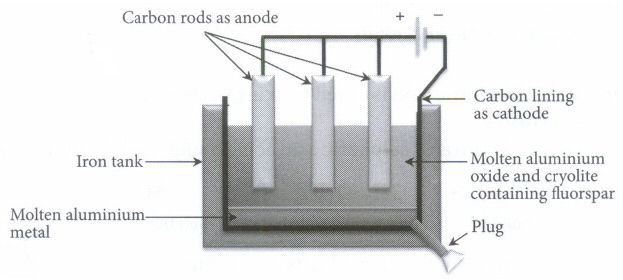
(b) Draw a labelled diagram of the electrolytic tank cell used for the extraction of aluminium from alumina.
5.
Of the three metals X, Y and Z, X reacts with cold water, Y with hot water and Z with steam only. Identify X, Y and Z and also arrange them in order of increasing reactivity.
6.
Samples of four metals A, B, C and D were taken and added to the following solution one by one. The result obtained have been tabulated as follows :
| Metals | Iron (II) Sulphate | Copper (II) Sulphate | Zinc Sulphate | Silver Nitrate |
| A | No reaction | Displacement | - | - |
| B | Displacement | - | No reaction | - |
| C | No reaction | No reaction | No reaction | Displacement |
| D | No reaction | No reaction | No reaction | No reaction |
Use the given table above to answer the following questions about metals A, B, C and D
(i) Which is the most reactive metal?
(ii) What would you observed if B is added to a solution of copper (II) sulphate?
(iii) Arrange the metals A, B, C and D in the order of decreasing reactivity.
7.
Why are aluminium and copper metals used for making cooking vessels?
8.
Give reason:
(i) Sodium metal is stored under kerosene oil.
(ii) Inspite of being highly reactive, aluminium is still used for making utensils.
9.
Name a non-metal which is lustrous and a metal which is non-lustrous.
10.
Name one metal and non-metal which exists in liquid state at room temperature?
11.
What is solder?
12.
What is amalgam?
13.
What makes silver turn black and copper turn green when kept exposed for few days?
14.
What are ionic bonds?
15.
State a reaction in which SO2 acts as an oxidising agent.
16.
An alkali metal A gives a compound B (molecular mass = 40) on reacting with water. The compound B gives a soluble compound C on treatment with aluminium oxide. Identify A, B and C and give the reaction involved.
17.
Name the constituents of solder alloy. Which property of solder makes it suitable for welding electrical wires?
18.
Generally, when metals are treated with mineral acids, hydrogen gas is liberated but when metals (except Mn and Mg), treated with HNO3 , hydrogen is not liberated, why?
19.
In the electrolytic refining of a metal M, what would you take as the anode, the cathode and the electrolyte?
20.
What are amphoteric oxides? Give two examples of amphoteric oxides.
21.
Define the following terms:
(i) Mineral
(ii) Ore
(iii) Gangue
22.
Which of the following can undergo a chemical reaction?
MgSO4 + Fe
ZnSO4 + Fe
MgSO4 + Pb
CuSO4 + Fe
23.
An element A is soft and can be cut with a knife. This is very reactive to air and cannot be kept open in air. It reacts vigorously with water. Identify the element from the following
Mg
Na
P
Ca
24.
Generally, non-metals are not lustrous. Which of the following nonmetal is lustrous?
Sulphur
Oxygen
Nitrogen
Iodine
25.
Galvanisation is a method of protecting iron from rusting by coating with a thin layer of
Gallium
Aluminium
Zinc
Silver
26.
The composition of aqua-regia is
Dil.HCl : Conc.HNO3 [3 : 1]
Conc.HCl : Dil.HNO3 [3 : 1]
Conc.HCl : Conc.HNO3 [3 : 1]
Dil.HCl : Dil.HNO3 [3 : 1]
27.
Aluminium is used for making cooking utensils. Which of the following properties of aluminium are responsible for the same?
(i) Good thermal conductivity
(ii) Good electrical conductivity
(iii) Ductility
(iv) High melting point
(i) and (ii)
(i) and (iii)
(ii) and (iii)
(i) and (iv)
28.
Food cans are coated with tin and not with zinc because
Zinc is costlier than tin
Zinc has a higher melting point than tin
Zinc is more reactive than tin
Zinc is less reactive than tin
29.
You are given samples of three metals: Sodium, magnesium and copper. Suggest any two activities to arrange them in order to their decreasing reactivity
30.
Write one example of each of the following:
(i) Most malleable metal and most ductile metal.
(ii) The best conductor of heat and the poorest conductor of heat.
(iii) A metal with highest melting point and a metal with lowest melting point.
31.
Point out any 3 differences between calcination and roasting.
32.
Name two metals which react violently with cold water. Write any three observation you would make when such a metal is dropped into water. How would you identify the gas evolved, if any during the reaction?
33.
(a) Name the chief ore of iron. Write its formula.
(b) How is an iron ore concentrated? Describe it briefly.
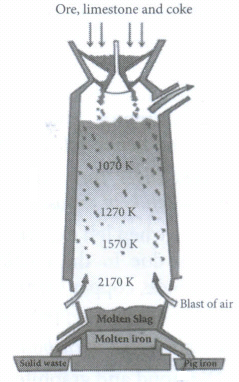
(c) Draw a labelled diagram of the blast furnace used in the extraction of iron from its concentrated ore.
1.
(i) The nature of the solution is acidic. It is a mixture of conc. HNO3, and conc. HCI in the ratio of 1 : 3. It can dissolve gold as it is an oxidising agent.
(ii) Pure gold is 24 carat gold which is very soft.
2.
(a) The main ore of aluminium is bauxite ore. Its formula is A1203.The impurities sociated with this ore are iron oxide and sand. .
(b) The reaction involved in obtaining pure alumina from mineral bauxite having impurities of iron oxide and silica are:
(i) \(\underset { Aluminiumoxide\\ (frombauxiteore) }{ { A1 }_{ 2 }{ O }_{ 3 } } +\underset { Sodiumhydroxide\\ \quad (hot) }{ 2NaOH(aq) } \rightarrow \underset { Sodiumaluminate\\ \quad (Soluble) }{ { 2NaA1O }_{ 2 }(aq) } +\underset { Water }{ { H }_{ 2 }O(1) } \)
The iron oxide and silica (sand) present in the bauxite ore do not dissolve in sodium hydroxide solution. Therefore, they are separated by filtration.
(ii) \(\underset { Sodiumaluminate }{ { NaA1O }_{ 2 }(aq) } +\underset { Water }{ { 2H }_{ 2 }O(1) } \rightarrow \underset { Aluminiumhydroxide\\ \quad (Whiteppt) }{ { A1(OH) }_{ 3 }(s) } +\underset { Sodiumhydroxide }{ NaOH(aq) } \)
(iii) \(\underset { Aluminiumhydroxide }{ { 2A1(OH) }_{ 3 }(s) } \underrightarrow { heat } \underset { Aluminiumoxide\\ \quad (Pure) }{ { A1 }_{ 2 }{ O }_{ 3 }(s) } +\underset { Steam }{ { 3H }_{ 2 }O(g) } \)
3.
(a) The arrangement of metals in a vertical column in the order of decreasing reactivity is called the 'activity series' of metals.
Following is the order of decreasing order of reactivity:
Cu> Fe> Zn> AI> Mg
(b) (i) When some zinc is put into blue copper sulphate solution, the blue colour of the copper sulphate solution fades gradually due to the formation of colourless zinc sulphate and red-brown copper metal is deposited on the zinc strip.
\(\underset { Coppersulphate\\ \quad (blue) }{ { CuSO }_{ 4 }(aq) } +\underset { Zinc }{ Zn } \rightarrow \underset { Zincsulphate\\ (Colourless) }{ { ZnSO }_{ 4 }(aq) } +\underset { \quad Copper\\ (Red-brown) }{ Cu(s) } \)
(ii) No reaction will take place since copper is less reactive than iron and hence will not displace it from ferrous sulphate solution.
(c) Sodium metal combines with hydrogen gas to form sodium hydride.
\(\underset { Sodiummetal }{ 2Na(s) } +\underset { Hydrogengas }{ { H }_{ 2 }(g) } \rightarrow \underset { Sodiumhydride }{ 2NaH(s) } \)
4.
(a) The reaction involved in obtaining pure alumina from the mineral bauxite having impurities of iron oxide and silica is:
(i) \(\underset { Aluminiumoxide\\ (frombauxiteore) }{ { AI }_{ 2 }{ O }_{ 3 }(s) } +\underset { Sodiumhydroxide\\ \quad (hot) }{ 2NaOH(aq) } \rightarrow \underset { Sodiumaluminate\\ \quad (Soluble) }{ { 2NaAIO }_{ 2 }(aq) } +\underset { Water }{ { H }_{ 2 }O(I) } \)
The iron oxide and silica (sand) present in the bauxite ore do not dissolve in sodium hydroxide solution. Therefore, they are separated by filtration.
(ii) \(\underset { Sodiumaluminate }{ { NaAIO }_{ 2 }(aq) } +\underset { Water }{ { 2H }_{ 2 }O(I) } \rightarrow \underset { Aluminiumhydroxide\\ \quad (Whiteppt) }{ { AI(OH) }_{ 3 }(s) } +\underset { Sodiumhydroxide }{ NaOH(aq) } \)
(iii) \(\underset { Aluminiumhydroxide }{ { 2AI(OH) }_{ 3 }(s) } \underrightarrow { heat } \underset { Aluminiumoxide\\ \quad (Pure) }{ { AI }_{ 2 }{ O }_{ 3 }(s) } +\underset { Steam }{ { 3H }_{ 2 }O(g) } \)
(b)
5.
Since the metal X react with cold water, it must be high in the reactivity series i.e., sodium or potassium.
X is alkali metal, Na or K.
Since the metal Y reacts with hot water, it must be middle in the reactivity series i.e., magnesium or calcium.
Y is alkaline earth metal, Mg or Ca.
Since the metal X reacts with steam only, it must be low in the reactivity series i.e., iron Z is Fe.
Increasing reactivity series : Na > Mg > Fe.
6.
(i) B is the most active metal as it displaces iron from its salt solution.
(ii) B will displace Cu from CuSO4 solution because B is more reactive than copper.
(iii) B > A > C > D.
7.
Aluminium and copper metals are used for making cooking vessels because they are good conductors of heat and they have high melting points.
8.
(i) Sodium is a highly reactive metal. It can catch fire if kept in open. Hence to protect it and prevent accidental fire, it is stored under kerosene oil.
(ii) Due to high reactivity of aluminium, a thin layer of aluminium oxide is formed on it. This protective layer of aluminium oxide prevents the metal from further corrosion. Hence, aluminium can be used for making utensils. This process is anodising
9.
Non-metal (lustrous) = Iodine (I)
Metal (non-lustrous) = Sodium (Na)
10.
Metal- mercury, Non-metal- bromine.
11.
Solder is an alloy of lead and tin.
12.
While making an alloy of metal and metal, if one of the metal is mercury then it is called amalgam,
e.g., Ag + Hg → silver amalgam
13.
Silver when left exposed in air turns black due to the coating of silver sulphide, copper turns green due to the coating of copper carbonate.
14.
Bonds formed between a metal and a non-metal by the transfer of electrons are known as ionic bonds.
e.g., Na++Cl−→NaCl
15.
Sulphur dioxide oxidises hydrogen sulphide (H2 S) to sulphur (S).
SO2(g)+2H2S(aq)→3S(s)+2H2O(I)
16.
Since compound B has molecular mass 40, it must be sodium hydroxide. When sodium hydroxide is treated with aluminium oxide, it gives sodium aluminate. Then the compound A must be sodium.
A - Sodium Na; B - Sodium hydroxide NaOH; C - Sodium aluminate NaAIO2.
\(2Na+{ 2H }_{ 2 }O\rightarrow 2NaOH+{ H }_{ 2 }\\ { AI }_{ 2 }{ O }_{ 3 }+2NaOH\rightarrow { 2NaAIO }_{ 2 }+{ H }_{ 2 }O\)
17.
Solder is an alloy of lead and tin. Low melting point of solder makes it suitable for welding electrical wires.
18.
It is because HNO3 is a strong oxidising agent. It oxidises the H2 produced to H2O.
19.
Anode (positively charged) Block of the impure metal M. Cathode (negatively charged) Strip of the pure metal M. Electrolyte Aqueous solution of a salt of the metal M.
20.
The metallic oxides which show the properties of acids as well as bases are called amphoteric oxides. It means that they react with both bases and acids to form salt and water.
e.g. ZnO and Al2O3
ZnO(s) + 2HCl(aq) \(\rightarrow\) ZnCl2 (aq) + H2O(l)
Zinc oxide (As a base) Hydrochloric acid Zinc chloride Water
ZnO(s) + 2NaOH(aq) \(\rightarrow\) Na2ZnO2(aq) + H2O(l)
Zinc oxide (As an acid) Sodium hydroxide Sodium zincare Water
21.
(i) The naturally occurring elements or compounds of metals present in the earth's crust are called minerals.
(ii) Ores are those minerals from which a particular metal can be extracted profitably.
(iii) The undesirable impurities present in the ore are called gangue or matrix.
22.
(d)
CuSO4 + Fe
23.
(b)
Na
24.
(d)
Iodine
25.
(c)
Zinc
26.
(c)
Conc.HCl : Conc.HNO3 [3 : 1]
27.
(d)
(i) and (iv)
28.
(c)
Zinc is more reactive than tin
29.
Different metals react with oxygen at different rates. e.g., Sodium (Na) and potassium (K) catch fire, if left in open. Hence, these are the most reactive metals. To prevent accidental fires, these metals are kept immersed in kerosene oil. Magnesium burns in air only by heating. So, it is less reactive than sodium and potassium. Copper (Cu) does not burn on heating but blister copper burns. Hence the order of reactivity of these metals with oxygen is :
Na >Mg> Cu.
Metals react with water to produce a metal oxide and hydrogen gas. Sodium (Na) and potassium (K) react violently with cold water. So the reaction is violent and exothermic. Magnesium (Mg) does not react with cold water. It reacts with hot water. Metals like lead, copper, silver do not react with water at all. The reactivity series of metals towards water is:
Na > Mg > Cu.
30.
(i) Gold and silver are most malleable metal and most ductile metal,
(ii) Silver is the best conductor of heat and lead is the poorest conductor of heat.
(iii) Metal with highest melting point - Tungsten, iron. Metal with lowest melting point - Gallium, Cesium.
31.
| Calcination | Roasting | ||
| 1. | Heating the carbonate ore in the absence of oxygen is called calcination. | 1. | Heating the sulphide ores in the presence of oxygen is called roasting. |
| 2 | CO2 gas is evolved. | 2. | SO2 gas is evolved. |
| 3. | \({ ZnCO }_{ 3 }\underrightarrow { Heat } ZnO+{ CO }_{ 2 }\) | 3. | \(2ZnS+{ 3O }_{ 2 }\rightarrow ZnO+{ SO }_{ 2 }\) |
32.
Sodium and potassium react vigorously with cold water.
When these metals are dropped in water, bubbles will be evolved due to evolution of hydrogen gas, large amount of heat is produced and the solution will change red litmus blue.
Hydrogen gas is formed. Bring burning splinter near the mouth of the test tube where gas is evolved, the splinter bums with a pop sound.
33.
Haematite (Fe2O3) is an important ore of iron.
In the upper part of the blast furnace, carbon monoxide reduces iron (III) oxide to iron metal.
\(\underset { Iron(III)oxide }{ { Fe }_{ 2 }{ O }_{ 3 } } +\underset { Carbonmonoxide }{ 3CO(g) } \rightarrow \underset { Ironmetal }{ 2Fe(I) } +\underset { Carbondioxide }{ { 3CO }_{ 2 }(g) } \)
Following reactions are involved in the blast furnace:
(i) Formation of carbon monoxide
\(\underset { Carbon }{ C(s) } +\underset { Oxygen }{ { O }_{ 2 }(g) } \rightarrow \underset { Carbondioxide }{ { CO }_{ 2 }(g) } +Heat\\ \underset { Carbondioxide }{ { CO }_{ 2 }(g) } +\underset { Coke }{ C(s) } \rightarrow \underset { Carbonmonoxide }{ 2CO(g) } \)
(ii) Reduction of iron (III) oxide or haematite to iron
\(\underset { Iron(III)oxide }{ { Fe }_{ 2 }{ O }_{ 3 } } +\underset { Carbonmonoxide }{ 3CO(g) } \rightarrow \underset { Ironmetal }{ 2Fe(I) } +\underset { Carbondioxide }{ { 3CO }_{ 2 }(g) } \)

10th Standard CBSE Syllabus & Materials
10th Standard CBSE
CBSE 10th Social Science PS - Federalism - New Model Questions Papers Study Material - QB365 Set A
NEW10th Standard CBSE
CBSE 10th Social Science PS - Power Sharing - New Model Questions Papers Study Material - QB365 Set A
NEW10th Standard CBSE
CBSE 10th Social Science GEO - Manufacturing Industries - New Model Questions Papers Study Material - QB365 Set A
NEW10th Standard CBSE
CBSE 10th Social Science GEO - Minerals and Energy Resources - New Model Questions Papers Study Material - QB365 Set A



CBSE 10th Standard CBSE Subjects
CBSE Standards





