
 100% FREE ACCESS
11th Standard CBSE Syllabus & Materials
11th Standard CBSE
CBSE 11th Economics PART-A - Presentation of Data - New Sample Question Papers Study Material - QB365 Set A
NEW11th Standard CBSE
CBSE 11th Economics PART-A - Organisation of Data - New Sample Question Papers Study Material - QB365 Set A
NEW11th Standard CBSE
CBSE 11th Economics PART-A - Collection of Data - New Sample Question Papers Study Material - QB365 Set A
NEW11th Standard CBSE
CBSE 11th Economics PART-A - Introduction to Economics and Statistics - New Sample Question Papers Study Material - QB365 Set A
NEW11th Standard CBSE
CBSE 11th Business Studies International Trade Sample Question Papers Study Material - QB365 Set A
NEW11th Standard CBSE
CBSE 11th Business Studies Evolution and Fundamentals of Business Sample Question Papers Study Material - QB365 Set A

Published on: 05/03/2019
Morphology of Flowering Plants Important Questions
Download CBSE Class 11th Standard CBSE Biology question papers, sample papers, important questions, and previous year solved papers in PDF format. Get free study materials, NCERT solutions, and exam preparation resources for Class 11th Standard CBSE Biology
Questions + Answers key
Take MCQ Biology Test
1.
What is the function of lenticels in woody trees?
2.
You are given two slides having T.S. of roots and stems. How will you identify which slide is of root and which is of stem?
3.
Cut a transverse section of young stem of a plant from your school garden and observe it under the microscope. How would you ascertain whether it is a monocot stem or a dicot stem? Give reasons.
4.
Describe the fruit of Allium cepa(onion).
5.
Write one diagnostic feature of Fabaceae.
6.
Describe the modification of stem with suitable examples. "Thorns"
7.
Distinguish between stamen and staminoide
8.
Write the floral formula of family-Fabaceae and give its two examples.
9.
Tendrils of grapevine are homologous to tensrils of pumpkin, but analogous to those of pea.Justify the above statement
10.
Why some tap roots become swollen and fleshy?
11.
How the runners of grasses can serve as means of vegatative propagetion?
12.
What is the difference between monocot and dicot leaves?
13.
Differentiate among parenchyma, collenchyma and sclerenchyma.
14.
Give a brief overview of structure and function of parenchyma.
15.
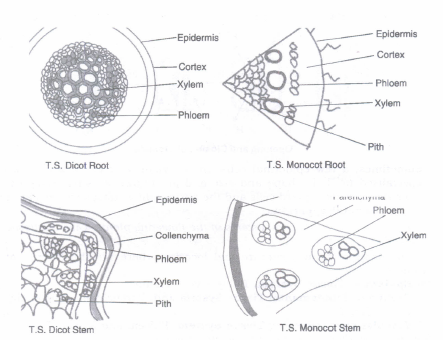
Draw illustrations to bring out the anatomical difference between
(a) Monocot root and Dicot root
(b) Monocot stem and Dicot stem
16.
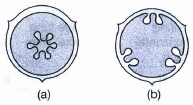
Name the type of placentation shown in the given figures and give one example of each.
17.
Justify the following statements on the basis of external features.
(a) Underground parts of a plant are not always roots.
(b) Flower is a modified shoot.
18.
In dicot leaves stomata is present on which surface of the leaf?
Dorsal Surface
Ventral Surface
Both Surfaces
On the midrib
19.
Open bundle is found in which of the following?
Monocot stem
Monocot Root
Dicot Stem
Dicot Leaf
20.
Companion cells are found in which tissue?
Xylem
Phloem
Both xylem and phloem
None of these
21.
Which is the position of intercalary meristem?
Between mature tissues
In mature tissues
Between two nodes
In the calyx
22.
Describe the structure of an isobilateral leaf. Differentiate between a moncot and dicot leaf.
1.
Exchange of gases.
2.
Presence or absence of hair on the epidermis will give the clue. Those with hair are slides of root. Cuticles will be present on the slide of stem.
3.
As shown in above diagrams the vascular bundles in dicot stems are arranged in a ring, while they are in scattered arrangement in monocot stems.
4.
A loculicidal capsule with endospermic seeds.
5.
The presence of nodulated roots.
6.
Thorns are woody pointed,straight structures to protect plants from browing animals e.g. Baugainvillea
7.
Distinguish between stamen and staminoide are
| Stamen | Staminoide |
| It is a complete functional male reproductivge part of a flower. |
It is rudimentary, sterile or non-functional male reproductive part of a flower. |
| In produces pollen grains. | It does not produce pollen grains. |
8.
Arachis Hypogea (groundnut) and Glycine max (soyabean)
9.
Tendrils of grapevine and pumpkin are stem structures while those of pea are foilar in nature. Hence, the tendrils of grapevine and pea are analogous structures.
10.
Tap roots of some plants become fleshy due to storage of reserve food. The main root stores extra food whereas secondary roots are thin and are involved in absorption of minerals from the soil. The swollen roots occur in different shapes.
11.
When a runner gets cut incidentally into the several parts and each can grow independently.
12.
Stomata are found on both surfaces in monocot leaves, while they are found on ventral surface only, in dicot leaves. In monocot leaves, venation is parallel, which is evident by similar size of vascular bundles. In dicot leaves venation is reticulate, so vascular bundles are of various sizes.
Spongy mesophyll is present in dicot leaves, and absent in monocot leaves.
13.
| Parenchyma | Collenchyma | Sclerenchyma |
|---|---|---|
| 1. Living cells. | 1. Living cells. | 1. Dead cells. |
| 2. Forms major component of organs | 2. Found below epidermis. | 2. Usually found in epidermis. |
| 3. Chloroplast present. | 3. Chloroplast present sometimes. | 3. Chloroplast absent. |
| 4. Performs many vital functions. | 4. Provides mechanical support to growing parts. | 4. Provides mechanical support in organs. |
14.
Structure of Parenchyma. It is composed of round, spherical or polygonal cells. Cells are isodiametric with thin walls. The tissue has intracellular spaces. Function. Photosynthesis, food storage and secretion.
15.
Cross Section of Dicot Root
16.
(a) Free-central placentation, e.g., primrose.
(b) Parietal placentation, e.g., mustard.
17.
(a) Underground parts of a plant are not always roots. Sometimes stem or stem branches occur underground to perform some special functions. For example, potato tubar is a modified stem which is underground. A potato tubar shows nodes and internodes, scale leaves and buds at the nodes.
(b) Flower is a modified shoot consisiting of a highly reduced stem bracnch to form thalamus in which the nodes are borne only towards the trip. The floral parts, i.e. sepals,petals,stamens and carpels are arranged in their respective whorls and arise from nodes.
18.
(b)
Ventral Surface
19.
(c)
Dicot Stem
20.
(b)
Phloem
21.
(c)
Between two nodes
22.
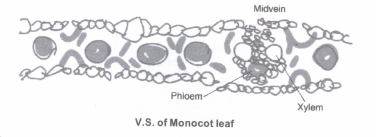
Isobilateral (Monocotyledonous) Leaf
Structure: -
1. Epidermis is composed of single layer of cells.
2. Stomata are present on both surfaces of leaf.
3. Mesophyll is not differentiaited into palisade and spongy parenchyma.
4. In grasses, certain adaxial epidermal cells along the veins modify themselves into large, empty, colourless cells. These are called bulliform cells. When the bulliform cells in the leaves have absorbed water and are turgid, the leaf surface is exposed. When they are flaccid due to water stress, they make the leaves curl inwards to minimise water loss.
5. The parallel venation in monocot leaves is reflected in the near similar sizes of vascular bundles (except in main veins) as seen in vertical sections of the leaves.
Differences between Dicot and Monocot Leaf
| Dicot Leaf | Monocot Leaf |
|---|---|
| 1. Stomata on ventral surface. | 1. Stomata on both surfaces |
| 2. Mesophyll differentiated in Pallisade and spongy parenchyma | 2. Mesophyll is not differentiated |
| 3. Bulliform cells absent. | 3. Bulliform cells present. |
| 4. Vascular bundles are of different sizes. | 4. Vascular bundles are of similar sizes (except in main veins) |

11th Standard CBSE Syllabus & Materials
11th Standard CBSE
CBSE 11th Business Studies Forms of Business Organisation Sample Question Papers Study Material - QB365 Set A
NEW11th Standard CBSE
CBSE 11th Business Studies Business, Trade and Commerce Sample Question Papers Study Material - QB365 Set A
NEW11th Standard CBSE
CBSE 11th Physics Waves Sample Question Papers Study Material - QB365 Set A
NEW11th Standard CBSE
CBSE 11th Physics Kinetic Theory Sample Question Papers Study Material - QB365 Set A



CBSE 11th Standard CBSE Subjects
CBSE Standards









