
 100% FREE ACCESS
11th Standard CBSE Syllabus & Materials
11th Standard CBSE
CBSE 11th Economics PART-A - Presentation of Data - New Sample Question Papers Study Material - QB365 Set A
NEW11th Standard CBSE
CBSE 11th Economics PART-A - Organisation of Data - New Sample Question Papers Study Material - QB365 Set A
NEW11th Standard CBSE
CBSE 11th Economics PART-A - Collection of Data - New Sample Question Papers Study Material - QB365 Set A
NEW11th Standard CBSE
CBSE 11th Economics PART-A - Introduction to Economics and Statistics - New Sample Question Papers Study Material - QB365 Set A
NEW11th Standard CBSE
CBSE 11th Business Studies International Trade Sample Question Papers Study Material - QB365 Set A
NEW11th Standard CBSE
CBSE 11th Business Studies Evolution and Fundamentals of Business Sample Question Papers Study Material - QB365 Set A

Published on: 30/07/2018
Some of the important questions are prepared from this Morphology of Flowering Plants. In this question paper, questions are prepared from the book back and creative question.
For parents, Please subscribe and get the plenty of question with answer for your children practice. For Subscription please Click here.
Download CBSE Class 11th Standard CBSE Biology question papers, sample papers, important questions, and previous year solved papers in PDF format. Get free study materials, NCERT solutions, and exam preparation resources for Class 11th Standard CBSE Biology
Questions + Answers key
Take MCQ Biology Test
1.
Describe the fruit of Allium cepa(onion).
2.
Name one ornamental plant each of family.Solanaceae and Fabaceae
3.
Write the common source of oil yielding plants from the family-Fabaceae.
4.
Write one diagnostic feature of Fabaceae.
5.
Mango and coconut are drupe type of fruits. In mango, fleshy mesocarp is edible. What is the edible part of coconut? What does milk of tender coconut represent?
6.
Differentiate between pedical and peduncle.
7.
List out the three characteristics of modified stem bulb with examples.
8.
Differentiate between reticulate venation and paralleel venation.
9.
What are the two layers of seed coat?
10.
Write one function of root
11.
Why some tap roots become swollen and fleshy?
12.
In Alstonia, the phyllotaxy is called whorled. Why?
13.
Where are root hairs present in root?
14.
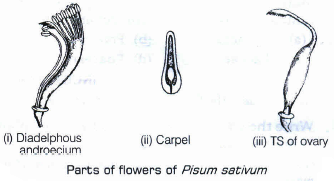
Draw the following structures of Pisum sativum
(i) Diadelphous androecium
(ii) Carpel
(iii) TS of ovary
15.
Differentiate between bract and bractole.
16.
Differentiate between (a) Racemose and cymose inflorescence (b) Apocarpous and syncarpous ovary
17.
Define the term inflorescence. Explain the basis for the different types inflorescence in flowering plants.
18.
Differentiate between fibrous root and adventitious roots
19.
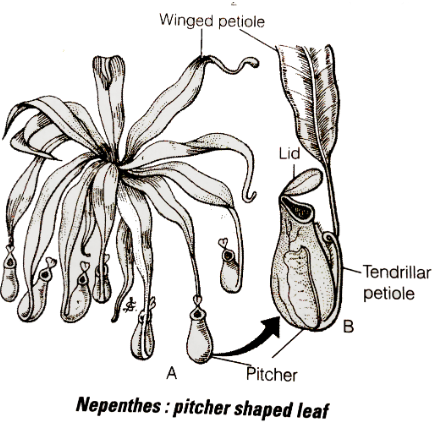
You have heard about several insectivorous plant that feed on insects. Nepenthes or the pitcher plant is one such example which usually grows in shallow water or in marsh lands. What part of the plant is modified into a 'pitcher'. How does this modification help the plant for food even though it can photosynthesisie like any other green plant?
20.
Explain with suitable examples the different types of phyllotaxy.
21.
Stolon,offset and rhizome are different forms of stem modification. How can these modifiedforms of stem be distinguished from each other?
22.
What is meant by modification of root? What type of modification of root is found in the:
(a) Banyan tree
(b) Turnip
(c) Mangrove trees
23.
Add the missing floral organs of the given formula of Fabaceae,______.
1.
A loculicidal capsule with endospermic seeds.
2.
Cestrum nocturnum of family Solanaceae and Lupinus of family FABACEAE.
3.
Grain legumes are cultivated for their seeds, and are also called pulses. The seeds are used for human and animal consumption or for the production of oils for industrial uses. Grain legumes include both herbaceous plants like beans, lentils, lupins, peas and peanuts, and trees such as carob, mesquite and tamarind. Groundnut and soyabean
4.
The presence of nodulated roots.
5.
Mango and coconut are drupe fruits. They develop from monocarpellary superior ovaries and are one seeded. It is differentiated into outer thin epicarp, middle fleshy mesocarp and inner stony endocarp.

The edible part of coconut (Cocos nucifera) is endosperm. The milk of tender coconut represents the oily endosperm in liquid form. Later it gets deposited along the walls of endocarp and forms edible flesh.
6.
Differentiate between pedical and peduncle are
| Pedicel | Peduncle |
| It is a stalk of the flower | It is the axis of inflorescence. |
| Pedicel bears a single flower. | It generally bears a number of flowers |
7.
Modified stem bulb is highly reduced disc-like stem.It bears fibrous adventitious roots at its base.Leaf bases form bultslets that grow into new plant,e,g.,Allium cepa(onion).
8.
Differentiate between reticulate venation and paralleel venation are
| Reticulate Venation | Parallel Venation |
| Veins are not oriented parallel to one another | Veins are oriented parallel to one another. |
| Smaller veins produce a network or reticulum. | A reticulum is not produced |
| It is the charactersitic feature of dictyledons. | It is the characterstic feature of monocotyledons. |
9.
Testa is the outer hard layer of the seed coat, while tegmen is an nner thin layer of seed coat.
10.
Primary function of the roots is to absorb water and dissolved minerals from the soil. This is crucial as it helps in the process of photosynthesis. Storage: Plants prepare food and store in the form of starch in the leaves, shoots and roots.
11.
Tap roots of some plants become fleshy due to storage of reserve food. The main root stores extra food whereas secondary roots are thin and are involved in absorption of minerals from the soil. The swollen roots occur in different shapes.
12.
The number of leaves arise from a single node in Alstonia, so it is called whorled.
13.
The root bears unicellular root hairs in the zone of maturation.
14.
15.
Differentiate between bract and bractole are
| Bract | Bracteole |
| It is a small leaf-like structure borne on the mother axis from where a flower develops |
It is a small leaf-like structure present on the pedicel of a flower. |
| It bears a flower in its axil. | It is borne over the stalk of the flower. |
| A single bract occurs at one place. | Generally two bracteoles occur over the pedicel of a flower. |
16.
Differentiate between recemose inflorescene and cymose inflorescene are
| Racemose inflorescene | Cymose inflorescene |
| Flowers are bome laterally. | Flowers are actually terminal |
| Growing point does not end in a flower. | Growing point or terminal bud always ends in a flower. |
| Flowers develop from all sides. | Flowers develop from one or two sides. |
| Opening of flowers occurs at short intervals | Opening of successive flowers takes longer intervals. |
| Young fruits are not protected by flowers | Young fruits are protected by flowers |
(ii) Differentiate between apocarpous and syncarpous ovary is
| Apocarpous Ovary | Syncarpous Ovary |
| It has more than one and free carpels. | It has more than one and fused carpels. |
| e.g lotus,rose | e.g. Hibiscus (Shoe flower), Petunia |
17.
The inflorescence is how the flowers are arranged on the flowering axis. During the flowering season, the vegetative apex of the stem gets converted into a floral meristem. Based on whether the floral axis continues to grow or ends in a flower, the inflorescence is classified into racemose and cymose. In racemose inflorescence, the floral axis continues to grow and produces flowers laterally. On the other hand, in a cymose inflorescence, the main axis terminates into a flower. Hence, it is limited in growth.
Growth : Indefinite (race mose) and definite.
Number of branches : Cymose, uniparous, biparous, multiparous
Pedicel : Presence or absence of pedicel in inflorescene.
Branching of peduncle : Unbranched and branched.
Sex of flowers : Certain types have unisexual flowers. e.g, Catkin.
18.
Differentiate between fibrous root and adventitious roots are
| Fibrous Roots | Adventitious Roots |
| They arise from the radicle | These develop from any part of the plant other then radicle |
| They help in anchorage and absorption. | They help in different functions like storage, climbing, respiration, etc |
| They are found in grasses. | They are found in a variety of plants. |
| They are usually below the soil. | They may be underground or aerial. |
19.
In insectivorous plant e.g., Nepenthes, the leaf lamina gets modified in the form of pitcher and anterior part of petiole coils like tendril which keeps the pitcher in a vertical direction. Posterior part of the petiole remains flattened like a leaf. The apex of lamina forms a lid. Pitcher contains digestive enzyme which the trapped insects .
All these modifications and adaptation are developed to make up the nitrogen deficiency in the plant because these plants are found in N2 deficient soil, (marshy/swamp soils)
20.
The mode of arrangement of leaves on the stem and its branches is called phyllotaxy (Phyllon-leaf; taxis arrangement). They are arranged most systematically, regularly and mathematically, so as to get proper sunlight and avoid overcrowding.
Phyllotaxy in leaves is of following three types.
(i) Alternate: A single leaf arises at a node. e.g, China rose, mango, mustard, sunflower, etc.
(ii) Oppposite: Two leaves arise at a node,opposite to each other e.g, guava, Calotropis tulsi, etc.
(iii) Whorled: More than two leaves arise at each node forming a circle or whorl, e.g, Alstonia Scholaris etc.
21.
These can be distinguished as follows
| Stolon | Offset | Rhizome |
| It is more than one internode long arched horizontal stem branch |
It is one internode long horizontal stem branch. | It represents the main axis. |
| It is subaerial. | It is subaerial. | It is underground |
| It does not store | It does not sore food. | it stores food for new growth. |
| It is generally green | It is green | It is non-green |
| e.g., strawberry | e.g., Pistia | e.g., ginger |
22.
Primarily, there are two types of root systems found in plants, namely the tap root system and fibrous root system. The main function of the roots is to absorb water and minerals from the soil. However, roots are also modified to perform various other functions. The roots of some plants act as storage sites for food, some provide support to massive plant structures, while others absorb oxygen from the atmosphere.
Roots and its modifications in various plants:
(a) Banyan tree
The banyan tree (Ficus benghalensis) has massive pillar-like adventitious roots arising from the aerial part of the stem. These roots grow towards the ground and provide support to the tree. Such roots are called prop roots.
(b) Turnip
The roots of turnip (Brassica rape) help in the storage of food. Similar food-storing roots are found in radishes, carrots, and sweet potatoes.
(c) Mangrove tree
The roots of mangrove plants grow vertically upwards from the soil for the absorption of oxygen from the atmosphere as the soil is poorly aerated. These types of roots are called pneumatophores.
23.
()
Br \(\oplus \)\({ K }_{ (5) }{ C }_{ (1+2) }{ A }_{ (1+(9)) }{ G }_{ (1) }\)

11th Standard CBSE Syllabus & Materials
11th Standard CBSE
CBSE 11th Business Studies Forms of Business Organisation Sample Question Papers Study Material - QB365 Set A
NEW11th Standard CBSE
CBSE 11th Business Studies Business, Trade and Commerce Sample Question Papers Study Material - QB365 Set A
NEW11th Standard CBSE
CBSE 11th Physics Waves Sample Question Papers Study Material - QB365 Set A
NEW11th Standard CBSE
CBSE 11th Physics Kinetic Theory Sample Question Papers Study Material - QB365 Set A



CBSE 11th Standard CBSE Subjects
CBSE Standards









