
 100% FREE ACCESS
11th Standard CBSE Syllabus & Materials
11th Standard CBSE
CBSE 11th Economics PART-A - Presentation of Data - New Sample Question Papers Study Material - QB365 Set A
NEW11th Standard CBSE
CBSE 11th Economics PART-A - Organisation of Data - New Sample Question Papers Study Material - QB365 Set A
NEW11th Standard CBSE
CBSE 11th Economics PART-A - Collection of Data - New Sample Question Papers Study Material - QB365 Set A
NEW11th Standard CBSE
CBSE 11th Economics PART-A - Introduction to Economics and Statistics - New Sample Question Papers Study Material - QB365 Set A
NEW11th Standard CBSE
CBSE 11th Business Studies International Trade Sample Question Papers Study Material - QB365 Set A
NEW11th Standard CBSE
CBSE 11th Business Studies Evolution and Fundamentals of Business Sample Question Papers Study Material - QB365 Set A

Published on: 05/03/2019
Motion in a Plane
Download CBSE Class 11th Standard CBSE Physics question papers, sample papers, important questions, and previous year solved papers in PDF format. Get free study materials, NCERT solutions, and exam preparation resources for Class 11th Standard CBSE Physics
Questions + Answers key
Take MCQ Physics Test
1.
What is the angle between velocity vector and acceleration vector in uniform circular motion?
2.
Establish the following inequalities geometrically or otherwise:
\(|\mathbf{a}+\mathbf{b}| \geq|| \mathbf{a}|-| \mathbf{b}||\) When does the equality sign above apply?
3.
Under what condition, the three vectors give zero resultant?
4.
Hatrick and Peterson were good friends. They went to a international trade fair at Pragati Maidan. Peterson saw a shop, where people were firing at balloons. He also asked the shopkeeper for a gun. Peterson fired three shots but none of the shots hit the target and he was qiute confused. Hatrick was watching Peterson. He told Peterson to fire at the balloon by taking aim just above the balloon. Peterson listened to the advice of Hatrick and then he successfully hit all the balloons.
What do you mean by projectile motion?
5.
Two bodies are projected at an angle \(\theta \) and \(\left( { \pi }/{ 2 }-\theta \right) \)to the horizontal with same speed. Find the ratio of their time of flight.
6.
A stone is thrown vertically upwards and then it returns to the thrower. Is it a projectile?
7.
From a school, a group of boys went for a picnic in a village. They went through fields and enjoyed the beauty of nature. While walking, they saw a well which they had never seen in the city. They were very excited and started drawing water from well. They planned to have a competition in which they decide that the who would draw more water would become winner . A villager who was listening to them, went to them and told them about the importance of water. He also explained that they use the water of this for irrigating their fields and also for drinking.
If the two boys raising the bucket, pull it an angle \(\theta \) to each other and each exerts a force of 20N, their effective pull is 30N. What is the angle between their arms?
8.
Sita a student of class XII was suffering from malaria. The area is full of mosquitoes. She was not having mosquito net. Her friend Geetha has an extra net. She gave it to Sita. Also, she took Gita to a Doctor, got her medicines. After a week sita became normal.
(a) Comment upon the qualities of Sita.
(b) The mosquito net over a 7m x 4m bed is 3m high. The net has a hole at one corner of the bed through which a mosquito enters the net. If files and sits at the diagonally opposite upper corner of the net.
Find the magnitude of the displacement of the mosquito.
9.
A hiker begins a trip by walking 25.0 km South East from her base camp.On the second day she walks 40.0 km in direction 60,0o North to east, at which point she discover a forest ranger's tower?
Determine the component of the hiker's displacement in the first and second days.
10.
State the reason , whether the following algebraic operations with scalar and vector physical quantities are meaningful
Adding any two vectors
11.
To a person moving eastwards with a velocity of 48km/h, rain appears to fall vertically downwards with a speed of 6.4km/h. Find the actual speed and direction of the rain.
12.
A passenger arriving in a new town wishes to go from the station to a hotel located 10 km away on a straight road from the station. A dishonest cabman takes him along a circuitous path 23 km long and reaches the hotel in 28 min. What is
(a) the average speed of the taxi,
(b) the magnitude of average velocity ? Are the two equal ?
13.
A stone tied at the end of string is whirled in a circle. If the string breaks, the stone flies away tangentially. Why?
14.
When the sum of the two vectors maximum and minimum?
15.
What are the minimum number of forces which are numerically equal whose vector sum can be zero?
16.
What is the property of two vectors A and B such that A + B = C and A + B = C?
17.
Three vectors not lying in a plane can never end up to give a null vector. Is it true?
18.
If the horizontal range of projectile be a and the maximum height attained by it is b, then prove that the velocity of projectile is \([2g({b+{a^2\over 16b}})]^{1/2}\)
19.
A particle is thrown over a triangle from one end of a horizontal base that grazing the vertex falls on the other end of the base. If \(\alpha\) and \(\beta\) be the base angles and \(\theta\) the angle of projection; prove that: tan \(\theta\) = tan \(\alpha\)+ tan\(\beta\)
20.
A body is projected with some initial velocity making an angle\(\theta\) with the horizontal. Show that its path is a parabola. Find the maximum height attained, time for maximum height, horizontal range, maximum horizontal range and the time of flight.
21.
Consider vectors A and B having equal magnitude of 5 units and are inclined each other by 60°. Find the magnitude of sum and difference of these vectors.
22.
A particle starts from origin at t = 0 with a velocity 5\(\overset { \wedge }{ i } \)m/s and moves in xy-plane under action of a force which produces a constant acceleration of (3\(\overset { \wedge }{ i } \)+2\(\overset { \wedge }{ j} \))\({ m }/{ { s }^{ 2 } }\). What is the y-coordinate of the particle at the instant its x-coordinate is 84m?
23.
Show that the projection angle \(\theta\) for a projectile launched from the origin is given by \(\theta\) 0 = tan-1 \(\left( \frac { 4H }{ R } \right) \) where, H is the maximum height attained by the projectile and R IS the range of the projectile.
24.
Derive a relation for the time taken by a projectile to reach the highest point and the maximum height attained.
25.
Read each statement below carefully and state with reasons, if it is true or false.
(i) Each component of a vector is always a scalar.
(ii) The average speed of a particle (defined as total path length divided by the time taken to cover the path) is either greater or equal to the magnitude of average velocity of the particle over the same interval of time.
26.
Galileo, in his book Two new sciences, stated that “for elevations which exceed or fall short of 45° by equal amounts, the ranges are equal”. Prove this statement.
27.
Determine a unit vector which is perpendicular to both \(A=2\hat { i } +\hat { j } +\hat { k } \) and \(B=\hat { i } -\hat { j } +\hat { k } \)
1.
Angle between velocity vector and acceleration vector in uniform circular motion is 90°.
2.
To prove\(\left| \overset { \rightarrow }{ A } +\overset { \rightarrow }{ B } \right| \ge \left| \left| \overset { \rightarrow }{ A } \right| -\left| \overset { \rightarrow }{ B } \right| \right| \)
From \(\Delta \)OPS, we have OS + Ps > OP or OS > lOP - Ps I or OS > lOP _ OQ I ...(ii) (\(\therefore\)PS = OQ)
The modulus of (OP - PS) has been taken because the L.H.S. is always positive but the R.H.5. may be negative if OP < PS. Thus from
(iii) we have.\(\left| \overset { \rightarrow }{ A } +\overset { \rightarrow }{ B } \right| >\left| \left| \overset { \rightarrow }{ A } \right| -\left| \overset { \rightarrow }{ B } \right| \right| \) ...(iv)
If the two vectors A and 13are acting along a straight line in opposite directions, then
\(\left| \overset { \rightarrow }{ A } +\overset { \rightarrow }{ B } \right| =\left| \left| \overset { \rightarrow }{ A } \right| -\left| \overset { \rightarrow }{ B } \right| \right| \) ...(v)
Combining the conditions mentioned in (iv) and (v) we get.
\(\left| \overset { \rightarrow }{ A } +\overset { \rightarrow }{ B } \right| \ge \left| \left| \overset { \rightarrow }{ A } \right| -\left| \overset { \rightarrow }{ B } \right| \right| \)
3.
If three vectors acting on a point object at the same time are represented in magnitude and direction by the three sides of a triangle Q taken in the same order, their resultant is zero. The object is said to be in equilibrium.

4.
An object that is in flight after being projected is called a projectile.
5.
The times of flights are \( { T }_{ 1 }=\frac { 2u\sin { \theta } }{ g }\) and
\({ T }_{ 2 }=\frac { 2u\sin { \left( \frac { \pi }{ 2 } -\theta \right) } }{ g } =\frac { 2u\cos { \theta } }{ g }\)
\(\therefore \frac { T_{ 1 } }{ { T }_{ 2 } } =\frac { \sin { \theta } }{ \cos { \theta } } =\tan { \theta }\)
6.
No, it is not a projectile, because a projectile should have two component velocities in two mutually perpendicular directions but in this case, the body has velocity only in one direction while going up or coming down.
7.
Given, A = 20 N, B = 20 N, R = 30 N, \(\theta \) = ?
\(R=\sqrt { { A }^{ 2 }+{ B }^{ 2 }+2AB\cos { \theta } }\)
\( \\ 30=\sqrt { { 2 }0^{ 2 }+{ 2 }0^{ 2 }+2\times 20\times 20\cos { \theta } } \)
\(\\ \cos { \theta } =\frac { { 30 }^{ 2 }-{ 2 }0^{ 2 }-{ 2 }0^{ 2 } }{ 2\times { 2 }0^{ 2 } } =0.125\)
\( \Rightarrow \quad \theta ={ 82 }^{ 0 }{ 49 }^{ ' }\)
8.
74 m
9.
\({ A }_{ x }=17.7km,{ A }_{ y }=-17.7km,B_{ x }=20.0km,B_{ y }=34.6km\)
10.
No,adding any two vectors is not meaningful because only vectors of the same dimensions i.e. having same unit can be added.
11.
v = 8km/h, θ = 5307'33''
12.
Here, actual path length travelled, s = 23 km; Displacement = 10 km;
Time taken, t = 28 min = \(\frac{28}{60} h\)
(a) Average speed of taxi = \(\frac{\text { actual path length }}{\text { time taken }}=\frac{23}{\frac{28}{60}} k \frac{m}{h}=49.3 \mathrm{~km} / \mathrm{h}\)
(b) Magnitude of average velocity = \(=\frac{\text { displacement }}{\text { time taken }}=\frac{10}{\frac{28}{60}} \mathrm{~km} / \mathrm{h}=21.4 \mathrm{~km} / \mathrm{h}\)
The average speed is not equal to the magnitude of average velocity. The two are equal for the motion of taxi along a straight path in one direction.
13.
When a stone is going around a circular path, the instantaneous velocity of stone is acting as tangent to the circle. When the string breaks, the centripetal force stops to act. Due to inertia, the stone continues to move along the tangent to circular path. So, the stone flies off tangentially to the circular path.
14.
The sum of two vectors is maximum, when both the Vectors are in the same direction and is minimum when they act in opposite direction.
As, \(R =\sqrt { A^{ 2 }+B^{ 2 }+2ABcos\theta }\)
(i) For R to be maximum, cos θ = +1
\(R_{ max }\sqrt { A^{ 2 }+B^{ 2 }+2AB } =A+B\)
(ii) For R to be minimum
cos θ = -1 or θ = 1800
\(R_{ min }\sqrt { A^{ 2 }+B^{ 2 }+2AB\left( -1 \right) } =A-B\)
15.
Two only, provided that they are acting in opposite directions.
16.
The two vectors are parallel and acting in the same direction i.e.θ = 00
17.
Yes, because they cannot be represented by the three sides of a triangle taken in the same order
18.
Maximum height = b =\(u^2sin^2\theta\over 2g\)
or \(sin^2 \theta={2bg\over u^2}\)
Horizontal range, a =\({u^2sin2\theta\over 2g }={u^2sin\theta cos \theta\over g }\)
\(\Rightarrow 2 sin \theta cos \theta={ag\over u^2}\)
or \(4 sin^2 \theta cos^2 \theta={a^2g^2\over u^4}\)
\(\Rightarrow 4 sin^2 \theta (1-sin^2 \theta)={a^2g^2\over u^4}\) ............(i)
or \( 4({2bg\over u^2})[{1-{2bg\over u^2}}]={a^2g^2\over u^4}\)
or \({8bg\over u^2}-{16b^2g^2\over u^4}={a^2g^2\over u^4}\)
\(\Rightarrow a^2g^2+16b^2g^2=u^28bg\)
or \(u^2={a^2g^2+16b^2g^2\over 8bg}\)
or \(u=[2g(b+{a^2\over 16b})]^{1/2}\)
19.
The statement in the question is shown in the diagram,
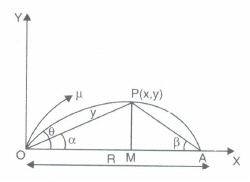
tan \(\alpha={y\over x}\) and tan \(\beta ={y\over MA}={y\over R-x},\) where R is horizontal range
\(\therefore\) tan \(\alpha\)+ tan\(\beta ={y\over x}+{y\over R-x}\)
\(={(R-x+x)y\over x(R-x)}={yR\over x(R-x)}\)
or tan \(\alpha\)+ tan\(\beta ={yR\over x(R-x)}\) ..........(i)
Again, x =(u cos \(\theta\)) t ..........(ii)
y=(u sin \(\theta\)) t -\({1\over2}\)gt2 ...........(iii)
From (ii) and (iii), we have
y = x tan \(\theta =[1-{xg\over 2u^2 cos^2\theta tan \theta}]\)
Putting, \(R={2u^2sin \theta cos \theta\over g}\)
we get y=\(x=tan \theta[1-{xg \over2u^2 cos\theta sin \theta}]\)
\(=xtan\theta[1-{x\over R}]\)
or \({y\over x}=tan \theta({R-x\over R})\) .........(iv)
Putting (iv) in (i), we get
tan \(\alpha\)+ tan\(\beta ={yR\over x(R-x)} =tan \theta\)
\(\therefore\) tan \(\alpha\)+ tan\(\beta =tan \theta\).
20.
Let the body be projected with velocity u inclined at angle \(\theta\) with the horizontal. The horizontal and vertical components of velocity and acceleration are
ux, ax and uy, ay
where ux = u cos \(\theta\) uy = u sin\(\theta\) ,ax = 0,aY = -g
g is the acceleration due to gravity.
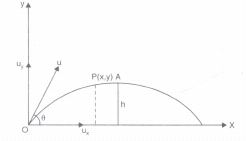
The coordinates of O are (0, 0) considering horizontal motion.
The position of the body after time t has coordinate (x, y);
where x (t)=xo + ux t + \({1\over2}a_x t^2\)
Substituting for various factors
x (t)=xo + U cos \(\theta\) . t + \({1\over2}\) x 0 x t2
or x (t) =u cos \(\theta\) . t
\(t={x(t)\over u \ cos \theta}\) ............(i)
Considering the vertical motion
y (t) Y (0) + uy +\({1\over2}a_y t^2\)
or y (t)=0+ U sin \(\theta\) . t - \({1\over2}\) gt2
or y (t)=U sin \(\theta\) . t - \({1\over2}\) gt2 ............(ii)
Substituting for t from equation (i) in equation (ii), we get
\(y(t)=u \ sin \theta ({x(t)\over u \cos \theta})-{1\over 2}g({x(t)\over u \ cos \theta})^2\)
\(\Rightarrow \ y(t)=x(t)tan \theta -{1\over2}g{x^2(t)\over u^2 \ cos^2 \theta}\) ...............(iii)
This is an equation of parabola. Thus, the path of a projectile is a parabola.
Maximum height attained. At the maximum height, the vertical component of velocity becomes zero. Now using the equation of motion.
\(h={v^2_y-u^2_y\over 2a_y}\)
We have maximum height
\(\therefore h_{max}={0^2-(u \ sin \theta)^2\over 2(-g)}\)
or \(H={u^2sin^2\theta \over 2g}\) .....................(iv)
Time for maximum height. Using equation of motion v = u + at
or vx = ux + ay t
we have 0 =u sin \(\theta\) - gt
or t=\(u \ sin \theta \over \ g\) .....................(v)
Horizontal range. Let the horizontal range be x. Since there is no acceleration in the horizontal direction so
x = x (0) + ux t + \({1\over2}a_x t^2\)
As x (0) = 0, ux = U cos \(\theta\), ax= 0 and it is the total time of the flight which is twice the time for maximum height because body takes same time in rising to and falling from the highest point.
Hence, t = \({2u \ sin \theta \over g}\)
\(\therefore \) x = o + u cos \(\theta\) . t = u cos\(\theta\)\(({2u \ sin \theta \over g})\)
or x \(={u^2\over \ g}(2 \ sin \theta cos \theta)\)
\(\Rightarrow \ x={u^2\over g}sin \ 2 \theta\) ....................(vi)
Maximum horizontal range. From equation (vi) for x to be maximum, the value of sin 2\(\theta\) should be maximum which is 1,
hence \(x_{max}={u^2\over g}\) ....................(vii)
For this xmax' sin 2\(\theta\)= 1\(\Rightarrow\) \(\theta\) = 45°
Therefore, the horizontal range will be maximum if the angle of projection is 45° or \(\pi\over 4\) radians.
Time of flight of the projectiles. The projectile after completing its flight returns back to the same horizontal level from which it was projected. Therefore, the vertical displacement in the whole flight is zero. Considering vertical motion.
y(t) = y(0) +uyt + \({1\over2}a_yt^2\)
Now y(t) = 0,y(o) = 0,uy = u sin \(\theta\) , ay = -g
Then 0 = 0 + u sin \(\theta\) . T-\({1\over2}gT^2\)
\(\Rightarrow T({u \ sin \theta -{1\over2}gT})=0\)
Therefore T = 0
and U sin \(\theta -{1\over 2}gT=0\Rightarrow u\ sin \theta ={1\over2}gT\)
or gT = 2u sin \(\theta\)
\(T={2u \ sin \theta \over g}\) ...........(viii)
Equation (viii) gives the total time of flight. This is twice the time for maximum height.
21.
Given, A = 5 units, B = 5units, \(\theta =60°\) A + B=? and A - B = ?
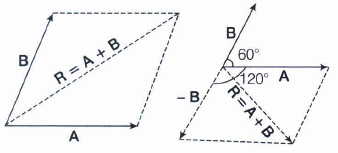
The magnitude of the resultant vectors of the sum,
\(R=\sqrt { { A }^{ 2 }+{ B }^{ 2 }+2AB\cos { \theta } } \)
=\(\sqrt { { 5 }^{ 2 }+{ 5 }^{ 2 }+2\times 5\times 5\times \cos { 60° } } \)
= \(5\sqrt { 3 } \) unit
The magnitude of the resultant vector of the difference,
\(R=\sqrt { { A }^{ 2 }+{ (-B) }^{ 2 }+2AB\cos { \theta } } \)
R =\(\sqrt { { 5 }^{ 2 }+{ 5 }^{ 2 }+2\times 5\times 5\times \cos { 120° } } \)
R = 5 unit
22.
Given, \(\nu _{ 0 }=5\overset { \wedge }{ i } m/s\),a = \(\nu _{ 0 }=3\overset { \wedge }{ i } +2\overset { \wedge }{ j } m/s^{ 2 }\)
y(t) = ?,x(t) = 84m (ii) Speed \(\nu \) = ?
Then, \(y(t)={ \nu }_{ 0 }\quad t+\frac { 1 }{ 2 } at^{ 2 }\quad and\quad { \sqrt { { v }_{ x }^{ 2 }+{ v }_{ y }^{ 2 } } }\)
\(y(t)=5\overset { \wedge }{ i } t+\frac { 1 }{ 2 } (3\overset { \wedge }{ i } +2\overset { \wedge }{ j } ){ t }^{ 2 }\)
\(\\ =\left( { 5\overset { \wedge }{ i } }t+\frac { 3 }{ 2 } { t }^{ 2 } \right) \overset { \wedge }{ i } +{ t }^{ 2 }\overset { \wedge }{ j } \)
On comparing, \(\quad x(t)=5t+\frac { 3 }{ 2 } { t }^{ 2 }\)
\(\\ \Rightarrow y(t)=1{ t }^{ 2 }\)
23.
The path followed by a projectile projected at an angle \(\theta\) with velocity \(\overset\rightarrow{u}\) is shown in figure. The maximum height attained by the projectile is given by
H=\(\frac { { u }^{ 2 }{ sin }^{ 2 }{ \theta }_{ 0 } }{ 2g } \) ..(i)
The range of the projectile is given by
R=\(\frac { { u }^{ 2 }{ sin }^{ 2 }{ \theta }_{ 0 } }{ g } =\frac { { 2u }^{ 2 }{ sin }^{ 2 }{ \theta }_{ 0 }cos{ \theta }_{ 0 } }{ g } \) ..(ii)
Dividing eqn. (i) by eqn. (ii), we get
tan \({ \theta }_{ 0 }=\frac { 4H }{ R } \)
\(\Rightarrow\) \(\theta\)0 tan-1\(\left( \frac { 4H }{ R } \right) \) .
24.
Consider a projectile projected at an \(\theta\) angle to the horizontal with velocity u, the horizontal and vertical components initially with velocity u cos \(\theta\) and u sin \(\theta\) respectively. Vertical velocity at highest point is zero, due to gravity acting vertically downwards.
Using, \(\upsilon \)=u+at
we have, 0=u sin \(\theta\) -gt
\(\Rightarrow\) t=\(\frac { u sin\theta }{ g } \)
The time to reach topmost point, t =\(\frac { u sin\theta }{ g } \)
Using \(\upsilon ^{ 2 }\)=u2+2as
we have, 0=u2sin2\(\theta\)-2g hmax
\(\Rightarrow\) hmax=\(\frac { { u }^{ 2 }{ sin }^{ 2 }\theta }{ 2g } \).
25.
(i) False, each component of a vector is also a vector.
(ii) True, because the total path length is either greater than or equal to the magnitude of the displacement vector.
26.
For a projectile launched with velocity \(v _{ 0 }\)at an angle \(\theta _{ 0 }\), the range is given by \(R=\frac { { v }_{ 0 }^{ 2 }sin2\theta _{ 0 } }{ g } \).
Now, for angles, (45° + α) and ( 45° – α), 2θo is (90° + 2α) and ( 90° – 2α) , respectively. The values of sin (90° + 2α) and sin (90° – 2α) are the same, equal to that of cos 2α. Therefore, ranges are equal for elevations which exceed or fall short of 45° by equal amounts α.
27.
Unit vector perpendicular to both
\(\overrightarrow{\mathrm{A}}=2 \hat{i}+\hat{j}+\hat{k} \text { and } \hat{i}-\hat{j}+2 \hat{k}\)
is given by \(\hat{n}=\frac{\overrightarrow{\mathrm{A}} \times \overrightarrow{\mathrm{B}}}{|\overrightarrow{\mathrm{A}} \times \overrightarrow{\mathrm{B}}|}\)
\(=\overrightarrow{\mathrm{A}} \times \overrightarrow{\mathrm{B}}=\left|\begin{array}{rrr}
\hat{i} & \hat{j} & \hat{k} \\
2 & 1 & 1 \\
1 & -1 & 2
\end{array}\right|\)
\(=\hat{i}[2-(-1)]-\hat{j}(4-1)+\hat{k}(-2-1)\)
\(=3 \hat{i}-3 \hat{j}-3 \hat{k}\)
Unit vector is \(\hat{n}=\frac{3 \hat{i}-3 \hat{j}-3 \hat{k}}{\sqrt{9+9+9}}\)
\(\frac { 3\hat { i } -\hat { 3j } +3\hat { k } }{ \sqrt { 27 } } \)

11th Standard CBSE Syllabus & Materials
11th Standard CBSE
CBSE 11th Business Studies Forms of Business Organisation Sample Question Papers Study Material - QB365 Set A
NEW11th Standard CBSE
CBSE 11th Business Studies Business, Trade and Commerce Sample Question Papers Study Material - QB365 Set A
NEW11th Standard CBSE
CBSE 11th Physics Waves Sample Question Papers Study Material - QB365 Set A
NEW11th Standard CBSE
CBSE 11th Physics Kinetic Theory Sample Question Papers Study Material - QB365 Set A



CBSE 11th Standard CBSE Subjects
CBSE Standards









