
 100% FREE ACCESS
11th Standard CBSE Syllabus & Materials
11th Standard CBSE
CBSE 11th Economics PART-A - Presentation of Data - New Sample Question Papers Study Material - QB365 Set A
NEW11th Standard CBSE
CBSE 11th Economics PART-A - Organisation of Data - New Sample Question Papers Study Material - QB365 Set A
NEW11th Standard CBSE
CBSE 11th Economics PART-A - Collection of Data - New Sample Question Papers Study Material - QB365 Set A
NEW11th Standard CBSE
CBSE 11th Economics PART-A - Introduction to Economics and Statistics - New Sample Question Papers Study Material - QB365 Set A
NEW11th Standard CBSE
CBSE 11th Business Studies International Trade Sample Question Papers Study Material - QB365 Set A
NEW11th Standard CBSE
CBSE 11th Business Studies Evolution and Fundamentals of Business Sample Question Papers Study Material - QB365 Set A

Published on: 30/07/2018
Some of the important questions are covered in this question paper from the chapter Motion in a Plane. It covers one mark, two, three and five marks questions from the book back and PTA question.
Download CBSE Class 11th Standard CBSE Physics question papers, sample papers, important questions, and previous year solved papers in PDF format. Get free study materials, NCERT solutions, and exam preparation resources for Class 11th Standard CBSE Physics
Questions + Answers key
Take MCQ Physics Test
1.
An aircraft is flying at a height of 3400 m above the ground. If the angle subtended at a ground observation point by the aircraft positions 10.0 s a part is 30°, wat is the speed of the aircraft ?
2.
When do we say two vectors are orthogonal?
3.
A stone is thrown vertically upwards and then it returns to the thrower. Is it a projectile?
4.
A boat is moving with a velocity \(\left( 3\overset { \wedge }{ i } +4\overset { \wedge }{ j } \right) \)with respect to ground. The water in the river is moving with a velocity\(-3\overset { \wedge }{ i } -4\overset { \wedge }{ j } \)with respect to water?
5.
A cricket can throw a ball to a maximum horizontal distance of 100 m. With the same speed, how high above the ground can the cricketer throw the same ball?
Horizontal range is maximum when angle of projection is 45o .
6.
A bullet fired at an angle of 30o with the horizontal hits the ground 3 km away. By adjusting its angle of projection, can one hope to hit a target 5 km away? Assume the muzzle speed to be fixed, and neglect air resistance?
7.
To a person moving eastwards with a velocity of 48km/h, rain appears to fall vertically downwards with a speed of 6.4km/h. Find the actual speed and direction of the rain.
8.
A passenger arriving in a new town wishes to go from the station to a hotel located 10 km away on a straight road from the station. A dishonest cabman takes him along a circuitous path 23 km long and reaches the hotel in 28 min. What is
(a) the average speed of the taxi,
(b) the magnitude of average velocity ? Are the two equal ?
9.
A stone tied at the end of string is whirled in a circle. If the string breaks, the stone flies away tangentially. Why?
10.
What is the angle between A and B, if A and B denote the adjacent sides of a parallelogram drawn from a point and the area of the parallelogram is 1/2 AB?
11.
Explain the property of two vectors A and B if \(|\mathbf{A}+\mathbf{B}|=|\mathbf{A}-\mathbf{B}|\)
12.
Under what condition the three vectors cannot give zero resultant?
13.
Two equal forces having their resultant equal to either. At what angle are they inclined?
14.
What is the value of \(\hat { i } +m\hat { j } ++\hat { k } \) to be unit vector?
15.
Three vectors not lying in a plane can never end up to give a null vector. Is it true?
16.
In a harbour, wind is blowing at the speed of 72 km/h and the flag on the mast of a boat anchored in the harbour flutters along the N-E direction. If the boat starts moving at a speed of 51 km/h to the North, what is the direction of flag on the mast of the boat?
17.
Rain is falling vertically with a speed of 30 m/s. A woman rides a bicycle with a speed of 10 m/s in the North to South direction. What is the direction in which she should hold her umbrella?
18.
The range of a rifle bullet is 1000m, when \(\theta \) is the angle of projection. If the bullet is fired with the same angle from a car travelling at 36km/h towards the target, show that the range will be increasing by 142.9\(\sqrt { tan\theta m } \).
When the bullet is fired from the moving car, the horizontal component velocity of the bullet increases with the velocity of car. But the vertical component of the velocity remains uneffected.
19.
The ceiling of a long hall is 25 m high. What is the maximum horizontal distance that a ball thrown with a speed of 40 m s-1 can go without hitting the ceiling of the hall ?
20.
Determine a unit vector which is perpendicular to both \(A=2\hat { i } +\hat { j } +\hat { k } \) and \(B=\hat { i } -\hat { j } +\hat { k } \)
21.
A cyclist is riding with a speed of 27kmh-1. As he approaches, a circular turn on the road of f radius 80 m, he applies brakes and reduces his speed at the constant rate of 0.5 ms-2.What is the magnitude and direction of the net acceleration of the cyclist on the circular turn?
22.
A machine gun is mounted on the top of a tower 100m high. At what angle should the gun be inclined to cover a maximum range of firing on the ground below? The muzzle speed of the bullet is 150 m/s. Take g=10 m/s2
23.
A ball rolls of the top of a stairway with horizontal velocity of 1.8 m/s. The steps are 0.24 m high and 0.2 m wide. Which step will the ball hit first? Take g=9.8 m/s2
1.
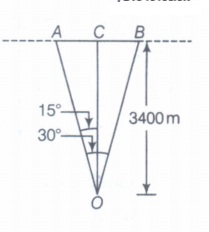
In figure, 0 is the observation point at the ground, A and B are the positions of aircraft for which \(\angle AOB=30°\). Draw a perpendicular OC on AB.Here OC = 3400 m and \(\angle AOC=\angle COB=15°\).Time taken by aircraft from A to B is 10 s.
In \(\Delta \)AOC, AC=OC \(\tan { 15° } \)
= 3400\(\times \)0.2679
= 910.86 m
AB = AC + CB = AC + AC = 2AC
=2\(\times \)910.86 m
Speed of the aircraft
v = \(\frac { distance \ AB }{ time } =\frac { 2\times 910.86 }{ 10 } \)
= 182.17 ms-1 = 182.2 ms-1
2.
If the dot product of two vectors is zero, then the vectors are orthogonal.

3.
No, it is not a projectile, because a projectile should have two component velocities in two mutually perpendicular directions but in this case, the body has velocity only in one direction while going up or coming down.
4.
Velocity of boat with respect to ground, \({ v }_{ g }=3\overset { \wedge }{ i } +4\overset { \wedge }{ j }\)
Velocity of water with respect to ground,
\({ v }_{ w }=-3\overset { \wedge }{ i } -4\overset { \wedge }{ j } \)
∴ Relative velocity of bat w.r.t water,
\({ v }_{ gw }={ v }_{ g }-{ v }_{ w }=3\overset { \wedge }{ i } +4\overset { \wedge }{ j } -(-3\overset { \wedge }{ i } -4\overset { \wedge }{ j } )= (6\overset { \wedge }{ i } + 8\overset { \wedge }{ j } )\)
5.
Let u be the velocity of projection of the ball. The ball will cover maximum horizontal distance when angle of projection with horizontal, \(\theta ={ 45 }^{ o }\) Then, \({ R }_{ max }={ u }^{ 2 }/g\)
Here, \({ u }^{ 2 }/g=100m\)
In order to study the motion of the ball along vertical direction, consider a point on the surface of Earth as the origin and vetical upward direction as the positive direction of Y-axis. Taking motion of the ball along vertical upward direction, we have
\({ u }_{ y }=u,{ a }_{ y }=-g,{ v }_{ y }=0,t=?,{ y }_{ o }=0,y=?\)
As, \({ v }_{ y }={ u }_{ y }+{ a }_{ y }t\)
\(\\ 0=u+(-g)t\Rightarrow t=u/g\)
Also, \(y={ y }_{ o }+{ u }_{ y }t+\frac { 1 }{ 2 } { a }_{ y }{ t }^{ 2 }\)
\(\\ y=0+u(u/g)+\frac { 1 }{ 2 } (-g){ u }^{ 2 }/{ g }^{ 2 }\)
\(\\ =\frac { { u }^{ 2 } }{ g } -\frac { 1 }{ 2 } \frac { { u }^{ 2 } }{ g } =\frac { 1 }{ 2 } \frac { { u }^{ 2 } }{ g } =\frac { 100 }{ 2 } =50m\quad [\frac { { u }^{ 2 } }{ g } =100]\)
6.
Horizontal range,
R = \(\frac { { u }^{ 2 }sin2\theta }{ g } or\quad 3=\frac { { u }^{ 2 }sin6{ 0 }^{ o } }{ g } =\frac { { u }^{ 2 } }{ g } \sqrt { 3/2 } \)
or \(\frac { { u }^{ 2 } }{ g } 2\sqrt { 3 } \)
Since, the muzzle velocity is fixed
Therefore, maximum horizontal range,
\({ R }_{ max }=\frac { { u }^{ 2 } }{ g } 2\sqrt { 3 } =3.464km\)
So, the bullet cannot hit the target.
7.
v = 8km/h, θ = 5307'33''
8.
Here, actual path length travelled, s = 23 km; Displacement = 10 km;
Time taken, t = 28 min = \(\frac{28}{60} h\)
(a) Average speed of taxi = \(\frac{\text { actual path length }}{\text { time taken }}=\frac{23}{\frac{28}{60}} k \frac{m}{h}=49.3 \mathrm{~km} / \mathrm{h}\)
(b) Magnitude of average velocity = \(=\frac{\text { displacement }}{\text { time taken }}=\frac{10}{\frac{28}{60}} \mathrm{~km} / \mathrm{h}=21.4 \mathrm{~km} / \mathrm{h}\)
The average speed is not equal to the magnitude of average velocity. The two are equal for the motion of taxi along a straight path in one direction.
9.
When a stone is going around a circular path, the instantaneous velocity of stone is acting as tangent to the circle. When the string breaks, the centripetal force stops to act. Due to inertia, the stone continues to move along the tangent to circular path. So, the stone flies off tangentially to the circular path.
10.
Area of parallelogram \(|A\times B|=AB\sin\theta =\frac { 1 }{ 2 } AB\)
\(\sin\theta =\frac { 1 }{ 2 } =\sin30^{ 0 }or\ \theta =30^{ 0 } \)
11.
As we know that
\(\left| A+B \right| =\sqrt { A^{ 2 }+{ B }^{ 2 }+2AB\quad cos\quad \theta } \)
And \(\left| A-B \right| =\sqrt { A^{ 2 }+{ B }^{ 2 }-2AB\quad cos\quad \theta } \)
But as per question, we have
\(\sqrt { A^{ 2 }+{ B }^{ 2 }+AB\quad cos\quad \theta } =\sqrt { A^{ 2 }+{ B }^{ 2 }-2AB\quad cos\theta } \)
Squaring both sides, we have (4 AB cos ) = 0
\(\sqrt { A^{ 2 }+{ B }^{ 2 }+AB\quad cos\quad \theta } =\sqrt { A^{ 2 }+{ B }^{ 2 }-2AB\quad cos\theta } \)
Hence, the two vectors A and B are perpendicular to each other.
12.
If three vectors acting on a point object at the same time are represented in magnitude and direction by tlte three sides of a triangle taken in the same order, their" resultant is zero.
The object is said to be in equilibrium

13.
A = F, B = F, R = F, θ = ?
\(R=\sqrt { A^{ 2 }+B2+2AB \cos\theta }
\)
\(\Rightarrow R^{ 2 }=A^{ 2 }+B2+2AB \cos\theta
\)
\(F^{ 2 }=F^{ 2 }+F^{ 2 }+2F^{ 2 }\cos\theta\)
\(1=2(1+\cos\theta )
\)
\( \cos\theta =\frac { 1 }{ 2 } -1=\frac { -1 }{ 2 } =120^{ 0 } \)
14.
For Unit Vector
\(|\hat { i } +m\hat { j } ++\hat { k } |=\sqrt { 1+m^{ 2 }+1 } =1\)
\(m^{ 2 }+2=1\)
\(m^{ 2 }=-1\Rightarrow m=\sqrt { -1 }\)
15.
Yes, because they cannot be represented by the three sides of a triangle taken in the same order
16.
When the boat is anchored in the harbour, the flag flutters along the N-E direction. It shows that the velocity of wind is along the North-East direction. When the boat starts moving, the flag will flutter along the direction of relative velocity of wind W.r.t. boat. Let vwb be the relative velocity of wind W.r.t.boat and \(\beta \) be the angle between vwb and vw.
Then, vwb= vw + (-vb)
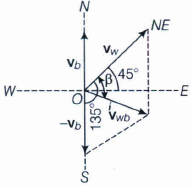
Here, |vw| = 72 km/h and |-vb| = 15 km/h
Angle between vw and - vb is \(135°\) i.e. \(\theta =135°\) Then,
\(\tan { \beta } =\frac { 51\sin { 135° } }{ 72+51\cos { 135° } } =\frac { 51\sin { 45° } }{ 72+51(-\cos { 45°) } } \)
=\(\frac { 51\times (1/\sqrt { 2 } ) }{ 72-51(1/\sqrt { 2 } ) } \) = 1.0039
\(\therefore \) \(\beta =\tan ^{ -1 }{ (1.0039)=45.1° } \)
Angle w.r.t. East direction = \(45.1°\)-\(45°\)=\(0.1°\)
It means the flag will flutter almost due East.
17.
Figure shows vectorially the situations,
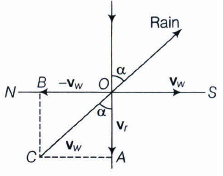
Velocity of rain falling vertically downward vr = 30 m/s
Velocity of woman riding a bicycle vw=10 m/s (North to South)
To protect herself from rain, the woman should hold her umbrella in the direction of relative velocityof the rain with respect to the woman i.e.vrw.
The relative velocity of rain with respect to the woman i.e.
vrw=vr-vw
\(\left| { v }_{ rw } \right| =\sqrt { { (30) }^{ 2 }+{ (10) }^{ 2 } } \)
\(=\sqrt { 900+100 } =\sqrt { 1000 } \)
= \(10\sqrt { 10 } \) m/s
If vrw makes an angle \(\alpha \) with the vertical, then
\(\tan { \alpha } =\frac { { v }_{ w } }{ { v }_{ r } } =\frac { OB }{ OA } =\frac { 10 }{ 30 } \)
=\(\frac { 1 }{ 3 } \) = 0.3333
\(\Rightarrow \alpha =18°26\prime \)
Hence, woman should hold her umbrella at an angle \(18°26\prime \) with the vertical towards South.
18.
Given, R = 1000m
Horizontal range of the bullet fired at an angle \(\theta \) is
\(R=\frac { { u }^{ 2 }sin2\theta }{ g } \Rightarrow 1000=\frac { { u }^{ 2 }sin\theta cos\theta }{ g } ....(i)\)
Bullet is fired from the car moving with 36km/h
i.e.10m/s, then horizontal component of the velocity of = usin\(\theta \) + 10
Vertical component of the velocity of the bullet=usin\(\theta \)
Then, new range of the bullet is
\({ R }_{ 1 }=\frac { 2 }{ g } (usin\theta )(ucos\theta +10)\)
\(\\ =\frac { 2 }{ g } { u }^{ 2 }sin\theta cos\theta +\frac { 20 }{ g } usin\theta \Rightarrow { R }_{ 1 }=R+\frac { 20 }{ g } usin\theta\)
\( \\ \Rightarrow { R }_{ 1 }-R=\frac { 20 }{ g } usin\theta ....(ii)\)
\(\\ From\ Eq.(i),we \ have \ u=\sqrt { \frac { 1000\times g }{ 2sin\theta cos\theta } } .....(iii)|\)
\(\\ Now, \ substituting \ the \ value \ of \ u \ in \ Eq.(ii), \ we \ get\ \)
\(\\ { R }_{ 1 }-R=\frac { 20 }{ g } \sqrt { \frac { 1000\times g }{ 2sin\theta cos\theta } } sin\theta =20\sqrt { \frac { 500\times sin\theta }{ gcos\theta } }\)
\( \\ =20\sqrt { \frac { 500 }{ 9.8 } tan\theta } =142.9\sqrt { tan\theta } \)
19.
Given, initial velocity (u) = 40m/s
Height of the hall (H) = 25m
Let the angle of projection of the ball be \(\theta \), when maximum height attained by it be 25m.
Maximum height attained by the ball
\(H=\frac { { u }^{ 2 }{ sin }^{ 2 }\theta }{ 2g } \Rightarrow 25=\frac { { (40) }^{ 2 }{ sin }^{ 2 }\theta }{ 2\times 9.8 }\)
\(or\ { \sin }^{ 2 }\theta =\frac { 25\times 2\times 9.8 }{ 1600 } =0.3068\)
\(or\ \sin\theta =0.5534=\sin{ 33.6 }^{ 0 }\)
\(or\ \theta ={ 33.6 }^{ 0 }\)
\( \therefore \text{ Horizontal range (R)}=\frac { { u }^{ 2 }\sin2\theta }{ g }\)
\( \\ =\frac { { (40) }^{ 2 }sin2\times { 33.6 }^{ 0 } }{ 9.8 } =\frac { 1600\times sin{ 67.2 }^{ 0 } }{ 9.8 } \)
\(\\ =\frac { 1600\times 0.9219 }{ 9.8 } =150.5m\)
20.
Unit vector perpendicular to both
\(\overrightarrow{\mathrm{A}}=2 \hat{i}+\hat{j}+\hat{k} \text { and } \hat{i}-\hat{j}+2 \hat{k}\)
is given by \(\hat{n}=\frac{\overrightarrow{\mathrm{A}} \times \overrightarrow{\mathrm{B}}}{|\overrightarrow{\mathrm{A}} \times \overrightarrow{\mathrm{B}}|}\)
\(=\overrightarrow{\mathrm{A}} \times \overrightarrow{\mathrm{B}}=\left|\begin{array}{rrr}
\hat{i} & \hat{j} & \hat{k} \\
2 & 1 & 1 \\
1 & -1 & 2
\end{array}\right|\)
\(=\hat{i}[2-(-1)]-\hat{j}(4-1)+\hat{k}(-2-1)\)
\(=3 \hat{i}-3 \hat{j}-3 \hat{k}\)
Unit vector is \(\hat{n}=\frac{3 \hat{i}-3 \hat{j}-3 \hat{k}}{\sqrt{9+9+9}}\)
\(\frac { 3\hat { i } -\hat { 3j } +3\hat { k } }{ \sqrt { 27 } } \)
21.
Here, v = 27 kmh-1 = 27\(\times \)(1000 m) \(\times \)(60\(\times \)60 s)-1 = 7.5 ms-1, r = 80 m
Centripetal acceleration, ac=\(\frac { { v }^{ 2 } }{ r } =\frac { { (7.5) }^{ 2 } }{ 80 } \) = 0.7 ms-2
Let the cyclist applies the brakes at the point P of the circular turn, then tangential acceleration aT will act opposite to velocity.
Acceleration along the tangent, aT = 0.5 ms-2
Angle between both the accelerations is \(90°\)
Therefore, the magnitude of resultant acceleration \(a=\sqrt { { a }_{ C }^{ 2 }+{ a }_{ T }^{ 2 } } =\sqrt { { (0.7) }^{ 2 }+{ (0.5) }^{ 2 } } \)
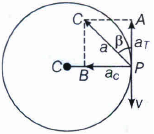
Let the resultant acceleration make an angle \(\beta \) with the tangent i. e. the direction of net acceleration of the cyclist then, \(\tan { \beta } =\frac { { a }_{ C } }{ { a }_{ T } } =\frac { 0.7 }{ 0.5 } \) = 1.4 or \(\beta =54°28\prime \)
22.
\(\alpha=\frac{1}{2} \cos ^{-1}\left(1-\frac{u^2}{u^2+g h}\right)=43^{\circ} 47^{\prime}\)
23.
Let the ball strike the nth step of stairs.
∴ Vertical distance travelled \(=\mathrm{ny}=\mathrm{n} \times 0.2=\frac{1}{2} \mathrm{gt}^2\)
Horizontal distance travelled \(=\mathrm{nx}=\mathrm{ut}\)
\(\Rightarrow \mathrm{t} =\frac{\mathrm{nx}}{\mathrm{u}} \)
\(\mathrm{ny} =\frac{1}{2} \mathrm{gt}^2=\frac{1}{2} \mathrm{~g}\left(\frac{\mathrm{nx}}{\mathrm{u}}\right)^2=\frac{1}{2} \mathrm{~g} \frac{\mathrm{n}^2 \mathrm{x}^2}{\mathrm{u}^2} \)
\(\Rightarrow \mathrm{n} =\frac{2 \mathrm{u}^2 \mathrm{y}}{\mathrm{gx^{2 }}} \)
\(=\frac{2 \times 1.8^2 \times 0.2}{9.8 \times 0.2^2} \approx 3.3\)
So, Fourth step.

11th Standard CBSE Syllabus & Materials
11th Standard CBSE
CBSE 11th Business Studies Forms of Business Organisation Sample Question Papers Study Material - QB365 Set A
NEW11th Standard CBSE
CBSE 11th Business Studies Business, Trade and Commerce Sample Question Papers Study Material - QB365 Set A
NEW11th Standard CBSE
CBSE 11th Physics Waves Sample Question Papers Study Material - QB365 Set A
NEW11th Standard CBSE
CBSE 11th Physics Kinetic Theory Sample Question Papers Study Material - QB365 Set A



CBSE 11th Standard CBSE Subjects
CBSE Standards









