
 100% FREE ACCESS
11th Standard CBSE Syllabus & Materials
11th Standard CBSE
CBSE 11th Economics PART-A - Presentation of Data - New Sample Question Papers Study Material - QB365 Set A
NEW11th Standard CBSE
CBSE 11th Economics PART-A - Organisation of Data - New Sample Question Papers Study Material - QB365 Set A
NEW11th Standard CBSE
CBSE 11th Economics PART-A - Collection of Data - New Sample Question Papers Study Material - QB365 Set A
NEW11th Standard CBSE
CBSE 11th Economics PART-A - Introduction to Economics and Statistics - New Sample Question Papers Study Material - QB365 Set A
NEW11th Standard CBSE
CBSE 11th Business Studies International Trade Sample Question Papers Study Material - QB365 Set A
NEW11th Standard CBSE
CBSE 11th Business Studies Evolution and Fundamentals of Business Sample Question Papers Study Material - QB365 Set A

Published on: 02/03/2019
Motion in a Straight Line Important Questions
Download CBSE Class 11th Standard CBSE Physics question papers, sample papers, important questions, and previous year solved papers in PDF format. Get free study materials, NCERT solutions, and exam preparation resources for Class 11th Standard CBSE Physics
Questions + Answers key
Take MCQ Physics Test
1.
What is the relative velocity of have bodies having equal velocities?
2.
A boy standing on a stationary lift (open from above) throws a ball upwards with the maximum initial speed he can, equal to 49 m s-1. How much time does the ball take to return to his hands? If the lift starts moving up with a unifornt speed of 5 m s-1 and the boy again throws the ball up with the maximum speed he can, how long does the ball take to return to his hands?
3.
A woman starts from her home at 9.00 am, walks with a speed of 5 km h–1 on a straight road up to her office 2.5 km away, stays at the office up to 5.00 pm, and returns home by an auto with a speed of 25 km h–1. Choose suitable scales and plot the x-t graph of her motion.
4.
Draw position-time graph for a non-uniform motion, when body starts from origin with increasing velocity.
5.
John and Kuldeep are good friends.Both were driving their bikes.Speed thrill Kuldeep.Suddenly, Kuldeep met an accident.He was injured.When John heard about accident,he reached at the site of the accident and noticed that Kuldeep was lying on the roadside John informed the PCR that was petrolling.Kuldeep was taken to the city hospital,where he was treated by doctors.The speedometer of the bike of Kuldeep was reading 110km/h at the time of accident.
Which physical quantity is measured by the speedometer of the bike?
6.
The position of an object is given by x = 2t2 + st. Find out that its motion is uniform and nonuniform.
7.
The displacement o a particle is given by at2. What is the dependency of accleration on time?
8.
Can the relative velocity of two bodies be greater than the absolute velocity of either?
9.
Uniform Acceleration
The displacement x of a particle varies with time t as \(x={ 4t }^{ 2 }-15t+25\)
Can we call the motion of the particle as one with uniform acceleration?
10.
The position coordinate of a moving particle is given by x = 6 + 18t + 9t2, where x is the metres and t in seconds. What is the velocity at t = 2 s ?
11.
In which of the following examples of motion, can be the body be considered approximately a point object?
A monkey sitting on the top of a man cycling smoothly on a circular track.
12.
Position-time graph could have negative slope Is it true or false?
13.
Can a tumbling beaker that has slipped off the edge of a table considered as a point object?
14.
A motor boat covers the distance between two spots on the river in time of 8 hours and 12 hours downstream and upstream respectively. What is the time required for the boat to cover this distance in still water?
15.
Two trains of lengths 109 m and 91m are moving in opposite directions with velocities 34 km h-1 and 38 kmh-1 respectively. In what time the two trains will completely cross each other? Choose the most logical reference point for time measurement.
16.
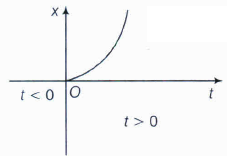
Figure shows the x-t plot of onedimensional motion of a particle. Is it correct to say from the graph that the particle moves in a straight line for t < 0 and on a parabolic path for t >0 ? If not, suggest a suitable physical context for this graph.
17.
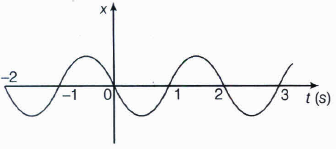
Figure gives the x-t plot of a particle executing one-dimensional simple harmonic motion. (You will learn about this motion in more detail in Chapter13). Give the signs of position, velocity and acceleration variables of the particle at t = 0.3 s, 1.2 s, – 1.2 s.
18.
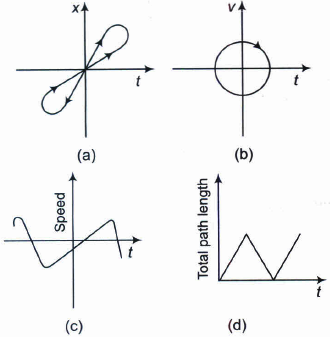
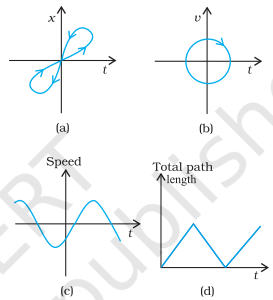
Look at the graphs (a) to (d) carefully and state with reasons, which of these cannot possibly represent one-dimensional motion of a particle?
19.
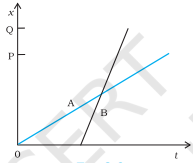
In Exercises 2.9 and 2.10, we have carefully distinguished between average speed and magnitude of average velocity. No such distinction is necessary when we consider instantaneous speed and magnitude of velocity. The instantaneous speed is always equal to the magnitude of instantaneous velocity. Why?
20.
A train 500m long crosses a bridge of 1000 m in 10s. Find the average speed of the train when it just crosses the bridge.
21.
A body is moving in a straight line along x-axis Its distance from the origin is given by the equation x = at2 - bt3, where x is in metre and t is in second. Find
(i) The avearge speed of the body in the interval t = 0 and t = 2 and
(ii) Its instantaneous speed at t =2s
22.
Read each statement below carefully and state with reasons and examples if it true or false. A particle in 1-D motion
(i) with zero speed may have non-zero velocity.
(ii) with constant speed must have zero acceleration
(iii) with positive value of acceleration must be speeding up.
23.
A player throws a ball upwards with an initial speed of 29.4 m s–1 .
(a) What is the direction of acceleration during the upward motion of the ball ?
(b) What are the velocity and acceleration of the ball at the highest point of its motion ?
(c) Choose the x = 0 m and t = 0 s to be the location and time of the ball at its highest point, vertically downward direction to be the positive direction of x-axis, and give the signs of position, velocity and acceleration of the ball during its upward, and downward motion.
(d) To what height does the ball rise and after how long does the ball return to the player’s hands ? (Take g = 9.8 m s–2 and neglect air resistance).
24.
The acceleration experienced by a boat, after its engine is cut off, given by,\( \frac{dv}{dt}=-kv^3\) , where k is a constant. If Vo is the magnitude of velocity at cut off (t = 0), find the magnitude of the velocity at a time t after the cut off.
25.
Paul went to Shimla with his friends on a college trip. In Shimla, they went for ride in a hot air balloon. They were in picnic mood, so they took different variety of food packets with them. As the balloon rose up and started wandering in the air they started enjoying. Suddenly, Paul saw that at a place some people were struck on an island and shouting for help. He wanted to help those people but all be could do at that time was dropping the food packets so that they could survive till the help arrived after coming down on the ground, he immediately called the police to help those people.
(iii) What will be the position-time curve for dropped packet?
26.
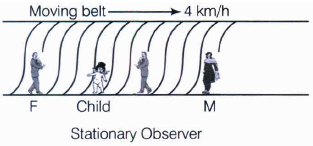
On a long horizontal moving belt (as shown in figure), a child runs to and fro with a speed 9 kmh-1 (with respect to the belt) between his father and mother located 50 m apart on the moving belt. The belt moves with a speed of 4 kmh-1. For an observer on a stationary platform outside, what is the
(i) speed of child running in the direction of motion of the belt?
(ii) speed of the child running opposite to the direction of motion of the belt?
(iii) time taken by the child in (i) and (ii) to cover the distance of 50m?
Which of the answers will alter if motion is viewed by one of the parents?
27.
Uniform and Non-uniform Accelerated Motion of a Particle.
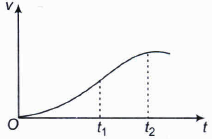
The velocity-time graph of a particle in one-dimensional motion is shown in figure. Which of the following formulae are correct for describing the motion of the particle over the time interval t1 to t2 ?
\((i)\ x({ t }_{ 2 })=x({ t }_{ 1 })+v({ t }_{ 1 })({ t }_{ 2 }-{ t }_{ 1 })+\frac { 1 }{ 2 } a{ ({ t }_{ 2 }-{ t }_{ 1 }) }^{ 2 }\)
\((ii)\ v({ t }_{ 2 })=v({ t }_{ 1 })+a({ t }_{ 2 }-{ t }_{ 1 })\)
\((iii)\ { v }_{ av }=\left[ \frac { x({ t }_{ 2 })-x({ t }_{ 1 }) }{ ({ t }_{ 2 }-{ t }_{ 1 }) } \right] \)
\( (iv) \ { a }_{ av }=\frac { \left[ v({ t }_{ 2 })-v({ t }_{ 1 }) \right] }{ ({ t }_{ 2 }-{ t }_{ 1 }) }\)
\((v)\ x({ t }_{ 2 })=x({ t }_{ 1 })+{ v }_{ av }({ t }_{ 2 }-{ t }_{ 1 })+\frac { 1 }{ 2 } { a }_{ av }{ ({ t }_{ 2 }-{ t }_{ 1 }) }^{ 2 }\)
\((vi)\ x({ t }_{ 2 })-x({ t }_{ 1 })\)=Area under v-t curve bounded by the t-axis and the dotted line shown.
1.
When two bodies have equal veloci.ties (i.e., \(\overrightarrow { v_{ a } } =\overrightarrow { v_{ b } } =\overrightarrow { v } \)), then their relative velocity is zero i.e., \(\overrightarrow { v_{ ab } } =\overrightarrow { v_{ a } } -\overrightarrow { v_{ b } } =\overrightarrow { v } -\overrightarrow { v } =0.\)
2.
When either the lift is at rest or the lift is moving either vertically upward or downward with a constant speed, we can apply three simple kinetnatic motion equations presuming a = ± g (as the case may be).
In present case u = 49 ms-1 (upward) a = g = 9.8 ms-2 (downward)
If the ball returns to boy's hands after a time t, then displacement of ball relative to boy is zero
i.e., s = O. Hence, using equation s = ut + \(\frac{1}{2}\) at2, we have
0 = 49 ± - \(\frac {1} {2}\) x 9.8 x t2
\(\Rightarrow\) 4.9 t2 - 49t = 0 \(\Rightarrow\) t = 0 or 10 s
As t = 0 is physically not possible, hence time t = 10 s.
3.
Time taken in reaching the office=\(\frac { distance }{ speed } =\frac { 2.5 }{ 5 } =0.5h\)
Time taken in returning from office\(=\frac { 2.5 }{ 25 } =0.1, \ h=6min\)
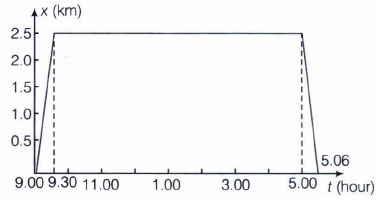
It means that woman reaches the office at 9:30 am and returns home at 5:06 pm.
4.

In the above x-t graph, the slope of x-t graph is increasing, it means that the velocity is increasing.
5.
Instantaneous speed is measured by the speedometer.
6.
As given, x = 2t2 + 3t
by differentiating x w.r.t, we get
Velocity, \(v=\frac { dx }{ dt } =\frac { d }{ dt } ({ 2 }t^{ 2 }+3t)\)
v = (4t +3)
As velocity is time dependent, it means that motion is non-uniform
7.
Let x be the displacement . Then, x = at2
\(\therefore\) Velocity of the object , v = \(\frac{dx}{dt}\)
Accleration of the object , a = \(\frac{dv}{dt}\)
It means that a is constant.
8.
Yes, when two bodies move in opposite direction then relative velocity of each is greater than the individual velocities.
9.
Yes,the particle has a uniform acceleration because it does not depend on time t
10.
Given, x = 6 + 18t + 9t2
\({ v }_{ 1 }=\frac { dx }{ dt } =18+18t\)
At t = 2, v2 = 18 + 18 x 2 = 54 m/s
11.
Any object can be considered as a point object if the distance travelled by it is very large in comparison to its dimensions.
Man along with monkey is cycling smoothly which indicates that the distance travelled by the man is very large, therefore monkey can be taken as a point object.
12.
It is true because if the velocity of the object is negative, then slope of v-t graph is negative.
13.
No, because the size of the beaker is not negligible as compared to the height of the table.
14.
Time taken in downstream,
8 = \(\frac { S }{ { v }_{ r }+v_{ b } } \)
Given vr + vb = \(\frac { s }{ 8 } \),vb-vr = \(\frac { s }{ 12 } \)
By solving the equations, we get
vb = \(\frac { s }{ 12 } \left( \frac { 1 }{ 8 } +\frac { 1 }{ 12 } \right) \)
or, vb = \(\frac { s }{ 2 } \times \frac { 20 }{ 96 } \)
or, vb = \(\frac { 10s }{ 96 } \)
Now, vr = \(\frac { 10s }{ 96 } -\frac { S }{ 12 } =\frac { 2S }{ 96 } \)
In still water, only the velocity is to be considered.
∴ time taken in still water for covering length s is,
t = \(\frac { S }{ v_{ b } } =\frac { S\times 96 }{ 10S } \)
= 9.6 seconds.
15.
Relative speed = (34 + 38) kmh-1 = 72 krnh-1
= 72 x - ms-1 = 20 ms-1
Total distance = (109 + 91) m = 200 m
Time = \(\frac { 200m }{ 20ms^{ -1 } } \) =10 s.
16.
No. because the x-t graph does not represent the trajectory of the path followed by a particle. From the graph, it is noted that at t = 0, x =0. Context The abovb graph can represent the motion of a body falling freely from a tower under gravity.
17.
In the SHM, acceleration a = -aix, where m(i.e. angular frequency) is constant.
(i) At time t = 0.3s, x is negative, the slope of x-t plot is negative, hence position and velocity are negative. Since \(a={ -\omega }^{ 2 }x\), hence acceleration is positive.
(ii) At time t = 1. 2s, x is positive, the slope of x-t plot is also positive, hence position and velocity are positive. Since \(a={ -\omega }^{ 2 }x\), hence acceleration is negative.
(iii) At t = -1.2s, x is negative, the slope of x-t plot is also negative. But since both x and t are negative here, hence velocity is positive. Finally, acceleration a is also positive.
18.
(a) No, graph (a) is not representing one-dimensional motion of a particle, because graph shows two different positions of the particle at same instant of time. (At time t1 particle is at positions P and Q and at time t2, particle is at positions Rand S), which is not possible.
-S.png)
(b) No, graph (b) cannot represent one-dimensional motion of a particle, because graph shows one positive velocity (v1 ) and another negative velocity (-v2) of the particle at the same instant of time (t1) which is not possible.
-S.png)
(c) No, graph (c) cannot represent one-dimensional motion of a particle, because graph shows negative speed of the particle but speed cannot be negative.
-S.png)
(d) No, graph (d) cannot represent one-dimensional motion of a particle, because graph shows that total path length increases from time t = 0 to t = t1, but decreases from t = t1 to t = t2 But total path length of a moving particle can never decrease with time.
-S.png)
19.
Instantaneous speed (vins) of the particle at an instant is the first derivative of the distance with respect to time at that instant of time i.e. \({ v }_{ ins }=\frac { dx }{ dt } .\)
Since, in instantaneous speed, we take only a small interval of ime(dt) during which direction of motion of a body is not supposed to change, hence there is nodifference between total path length and magnitude of displacement for small interval of time dt.
Hence, instantaneous speed is always equal to magnitude of instantaneous velocity.
20.
To fully cross the bridge, distance to covered by end far away from train is equal to (500+1000) m
\(\text { Average speed } -\frac{1500}{10} =150 \mathrm{~m} / \mathrm{s}\)
21.
(i) The given equation x = at2 - bt3
If t = 0, xo=0
if t = 2s,x2 = 4a - 8b
\(\triangle x={ x }_{ 2 }-{ x }_{ 0 }=4a-8b-0=4a-8b\)
Average speed in the given interval of time.
\({ v }_{ av }=\frac { \triangle x }{ \triangle t } =\frac { 4a-8b }{ 2 } =2a-4b\)
(ii) Instantaneous speed
\(v=\frac { dx }{ dt } =\frac { d }{ dt } ({ at }^{ 2 }-{ bt }^{ 3 })=2at-3b{ t }^{ 2 }\)
At t = 2s, v = 4a - 12 b m/s
22.
(i) False, because velocity is the speed of body in a given direction. When speed is zero, the magnitude of velocity of body is zero, hence velocity is zero.
(ii) True, when a particle is moving along a straight line with a constant speed, its velocity remains constant with time. Therefore, acceleration (i,e. change in velocity/time) is zero.
(iii) False, if the initial velocity of a body is negative, then even in the case of positive acceleration, the body speeds down. A body speeds up when the acceleration acts in the direction of motion.
23.
(i) Since, the ball is moving under the effect of gravity, the direction of acceleration due to gravity is always vertically downwards.
(ii) At the highest point, the velocity of the ball becomes zero and acceleration is equal to the acceleration due to gravity=9.8ms-2 in vertically downward direction.
(iii) When the highest point is chosen as the location for x=0 and t=0 and vertically downward direction to be the positive direction of x-axis and upward direction as negative direction of x-axis.
During upward motion, sign of position is negative, sign of velocity is negative and sign of acceleration is positive.During downward motion, sign of position is positive, sign of velocity is positive and sign of acceleration is also positive.
(iv) Let t be the time taken by the ball to reach the highest point where height from ground be s.
Taking vertical upward motion of the ball, we have u = -29.4ms-, a = 9.8ms-, v = 0, s = S,t = ?
As, v2 - u2 = 2 as
0 - (-29.4)2=2 x 9.8 x S
or \(S=\frac { -{ (29.4) }^{ 2 } }{ 2\times 9.8 } =-44.1m\)
Here, negative sign shows that the distance is covered in upward direction.
As, v = u + at
\(\therefore 0=-29.4+9.8\times t\ or\ t=\frac { 29.4 }{ 9.8 } =3s\)
It means time of ascent = 3s
When an object moves under the effect of gravity alone, the time of ascent is always equal to the time of descent.
Therefore, total time after which the ball returns to the player's hand = 3 + 3 = 6s.
24.
\( \frac{dv}{dt}=-kv^2\)
Integrating both sides, we get
\( \int\frac{dv}{v^3}=-k\int dt\)
or \( -\frac{1}{2v^2}=-kt+c\)
At t = 0,v = v0
∴ c= \(-\frac{1}{2v_0^2}\)
∴ \(-\frac{1}{2v^2}=-kt-\frac{1}{v_0^2}\)
or \(2v^2=\frac{2v_0^2}{(2v_0^2 kt+1)}\)
or v= \(\sqrt{\frac{v_0^2}{(2v_0^2 kt+1)}}\)
25.
(iii) What will be the position-time curve for dropped packet?
In position-time curve, when a packet is dropped. Let us consider origin at the point where packet was dropped.
-S.png)
26.
Let us consider left to right to be the positive direction of x-axis.
(i) Here, velocity of belt, VB = + 4 kmh-1,speed of child w.r.t. belt Vc = + 9 kmh-1 = 5/2 ms-1
Speed of the child w.r.t. stationary observer,
V'C = vC + vB= 9 + 4 = 13kmh-1
(ii) Here, vB = + 4 kmh -1, "c = - 9 kmh "
Speed of the child w.r.t. stationary observer,
v'C = vC + vB = - 9 + 4 = - 5 krnh-1
Here, negative sign shows that the child will appear to run in a direction opposite to the direction of motion of the belt.
(iii) Distance between the parents, s = 50 m Since parents and child are located on the same belt, the speed of the child as observed by stationary observer in either direction (either from mother to father or from father to mother) will be 9 km -I Time taken by child in case (i) and (ii) is
\(t=\frac { 50 }{ (5/2) } =20\)
If motion is observed by one of the parents, answer to case (i) or case (ii) will get altered. It is so because speed of child w.r,t either of mother or father is 9 kmh-1 But answer (iii) remains unaltered due to the fact that parents and child are on the same belt and as such all are equally affected by the motion of the belt.
27.
The slope of the given graph over the time interval t1, to t2 is not constant and is not uniform. It means acceleration is not constant or uniform, therefore relations (i), (ii) and (v) are not correct which is uniform accelerated motion, but relations (iii), (iv) and (vi) are correct, because these relations are true for both uniform or non-uniform accelerated motion.

11th Standard CBSE Syllabus & Materials
11th Standard CBSE
CBSE 11th Business Studies Forms of Business Organisation Sample Question Papers Study Material - QB365 Set A
NEW11th Standard CBSE
CBSE 11th Business Studies Business, Trade and Commerce Sample Question Papers Study Material - QB365 Set A
NEW11th Standard CBSE
CBSE 11th Physics Waves Sample Question Papers Study Material - QB365 Set A
NEW11th Standard CBSE
CBSE 11th Physics Kinetic Theory Sample Question Papers Study Material - QB365 Set A



CBSE 11th Standard CBSE Subjects
CBSE Standards









