
 100% FREE ACCESS
11th Standard CBSE Syllabus & Materials
11th Standard CBSE
CBSE 11th Economics PART-A - Presentation of Data - New Sample Question Papers Study Material - QB365 Set A
NEW11th Standard CBSE
CBSE 11th Economics PART-A - Organisation of Data - New Sample Question Papers Study Material - QB365 Set A
NEW11th Standard CBSE
CBSE 11th Economics PART-A - Collection of Data - New Sample Question Papers Study Material - QB365 Set A
NEW11th Standard CBSE
CBSE 11th Economics PART-A - Introduction to Economics and Statistics - New Sample Question Papers Study Material - QB365 Set A
NEW11th Standard CBSE
CBSE 11th Business Studies International Trade Sample Question Papers Study Material - QB365 Set A
NEW11th Standard CBSE
CBSE 11th Business Studies Evolution and Fundamentals of Business Sample Question Papers Study Material - QB365 Set A

Published on: 30/07/2018
In this question paper, some of the important one mark, two and five marks questions from the chapter Motion in a Straight Line are covered.
Teachers can prepared question paper with answer key within five minutes. Please Click Here for getting the question paper with answer key.
Download CBSE Class 11th Standard CBSE Physics question papers, sample papers, important questions, and previous year solved papers in PDF format. Get free study materials, NCERT solutions, and exam preparation resources for Class 11th Standard CBSE Physics
Questions + Answers key
Take MCQ Physics Test
1.
The speed-time graph for a car is shown in figure below.
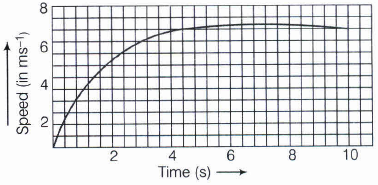
(i) Find how far the car travels in the first 4 s? Shade the area on the graph that represents the distance travelled by the car during the period.
(ii) Which part of the graph represent uniform motion of the car?
2.
Suppose two trains A and B are moving with uniform velocities along parallel tracks in the same direction and the velocities of A and B be 60 km/h in East and 65 km/h in East. Find the relative velocity of B w.r.t. A.
3.
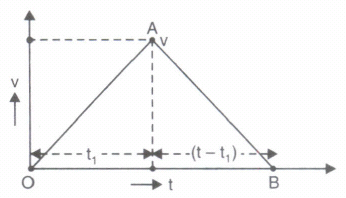
A car starts accelerating from rest for sometime, maintains the velocity for sometime and then comes to rest with uniform deceleration. Draw v-t graph.
4.
Draw position-time graph for a body at rest.
5.
A car accelerates from rest at a constant rate \(\alpha \) for some time, after which it decelerates at a constant rate \(\beta \) to come to rest. If t is total time elapsed, then calculate
(i) the maximum velocity attained by the car
(ii) the total distance travelled by the car
6.
The distance travelled by a body is proportional to the square of time. What type of motion this body has?
7.
Thye position x of a body is given by x = A sin(wt). Find the time at which the displacements is maximum.
8.
A drunkard walking in a narrow lane takes 5 steps forward and 3 steps backward, followed again by 5 steps forward and 3 steps backward, and so on. Each step is 1 m long and requires 1 s. Plot the x-t graph of his motion. Determine graphically and otherwise how long the drunkard takes to fall in a pit 13 m away from the start.
9.
For what condiion, an object could be considered as a point object? Describe in brief
10.
Find the acceleration and velocity of a ball at the instant it reaches its highest point it was thrown up with velocity v.
11.
Uniform Acceleration
The displacement x of a particle varies with time t as \(x={ 4t }^{ 2 }-15t+25\)
Can we call the motion of the particle as one with uniform acceleration?
12.
Constant acceleration menas that x - t graph will have constant slope? Yes / No
13.
With zero speed a particle may have non-zero velocity. Is the statement true or false, explain?
14.
The displacement-time graph for two particles X and Y are straight lines making angles of 30o and 60o with the time axis. What is the ratio of the velocities of Y and X ?
15.
In which of the following examples of motion, can be the body be considered approximately a point object?
A monkey sitting on the top of a man cycling smoothly on a circular track.
16.
For which condition, the distance and the magnitude of displacement of an object have the same values?
17.
Does the displacement of an object depend on the choice of the postion of origin of the coordinate system?
18.
What is the condition for an object to be considered as a point object?
19.
A jet plane beginning its take off moves down the runway at a constant acceleration of 4.00 m/s2 If a speed of 70.0 m/s is required for the plane to leave the ground, how long a runwasy is required? Because the acceleration is constant , we can apply the equations of motion derived above.
20.
A car moving with a speed of 50 km/h can be stopped by brakes after at least 6m.What will be the minimum stopping distance, if the same car is moving at a speed of 100 km/h?
21.
Explain clearly, with examples, the distinction between :
(a) magnitude of displacement (sometimes called distance) over an interval of time, and the total length of path covered by a particle over the same interval;
(b) magnitude of average velocity over an interval of time, and the average speed over the same interval. [Average speed of a particle over an interval of time is defined as the total path length divided by the time interval]. Show in both (a) and (b) that the second quantity is either greater than or equal to the first. When is the equality sign true ? [For simplicity, consider one-dimensional motion only].
22.
The position of an object moving along x-axis is given by x = a + bt2, where a = 8.5 m, b = 2.5 m s–2 and t is measured in seconds. What is its velocity at t = 0 s and t = 2.0 s. What is the average velocity between t = 2.0 s and t = 4.0 s ?
23.
A passenger is standing d metres away from a bus. The bus begins to move with constant acceleration (a).To catch the bus, the passanger runs at a constant speed(v) towards the bus.What must be the minimum speed of the passenger so that he may catch the bus?
24.
A player throws a ball upwards with an initial speed of 29.4 m s–1 .
(a) What is the direction of acceleration during the upward motion of the ball ?
(b) What are the velocity and acceleration of the ball at the highest point of its motion ?
(c) Choose the x = 0 m and t = 0 s to be the location and time of the ball at its highest point, vertically downward direction to be the positive direction of x-axis, and give the signs of position, velocity and acceleration of the ball during its upward, and downward motion.
(d) To what height does the ball rise and after how long does the ball return to the player’s hands ? (Take g = 9.8 m s–2 and neglect air resistance).
25.
Two parallel rail tracks run North-South.Train A moves North with a speed of 54 kmh-1. and train B moves South with a speed of 90 kmh-1 . What is the velocity of monkey on the roof of the train A against its motion (with a velocity of 18 kmh-1 with respect to train A) as observed by a man standing on the ground?
1.
(i) The shaded portion of the car represents the distance travelled by the car in the first four seconds
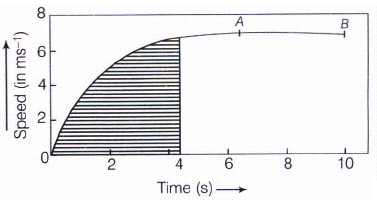
The car travels with a non-uniform speed which is accelerated in nature.
(ii) The straight line portion of the graph represents the uniform motion of the car i.e. from point A to B.
2.
Relative velocity of B W.Lt. A, vAB = vA - VB

3.

4.

In the above x-t graph, body is at rest at position x0
5.
(a) Let the car accelerate at a rate a for time t1 and attain a maximum velocity v. Then the car decelerates at a constant rate \(\beta\) for remaining time (t - t1) and again comes to rest. Then from adjoining figure, it is clear that
\(v=\alpha t_1=\beta(t-t_1)\)
\(\therefore t_1=\frac{v}{\alpha}\) and \((t-t_1)=\frac{v}{\beta}\)
Adding these two, we have
\(t=\frac{v}{\alpha}+\frac{v}{\beta}=v(\frac{\alpha+\beta}{\alpha\beta})\)
\(\Rightarrow v=\frac{\alpha\beta t}{(\alpha+\beta)}\)
(b) Total distance travelled by the car s = area OAB = \(\frac{1}{2}(t)\times (v)\)
\(\therefore s=\frac{1}{2}t\times \frac{\alpha\beta t}{(\alpha+\beta)}=\frac{1}{2}\frac{\alpha\beta}{2(\alpha+\beta)}t^2\)
6.
Let x bet the distance travelled in time t. Then ,
x \(\propto\) t2
x = kt2 [ here, k = constant of proportionality ]
We know that velocity is gigven
v = \( \frac{dx}{dt}\)
= 2kt
and acceleration is given by
a = \(\frac{dv}{dt}\) = 2 k [ constant ]
thus, the body has uniform accelerated motion.
7.
The value of position x will be maximum, when the value of sin (wt) is maximum for this
\(sin(\omega t)=1=sin\quad \pi /2\)
or \(\omega t=\frac { \pi }{ 2 } \Rightarrow t=\left( \frac { \pi }{ 2\omega } \right) \)
8.
The effective distance travelled by drunked in 8 steps = 5-3 = 2 m
Therefore, he takes 32 steps to move 8 m
Now he will have to cover 5 m more to reach the pit, for which he has to take only 5 forward steps.
Therefore, he will have to take = 32 + 5 = 37 steps to move 13 m. Thus, he will fall into the pit after taking 37 steps. i.e., after 37 s from the start.
9.
An object could be considered as a point object if it covers a distance much larger than its own size.
e.g., If a bus of 5 m in size move 100 km, then the bus can be considered as a point object.
10.
Acceleration is 9.8 m/s2 (downwards) and velocity is zero at the highest point.
11.
Yes,the particle has a uniform acceleration because it does not depend on time t
12.
Acceleration means that velocity is non - uniform. So, x - t graph will be curved.
13.
False,because velocity is the speed of body in a given condition. When speed is zero, the magnitude of velocity of body is zero. Thus, velocity is zero.
14.
\(\frac { { v }_{ y } }{ v_{ x } } =\frac { tan60^{ o }\ }{ tan30^{ o } } =\frac { \sqrt { 3 } }{ 1/\sqrt { 3 } } =3:1\)
15.
Any object can be considered as a point object if the distance travelled by it is very large in comparison to its dimensions.
Man along with monkey is cycling smoothly which indicates that the distance travelled by the man is very large, therefore monkey can be taken as a point object.
16.
The distance and the magnitude of displacement of an object have the same values, when the body is moving along a straight line path in a fixed direction.
17.
No, the displacement of the objects does not depend on the choice of the position of the origin.
18.
An object can be considered as a point object if the distance travelled by it is very large than its size.
19.
The problem here may be stated as
Find x when v = 70.0 m/s
It contains the single unknown x, as well as aand v, which are known with u = 0, vx2 = 2axx
Solving for x, we obtain
x = \( \frac{v^2}{2a} \)
= \(\frac{(70.00 m/s)^2}{2(4.00 m/s^2)}\)
= 613 m
20.
\(u=50 \mathrm{~km} / \mathrm{h}=50 \times \frac{5}{18}=\frac{125}{9} \mathrm{~m} / \mathrm{s}, v=0, x=6 \mathrm{~m}\)
Using the relation, v 2 -u2 = 2ax
\(0-\left(\frac{125}{9}\right)^{2}=2 a \times 6\)
\(\Rightarrow \quad a=\frac{-125 \times 125}{81 \times 2 \times 6}=-16.27 \mathrm{~m} / \mathrm{s}^{2}=16 \mathrm{~m} / \mathrm{s}\)
In second case
\(u=100 \mathrm{~km} / \mathrm{h}=100 \times \frac{5}{18}=\frac{250}{9} \mathrm{~m} / \mathrm{s}\)
v = 0, a = -16m/s 2 and x = ?
Using the relation, v 2 -u2 = 2ax
\(0-\left(\frac{250}{9}\right)^{2}=2 \times(-16) x\)
\(\Rightarrow \quad x=\frac{250 \times 250}{81 \times 2 \times 16}=24.1 \mathrm{~m}\)
21.
(i) Magnitude of dusplacement of a particle in motion for a given time is the shortest distance between the initial and final position of the particle in that time, wheras the total legth of the path covered by particle is the length of actual path traversed by the particle in the given time.
(ii) Let us consider an example,
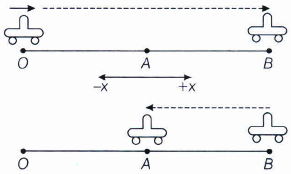
A car starts from 0 and moves along positive x-axis, The car stops at B and starts moving towards negative x-axis, Finally, the car reaches at A.
For the motion from O to B.
So, |Displacement| = Distance covered
|Average velocity| = Average speed
For the motion from \(O\rightarrow B\rightarrow A\)
So,|Displacement| < Distance covered
|Average velocity| < Average speed
22.
In notation of differential calculus, the velocity is
\(v=\frac { dx }{ dt }= \frac { d }{ dt } (a+{ bt }^{ 2 })=2bt=5.0t\ m/s^{-1}\)
At t = 0 s, v = 0 m s–1 and at t = 2.0 s, v = 10 m s-1
Average velocity \(=\frac { x(4.0)-x(2.0) }{ 4.0-2.0 } =\frac { a+16b-a-4b }{ 2.0 } = 6.0 \times b\)
= 6.0 × 2.5 = 15 m s–1
23.
Strategy: While solving such problems a very useful method is to assume that the event (catching the bus) happened at time t. Solve for t and find the condition that t is not a real value.
Let the passenger catches the bus after time t. Distance travelled by the bus in time t.
\(s=0+\frac{1}{2} a t^2=\frac{1}{2} a t^2\)
Distance travelled by the passenger, \(s_2=v t+0=v t\)
The passenger will catch the bus if, \(d+s_1=s_2\)
or, \(d+\frac{1}{2} a t^2=v t\) or \(\frac{1}{2} a t^2-v t+d=0\)
or, \(t=\frac{v \pm \sqrt{v^2-2 a d}}{a}\)
The passenger will catch the bus it t is real, i.e., \(v^2 \leq 2 a d\) or \(v \geq \sqrt{2 a d}\). Thus, minimum speed or passenger for catching the bus is \(\sqrt { 2ad } \)
24.
(i) Since, the ball is moving under the effect of gravity, the direction of acceleration due to gravity is always vertically downwards.
(ii) At the highest point, the velocity of the ball becomes zero and acceleration is equal to the acceleration due to gravity=9.8ms-2 in vertically downward direction.
(iii) When the highest point is chosen as the location for x=0 and t=0 and vertically downward direction to be the positive direction of x-axis and upward direction as negative direction of x-axis.
During upward motion, sign of position is negative, sign of velocity is negative and sign of acceleration is positive.During downward motion, sign of position is positive, sign of velocity is positive and sign of acceleration is also positive.
(iv) Let t be the time taken by the ball to reach the highest point where height from ground be s.
Taking vertical upward motion of the ball, we have u = -29.4ms-, a = 9.8ms-, v = 0, s = S,t = ?
As, v2 - u2 = 2 as
0 - (-29.4)2=2 x 9.8 x S
or \(S=\frac { -{ (29.4) }^{ 2 } }{ 2\times 9.8 } =-44.1m\)
Here, negative sign shows that the distance is covered in upward direction.
As, v = u + at
\(\therefore 0=-29.4+9.8\times t\ or\ t=\frac { 29.4 }{ 9.8 } =3s\)
It means time of ascent = 3s
When an object moves under the effect of gravity alone, the time of ascent is always equal to the time of descent.
Therefore, total time after which the ball returns to the player's hand = 3 + 3 = 6s.
25.
Taking South to North direction as the positive direction
i.e., x-axis, we have
Let velocity of monkey with respect to ground = v m
\(\therefore \) Relative velocity of monkey with respect to train A= vm-vA=-18kmh- = -5ms-1
vm= v-5 = 15 - 5 = 10ms-1

11th Standard CBSE Syllabus & Materials
11th Standard CBSE
CBSE 11th Business Studies Forms of Business Organisation Sample Question Papers Study Material - QB365 Set A
NEW11th Standard CBSE
CBSE 11th Business Studies Business, Trade and Commerce Sample Question Papers Study Material - QB365 Set A
NEW11th Standard CBSE
CBSE 11th Physics Waves Sample Question Papers Study Material - QB365 Set A
NEW11th Standard CBSE
CBSE 11th Physics Kinetic Theory Sample Question Papers Study Material - QB365 Set A



CBSE 11th Standard CBSE Subjects
CBSE Standards









