
 100% FREE ACCESS
10th Standard CBSE Syllabus & Materials
10th Standard CBSE
CBSE 10th Social Science ECO - Globalisation and the Indian Economy - New Model Questions Papers Study Material - QB365 Set A
NEW10th Standard CBSE
CBSE 10th Social Science ECO - Money and Credit - New Model Questions Papers Study Material - QB365 Set A
NEW10th Standard CBSE
CBSE 10th Social Science ECO - Sectors of the Indian Economy - New Model Questions Papers Study Material - QB365 Set A
NEW10th Standard CBSE
CBSE 10th Social Science ECO - Development - New Model Questions Papers Study Material - QB365 Set A
NEW10th Standard CBSE
CBSE 10th Social Science PS - Outcomes of Democracy - New Model Questions Papers Study Material - QB365 Set A
NEW10th Standard CBSE
CBSE 10th Social Science PS - Gender, Religion and Caste - New Model Questions Papers Study Material - QB365 Set A

Published on: 05/03/2019
Nationalism in India
Download CBSE Class 10th Standard CBSE Social Science question papers, sample papers, important questions, and previous year solved papers in PDF format. Get free study materials, NCERT solutions, and exam preparation resources for Class 10th Standard CBSE Social Science
Questions + Answers key
Take MCQ Social Science Test
1.
Why did the rich peasants take part in the Civil Disobedience Movement? Give reasons.
2.
What was the aftermath of the Jallianwalla Bagh Massacre?
3.
Why did the Non-cooperation Movement gradually slowdown in cities? Explain.
4.
Write a newspaper report on:
(a) The Jallianwala Bagh massacre
(b) The Simon Commission
5.
Why did the nationalists in India tour villages?
6.
With what object did General Dyer open fire on the peaceful gathering at Jallianwalla Bagh on 13th April, 1919?
7.
Name the auother of Anandamath.
8.
When did Lord Irwin, offer Dominion status for India?
9.
When was Rowlatt Act passed?
10.
What were the developments that led to the launching of the Civil Disobedience Movement?
11.
How did a variety of cultural processes plan an important role in developing a sense of nationalism in India? Explain. With examples?
12.
Why did Mahatma Gandhi feel the need to launch a broad-based movement in 1920? Give reasons.
13.
Why did Mahatma Gandhi relaunched the Civil Disobedience Movement with great apprehension? Explain.
14.
Describe any four features of Civil Disobedience Movement of 1930.
15.
Why did the peasant community actively participate in the Civil Disobedience Movement? Choose the most appropriate answer form the following:
Failure of talks in the 2nd Round table conference
The Government's refused to reduce the revenue demand
Khadi cloth was more expensive than mill made cloth
Racial discrimination
16.
Why was the Simon Commission sent to India in 1928?
To look into the functioning of Indian Constitutional system and suggest reforms.
To try Indian revolutionary leaders.
To frame the new Constitution for India.
To persuade Gandhiji to attend the Bound Table Conference.
17.
Which was the main cause for boycotting foreign goods during Non-Cooperation Movement?
A symbol of western economic and cultural domination
A symbol of foreign rule
A symbol of western political domination
A symbol of oppressive rule.
18.
Who was the author of the book 'Hindu Swaraj'?
Mahatma Gandhi
Jawahar Lal Nehru
Subas Chandra Bose
Rabindranath Tagore.
19.
The Peasants of Kheda district could not pay the revenue because they were affected by?
The crop
Extreme poverty
A plague epidemic
All of these
20.
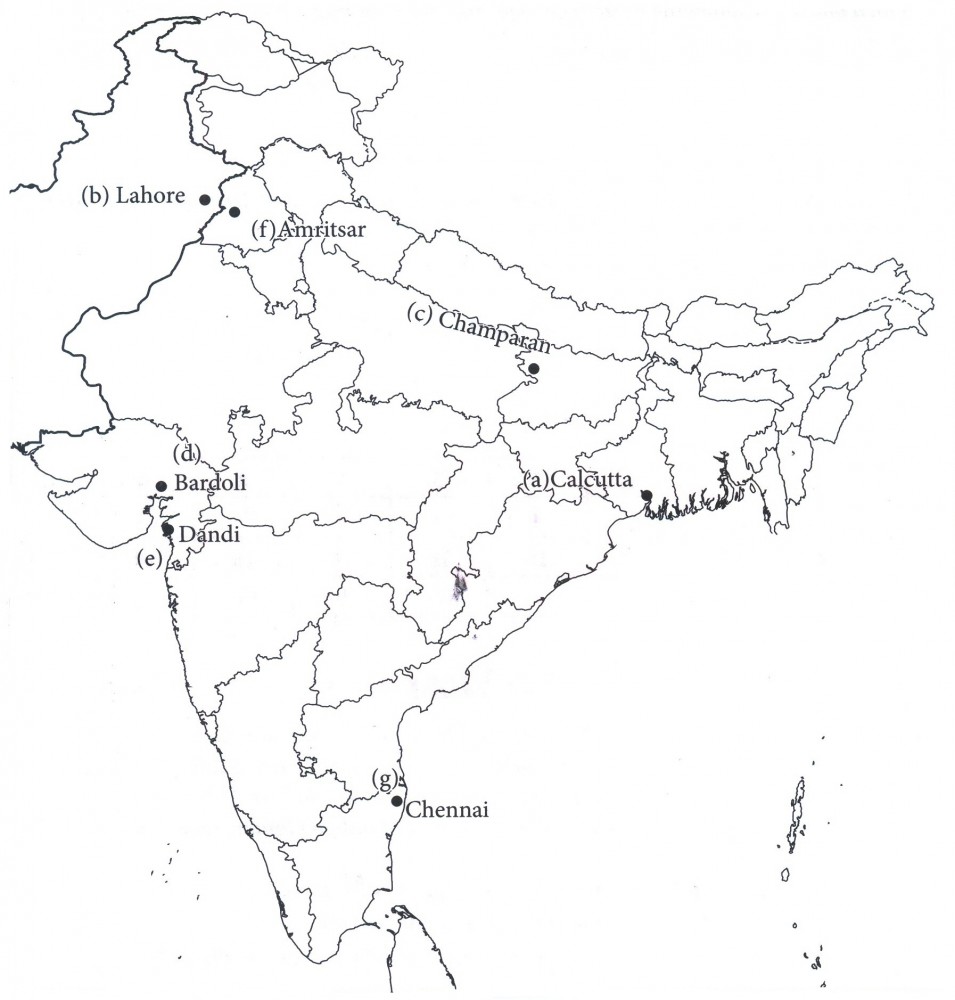
Locate and label the following on the given political outline map of India:
(a) A place where session of Indian National Congress was held in September 1920.
(b) A place where session of Indian National Congress was held in 1929.
(c) A place in Bihar where Satyagraha Movement of indigo planters took place.
(d) Baradoli, the place, from where No tax campaign was started.
(e) A place in Gujarat where Gandhiji violated the Salt law.
(f) a place in Punjab where Jalianwalla Bagh incident took place (or) Amritsar
(g) Chennai (Madras)
1.
The rich peasants too-like the patidars of Gujarat and the Jats of Uttar Pradesh- had their own views about Swaraj. They joined the movement because of the following reasons.
(a) The rich peasants who produced commercial crops were hard hit by the trade depression and falling prices which decreases their cash income and in turn they could not pay the government's revenue.
(b) The government, on the other hand, was reluctant to reduce the revenue demand.
(c) This led to widespread resentment among the peasants and they began to support the Civil Disobedience Movement, believing they would be saved from this situation.
2.
The news of the Jallianwalla Bagh tragedy spread in the country like a forest fire. The following were the consequences.
(a) Crowds took to the streets in many north Indian towns. Strikes, clashes with the police and attacks on government buildings were witnessed extensively.
(b) The British used brutal repression, seeking to humiliate and terrorise people. People were flogged and villages were bombed.
(c) This violence forced Gandhiji to stop the movement.
3.
(i) Khadi cloth was often more expensive than mass produced mill cloth and poor people could not afford to but it.
(ii) The boycott of British institutions posed s problem.
(iii) So, the students and teaches began trickling back to government schools and lawyers joined back work in government courts.
4.
(a) Jallianwala Bagh is situated in Amritsar (Punjab). Here as a mark of protest against the Rowlatt Act, a peaceful assembly was going on. People from many surrounding villages were participating. Some came here to attend the annual Baisakhi fair.
This garden is enclosed on three sides and has only one entrance. In order to terrorise the people, General Dyer entered the park with troops.
Without giving any warning to the people, he ordered his sepoys to fire at them. In this firing, many people were killed and many wounded.
(b) Simon Commission arrived in India in 1928. It was greeted with black flags and slogans like 'Simon Go Back'. Both Congress and Muslim League unitedly protested against it.
This Commission was boycotted by the Indian people as it did not include any Indian member in it. Also the Commission did not give any hope of 'Swaraj for the Indians'.
5.
Nationalists in India toured to gather folk songs and legends so as to produce a true picture of traditional Indian culture to discover one's identity and restore a sense of pride in one's past.
6.
General Dyer's objective was to create a feeling of terror and awe in the minds of the satyagrahis.
7.
Bankim Chandra Chattopadhyay.
8.
In October, 1929.
9.
Rowlatt Act was passed in the year 1919.
10.
Congress decided to launch a nationwide Civil Disobedience Movement because of the following reasons.
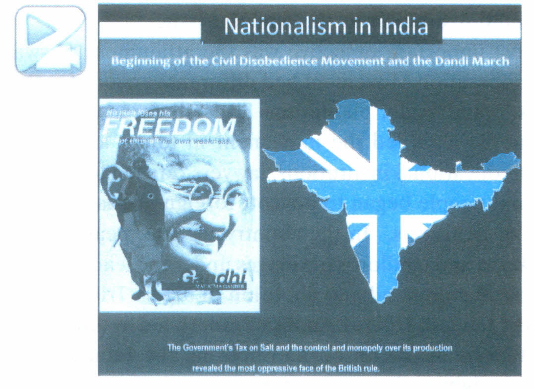
(a) Lord Irwin showed reluctance towards the eleven demands raised by Gandhiji. This led to the famous Salt March and beginning of the Civil Disobedience Movement.
(b) Worldwide economic depression slashed agricultural prices. This led to a decline in demand and exports. Peasants were the hardest hit by this crisis. On that, the government was not ready to lower the revenue demand. (c) The only-British commission called the Simon Commission was sent to India to look into the developments of the constitutional system. Indians got enraged as it had no Indian member in it. There were widespread agitations against the commission.
(d) Lord Irwin's proposal of granting dominion status and discussion at the Round Table Conference could not satisfy the nationalists.
(e) Finally at the Lahore session of Congress in 1929, it was decided to launch the Civil Disobedience Movement. This movement was sought to be related with the problems people faced in their daily life.
11.
(i) A variety of cultural processes captured people's imagination with the fold of nationalism. History and fiction, folklore and songs, popular prints and symbols, all played a part in the making of nationalism.
(ii) Bharat Mata: The identity of India was visually associated with the image of Bharat Mata. Abanindranath Tagore painted Bharat Mata in his painting as an ascetic figure. She is calm, composed, divine and spiritual.
(iii) Folklore: Ideas of nationalism also developed through a movement to revive Indian folklore. The nationalists felt the folktales gave a true picture of traditional culture. It was essential to preserve this folk tradition in order to discover one's national identity and restore a sense of pride in one's past.
(iv) Icons and symbols: As the national movement developed, nationalist leaders became more and more aware of such icons and symbols in unifying people such as tricolour flag.
(v) Reinterpretation of history: Many Indians began feeling that to instill a sense of pride in the nation, Indian history had to be thought about differently. The British saw Indians as backward and primitive, incapable of governing themselves. Indians began looking into the past to discover India's great achievements. They wrote about the glorious developments in ancient times when art and architecture, science and mathematics, religion and culture, law and philosophy, crafts and trade had flourished. This glorious time, in their view, was followed by a history of decline, when India was colonised. These nationalist histories urged the readers to take pride in India's great achievements in the past and struggle to change the miserable conditions of life under British rule.
12.
Indians felt that their hardships would be brought to an end after the First World War. But that did not happen.
The Rowlatt Act of 1919:
The Rowlatt Act been hurriedly passed through the Imperial Legislative Council. It gave the government enormous powers to repress political activities, and allowed detention of political prisoners without trial for two years. Mahatma Gandhi launched a movement against these unjust laws. But when people were violent, he called off the movement. This had been a wide spread movement but limited to cities and towns. Mahatma Gandhi now planned to launch a more broad-based movement.
The Khilafat issue : The First World war ended with the defeat of Ottoman Turks. A harsh peace treaty was to be imposed on the Ottoman emperor - the spiritual head of the Islamic world (the Khalifa). At the Calcutta session of 1920, Gandhiji expressed the need for a Non-Cooperation movement in support of Khilafat issue as well as for Swaraj. In his famous book "Hind Swaraj" (1909) Mahatma Gandhi declared that the British rule was established in India with the cooperation of Indians. It had survived only because of this cooperation. If Indians refused to cooperate, British rule would collapse within a year, and swaraj would come. Hence he started the Non-cooperation movement in full swing.
13.
Mahatma Gandhi entered into a pact with Irwin on 5 March, 1931.
(i) By this Gandhi - Irwin Pact, Gandhiji committed to participate in a Round Table Conference in London and the government agreed to release the political prisoners.
(ii) In December 1931, Gandhiji went to London for the conference, but the negotiations broke down and he returned disappointed.
(iii) Back in India, he discovered that the government had begun a new cycle of repressive measures.
(iv) Abdul Ghaffar Khan and Jawaharlal Nehru were both in jail and the Congress had been declared illegal.
(v) A series of measures has been imposed to prevent meetings, demonstrations, and boycotts. Thus, with great apprehension, Gandhiji relaunched the Civil Disobedience Movement.
14.
(a) People were now asked to refuse cooperation with the British as well as to break colonial laws. Soon, the movement spread to the entire nation.
(b) Colonial laws were violated, salt was manufactured in numerous places, foreign clothes were burnt and liquor shops were picketed.
(c) Peasants refused to pay revenue and chaukidari taxes.
(d) Village officials resigned and at many places people violated forest laws by going into reserved forests for collecting wood.
(e) The industrial workers in Shoplapur attacked police posts, municipal buildings, law courts and railway stations-all structures that symbolised British rule.
(f) Women and children were beaten by the government and peaceful satyagrahis were attacked.
15.
(b)
The Government's refused to reduce the revenue demand
16.
(a)
To look into the functioning of Indian Constitutional system and suggest reforms.
17.
(a)
A symbol of western economic and cultural domination
18.
(a)
Mahatma Gandhi
19.
(d)
All of these
20.

10th Standard CBSE Syllabus & Materials
10th Standard CBSE
CBSE 10th Social Science PS - Federalism - New Model Questions Papers Study Material - QB365 Set A
NEW10th Standard CBSE
CBSE 10th Social Science PS - Power Sharing - New Model Questions Papers Study Material - QB365 Set A
NEW10th Standard CBSE
CBSE 10th Social Science GEO - Manufacturing Industries - New Model Questions Papers Study Material - QB365 Set A
NEW10th Standard CBSE
CBSE 10th Social Science GEO - Minerals and Energy Resources - New Model Questions Papers Study Material - QB365 Set A



CBSE 10th Standard CBSE Subjects
CBSE Standards





