
 100% FREE ACCESS
10th Standard CBSE Syllabus & Materials
10th Standard CBSE
CBSE 10th Social Science ECO - Globalisation and the Indian Economy - New Model Questions Papers Study Material - QB365 Set A
NEW10th Standard CBSE
CBSE 10th Social Science ECO - Money and Credit - New Model Questions Papers Study Material - QB365 Set A
NEW10th Standard CBSE
CBSE 10th Social Science ECO - Sectors of the Indian Economy - New Model Questions Papers Study Material - QB365 Set A
NEW10th Standard CBSE
CBSE 10th Social Science ECO - Development - New Model Questions Papers Study Material - QB365 Set A
NEW10th Standard CBSE
CBSE 10th Social Science PS - Outcomes of Democracy - New Model Questions Papers Study Material - QB365 Set A
NEW10th Standard CBSE
CBSE 10th Social Science PS - Gender, Religion and Caste - New Model Questions Papers Study Material - QB365 Set A

Published on: 26/11/2018
NOVEMBER PHYSICS REVISION 2
Download CBSE Class 10th Standard CBSE Science question papers, sample papers, important questions, and previous year solved papers in PDF format. Get free study materials, NCERT solutions, and exam preparation resources for Class 10th Standard CBSE Science
Questions + Answers key
Take MCQ Science Test
1.
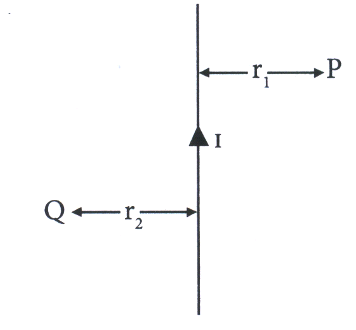
AB is a current conductor in the plane of the paper as shown in Figure. What are the directions of magnetic fields produced by it at points P and Q? Given r1 > r2, where will the strength of the magnetic field be larger?
2.
Which uses more energy, a 250 W TV set in 1 h or a 1200 W toaster in 10 min?
3.
Should the heating element of an electric iron be made of iron, silver or nichrome wire?
4.
What is the use of electric fuse?
5.
What is similar between solenoid and bar magnet?
6.
What is galvanometer?
7.
Name the device that converts electric energy into mechanical energy.
8.
What is meant by overloading.
9.
What happens if a bar magnet is cut into two pieces:
(a) Along its length.
(b) Transverse to its length.
10.
When does an electric short circuit occur?
11.
Why don’t two magnetic field lines intersect each other?
12.
Which has a higher resistance: a 50 W lamp bulb or a 25 W lamp bulb and how many times?
13.
What is the advantage of the third wire of earth connection in domestic electric appliances?
14.
Out of 60 W and 40 W lamps, which one has a higher electrical resistance when in use?
15.
Why does the cord of an electric heater not glow while the heating element does?
16.
On what factors do the resistance of a conductor depend?
17.
Why is the series arrangement not used for connecting domestic electric appliances in a circuit?
18.
Name a device that helps to maintain a potential difference across a conductor.
19.
Distinguish between an electric motor and generator?
20.
State the rule to determine the direction of a
(i) Magnetic field produced around a straight conductor carrying current
(ii) Force experienced by a current carrying straight conductor placed in a magnetic field which is perpendicular to it.
(iii) current induced in a coil due to its rotation in a magnetic field.
21.
A coil of insulated copper wire is connected to a galvanometer. What will happen if a bar magnet is
(i) Pushed into the coil
(ii) Withdrawn from inside the coil
(iii) Held stationary inside the coil
22.
Explain different ways to induce current in a coil.
23.
If a 12 V battery is connected to the arrangement of resistances given below, calculate
(i) the total effective resistance of the arrangement and
(ii) the total current flowing in the circuit
24.
A touch bulb is rated 2.5 V and 750 mA. Calculate (i) its power, (ii) its resistance and (iii) the energy consumed if this bulb is lighted for four hours.
25.
(a) State Ohm's Law.
(b) Draw a schematic diagram of the circuit for studying Ohm's Law.
26.
(a) What is meant by 'Electric Resistance' of a conductor?
(b) A wire of length 'L' and resistance 'R' is stretched so that its length is doubled and the area of cross-section is halved. How will its:
(i) resistance change
(ii) resistivity change
27.
Two lamps, one related 60W at 220 W at 220V and the other 40 W at 220 V, are connected in parallel to the electric supply at 220V.
(a) Draw a circuit diagram to show the connections.
(b) Calculate the current drawn from the electric supply.
(c) Calculate the total energy consumed by the two lamps together when they operate for one hour.
28.
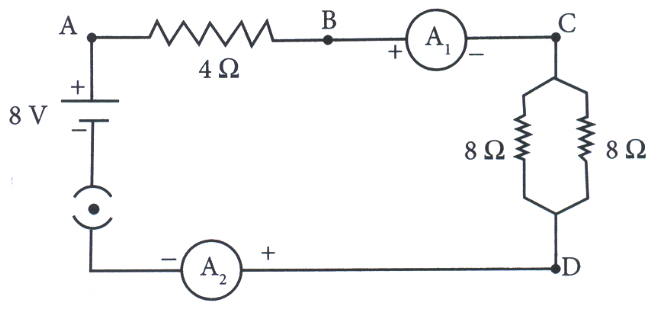
Find out the following in the electric circuit given in Figure
(a) Effective resistance of two 8 \(\Omega\) resistors in the combination
(b)Current flowing through 4 \(\Omega\) resistor
(c) Potential difference across 8 \(\Omega\) resistance
(d) Power dissipated in 4 \(\Omega\) resistor
(e) Difference in ammeter readings, if any.
29.
(a) What is an electromagnet?
(b) List any of its two uses.
(c) Draw a labelled diagram to show how an electromagnet is made.
(d) What is the purpose of the soft iron core used in making an electromagnet?
30.
(a) What is meant by a magnetic field?
(b) How is the direction of magnetic field at a point determined?
(c) Describe an activity to demonstrate the direction of the magnetic field generated around a current carrying conductor.
(d) What is the direction of magnetic field at the centre of a current carrying circular loop?
31.
Explain with the help of a labelled diagram the distribution of magnetic field due to a current through a circular loop. Why is it that if a current carrying coil has 'n' turns the field produced at any point is n times as large as that produced by a single turn?
32.
How will you infer with the help of an experiment that the same current flows through every part of the circuit containing three resistances in series connected to a battery?
1.
By applying the right hand thumb rule, the direction of magnetic field would be anti-clockwise around the direction of current. Thus, the magnetic field would be to point P and towards the plane of paper. At point Q, the direction of magnetic current would be from the conductor and away from the plane of paper. Since magnetic field is stronger near the conductor and weaker as we move away from the conductor, so the magnetic field would be stronger near point Q than near point P.
2.
Given, P1 = 250 W, P2 = 1200 W,
t1 = 1h = 3600 s, t2 = 10 min = 600 s
\(\therefore\) Energy
Q1 = P1t1 = 250 \(\times\)3600 = 900000 J = 900 kJ
and Q2 = P2t2 = 1200 \(\times\) 600 = 720000 J = 720 kJ
Thus, TV set uses more energy.
3.
Nichrome should be used as a heating element in an electric iron because its melting point is higher than iron and silver.
4.
Electric fuse is used for protecting the circuits due to short circuiting or overloading of the circuits.
5.
The magnetic field produced by a solenoid is similar to the bar magnet.
6.
A galvanometer is an instrument that can detect the presence of a current in a circuit.
7.
An electric motor.
8.
When the total current drawn by all the appliances at a particular time exceeds the bearing capacity of that wire, the wires of the domestic wiring gets heated. This is called overloading.
9.
(a) When the bar magnet is cut along its length, pole strength of each part is half the pole strength of the original magnet so its magnetic moment is also halved.
(b) In both cases, we get two magnets, each having north and south poles. When the bar magnet is cut transverse to its length, the pole strength of each part is same as that of the original magnet but its magnetic moment is halved because its length is halved.
10.
An electric short circuit occurs when the insulation of wires is damaged or there is a fault in the appliance. Due to this, the live wire and neutral wire come in direct contact and the current in the circuit increases abruptly.
11.
If two magnetic lines of force intersect each other, it would mean that there are two directions of the magnetic field at the point of intersection, which is not possible.
12.
The resistance of 25 W lamp bulb has a higher value as compound to that of 50 W lamp bulb. Resistance of the 25 W lamp bulb. Resistance of the 25 W lamp bulb will be double of that of the 50 W lamp bulb.
13.
Earth wire is used to provide a low resistance conducting path to any charge that gets leaked into the body of the appliance.
14.
Electric power, p = \( \frac{V^{2}}{R}\), where R
V = Potential difference across the circuit
For 40 W bulb, 40 =\(\frac{V^{2}}{R_{1}0}\), where
R40 = Resistance offered by the 40 W bulb
For 60 W bulb, 60 =\(\frac{V^{2}}{R_{6}0}\) , where
R40 = Resistance offered by the 60 W bulb
Therefore, \(R_{10}=\frac{V^{2}}{40}\) and \(R_{60}=\frac{V^{2}}{60}\) (as the voltage difference remains the same)
Therefore, R40 > R60
So, the 40 W bulb has a higher electrical resistance when in use.
15.
Thc cord of an electric heater has lesser resistance than its heating element. So, more heat is produced in the heating element than the cord and it glows.
16.
The resistance of a conductor depends on following factors:
(i) Length of the conductor.
(ii) Area of cross-section of the conductor.
(iii) Nature of material of the conductor.
17.
In a domestic circuit, parallel connection of devices is preferable for several reasons:
a. In series connection, if one of the devices is defective, if one of the devices is defective, then the current of the entire circuit is cut off. As a result, all the devices stop working. In parallel connection, even if one device is defective, the others continue working.
b. In series connection, selective operation of devices is not possible, but this is not so in the case of parallel connection.
c. In series connection, the same current passes through all the devices, regardless of the fact that different devices require different values of current to operate. In parallel connection, different values of current can be obtained for different devices according to their requirements.
18.
Electric cell or battery is a device that helps to maintain a potential difference across a conductor.
19.
The major differences between an electric motor and generator are stated below:
Electric Motor:
1. It converts electrical energy into mechanical energy.
2. It needs electrical energy for its works.
3. They are used as water pumps, marble grinders etc.
Generator:
1. It converts mechanical energy into electrical energy
2. It needs mechanical energy for its working.
3. They are used as water pumps, marble grinders etc.
4. diesel generator, hydro-electric generator are the examples of it.
20.
(i) Maxwell's right hand thumb rule:
It's a convenient way of finding the direction of magnetic field associated with a current carrying conductor. It states that, if you hold the current carrying straight wire in the grip of your right hand in such a way that the stretched thumb points in the direction of current, then the direction of the curl of the fingers will give the direction of the magnetic field. This rule is also called Maxwell's corkscrew rule.
(ii) Fleming's left hand rule:
The direction of force which acts on a current carrying conductor placed in a magnetic field is given by Fleming's left hand rule.
It states that, if the forefinger, thumb and middle finger of left hand are stretched mutually perpendicular to each other, such that the forefinger points along the direction of external magnetic field, middle finger indicates the direction of current, then the thumb points towards the direction of force acting on the conductor.
(iii) Fleming's right hand rule gives the direction of induced current in a coil due to it's rotation in a magnetic field. If the forefinger points in the directions of magnetic field, thumb in the direction of motion of the conductor, then the central finger points in the direction of current induced in the conductor.
21.
(i) When the bar magnet is pushed into the coil, the galvanometer needle would show deflection.
(ii) Withdrawn from the coil, the galvanometer needle would show deflection.
(iii) When the bar magnet is kept stationary inside the coil, when the bar magnet galvanometer needle would show no deflection.
22.
For electromagnetic induction, the coil and the magnet should be in relative motion. This can be ensured by any of the following two ways :
(a) The coil should be moved within a magnetic field.
(b) The magnet should be moved and coil can be kept static.
23.
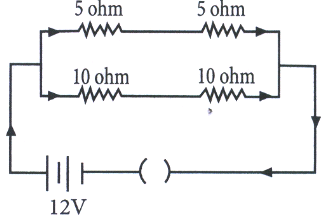
(i) The 5 Ω resistors are connected in series. Therefore, their effective resistance = (5 + 5) = 10 Ω
The 10 Ω resistors are connected in series. Therefore, their effective resistance = (10 + 10) = 20 Ω
Now these 10 Ω equivalent and 20 Ω equivalent are connected in parallel. Therefore, the equivalent resistance (Req) will be:
\(\frac { 1 }{ { R }_{ eq } } =\frac { 1 }{ { R }_{ 1 } } +\frac { 1 }{ { R }_{ 2 } } \)
\(\frac { 1 }{ { R }_{ eq } } =\frac { 1 }{ 10 } +\frac { 1 }{ 20 } \)
\(\frac { 1 }{ { R }_{ eq } } =\frac { 2+1 }{ 20 }
\)
\(\frac { 1 }{ { R }_{ eq } } =\frac { 20 }{ 3 } =6.76\Omega \)
(ii) Total Current = Total voltage / Total equivalent resistor
=12 / 6.67
= 1.8 A.
24.
It is given that: Voltage (V) = 2.50 V
Current (I) = 750 mA = 0.75 A
The bulb is lighted for 4 hours.
Thus,
(i) Power generated (P) = VI = 2.50\(\times\) 0.75 = 1.87 W
(ii) Resistance (R) = \(\frac { V }{ I } =\frac { 2.5 }{ 0.75 } =3.33\Omega \)
(iii) Energy consumed in 4 hours = Power\(\times\)Time = P\(\times\)t =1.87\(\times\)4 = 7.48 Wh
25.
(a) Ohm's Law states that at constant temperature, current flowing through a conductor is directly proportional to the potential difference across its ends.
-s.png)
26.
(a) Resistance is defined as the property of a conductor due to which it opposes the flow of current through it. The S.I. unit of resistance is Ohm \(\left( \Omega \right) \).
(b) (i) The resistance (R) of a conductor is related to its length (l) and area of cross section (A) as
\(R=\frac { p\times l }{ A } \) Where \(\rho \) is the resistivity of the conducting material.
Let R1= Resistance of the original wire
R2= Resistance of the wire when its length is doubled
I1= Length of original wire
l2= Length of original wire when doubled
A1= Area of the original wire
A2= Area when it is halved
Therefore,
\({ R }_{ 1 }=\frac { P\times { l }_{ 1 } }{ { A }_{ 1 } } \quad \quad ---\quad (1)\\ { R }_{ 2 }=\frac { P\times { l }_{ 2 } }{ { A }_{ 2 } } \quad \quad ---\quad (2)\)
Dividing equation (1) and (2) by equation (1), we obtain
\(\frac { { R }_{ 1 } }{ { R }_{ 2 } } =\frac { { l }_{ 1 } }{ { l }_{ 2 } } \times \frac { { A }_{ 1 } }{ { A }_{ 2 } } \quad ---\quad (3)\)
It is given that:
\({ l }_{ 1 }=2l_{ 1 }\quad and\quad { A }_{ 2 }=\frac { 1 }{ 2 } { A }_{ 1 }\\ \)
Putting these values in equation (3), we obtain
R2=4R1
Hence, the resistance of the wire will be 4 times of the original value.
(ii) The resistivity will not change on stretching the wire. Resistivity is the property of the conducting material. It does not depend on the dimension of the wire. As materials of both the wires are the same, the resistivity will not change.
27.
(a)
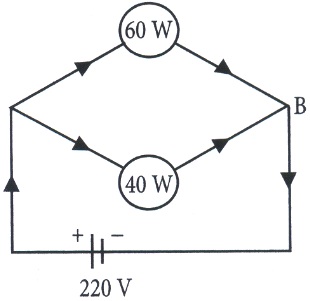
(b) Electric current flowing through a bulb = \(\frac { Power\quad of\quad the\quad bulb }{ Voltage\quad across\quad the\quad bulb } \)
\(i.e.,\quad I=\frac { P }{ V } \)
Therefore, \({ I }_{ 60 }=\frac { 60W }{ 220V } =\frac { 3 }{ 11 } A\quad and\quad { I }_{ 40 }=\frac { 40W }{ 220V } =\frac { 2 }{ 11 } A\)
Therefore, total current flowing through the circuit \(={ I }_{ 60 }+{ I }_{ 40 }=\frac { 3 }{ 11 } +\frac { 2 }{ 11 } =\frac { 5 }{ 11 } A=0.45A\)
(c) Total energy consumed = Power \(\times \) Time
That is, E = P \(\times \) T
= (40W+60W)\(\times \)1h
= 100 Wh
= 0.1 kWh
28.
(a) Since two \(8\Omega \) resistors are in parallel, their effective resistance (\({ R }_{ P }\)) is given by,
\(\frac { 1 }{ { R }_{ P } } =\frac { 1 }{ 8 } +\frac { 1 }{ 8 } +\frac { 1 }{ 4 } \) or \({ R }_{ P }=4\Omega \)
(b) Total resistance in the circuit
\(R=4\Omega +{ R }_{ P }=4\Omega +4\Omega =84\Omega \)
Current through the electric circuit
\(I=\frac { V }{ R } =\frac { 8V }{ 8\Omega } =1A\)
(c) The potential difference \(4\Omega \) resistor V
I \(=IR=1\times 4=4V\)
(d) Power dissipated in \(4\Omega \) resistor P=\({ (I) }^{ 2 }\)
\(R={ (1) }^{ 2 }(4)=4W\)
(e) There is no difference in the readings of ammeters \({ A }_{ 1 }\) and \({ A }_{ 2 }\) as same current flows through all elements in a series circuit.
29.
(a) An electromagnet is a device used to produce magnetic field with the help of electricity.
(b) An electromagnet is used for lifting heavy loads. It is also used in automatic door locking systems.
(c)
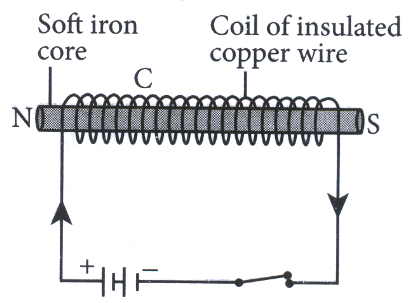
(d) A soft iron is used as a core in order to strengthen the magnetic field created by the electromagnet.
30.
(a) Magnetic field is the region around a magnet in which a magnetic material experiences a force because of that magnet.
(b) The direction of magnetic field at a point is determined by using a magnetic compass. The direction along which the needle of a magnetic compass gets aligned indicates the direction of the magnetic field.
(c) A straight thick conducting wire is inserted normally through centre of a plane paper. Now, electric current is passed through the wire. When a small magnetic compass is placed on the paper, the magnetic needle of the compass gets aligned along a particular direction. The positions of the North Pole and South Pole are marked on the paper. Now, the magnetic needle is shifted to a new position such that its South Pole occupies the position previously occupied by its North Pole. Again, the positions of the North Pole and South Pole are marked. These steps are repeated over and over again and the marked points are joined to obtain the direction of the magnetic field generated by the current-carrying straight wire.
(d) The direction of magnetic field at the centre of a current of a current carrying loop is normal to the plane formed by the loop.
31.
Magnetic Field Due to Circular Loop Current-Carrying Conductor:
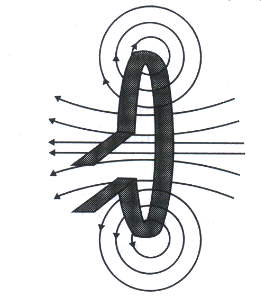
In case of a circular current carrying conductor, the magnetic field lines would be in the form of concentric circles around every part of the periphery of the conductor. Since, magnetic field lines tend to remain closer when near the conductor, so the magnetic field would be stronger near the periphery of the loop. On the other hand, the magnetic field lines would be distant from each other when we move towards the centre of the current carrying loop. Finally, at the centre, the arcs of big circles would appear as a straight lines.
Magnetic field and number of turns of coil: Magnitude of magnetic field gets summed up with increase in the number of turns of coil. If there are 'n' turns of coil, magnitude of magnetic field will be 'n' times of magnetic field in case of a single turn of coil.
32.
A number of resistors are said to be connected in series, if these are joined end to end and the same, current flows through each one of them when a potential difference is applied across the combination. If we connect ammeter first between the point A and R1, then between R1 and R2:R2 and R3 and lastly between R3 and the point B; it is same as current.

10th Standard CBSE Syllabus & Materials
10th Standard CBSE
CBSE 10th Social Science PS - Federalism - New Model Questions Papers Study Material - QB365 Set A
NEW10th Standard CBSE
CBSE 10th Social Science PS - Power Sharing - New Model Questions Papers Study Material - QB365 Set A
NEW10th Standard CBSE
CBSE 10th Social Science GEO - Manufacturing Industries - New Model Questions Papers Study Material - QB365 Set A
NEW10th Standard CBSE
CBSE 10th Social Science GEO - Minerals and Energy Resources - New Model Questions Papers Study Material - QB365 Set A



CBSE 10th Standard CBSE Subjects
CBSE Standards





